Many species of spider fly with a technique calling ballooning. We’ve touched on spider flight before, but more recent research adds a new dimension to the phenomenon. Researchers showed that spiders can actually use electrical fields in their flight. When isolated from flow or outside electrical fields, researchers found that spiders would still begin ballooning behaviors when subjected to electrical fields similar to those found in nature. The spiders were even able to take off in the artificial environment, using the electrostatic force between the surrounding fields and their negatively charged silk strands. While electrical fields alone were enough to get spiders aloft, the team thinks spiders in nature likely still use a combination of electrostatic force and aerodynamic drag in order to travel the vast distances spiders have been known to cover. (Video and image credit: BBC; research credit: E. Morley and D. Robert)
Month: May 2021

“The Golden Sutra”
“The Golden Sutra” is an homage to the colors of Buddhism, specifically the Longzangjing scripture illustrated in yellow, red, green, blue, and white with letters of gold. Artist Roman De Giuli captures some incredible fluid eddies and streaks with ink, paint, and glitter on paper. (Image and video credit: R. De Giuli)

Seeing Through
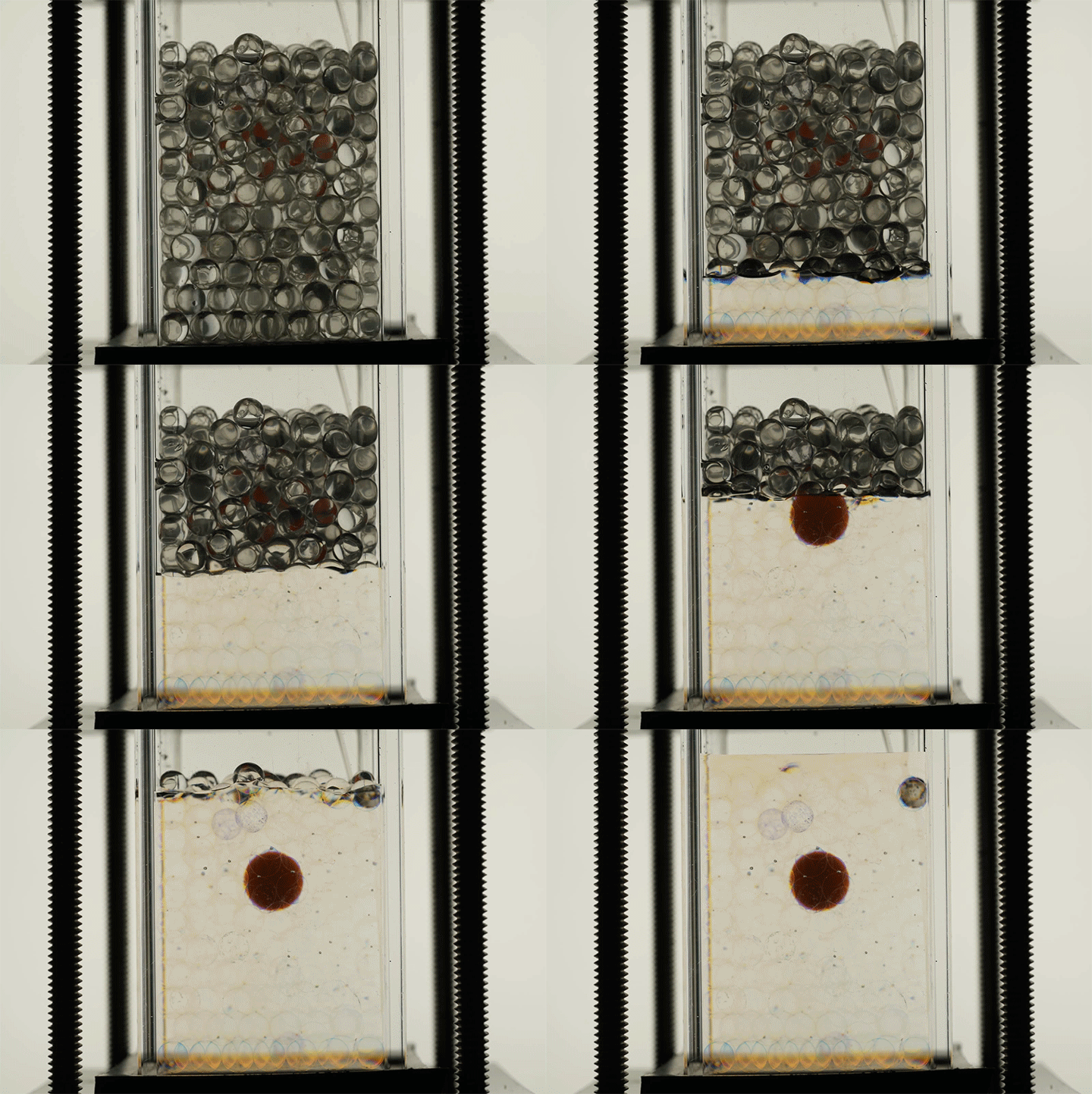
Often researchers are interested in flows around and between objects, but seeing those flows is a challenge in a crowded field of view. One useful trick for this problem is matching the refractive index of your objects and the fluid they’re immersed in. Here we see the glass beads in a container seemingly disappear when a mixture of water and ammonium thiocyanate is poured in. Now the researchers can use many different visual diagnostic techniques to observe the interior flow! (Image credit: Datta Lab, Princeton University, source)

Airborne Aerosol Transmission of COVID-19
Early in the COVID-19 pandemic health officials resisted the idea that the novel coronavirus was transmissible through tiny aerosol droplets rather than larger, non-buoyant droplets. One case that made headlines and helped shift opinion was that of an outbreak among patrons of a Guangzhou restaurant traced to a single, pre-symptomatic patient zero. The pattern of who became sick at the carrier’s table and those nearby made little sense unless the restaurant’s air flow played a role in spreading the virus.
This paper studies the incident in detail, using an in-house computational fluid dynamics (CFD) code to simulate both airflow in the restaurant and the paths aerosol droplets would follow in that environment. It takes into account flow from the air conditioner and the warm air rising from customers. The study’s predictions of which areas would have the highest concentrations of virus-laden aerosols matches well with the actual pattern of the outbreak. The authors hope that tools like theirs can help prevent future outbreaks by indicating the most dangerous paths for transmission and measures that can block those. (Image credit: Center for Disease Control; video, research, and submission credit: H. Liu et al.)

Reader Question: Kinetic Sand
An inquiring reader wants to know:
How does kinetic sand work to make it flow like a liquid? Thanks!
– 3 Year Olds EverywhereI confess I don’t have any firsthand experience with Kinetic Sand, but it certainly looks fun. It’s a colorful, moldable sand toy that holds together far better than your typical pile of sand. From what I’ve been able to find, the secret ingredients are a little bit of polydimethylsiloxane (PDMS) — a type of silicon-based polymer — and olive oil, which coats the sand and keeps it from drying out.
PDMS is viscoelastic, which is what gives the Kinetic Sand its unique properties. When a force is applied quickly, the material reacts like a solid, which is why you can mold or cut the sand and have it maintain its shape. But when left alone for awhile under gravity’s influence, the sand will flow like a liquid. This combination of behaviors usually comes down to the polymers in the material. When forces try to stretch these long molecules quickly, they resist; that’s what creates the elasticity of the material. On the other hand, when a force is gradual, the complex molecules have the time to untangle and relax, allowing the material to flow. (Image credit: Kinetic Sand, source)

Wind Turbine Efficiency
Wind turbines face a paradoxical challenge: they must extract the wind’s kinetic energy while still allowing the air to pass. In this Minute Physics video, Henry gives a crash course on wind turbine efficiency, based on the restrictions of conservation of mass and conservation of energy. When the two are combined, they show that an ideal wind turbine reduces the wind speed by 2/3rds to achieve ~59% efficiency.
Of course, actual wind turbines are far from ideal. They’re typically placed in staggered configurations in which upstream turbines can disrupt the flow seen by those downstream. And real wind turbines have to contend with dust, bugs, and other grime that builds up on the blades and disrupts air flow and their efficiency. But calculations like this one are still important for engineers seeking to make these machines as efficient as they can be. (Image and video credit: H. Reich/Minute Physics)

Metallic Magma
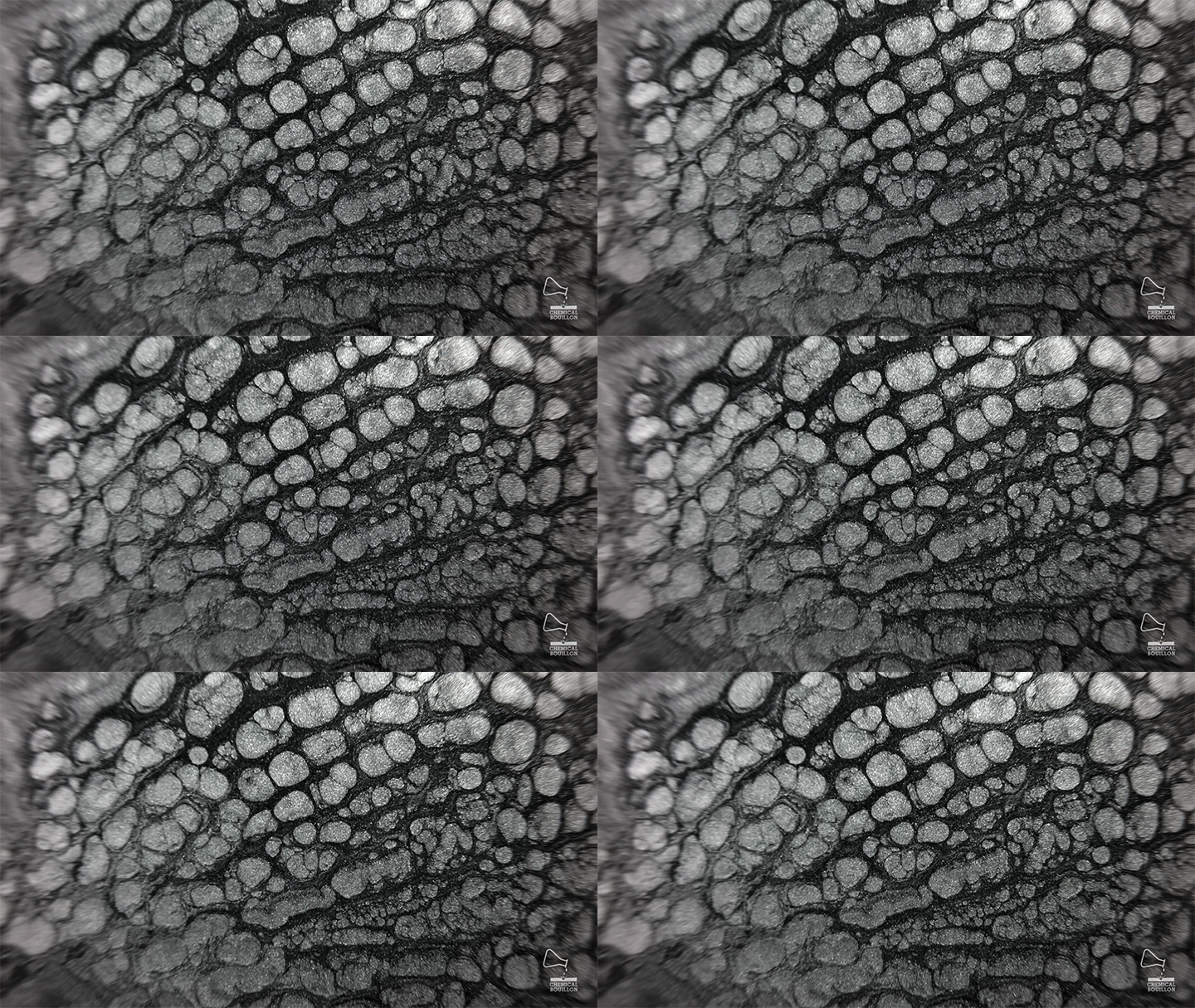
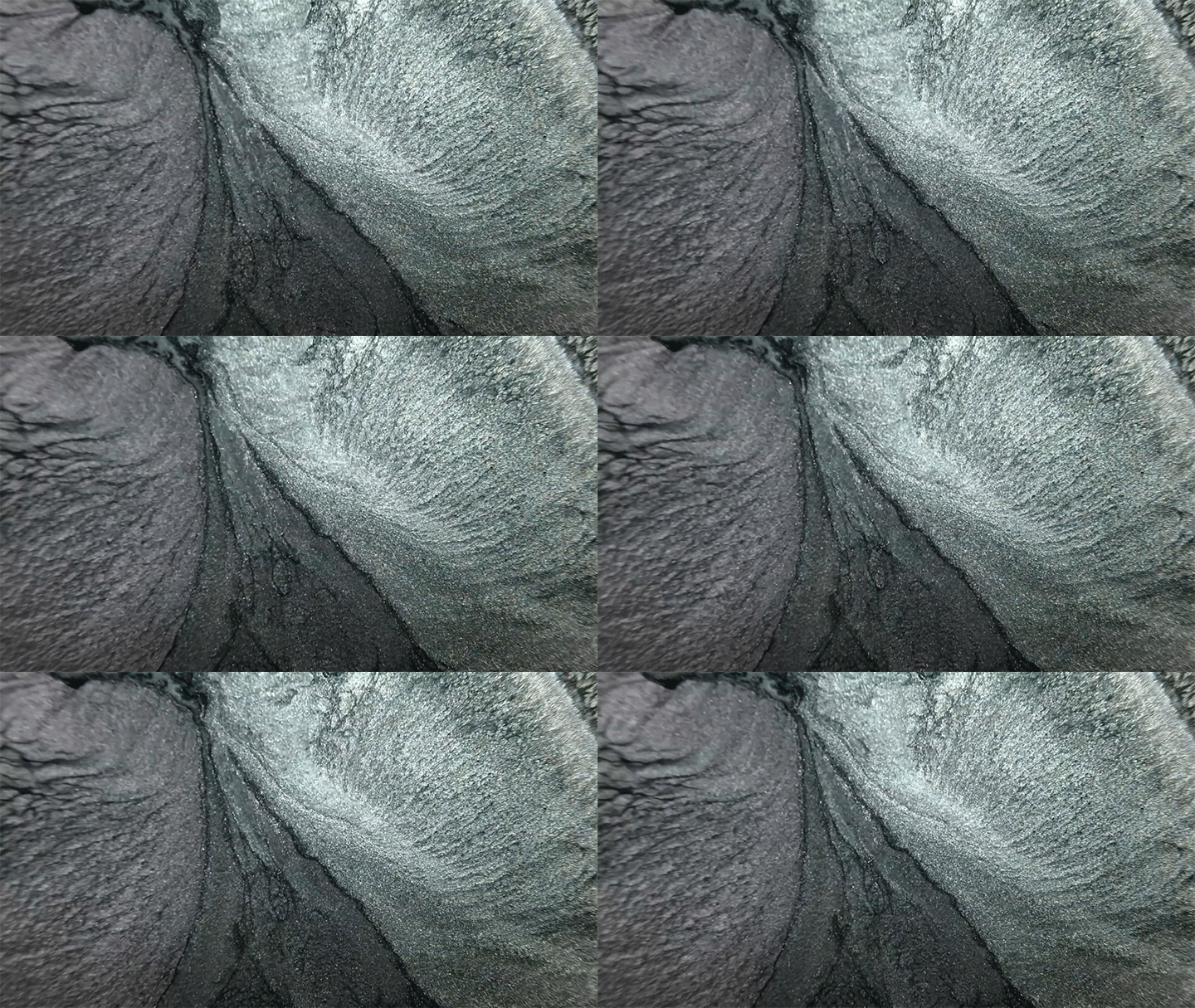
Metallic paint flows like silver lava in this macro video from Chemical Bouillon. The paint has been mixed with an unknown fluid (my guess is alcohol) to produce the flows we see here. My suspicion is that we’re seeing solutal convection where variations in surface tension create convective flow within the liquid. What do you think? (Video and image credit: Chemical Bouillon)

Oil-Coated Bubbles
Bubbles in industrial applications are often more complicated than a simple pocket of air surrounded by water. Here researchers investigate the formation of an air bubble coated in oil before it rises through water. The photo above shows a series of snapshots as the bubble forms. Initially, a droplet of oil sits pinned on the surface. As air gets injected, the oil stretches around the growing bubble. Eventually, buoyancy pulls the bubble off the injector, creating a rising air bubble coated in oil. The team found that oil-coated bubbles could grow much larger than those in water alone. (Image and research credit: B. Ji et al.)

Meeting Without Mixing
When bodies of water meet, they don’t always mix right away. Here we see the confluence of the Back and Hayes Rivers in the Canadian Arctic. The Back River appears as a darker blue-green color compared to the light turquoise Hayes River. The different colors reflect the levels of algae and sediment carried in their waters. As seen in both the aerial and satellite photos here, there’s a distinct line where the two waters meet without mixing, and that line persists for kilometers beyond their initial confluence. Typically, this lack of mixing between bodies of water is caused by differences in temperature, salinity, and turbidity (amount of sediment) that make the density of each river’s water different. (Image credit: top – R. Macdonald/Univ. of Manitoba, bottom – J. Stevens/USGS; via NASA Earth Observatory)


How the Hummingbird Got Its Hum
Summer hikes in the Rocky Mountains are frequently pierced by a hum that can deepen to a bomber-like buzz as hummingbirds flit by. They’re so small and fast that they’re hard to see, but they’re never hard to hear. A new study pins down just where that telltale hum comes from.
To determine the specific origin of the hummingbird’s sound, researchers observed hovering hummingbirds with an array of over 2,000 microphones and multiple high-speed cameras. With this set-up, they could create a 3D acoustic map of the bird’s sounds, correlated with its motions. They found that the bird’s sounds come primarily from aerodynamic forces generated during their distinctive wingstroke – not from vortices or the fluttering of their feathers.
They also found that the hummingbird’s fast wingstroke — about 40 times per second — fed into sounds at 40 and 80 Hz, as well as higher frequency overtones. Since these sounds are well within human hearing range, they make up most of what we hear from the birds. (Image credit: P. Bonnar; research credit: B. Hightower; via The Guardian; submitted by Kam-Yung Soh)