Month: June 2018

  • Visualizing Turbulence

    Visualizing Turbulence

    Turbulence, the seemingly random and chaotic state that fluids often tend toward, can be difficult to wrap one’s head around. Turn your faucet on high or pour milk into your coffee, and the flow just looks like a completely unpredictable mess. But there are important patterns to be found.These flows have many different lengthscales and timescales to them. Think of a cloud. There are very large-scale motions that are close to the size of the entire cloud, but there are also very small ones that may be only a centimeter or so in size. 

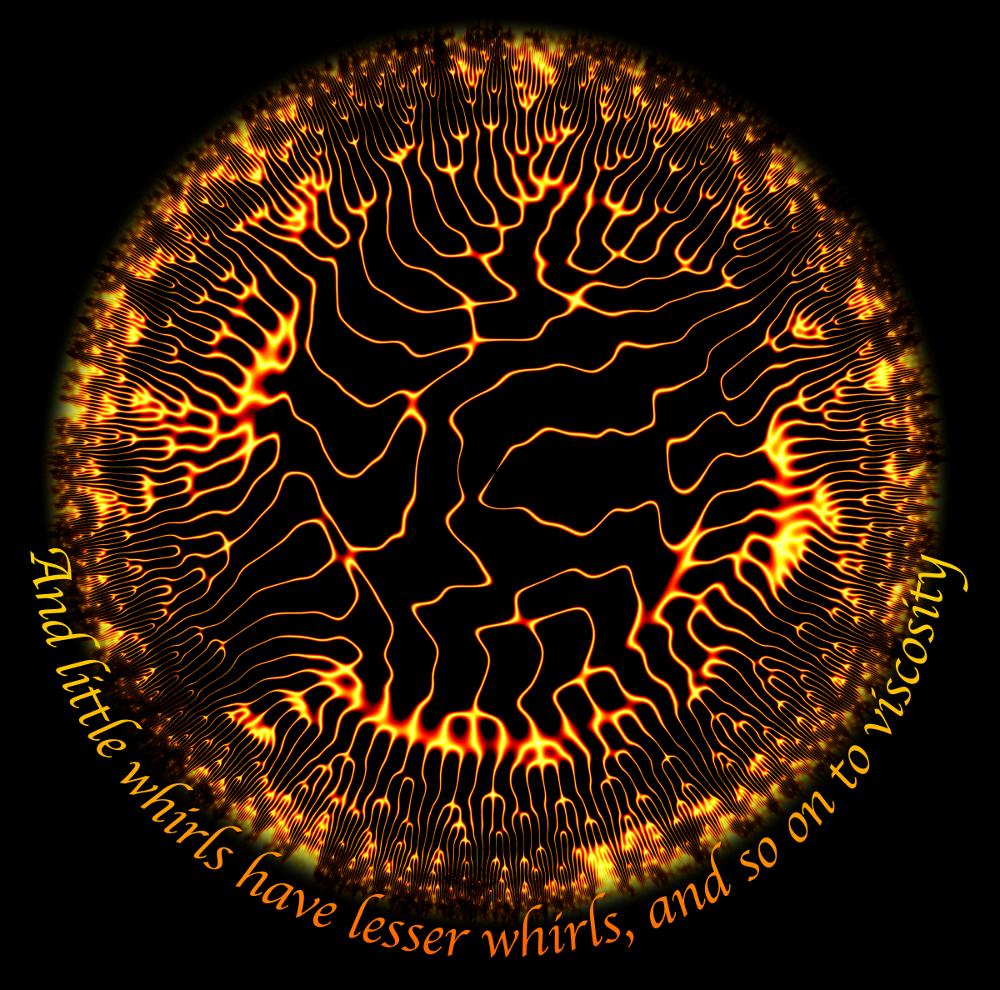
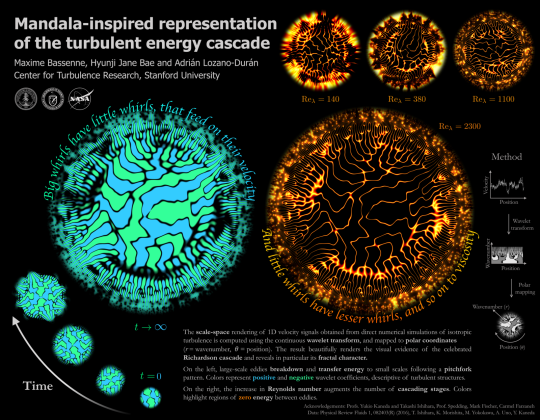
    Our best understanding of turbulence so far says that energy starts out in these large scales and slowly works its way down to the smaller ones, where viscosity (essentially friction, in this case) can transform that motion into heat. Above you see a creative way to display this fact. Using data from a numerical simulation, the authors transformed velocity information into these mandala-like patterns. The center of the image represents the large lengthscales, where energy is added. Moving around the circle, like a clock’s hand does, shows different positions in space. Moving radially from the center outward takes you through different lengthscales from large to small. 

    Notice how the large lengthscales break into smaller and smaller ones as you move outward. The pattern looks like a set of fractal pitchforks, with each lengthscale fracturing into smaller and smaller ones as the turbulence breaks down further. There’s lots more to see in the original poster, below, but you should really click here for the glorious full-size original. The poem, by the way, is the work of physicist Lewis Richardson, who wrote it to summarize how turbulence works. (Image credit: M. Bassenne et al.)
    image
  • Star Wars Aerodynamics

    Star Wars Aerodynamics

    Science fiction is not always known for hewing to scientific fact, so it will probably come as little surprise that Star Wars’ ships have terrible aerodynamics. But it’s nevertheless fun to see EC Henry’s analysis of drag coefficients of various Rebel and Imperial ships and just how poorly they fare against our own designs.

    Drag coefficients really only give a tiny piece of the story, though. We don’t know what speed Henry is testing the ships at, and we get no information about properties like lift or lift-to-drag ratio, which can be even more important than just the drag when it comes to evaluating an aircraft.

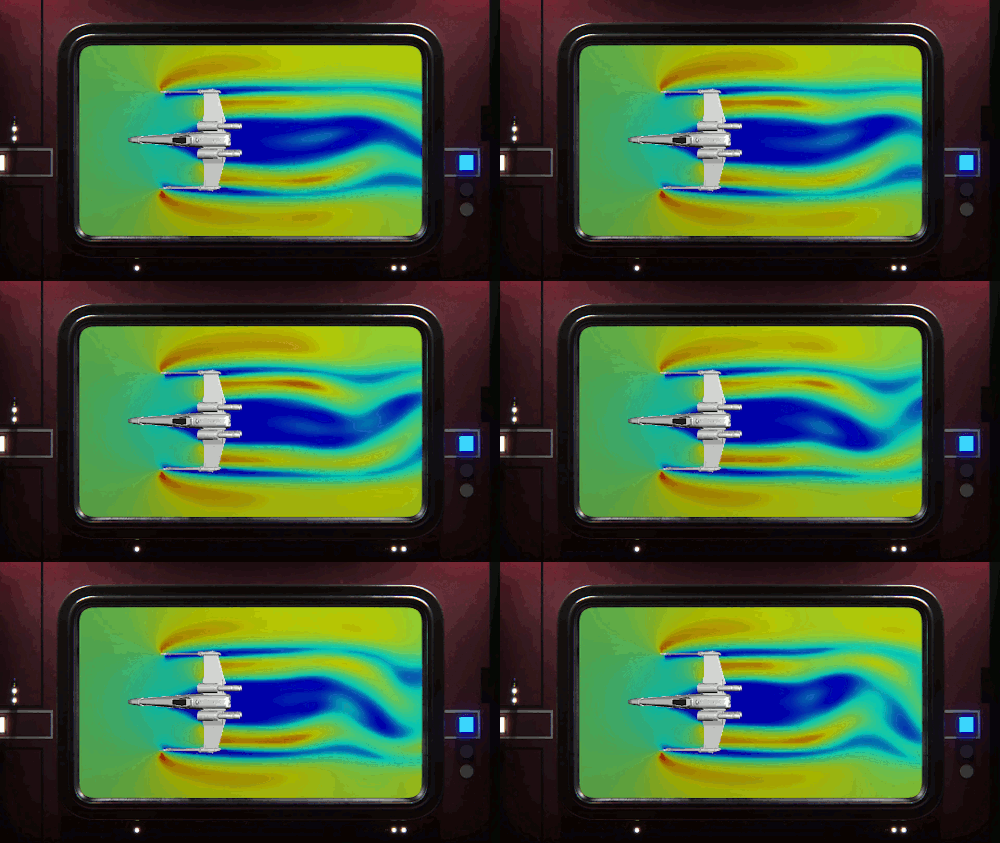
    There are some intriguing hints about other aerodynamic properties in the clips of flow around an X-wing and TIE fighter, though. Notice that the wake of both ships meanders back and forth. This is an indication of vortex shedding, and it means that both spacecraft would tend to be buffeted from side-to-side when flying in an atmosphere. Either the ships would need some kind of active control to counter those forces, or pilots would need iron constitutions to operate under those conditions! (Video and image credit: EC Henry)

    [original video no longer available]

  • Glorious Vortex Street

    Glorious Vortex Street

    Satellite imagery often reveals patterns we might struggle to see from the ground. Here Gaudalupe Island off the western coast of Mexico perturbs the atmosphere into a series of vortices. Air flowing across the open ocean gets deflected around and over the rocky, volcanic island, creating a line of vortices that get shed off one side of the island, then the other. The pattern is commonly referred to as a von Karman vortex street, and it appears in the wakes of spheres and cylinders, as well as islands. The two rainbow-like bands framing the vortex street are an optical phenomenon known as a glory, which NASA Earth Observatory explains here. (Image credit: NASA Earth Observatory)

  • Calving Icebergs

    Calving Icebergs

    The birth of icebergs from a glacier is known as calving. Although it’s extremely common for chunks of ice to break off a glacier’s terminus, the process is not well understood. In large calving events like the one shown above, the breakaway is preceded by the formation of a crack or crevasse in the main body of the glacier. How quickly that crack grows depends on many factors, including the presence (and temperature) of water in the crack, the topology of the underlying rock, and friction between the glacier and ground beneath. Once the crack is large enough that the glacier can’t support the weight of the ice at the terminus, the ice will break off, generating new icebergs and, potentially, large waves. (Image credit: T. James et al., source)

  • Tea Physics

    Tea Physics

    Tea is a popular beverage around the world, and nearly everyone has their own method for making the perfect cup. Perhaps unsurprisingly, scientists have studied tea physics as well. One such study used both experiments and numerical simulations to study tea infusion from teabags. The authors looked at round, two-dimensional teabags in two configurations – one in which the bag was left still during infusion and one in which the bag was dunked up and down in the water.

    In the static case, as the hot water leeches solutes out of the tea leaves, it forms a buoyant convection current. In this case, the convection is driven by solute concentration, not temperature. The convection creates a re-circulation in the cup that helps slowly distribute the tea solutes.

    The dunking method, unsurprisingly, distributes tea solutes much faster. In addition to stirring the cup’s contents, dunking helps drive flow through the tea leaves, releasing solutes faster. Although the authors study the two methods in detail, they decline to pass judgement on what method is “the best”. (Photo credit: T. Foster, source; research credit: G. Lian and C. Astill; submitted by Marc A.)

  • Featured Video Play Icon

    360 Fireball

    Flames are inherently fascinating to watch. Most of the ones we see regularly, like candle flames and campfires, tend to flicker unsteadily due to their turbulence. But larger fires have a spell-binding nature all their own, one that’s highlighted in slow motion. Here the Slow Mo Guys take flame-gazing to a new level by circling a fireball with a high-speed camera. In the resulting footage, you can admire the incredible expansion of the flame front, and the beautiful, detailed turbulence that creates all the myriad tiny eddies you see in the slow motion. It’s well worth watching more than once! (Video and image credit: The Slow Mo Guys)

  • The Dangerous Clatter of Dishes

    The Dangerous Clatter of Dishes

    Have you ever noticed how loud dishes are when you’re handling them? Under the right (or, perhaps more accurately, wrong) circumstances, the clatter of ceramics like porcelain can be dangerously loud, as engineer Phil Metzger discovered when repairing his toilet. At one point the lid to his tank slipped from his hands and fell about 20 centimeters to strike the edge of the toilet. The lid did not break, but Metzger stumbled away stunned from the loud noise. He immediately noticed that his hearing was distorted – he described his own voice as sounding “like talking through a kazoo”. Upon further experiment, he found that the distortion occurred at specific, regularly-spaced frequencies. Like any engineer, therefore, he turned to physics to analyze the accident.

    Since the lid didn’t break, he knew that the energy from the lid’s fall went into two places: the sound he heard and a small amount of dissipated heat. Using the speed of sound in a ceramic and the dimensions of the lid, he was able to calculate the frequency of sound produced by the impact, and with a little more work, he could estimate that the sound, as transmitted to his nearby ear, had been about 138 dB. Permanent damage from brief sounds can occur at 140 dB, so this was well inside the danger zone. The pressure from sounds this loud is enough to severely bend the tiny hairs in your cochlea that are responsible for sensing these vibrations. Luckily for Metzger, his hearing did recover after a few days, but it’s a good reminder to be careful. Sometimes everyday physics can be surprisingly dangerous! (”Research” credit: P. Metzger; image credit: comedynose/Flickr; via Motherboard via J. Ouellette)

  • Featured Video Play Icon

    Bubble Art

    Everyone loves soap bubbles, and bubble artist Melody Yang reveals how to make some pretty awesome ones in this video for Wired. The surface tension of bubbles makes them naturally seek a shape that minimizes their surface area relative to the volume they contain. For a single bubble, that’s a sphere. But once you start joining multiple bubbles, as Yang demonstrates, that minimal surface area can change, even to something unexpected like a cube.

    Bubbles also have an impressive ability to self-heal. As long as whatever passes through them is wet – whether it’s a hand, a straw, or even a ball bearing – the soap film will probably heal itself rather than break. This is a key feature for many of Yang’s tricks, including the impressive planetary bubble. (Video credit: Wired; image credits: Wired/Colossal; via Colossal)

  • Collecting Fog

    Collecting Fog

    In some parts of the world, fog is a major source of freshwater, but collecting it is a challenge. Most systems use a wire mesh to capture and collect droplets, but the process is highly inefficient, pulling only 1-3% of droplets from the fog. Researchers found that this is due largely to aerodynamic effects. The presence of the wire deflects droplets around it (bottom left). To solve this, engineers introduced an electric charge into the fog. The subsequent electric field actually pulls droplets to the wires (bottom right). When applied to a mesh (top), the efficiency of fog capture improves dramatically. 

    The technique can also be used to capture water vapor that would otherwise escape from the cooling towers of power plants. The MIT researchers who developed the technique will conduct a full-scale test at the university’s power plant this fall. They hope the technique will recapture millions of gallons of water that would otherwise drift away from the plant. (Image credits: MIT News, source; image and research credits: M. Damak and K. Varanasi, source)

  • Night Shine

    Night Shine

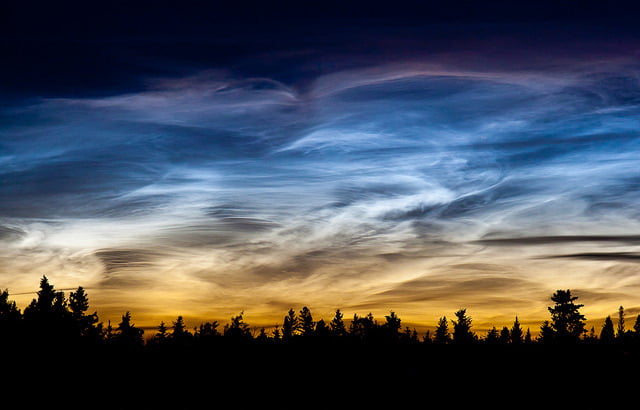
    Noctilucent – literally night-shining – clouds are a phenomenon unique to high latitudes during the summer months. Too dim and sparse to see in daylight, these clouds shine at night because their altitude of around 80 km allows them to catch sunlight long after dusk has fallen at the surface. They form when temperatures in the summer mesosphere drop to nearly -150 degrees Celsius, driven by perturbations that can originate in lower layers of the atmosphere on the opposite side of the Earth. Complex interactions and feedback between atmospheric waves, buoyancy, and Coriolis effect circulate those disturbances in such a way that the summer mesosphere can reach temperatures colder than any other place on Earth. Those frigid temperatures allow clouds to form even in this dry region near the edge of space. (Image credit: S. Stephens; see also: B. Karlsson and T. Shepard)