Month: May 2018

  • Building Smart Swimmers

    Building Smart Swimmers

    Scientists have long wondered whether the schooling of fish is driven by hydrodynamic benefits, but the complexity of their environment makes unraveling this complex motion difficult. A recent study uses a different tactic, combining direct numerical simulation of the fluid dynamics with techniques from artificial intelligence and machine learning to build and train autonomous, smart swimmers.

    The authors use a technique called deep reinforcement learning to train the swimmers. Essentially, the swimmer being trained is able to observe a few variables, like its relative position to the lead swimmer and what its own last several actions have been – similar to the observations a real fish could make. During training, the lead swimmer keeps a steady pace and position, and the follower, through trial and error, learns how to follow the leader in such a way that it maximizes its reward. That reward is set by the researchers; in this case, one set of fish was rewarded for keeping a set distance from their leader, one intended to keep them in a position that was usually beneficial hydrodynamically. Another set of fish was rewarded for finding the most energy-efficient method for following.

    Once trained, the smart swimmers were set loose behind a leader able to make random decisions. Above you can see the efficiency-seeker chasing this leader. Impressively, even though this smart swimmer had the option to go it alone (and had never followed such a dynamic leader), it does an excellent job of keeping to the leader’s wake. Compare it with real swimmers and there’s a definite similarity in their behavior, which suggests the technique may be capturing some of an actual fish’s intuition. (Image and research credit: S. Verma et al., source; thanks to Mark W. for assistance)

  • Featured Video Play Icon

    Martian Bees, Canopies, and Dandelion Seeds

    The latest FYFD/JFM video is out! May brings us a look at the incredible flight of dandelion seeds, numerical simulations that reveal the flow above forest canopies, and a look at bee-inspired flapping wing robots being developed for exploring Mars! Learn about all this in the video below, and, if you’ve missed other videos in the series, you can catch up here. (Image and video credit: N. Sharp and T. Crawford)

  • Jupiter’s Swirls

    Jupiter’s Swirls

    Sometimes it amazes me that the Juno spacecraft was originally designed without any cameras onboard. The JunoCam instrument has produced stunning imagery of Jupiter thus far and shows no signs of stopping soon. The latest wonder is this false-color, high-contrast animation showing the motion of Jupiter’s clouds swirling and flowing past one another. 

    Now, this is not Jupiter as you would see it by eye. This animation is derived from two images taken 8 minutes and 41 seconds apart. In that time, Juno  covered a lot of distance, so the two images had to be mathematically re-projected so that they appeared to be taken from the same location. Then, by comparing relative positions of recognizable features in the two photos and applying some understanding of fluid mechanics, observers could calculate the probable flow between those two states. Although this is a coarse example, it’s the same kind of technique often used in fluid dynamical experiments when measuring how flows change between two images. (Image credit: NASA/JPL/SwRI/MSSS/G. Eichstädt, source; via EuroPlanet; submitted by Kam-Yung Soh)

  • Featured Video Play Icon

    Kilauea’s Rivers of Lava

    Kilauea continues to erupt without signs of abating. Aerial video, like this footage from Mick Kalber, shows the scope of the flow. Lava spurts like a hellish fountain from various fissures, then forms a gravity current that slowly flows downhill toward the ocean. Some of the angles give you an excellent view of the texture atop the flowing lava; it looks relatively rope-like now before solidification, indicating pahoehoe flow. Whether the flow will transition to the rougher appearance of a’a lava remains to be seen; as the lava cools and crystallizes, it may develop a yield strength. That would make it similar to fluids like your toothpaste, which only flow once a critical force is applied. Stay safe, Hawaiians! (Image and video credit: M. Kalber; via Colossal)

  • Bouncing Off a Moving Wall

    Bouncing Off a Moving Wall

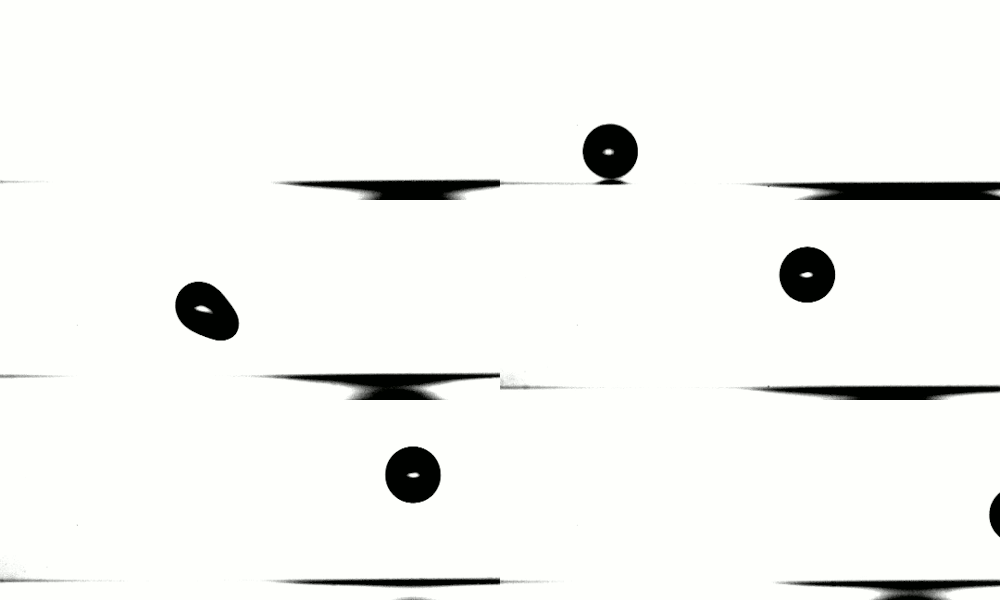
    There are many ways to repel droplets from a surface: water droplets will bounce off superhydrophobic surfaces due to their nanoscale structures; a vibrating liquid pool can keep droplets bouncing thanks to its deformation and a thin air layer trapped under the drop; and heated surfaces can repel droplets with the Leidenfrost effect by vaporizing a layer of liquid beneath the droplet. But all of these methods will only work for certain liquids under specific circumstances. 

    More recently, researchers have begun looking at a different way to repel droplets: moving the surface. The motion of the plate drags a layer of air with it; how thick that layer of air is depends on the plate’s speed. (Faster plates make thinner air layers.) Above a critical plate speed, a falling droplet will impact without touching the plate directly and will rebound completely. This works for many kinds of liquids – the researchers used silicone oil, water, and ethanol – across many droplet sizes and speeds. The key is that the air dragged by the plate deforms the droplet and creates a lift force. If that lift force is greater than the inertia of the droplet, it bounces. (Image and research credit: A. Gauthier et al., source)

  • Soapy Rainbows

    Soapy Rainbows

    The swirling psychedelic colors of a soap bubble come from the interference of light rays bouncing off the inner and outer surfaces of the film. As a result, the colors we see are directly related to the thickness of the soap film. Over time, as a film drains, black spots will appear in it. This happens where the bubble’s wall becomes thinner than the wavelength of visible light. Black spots will grow and merge as the film continues to thin. Then, when it’s too thin to hold together any longer, the bubble will pop and disappear. (Image credit: L. Shen et al., source)

  • Featured Video Play Icon

    The Many Shapes of Fish

    After visiting an aquarium or snorkeling near a reef, you may have wondered why fish come in so many different shapes. Given that all fish species need to get around underwater, why are some fish, like tuna, incredibly streamlined while others, like the box fish, are so, well, boxy? There are several major groupings for fish based on their shape and how they propel themselves, whether it’s by undulating their body and tail or primarily by flapping their fins. Which grouping a fish tends toward depends largely on its environment and needs. Open-water swimmers tend to use their bodies and tails. Their bodies are better streamlined, too, allowing them to outrace even some ships! Fish that live in more complicated environments, like along the seafloor or in a reef, tend to favor maneuverability over speed. These fish – which include rays, pufferfish, and surgeonfish – use their fins for their main propulsion. Many of these species are still faster swimmers than you or I, but their slower speeds have reduced their need for hydrodynamic streamlining, allowing these fish to evolve a wide variety of odd body shapes. (Video credit: TED-Ed)

  • Featured Video Play Icon

    Waves Below the Surface

    Even a seemingly calm ocean can have a lot going on beneath the surface. Many layers of water at different temperatures and salinities make up the ocean. Both of those variables affect density, and one stable orientation for the layers is with lighter layers sitting atop denser ones. Any motion underwater can disturb the interface between those two layers, creating internal waves like the ones in this demo. In the actual ocean, these internal waves can be enormous – 800 meters or more in height! In regions like the Strait of Gibraltar where flowing tides encounter underwater topography, large internal waves are a daily occurrence. Internal waves can also show up in the atmosphere and are sometimes visible as long striped clouds. (Video and image credit: Cal Poly)

  • Featured Video Play Icon

    Rainbow Paint on a Speaker

    Every year brings faster high-speed cameras and better quality imaging, so the Slow Mo Guys like to occasionally revisit topics they’ve done before, like paint vibrated on a speaker. The physics involved here are fantastic, so I’ll revisit the topic, too! In this version, Gav and Dan are using a pretty beefy speaker at a relatively high volume, so the paint gets a strong acceleration. As they note, the paint colors mix to brown almost immediately. In the high-speed footage, we can see why. 

    Watch how the individual strands of paint behave. As they fly upward, they stretch out and get thinner. That stretching has a side effect: it makes the paint spin. This is angular momentum of the paint being conserved. Just like a spinning ice skater who pulls his arms in, the paint spins faster as it gets thinner. This provides a lot of the mixing. Just look at how the different colors twist together! (Image and video credit: The Slow Mo Guys)

  • Using Air to Break Up Jets

    Using Air to Break Up Jets

    One method of breaking a liquid into droplets, or atomizing it, uses a slow liquid jet surrounded by an annulus of fast-moving gas. The gas along the outside of the liquid shears it, creating waves that the wind blowing past can amplify. This draws the liquid into thin ligaments that then break into droplets. This is a popular technique in rocket engines, where cryogenic liquid fuels often need to be atomized for efficient combustion. When things aren’t working exactly right, however, the liquid jet may start flapping instead of breaking up. In this case, the jet will swing back and forth, but only part of it will atomize. For a rocket engine, this would mean slower and less efficient combustion – never desirable outcomes! (Image credit: A. Delon et al.)