Year: 2017

  • Featured Video Play Icon

    Solving Mazes

    Earlier this fall, I attempted my first corn maze. It didn’t work out very well. Early on I unknowingly cut through an area meant to be impassable and thus ended up missing the majority of the maze. Soap, as it turns out, is a much better maze-solver, taking nary a false turn as it heads inexorably to the exit. The secret to soap’s maze-solving prowess is the Marangoni effect.

    Soap has a lower surface tension than the milk that makes up the maze, which causes an imbalance in the forces at the surface of the liquid. That imbalance causes a flow in the direction of higher surface tension; in other words, it tends to pull the soap molecules in the direction of the highest milk concentration. But that explains why the soap moves, not how it knows the right path to take. It turns out that there’s another factor at work. Balancing gravitational forces and surface tension forces shows that the soap tends to spread toward the path with the largest surface area ahead. That’s the maze exit, so Marangoni forces pull the soap right to the way out! (Video credit: F. Temprano-Coleto et al.; research credit: F. Peaudecerf et al.)

    ETA: Based on the latest research results, gravity may play less of a role than originally thought. Instead, it seems as though the soap chooses its path in part through pre-existing background levels of surfactant. As the dye advances, it compresses the background surfactant, decreasing the local surface tension until it is in equilibrium with dyed area. Because longer paths take longer to reach that equilibrium, the dye spreads preferentially toward the largest surface area.

  • Featured Video Play Icon

    Building with Sand

    Sand and water make a remarkable team when it comes to building. But the substrate – the surface you build on – makes a big difference as well. Take a syringe of wet sand and drip it onto a waterproof surface (bottom right), and you’ll get a wet heap that flows like a viscous liquid. Drop the same wet sand onto a surface covered in dry sand (bottom left), and the drops pile up into a tower. Watch the sand drop tower closely, and you’ll see how new drops first glisten with moisture and then lose their shine. The excess water in each drop is being drawn downward and into the surrounding sand through capillary action. This lets the sand grains settle against one another instead of sliding past, giving the sand pile the strength to hold its weight upright. (Video and image credit: amàco et al.)

  • Turbulent Volcanic Plumes

    Turbulent Volcanic Plumes

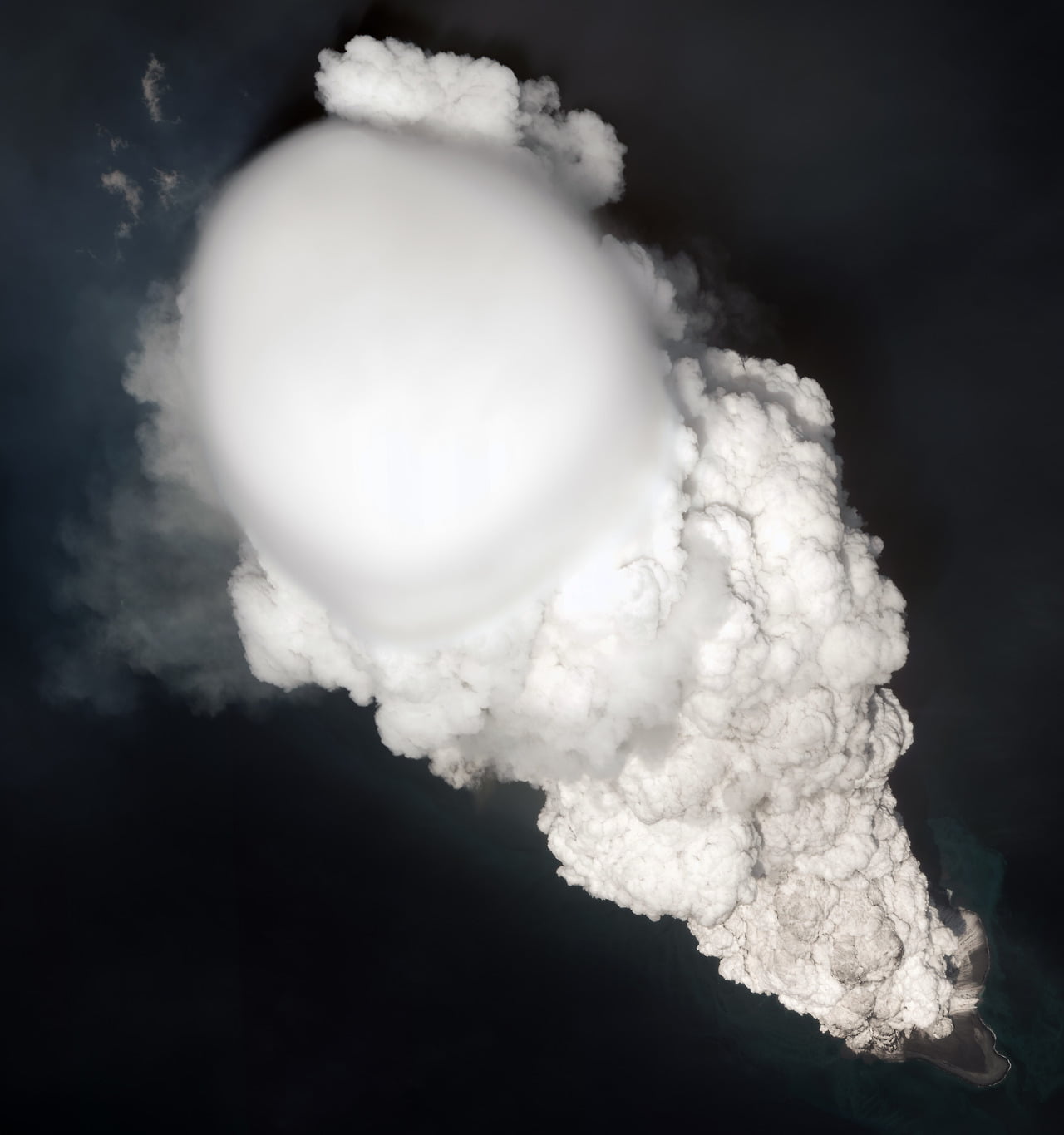
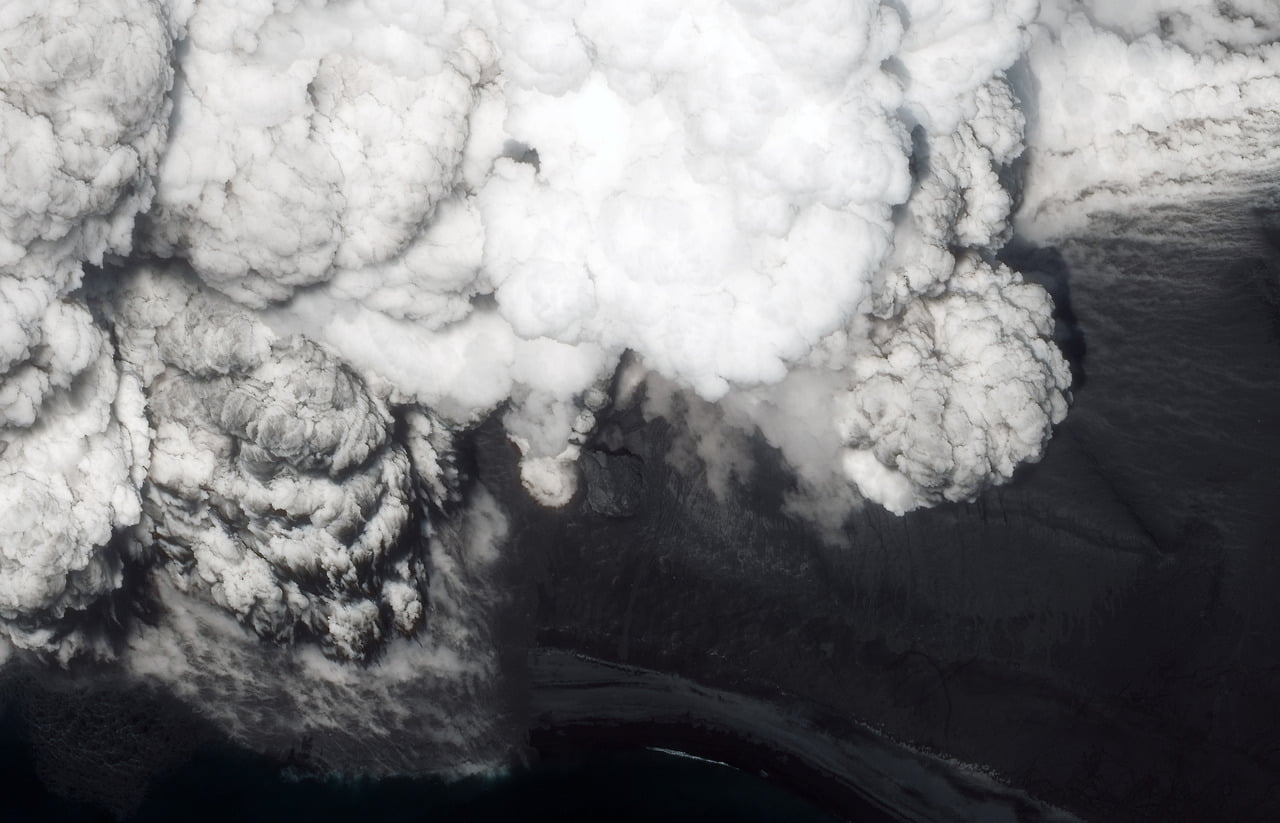
    Volcanic eruptions produce some of the largest flows on Earth. These towering ash clouds were imaged from orbit in May 2017 as an eruption began on Alaska’s Bogoslof Island. The clouds are a beautiful example of a turbulent flow. Turbulence is characterized by its many length scales. Some features in the plume are tens or hundreds of meters across, yet there are also coherent motions down at the centimeter or millimeter scale. In a turbulent flow, energy cascades from these very large scales down to the smallest ones, where viscosity is significant enough to dissipate it. This is part of the challenge of modeling turbulence; to fully describe it, you have to capture what happens at every scale. (Image credit: DigitalGlobe, via Apollo Mapping; submitted by Mark S.)

  • Microfluidic Chips in Action

    Microfluidic Chips in Action

    Earlier this year, The Lutetium Project explored how microfluidic circuits are made, and now they are back with the conclusion of their microfluidic adventures. This video explores how microfluidic chips are used and how microscale fluid dynamics relates to other topics in the field. Because these techniques allow researchers very fine control over droplets, there are many chemical and biological possibilities for microfluidic experiments, some of which are shown in the video. Microfluidics in medicine are also already more common than you may think. For example, test strips used by diabetic patients to measure their blood glucose levels are microfluidic circuits! (Video and image credit: The Lutetium Project; submitted by Guillaume D.)

  • Resisting Coalescence

    Resisting Coalescence

    When a droplet falls on a pool, we expect it to coalesce. There are exceptions, like bouncing droplets, but in general a droplet only sticks around for a split second before being engulfed. And yet, from morning coffee (top image) to walks in the woods, we frequently see millimeter-sized droplets sticking around for far longer than it seems like they should. New research offers a clue as to why: it’s thanks to a temperature difference. 

    When there’s an appreciable temperature difference between the drop and the pool, it causes rotating convective vortices (bottom image) in both the drop and the pool. When the temperature difference is large, the vortices are strong enough that their motion recirculates air inside the tiny gap between the drop and the pool. This supports the weight of the drop and keeps the two liquids separate. But the convection also redistributes heat, and eventually the drop and pool become similar enough in temperature that the circulation dies out, the air gap drains, and the two coalesce. (Image and research credit: M. Geri et al.; via MIT News; submitted by Antony B.)

  • Liquid Sculptures

    Liquid Sculptures

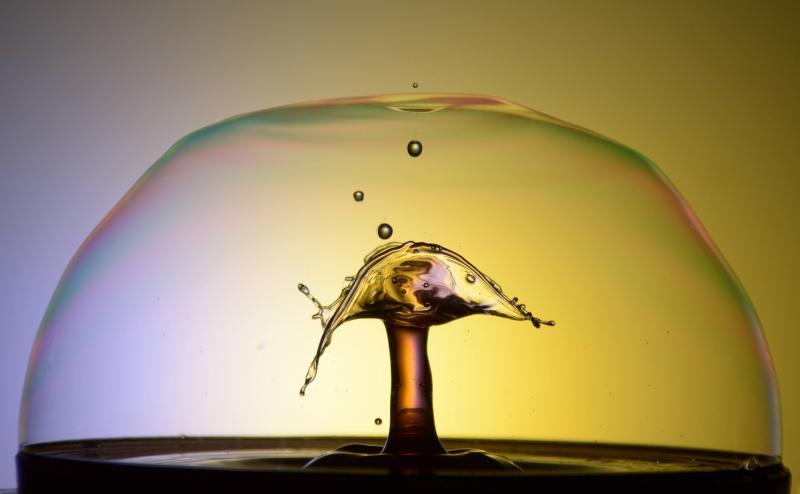
    With patience and timing, one can create remarkable sculptures with fluids. To capture this shot, Moussi Ouissem used two droplets, perfectly timed. The first fell through the soap bubble (which stayed intact thanks to its powers of self-healing) and hit the pool of water. The impact caused a cavity, which then inverted into a Worthington jet. The second drop was timed to impact the column of the jet, creating the saddle-shaped splash seen here. Ripples in the bubble are still visible from the passage of the second drop, and several satellite droplets are signs of the violence of the impacts. (Image credit: M. Ouissem)

  • Stopping a Bounce

    Stopping a Bounce

    One way to damp a bouncing ball is to partially fill it with a fluid (a) or granular material (b). For the fluid, the initial impact sloshes the liquid. That doesn’t change the trajectory of the initial bounce noticeably, but it interferes with the second impact, drastically damping the rest of the ball’s bounces until it comes to a stop. A grain-filled ball is similar, at least to begin with. The initial bounce sends the grains flying, forming a granular gas inside the ball. This doesn’t affect the trajectory of the first bounce, but the second impact collapses the granular gas. All the impacts of the grains with one another dissipate the energy of the bounce, and the ball comes to a complete stop. This suggests that a partially-grain-filled container can make a good damper in sport or industrial applications. It also suggests that it might be even better for water-bottle flipping than water is. (Image and research credit: F. Pacheco-Vázquez & S. Dorbolo)

  • Featured Video Play Icon

    Plate Tectonics

    We don’t typically think of the ground beneath our feet as anything but solid, but over geologically long time scales, even mountains can flow. Buoyant convection inside the Earth’s mantle is thought to drive the plate tectonics that have shaped the Earth as we know it. The video above explains some of the major processes and events that shaped the modern North American continent, including collisions, subduction, volcanism, and erosion. (Video credit: Ted-Ed)

  • Featured Video Play Icon

    “Monsoon IV”

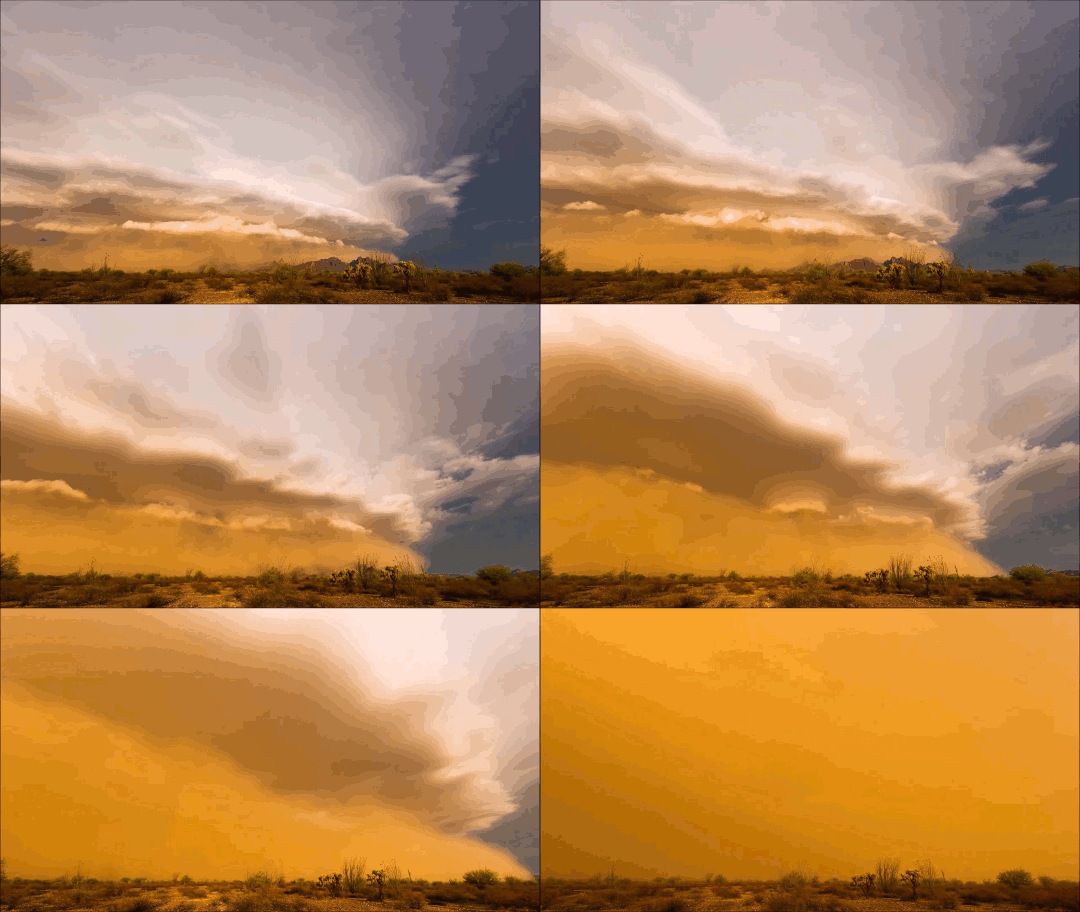
    It’s a cliché to claim that the sky is bigger in the American West, but the wide, open views in that region do offer a very different perspective on weather. Photographer Mike Olbinski’s works give viewers a taste of that perspective of far-off thunderstorms, towering anvil clouds, and massive downpours in the distance. At the same time, many of his sequences illustrate the birth and death of these massive storms. As warm, moist air rises, a puffy cumulus cloud (below) swells upward as fresh moisture condenses. When it reaches a thermal cap and can rise no further, precipitation begins to fall, dragging surrounding air with it. This is the mature stage of a storm, when both updrafts and downdrafts exist simultaneously.

    Eventually, the storm’s power begins to wane as the downdrafts cut off the updrafts that feed the storm. Sometimes this occurs in a massive downdraft where cool air sinks straight down and, upon encountering the ground, spreads radially outward. In dry regions, this outward burst of ground-level winds can pick up dirt, dust, and sand, forming a wall-like haboob (below) that advances past the remains of the storm. Watch the entire video to see some examples in their full glory! (Video and image credit: M. Olbinski, source; via Rex W.)

    image
  • Revealing Stress

    Revealing Stress

    What goes on inside of a granular material like sand when an object moves through it? Individual grains will shift and may impact one another or simply slide past. Researchers use special photoelastic materials to see these forces in action. A photoelastic material responds to changes in stress by polarizing light, revealing areas of stress concentration. For an entire network of photoelastic beads, forces between the grains appear like a web of lightning. Individual strands are known as force chains. Bright lines indicate areas where grains are jammed against one another in opposition to the object’s movement. As the intruder is pulled against the force chain network, grains shift and new force chains form. (Image credit: Y. Zhang and R. Behringer, source)