Month: August 2017

  • Rocket Launch Systems

    Rocket Launch Systems

    If you’ve ever watched a rocket launch, you’ve probably noticed the billowing clouds around the launch pad during lift-off. What you’re seeing is not actually the rocket’s exhaust but the result of a launch pad and vehicle protection system known in NASA parlance as the Sound Suppression Water System. Exhaust gases from a rocket typically exit at a pressure higher than the ambient atmosphere, which generates shock waves and lots of turbulent mixing between the exhaust and the air. Put differently, launch ignition is incredibly loud, loud enough to cause structural damage to the launchpad and, via reflection, the vehicle and its contents.

    To mitigate this problem, launch operators use a massive water injection system that pours about 3.5 times as much water as rocket propellant per second. This significantly reduces the noise levels on the launchpad and vehicle and also helps protect the infrastructure from heat damage. The exact physical processes involved – details of the interaction of acoustic noise and turbulence with water droplets – are still murky because this problem is incredibly difficult to study experimentally or in simulation. But, at these high water flow rates, there’s enough water to significantly affect the temperature and size of the rocket’s jet exhaust. Effectively, energy that would have gone into gas motion and acoustic vibration is instead expended on moving and heating water droplets. In the case of the Space Shuttle, this reduced noise levels in the payload bay to 142 dB – about as loud as standing on the deck of an aircraft carrier. (Image credits: NASA, 1, 2; research credit: M. Kandula; original question from Megan H.)
  • Tightrope Walkair

    Tightrope Walkair

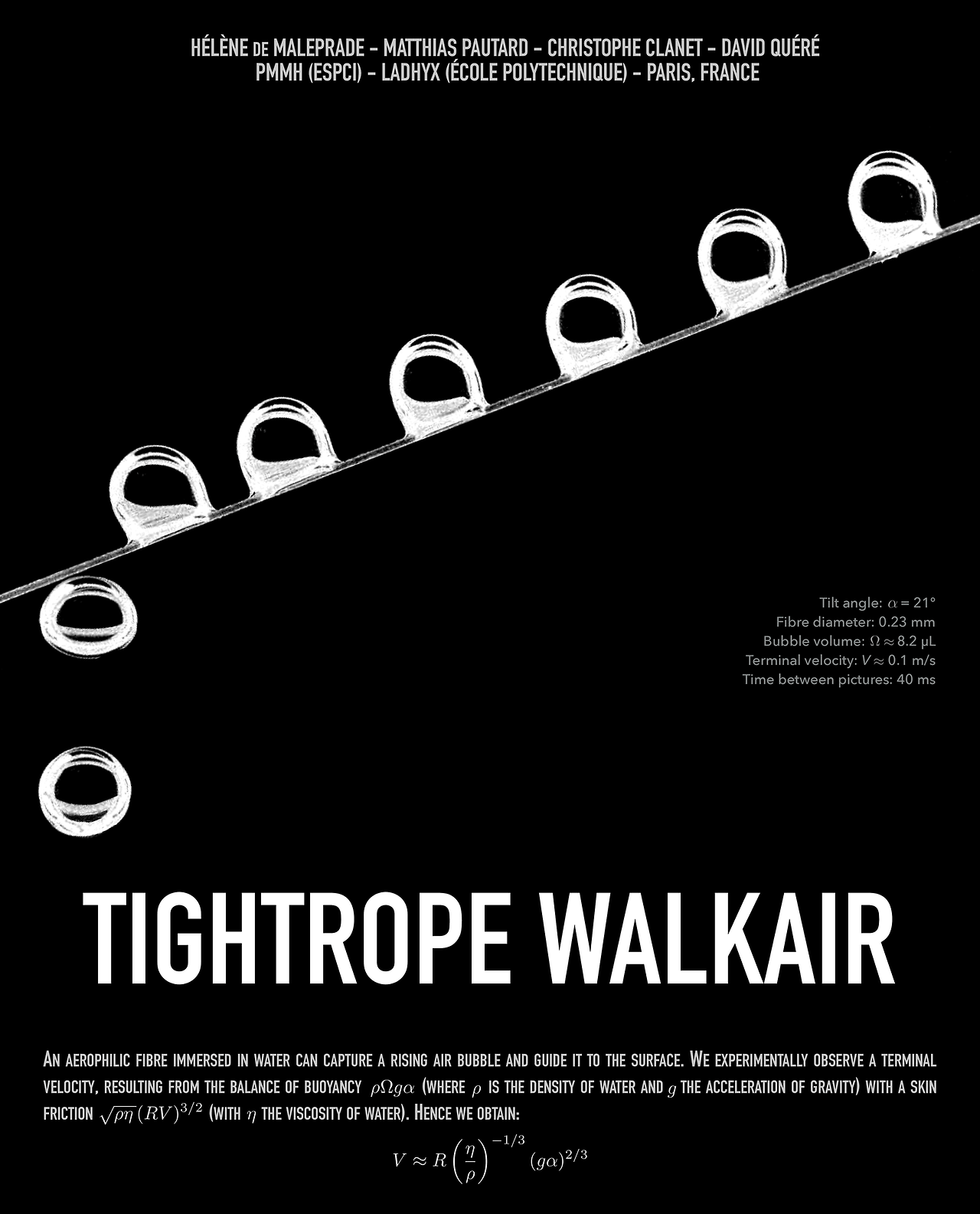
    A bubble rising through water can get caught on an aerophilic (air-attracting) fiber. The bubble will then adhere to the fiber and be guided to the surface by it. In the poster above, the image is a composite photo of such a bubble every 40 milliseconds. Once captured by the fiber, the bubble first accelerates and then reaches a terminal velocity, indicated by the equal spacing of the bubble photos toward the right end of the picture. The terminal velocity strikes a balance between buoyancy, which pulls the bubble upward, and skin friction between the bubble and the water, which acts like drag on the bubble. At the terminal velocity, these forces are equal; neither is able to speed up or slow down the bubble. (Image credit: H. de Maleprade et al.)

  • Chains of Salps

    Chains of Salps

    Salps are small, jellyfish-like marine invertebrates that swim by ejecting a pulsatile jet. They are unusual creatures whose lives have two major stages: one in which salps swim individually and one in which they link together and swim in large chains. In the chain, salps don’t synchronize their jetting; each salp jets with its own phase and frequency. A new study suggests that, in spite of this lack of synchronicity, the salp chain’s swimming reduces the animals’ drag. There are several  factors that contribute to this result. One is that drag is generally lower on a body moving at constant speed compared to one moving in bursts. When linked together and firing randomly, all the individual jets tend to average out into one continuous swimming speed. There’s even a benefit to being out of sync: previous work showed that synchronized jets lose some of their thrust when they are too close together. Salps avoid that loss by keeping to their own beat. (Image and research credit: K. Sutherland and D. Weihs, source; via Gizmodo)

  • Featured Video Play Icon

    Chinese Spouting Bowl Physics

    In their newest video, the Slow Mo Guys recreated one of my favorite effects: vibration-driven droplet ejection. For this, they use a Chinese spouting bowl, which has handles that the player rubs after partially filling the bowl with water. By rubbing, a user excites a vibrational mode in the bowl. Watch the GIFs above and you can actually see the bowl deforming steadily back and forth. This is the fundamental mode, and it’s the same kind of vibration you’d get from, say, ringing a bell. 

    Without a high-speed camera, the bowl’s vibration is pretty hard to see, but it’s readily apparent from the water’s behavior in the bowl. In the video, Gav and Dan comment that the ripples (actually Faraday waves) on the water always start from the same four spots. That’s a direct result of the bowl’s movement; we see the waves starting from the points where the bowl is moving the most, the antinodes. In theory, at least, you could see different generation points if you manage to excite one of the bowl’s higher harmonics. The best part, of course, is that, once the vibration has reached a high enough amplitude, the droplets spontaneously start jumping from the water surface! (Video and image credits: The Slow Mo Guys; submitted by effyeah-artandfilm)

  • Wrinkling Drops

    Wrinkling Drops

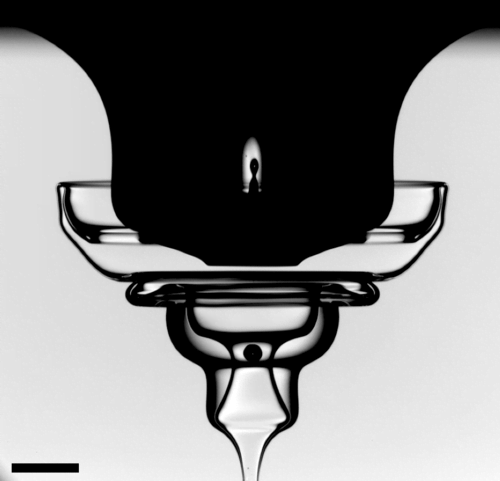
    When a viscous drop falls into a pool of a less viscous liquid, the drop can deform into some beautiful and complex shapes. Typically, shear forces between the drop and its surroundings cause a vortex ring to roll up and advect downward, thereby stretching the remainder of the drop into thin sheets that can buckle and wrinkle. Here the drop is about 150 times more viscous than the pool and impacts at 1.45 m/s, making a rather energetic entry. The vortex ring (not visible) has stretched the drop’s remains downward while a buoyant bubble caught by the impact pulls some of the drop back toward the surface. As a result, the thin sheets of the drop’s fluid are buckling and folding back on themselves like an elaborate and delicate glass sculpture. This entire paper is full of gorgeous images and videos. Be sure to check them out! (Image and research credit: E. Q. Li et al.; see supplemental info zip for videos)

  • Featured Video Play Icon

    When Fire Ants are a Fluid

    Substances don’t have to be a liquid or a gas to behave like a fluid. Swarms of fire ants display viscoelastic properties, meaning they can act like both a liquid and a solid. Like a spring, a ball of fire ants is elastic, bouncing back after being squished (top image). But the group can also act like a viscous liquid. A ball of ants can flow and diffuse outward (middle image). The ants are excellent at linking with one another, which allows them to survive floods by forming rafts and to escape containers by building towers. 

    Researchers found the key characteristic is that ants will only maintain links with nearby ants as long as they themselves experience no more than 3 times their own weight in load. In practice, the ants can easily withstand 100 times that load without injury, but that lower threshold describes the transition point between ants as a solid and ants as a fluid. If an ant in a structure is loaded with more force, she’ll let go of her neighbors and start moving around.

    When they’re linked, the fire ants are close enough together to be water-repellent. Even if an ant raft gets submerged (bottom image), the space between ants is small enough that water can’t get in and the air around them can’t get out. This coats the submerged ants in their own little bubble, which the ants use to breathe while they float out a flood. For more, check out the video below and the full (fun and readable!) research paper linked in the credits. (Video and image credits: Vox/Georgia Tech; research credit: S. Phonekeo et al., pdf; submitted by Joyce S., Rebecca S., and possibly others)

    ETA: Updated after senoritafish rightfully pointed out that worker ants are females, not males. 

  • Featured Video Play Icon

    Songs in Soap

    There are many beautiful ways to visualize sound and music – Chris Stanford’s fantastic “Cymatics” music video comes to mind – but this is one I haven’t seen. This visualization uses a soap film on the end of an open tube with music playing from the other end. You can see the set-up here. The result is a fascinating interplay of acoustics, fluid dynamics, and optics. As sound travels through the tube, certain frequencies resonant, vibrating the soap film with a standing wave pattern (3:20). At the same time, interference between light waves reflecting off the front and back of the soap film create vibrant colors that show the film’s thickness and flow.

    When the frequency and amplitude are just right, the sound excites counter-rotating vortex pairs in the film (0:05), mixing areas of different thicknesses. With just a single note, the vortex pairs appear and disappear, but with the music, their disappearance comes from the changing tones. Watching the patterns shift as the film drains and the black areas grow is pretty fascinating, but one of the coolest behaviors is how the acoustic interactions are actually able to replenish the draining film (2:15). Because the tube was dipped in soap solution, some fluid is still inside the tube, lining the walls. With the right acoustic forcing, that fresh fluid actually gets driven into the soap film, thickening it.

    There are several more videos with different songs here – “Carmen Bizet” is particularly neat – as well as a short article summarizing the relevant physics for those who are interested. (Video and research credit: C. Gaulon et al.; more videos here)

  • Featured Video Play Icon

    Flowing Ice

    Glaciers are kind of bizarre. Despite being very solid, they still flow, sometimes on the order of a meter a day. This flow is driven by gravity and the incredible weight of the dense ice. Near the base of the glacier, the pressure is great enough to cause some localized melting. (Very high pressures actually decrease the melting point of water.) Glaciers also move through plastic deformation – this is the internal slippage Joe refers to in the video when he compares glaciers to a deck of cards. Despite their vast differences from typical fluid flows, glacial flows are often still described by the same equations of motion used in the rest of fluid dynamics! (Video credit: It’s Okay to Be Smart; via PBS Digital Studios)

  • Squishy Impacts

    Squishy Impacts

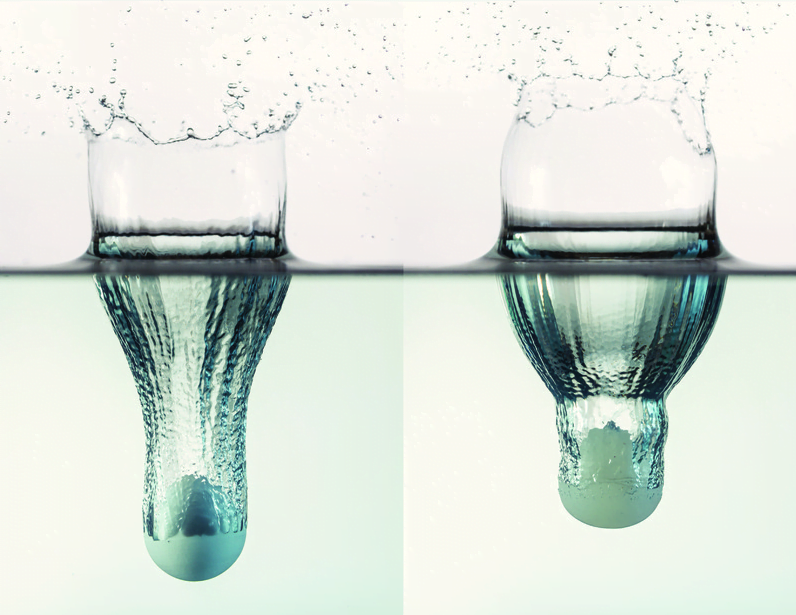
    How spheres impact water has been studied for more than a century. The typical impact for a rigid sphere creates a cavity like the one on the upper left – relatively narrow and prone to pinching off at its skinny waist. If the sphere is elastic –squishy – instead, the cavity ends up looking much different. This is shown in the upper right image, taken with an elastic ball and otherwise identical conditions to the upper left image. The elastic ball deforms; it flattens as it hits the surface, creating a wider cavity. If you watch the animations in the bottom row, you can see the sphere oscillating after impact. Those changes in shape form a second cavity inside the first one. It’s this smaller second cavity that pinches off and sends a liquid jet back up to the collapsing splash curtain

    From the top image, we can also see that the elastic sphere slows down more quickly after impact. This makes sense because part of its kinetic energy at impact has gone into the sphere’s shape changes and their interaction with the surrounding water. 

    If you’d like to see more splashy stuff, be sure to check out my webcast with a couple of this paper’s authors. (Image credits: top row – C. Mabey; bottom row – R. Hurd et al., source; research credit: R. Hurd et al.)

  • Flying Fragments

    Flying Fragments

    Flying fragments can be a big danger in explosions. Shown above are two shadowgraph images of 1 gram explosives originally packed in solid containers. Each explosion produced a visible spherical shock wave, about 1 meter across in both pictures. On the left side, the container has fragmented into large pieces, each of which travels near to but less than the speed of sound. On the right, the fragments are much smaller, but many of them are traveling at supersonic speeds ahead of the main shock wave. If you look closely, you can even see faint Mach cones extending from each fragment. In a real, full-scale explosion, these shards would strike like a hail of bullets ahead of the blast wave. (Image credit: G. Settles)