St. Pauli, a neighborhood in the German city of Hamburg, has demonstrated one of the most unusual applications of superhydrophobicity I’ve ever heard of. St. Pauli is known as a party district, and the residents of the area have grown understandably frustrated with inebriated visitors publicly urinating on their buildings and, yes, playgrounds. When fines failed to curb the issue, they took to treating walls chemically to make them superhydrophobic. As the targeted audience has discovered, water repellency tends to make liquid jets bounce off rather than run down a surface. Well played, St. Pauli. (Video credit: IG St. Pauli; submitted by entropy-perturbation)
Month: August 2015

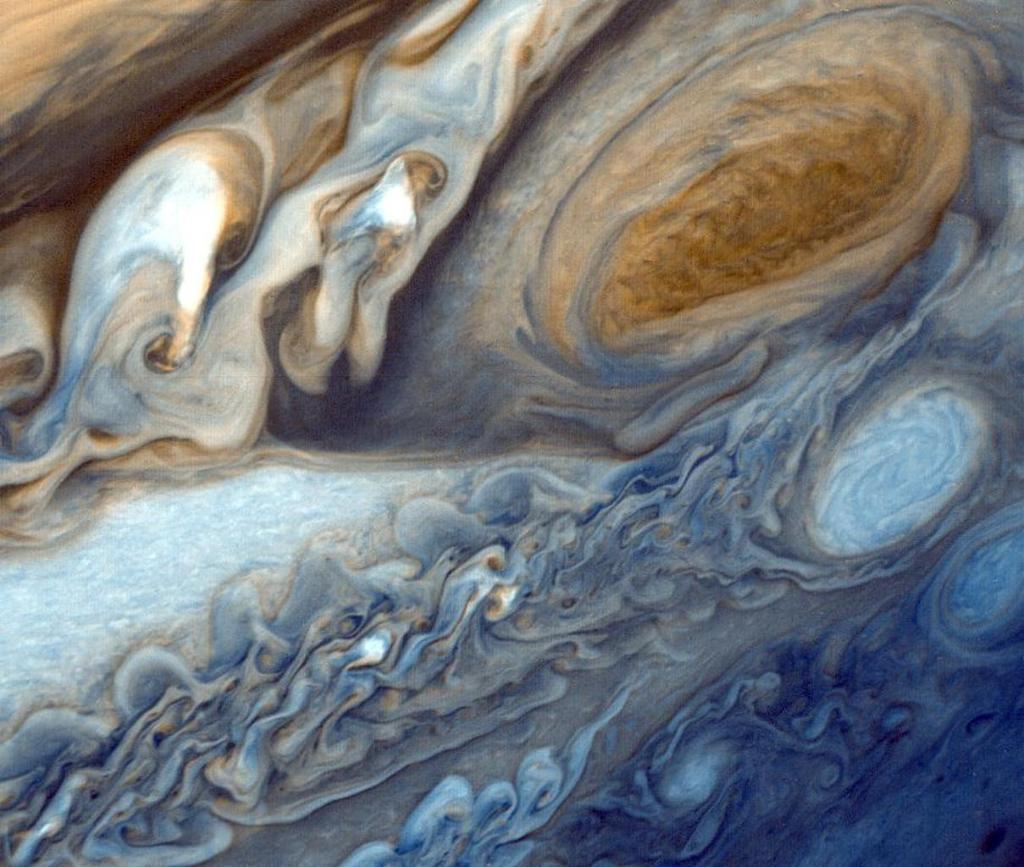
Jovian Dynamics
Our solar system’s largest planet is a mysterious and majestic font of fluid dynamics. Unlike rocky Earth, Jupiter is made entirely of fluids. Beneath its massive gaseous atmosphere lies an ocean of liquid hydrogen. The lack of solid ground to weaken storms may explain some of the longevity of Jupiter’s Great Red Spot, a hurricane that’s been raging on the planet for more than a hundred and fifty years. Part of the challenge of understanding Jupiter’s dynamics is that most of our data consists of observations of the uppermost layer of the atmosphere. It’s kind of like trying to describe an entire ocean based on the surface alone; what we see is part of the story, but it’s only a small portion of a much greater whole. (Image credit: NASA; submitted by jshoer)
——————
FINAL CALL: FYFD reader survey closes TODAY! I’ve teamed up with researcher Paige Brown Jarreau to create a survey of FYFD readers. By participating, you’ll be helping me improve FYFD and contributing to novel academic research on the readers of science blogs. It should only take 10-15 minutes to complete. You can find the survey here.

Convection Cells
This magnified photo shows Rayleigh-Benard convection cells in silicone oil. This buoyancy-driven convection occurs when a fluid is heated from below and cooled above. Inside the cells, fluid rises through the center and sinks along the edges; this motion is made apparent here thanks to aluminum flakes in the oil. The distinctive hexagonal shape of the cells is actually due to surface tension. Here, the upper surface of the fluid is left open to the air and this free surface boundary condition causes hexagonal shapes to form. If the fluid were instead covered by a solid surface, the convection cells that form would be shaped differently. (Image credit: M. Velarde et al.; via Van Dyke’s An Album of Fluid Motion)
——————
LAST CALL: FYFD reader survey closes Wednesday! I’ve teamed up with researcher Paige Brown Jarreau to create a survey of FYFD readers. By participating, you’ll be helping me improve FYFD and contributing to novel academic research on the readers of science blogs. It should only take 10-15 minutes to complete. You can find the survey here.