As a follow-up to last week’s “dancing droplet” post, here’s a video that describes how to recreate the experiment yourself at home. The droplet motion is driven by the two-component structure of the droplets, where differing evaporation rates and surface tension values between the two fluids in the drop cause the attractions and chasing behavior you see. To demonstrate this at home, you’ll need glass, fire (for sterilization), tweezers, a pipette, water, and food coloring. Looks like a fun way to spend a weekend afternoon! (Video credit: M. Prakash et al.; via io9)
Month: April 2015

Lab-borne Tornadoes
Conventional wind tunnels are great, but some aerodynamic testing requires facilities of a different nature. The video above is from the WindEEE dome, a hexagonal chamber with sixty fans on one wall, eight directional fans on the other five walls, and six fans in the upper chamber. Each is individually computer controlled, allowing the researchers to create straight flows as well as complex vortical ones. The video shows their tornado flow, which stands 5 m tall and swirls at 30 m/s. They can also move the tornado around the chamber at 2 m/s. This capability enables a kind of scale-model analysis of tornadoes and their impact that’s not possible in most facilities. You can read more about the dome at New Scientist or the WindEEE website. (Video credit: New Scientist/WindEEE; submitted by entropy-perturbation)

Rowing Water Striders

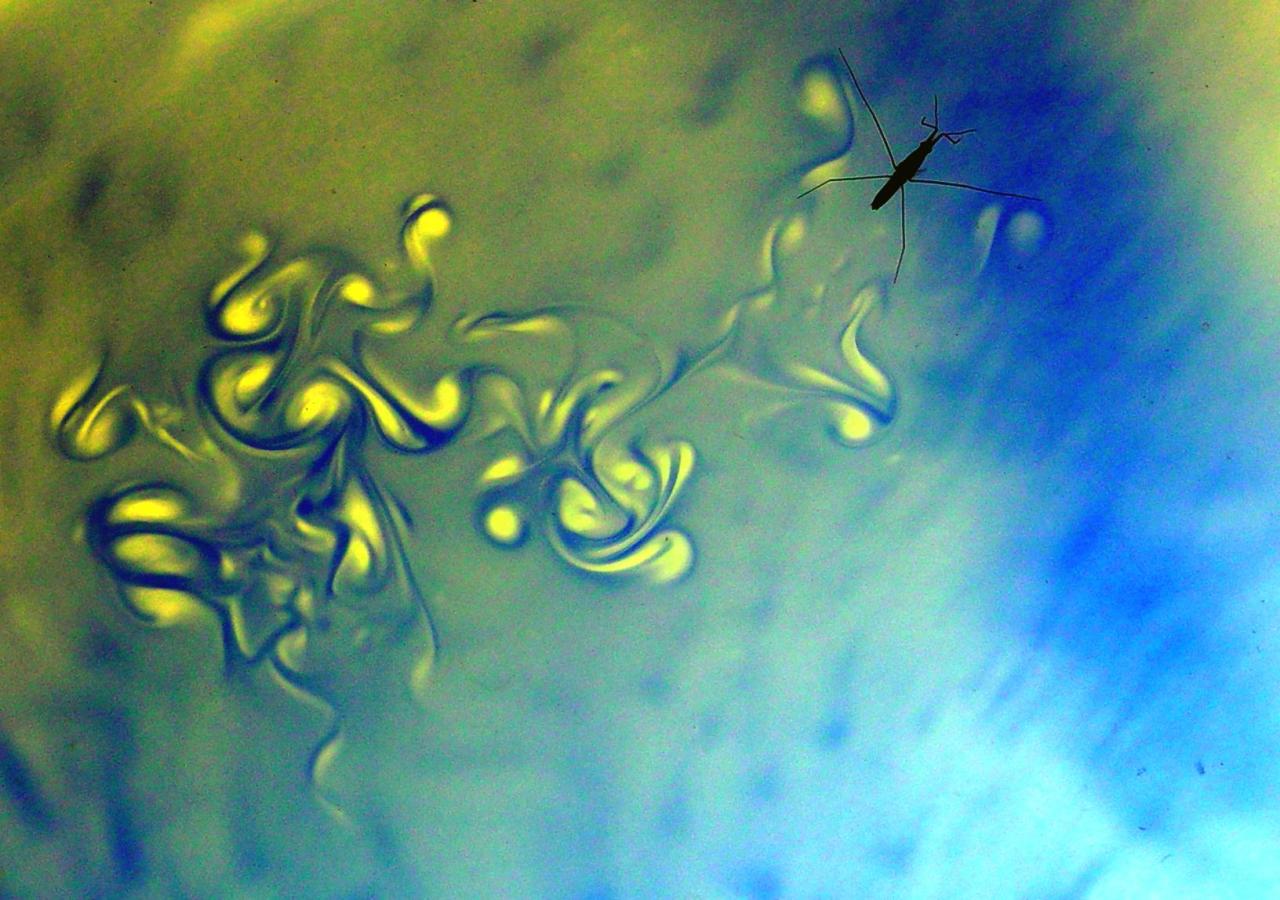
Water strider insects are light enough that their weight can be supported by surface tension. For some time, they were thought to propel themselves by using their long middle legs to generate capillary waves–ripples– that pushed them forward, but juvenile water striders are too small for this technique to work. Instead researchers found that water striders move by using their middle legs like oars. The leg motion creates vortices about 4 mm below the water surface, and this water moving backward propels the insect forward. In the photos above, the scientists visualized the flow by sprinkling thymol blue on the water and letting the striders move freely. You can learn more about the work here or in this Science Friday episode. (Photo credits: J. Bush et al.)