Timelapse photography reveals the tide-like motions of fog that filled the Grand Canyon last week. This unusual meteorological condition was created by a temperature inversion. Usually air near the ground is warmest and the atmosphere cools as the altitude increases. But occasionally a mass of warm air will trap a layer of cooler air beneath it. In the case of the Grand Canyon, cool foggy air was capped by a warmer air mass, resulting in a sea of fog. Depending on the conditions, temperature inversions can create other distinctive weather patterns like cloud streets or even supercell thunderstorms. (Video credit: Vox; via Flow Visualization)
Month: December 2014

Jumping Droplets
When droplets on a superhydrophobic surface coalesce with one another, they jump. Individually, each drop has a surface energy that depends on its size. When two smaller droplets coalesce into a larger drop, the final drop’s surface energy is smaller than the sum of the parent droplets. Energy has to be conserved, though, so that excess surface energy gets converted to kinetic energy, causing the new droplet to leap up. Smaller droplets have higher jumping velocities. For more, see the original video. (Image credit: J. Boreyko and C. Chen, source video)

Phytoplankton Flow Viz
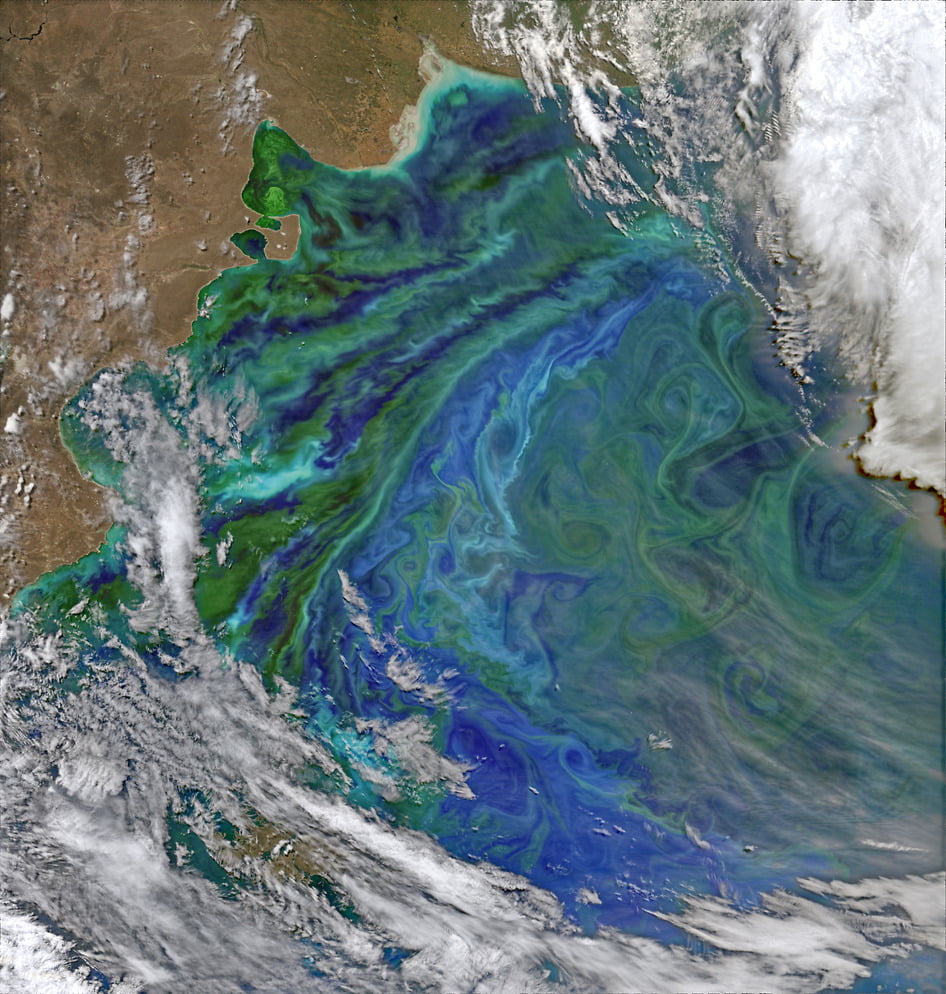
Nutrient-rich waters off Patagonia in South America blossom with phytoplankton in this satellite image. When present in large quantities, these microscopic photosynthesizers lend a green hue to the water. They act as seed particles in the flow, highlighting the currents and flow that carry them. If you check out the full resolution version of the photo, you can admire the rich detail in the whorls of ocean mixing. There even seem to be Kelvin-Helmholtz-like instabilities creating trains of vortices along the interface between separate bands. (Photo credit: NASA/ASU; via SpaceRef; submitted by jshoer)

Frog Tongues and Parrot Laser Safety Goggles


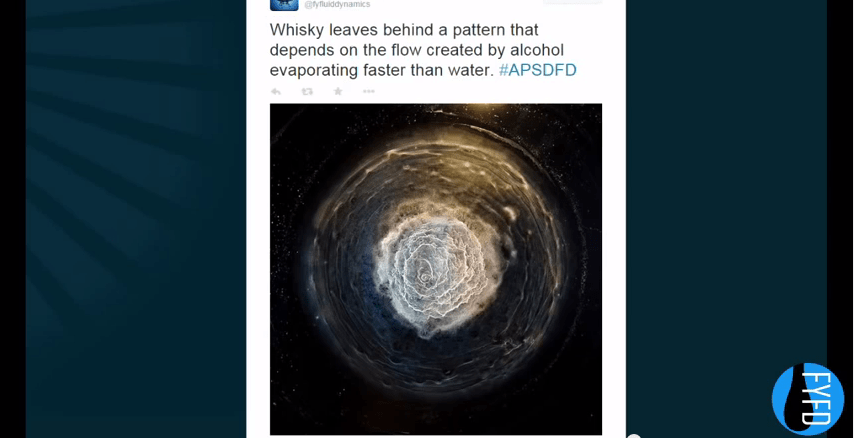
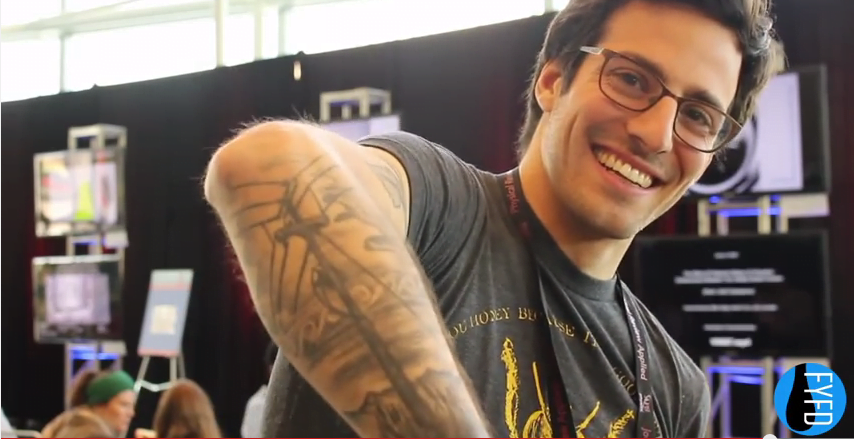
What do frog tongues, whisky, tattoos, and parrot laser safety goggles have in common? They’re all a part of the latest FYFD video! Check out my behind-the-scenes look at the biggest fluid dynamics conference of the year and find out what science everyone was talking about. (Image credits: N. Sharp, source video)

Behind the Science
FYFD features lots of science, but this new video gives you a chance to see the scientists, too! It’s a behind-the-scenes look at the American Physical Society Division of Fluid Dynamics meeting that took place in San Francisco recently. You may recognize some of the stories, but I guarantee there’s new stuff, even if you were there! Special thanks to everyone who helped me make the video; I had a blast doing this. (Video credit: N. Sharp)
Half Vortex Rings
Vortices are one of the most common structures in fluid dynamics. In this video, Dianna from Physics Girl explores an unusual variety of vortex you can create in a pool. Dragging a plate through the water at the surface creates a half vortex ring, which can be tracked either by the surface depressions created or by using food dye for visualization. Vortex rings are quite common, but a half vortex ring is not. The reason is that, ignoring viscous effects, a vortex filament cannot end in a fluid. The vortex must close back on itself in a loop, or, like the half vortex ring, the ends of the vortex must lie on the fluid boundary. It is possible to break vortex lines like those in smoke rings, but the lines will reattach, creating new vortex rings–just as they do in these vortex knots. (Video credit: Physics Girl; submitted by Tom)

Vertical-Axis Wind Turbines
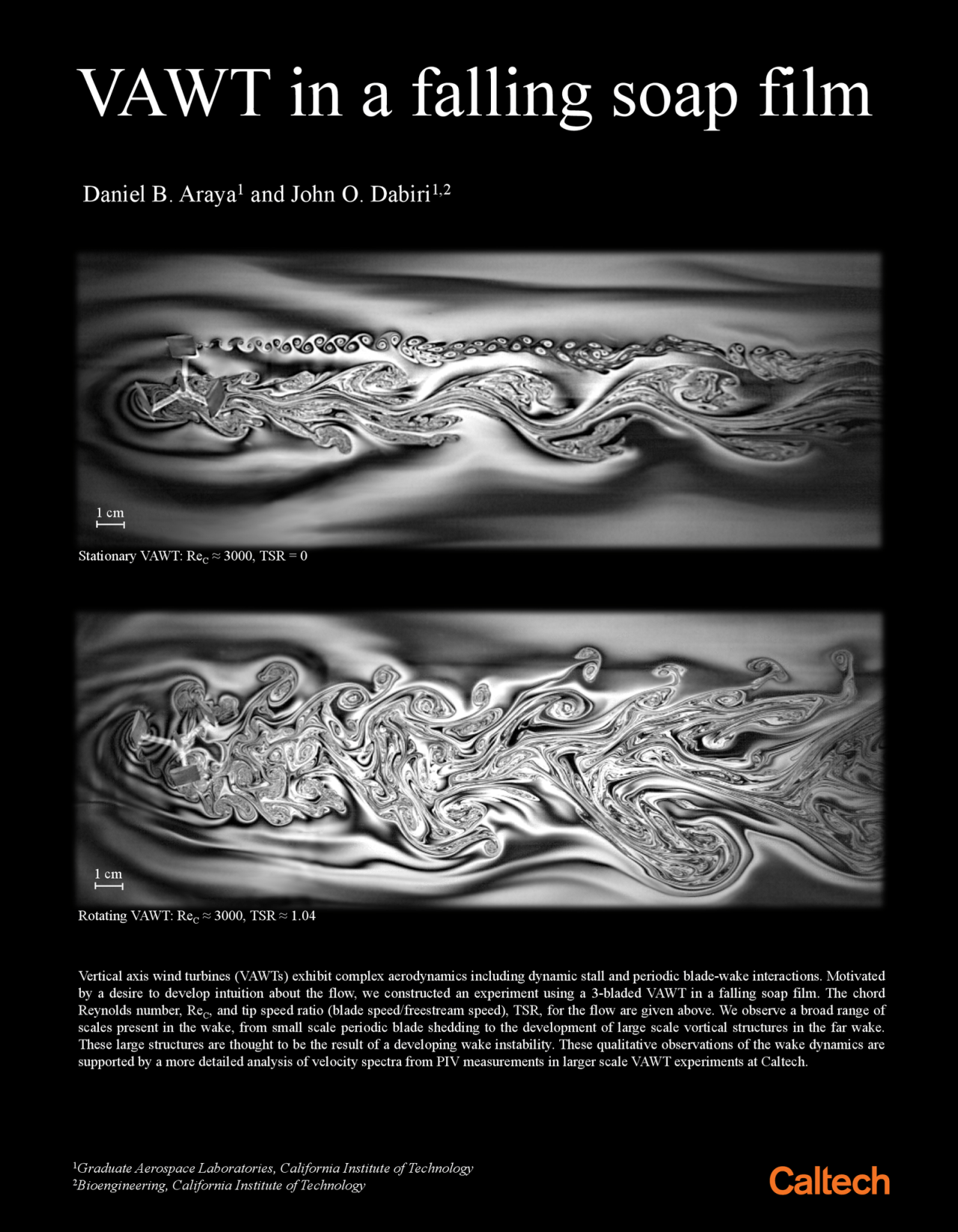
Vertical-axis wind turbines (VAWT) are an alternative to traditional wind turbine designs. Unlike their more common cousins, VAWTs rotate about a vertical axis and are omni-directional, meaning that they do not have to be pointed into the wind to produce power. While their size allows VAWTs to be packed much closer to one another than traditional turbines, a clear understanding of the flow around the turbines is needed in order to place the turbines for effective and efficient operation. The images above show the complicated and turbulent wake of a three-bladed VAWT when stationary (top) or rotating (bottom). The flow is visualized using a gravity-driven soap film (flowing left to right in the images) pierced by a model VAWT (seen at the left). The wakes contain many scales from simple, periodically-shed vortices off a blade to very large-scale vortical structures forming downstream of the turbine. This work originally appeared as a poster in the Gallery of Fluid Motion at the 2014 APS DFD Annual Meeting. (Image credit: D. Araya and J. Dabiri)
Cavitation
[original media no longer available]
Cavitation–the formation and collapse of vapor-filled cavities within a liquid–occurs in a variety of natural and manmade applications. It can shatter bottles, wreak havoc with boat impellers, is used as a hunting mechanism by several shrimp species, and can even generate light and sound. It is the collapse of the cavitation bubble that can be so damaging, and this video shows how. In the experiment, researchers generate a cavitation bubble near the free surface–or, in other words, near the air-water interface. Pressure in the bubble is much lower than the pressure of the surrounding liquid, so the bubble collapses after the momentum from its initial generation is spent. Interaction with the surface generates a jet that projects downward and pierces the cavitation bubble as it collapses. As seen from 0:54 onward, the bubble’s collapse generates a shock wave that propagates outward from the bubble site. It’s this shock wave that so effectively damages materials and stuns underwater prey. (Video credit: O. Supponen et al.)

Filter-Feeding
Sponges are filter-feeding marine animals that rely on water flow to obtain their nutrients and remove waste. By injecting non-toxic fluorescein dye at their base, one can visualize the flow they induce in the water. Only seconds after the dye is introduced, the sponges have pumped it in, through, and out. Different parts of the sponge filter particles of various sizes for food. Oxygen and carbon dioxide are transported, respectively, into and out of cells via diffusion. In this way, the sponge’s pumping fulfills digestive, respiratory, and excretory functions. (Image credit: Jonathan Bird’s Blue World, source video; submitted by Jason C)

Light Paintings
Photographer Stephen Orlando uses programmable LEDs to create light paintings. Here floating LEDs illuminate a track down a waterfall. In flow visualization terms, this is a pathline because it records the trajectory a particular particle followed through the flow. Streamlines, streaklines, and pathlines are all important concepts for interpreting fluid flow through visualization. To see more of Orlando’s light paintings, including some wonderful portraits of canoeing and kayaking, be sure to check out his galleries. (Photo credit: S. Orlando; via Colossal)