Air dancers–those long fabric tubes with fans blowing into the bottom–are a popular way for shops to draw attention. They bend and flutter, shake and kink, all due to the interaction of airflow in and around them with the fabric. When the interior flow is smooth and laminar, the tube will stand upright, with very little motion. As the air inside transitions, some fluttering of the tube can be observed. Ultimately, it is when the air flow becomes turbulent that the cloth really dances. Variations in the flow are strong enough at this point that the tube will occasionally buckle. Behind this constriction, the flow pressure increases until its force is enough to overcome the weight of the tube and lift it once more. (Video credit: A. Varsano)
Month: October 2013

Dynamic Stall
In nature, birds and other flying animals often use unsteady flow effects to enhance the lift their wings generate. When a wing sits at a high angle of attack, it stalls; the flow separates from the upper surface, and its lift force is suddenly lost. If, on the other hand, that wing is in motion and pitching upward, lift is maintained to a much higher angle of attack. The reason for this is shown in the flow visualization above. This montage shows a rectangular plate pitching upwards. Flow is left to right. Each row represents a specific angle of attack and each column shows a different spanwise location on the plate. As the plate pitches upward, a vortex forms and grows on the leading edge of the plate. Eventually, the leading-edge vortex separates, but not until a much higher angle of attack than the plate could sustain statically. This effect allows birds to maintain lift during perching maneuvers and is also key to helicopter rotor dynamics. (Image credit: K. Granlund et al.)

Fluids Round-up – 5 October 2013
This is the last week that my IndieGoGo project is open for donations. All money above and beyond what is needed for the conference will go toward FYFD-produced videos. Also, donors can get some awesome FYFD stickers.
As a reminder, those looking for more fluids–in video, textbook, or other form–can always check out my resources page. And if you know about great links that aren’t on there, let me know so that I can add them. On to the round-up!
- Popular Science has look at what it was like to fly on the Concorde, the only supersonic commercial airliner ever flown.
- For the cyclists and CFD folks out there, Zipp has put out a new video discussing their Firecrest wheels’ aerodynamics.
- io9 explains how superhydrophobic surfaces impart a charge to water droplets and how this can be used to increase efficiency at power plants.
- BuzzFeed UK has 32 fun science GIFs, several of which are fluids-related, and several of which will look familiar to long-time readers. (via Flow Visualization on FB)
- Wired has an intriguing short on Acoustic Archives, a group that focuses on capturing the acoustic qualities of historic locations using custom-designed 3D microphones.
- Congratulations to Richard over at Flow Viz for hitting his 100th post! Here’s to many more.
- Finally, our lead image comes from Martin Klimas. Smithsonian’s blog has a feature on his work in which he transforms songs from artists like Pink Floyd, Daft Punk, and Bach into sonic sculptures using paint on speakers. (via Flow Visualization on FB)
I had a lot of fun earlier this week giving a talk for the Texas A&M Applied Mathematics Undergraduate Seminar series. I didn’t get a chance to record it, but the slides are up here if anyone is interested.(Photo credit: M. Klimas)
Hydraulic Bumps
If you’ve ever noticed the circular jump in your kitchen sink when you turn on the faucet, you’re familiar with what a jet does when it plunges into a horizontal layer of liquid. If the liquid is deep enough, the jet will perturb the surface into a circular depression, as in Figure (a) above. As the flow rate increases, a recirculating vortex ring and hydraulic bump forms (Figure b photo and flow schematic). At a critical flow rate, the bump will become unstable and form polygons instead of circles. At even larger flow rates, the system will shift toward a hydraulic jump, with a larger change in fluid elevation. Like bumps, these jumps can also appear in a variety of shapes. (Image credit: M. Labousse and J. W. M. Bush)

“Supermajor”
In Matt Kenyon’s “Supermajor,” oil appears to flow upward against gravity from a puddle into a can. This optical illusion is a stroboscopic effect similar to the one that makes car wheels seem to rotate backwards. The human eye and brain can be tricked into seeing the stream of oil as being suspended or even moving backwards by changing the flicker of the lighting relative to the rate at which the drops fall. If you watch the videos carefully, the pedestal is vibrating, which imparts a specific frequency to the falling drops. Combine this with a light that flickers at a slightly different frequency than that of the vibration and you can make the stream of drops appear to move up or down. It’s a helpful way to trick the brain into freezing fluid motion we would normally be unable to appreciate without high-speed cameras. (Video credit: Science Gallery; exhibit credit: Matt Kenyon; submitted by jshoer)

The Bathtub Vortex
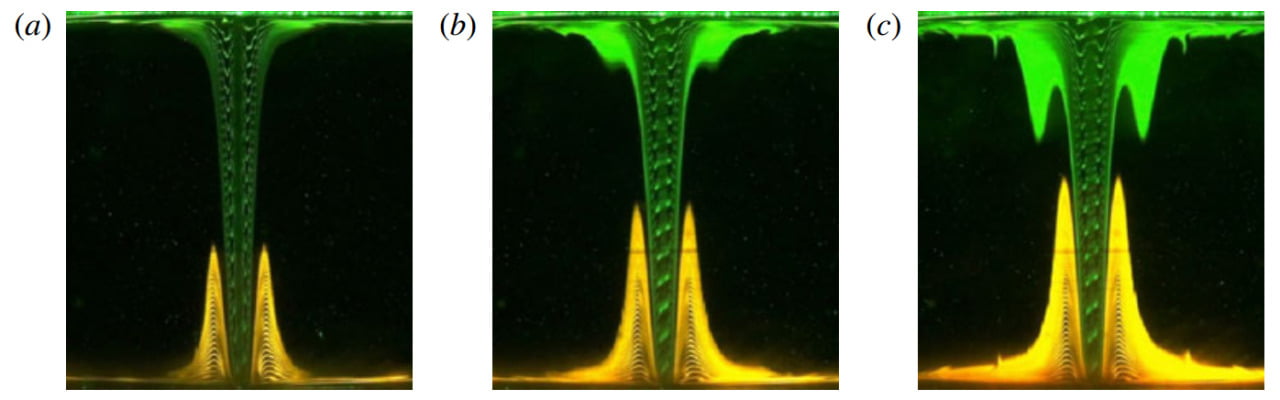
If you’ve ever watched a swirling vortex disappear down the drain of your bathtub and wondered what was happening, you’ll appreciate these images. This dye visualization shows a one-celled bathtub vortex, created by rotating a cylindrical tank of water until all points have equal vorticity before opening a drain in the bottom of the tank. A recirculating pump feeds water back in to keep the total fluid mass constant. Once a steady vortex is established, green dye is released from the top plate of the tank and yellow dye from the bottom. The green dye quickly marks the core of the vortex. Ekman layers–similar to the boundary layers of non-rotating flows–form along the top and bottom surfaces, and the yellow dye is drawn upward in a region of upwelling driven by Ekman pumping. (Photo credit: Y. Chen et al.)
Just a reminder for those at Texas A&M University: I will be giving a talk today Wednesday, October 2nd entitled “The Beauty of the Flow” as part of the Applied Mathematics Undergraduate Seminar series at 17:45 in BLOC 164.
Maze-Solving Droplets
The Leidenfrost effect occurs when liquids come in contact with a substrate much, much hotter than their boiling temperature. Rather than immediately boiling away, a thin layer of the liquid vaporizes and insulates the bulk of the liquid from the heat. This essentially turns droplets into tiny hovercrafts that skate over the surface. If you use a rough surface with rachets, the Leidenfrost drops will self-propel toward the steepest part of the rachet. The vapor underneath the drop is constantly trying to flow away, and the rachets in the surface prevent the vapor from escaping in the steeper direction. The vapor instead flows out the shallower side and–thanks to Newton’s third law–creates thrust that pushes the droplet the opposite direction. Here students from the University of Bath have used these effects to build a maze through which the droplets fly. (Video credit: C. Cheng et al.; via Flow Visualization FB page and several submissions)
For readers at Texas A&M University, I will be giving a talk Wednesday, October 2nd entitled “The Beauty of the Flow” as part of the Applied Mathematics Undergraduate Seminar series at 17:45 in BLOC 164.