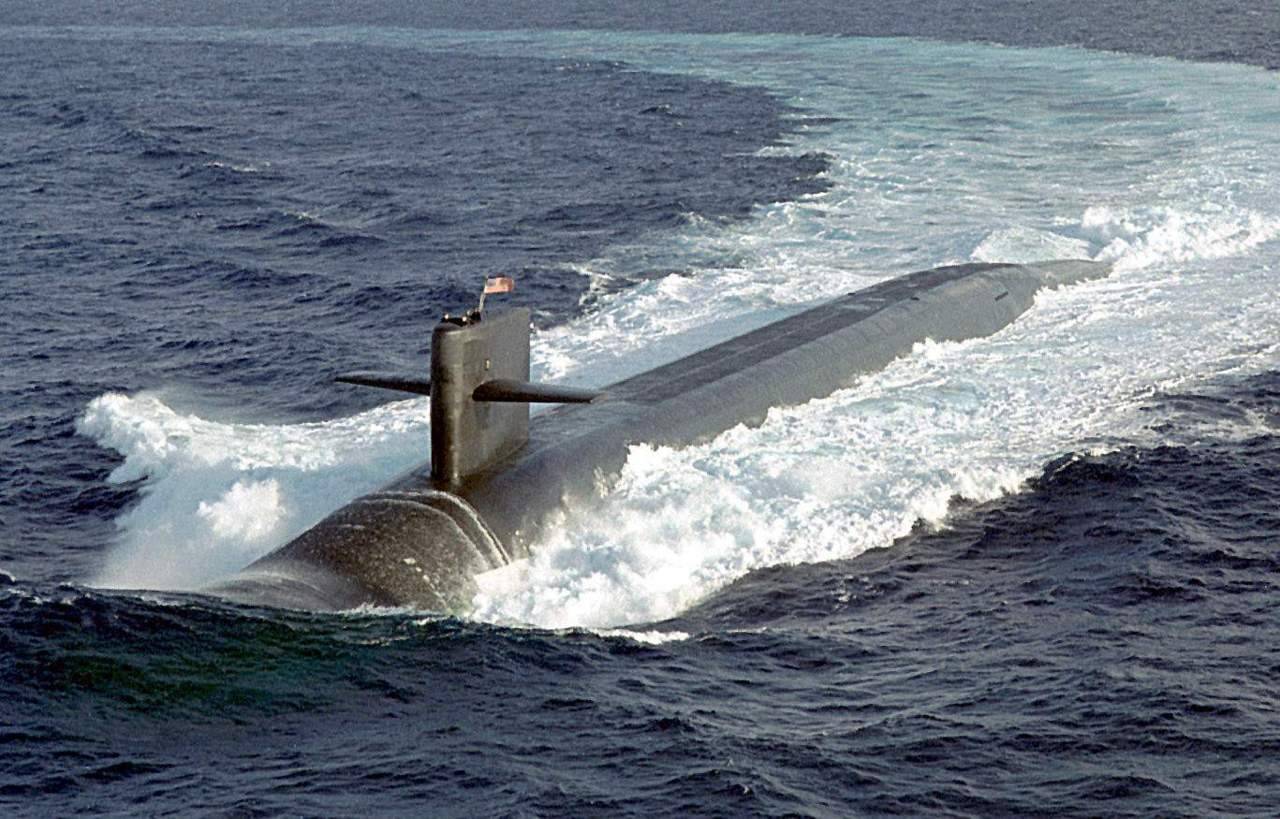
Researchers have suggested that it may be possible to cloak submerged objects as they move through a fluid using layers of mesh and micro-pumps. By redirecting the fluid so that it enters and leaves the mesh surrounding the object in the same speed and direction that it entered, it is theoretically possible to have zero drag and no wake. So far researchers have only simulated this set-up computationally using a sphere with 10 layers of mesh. It’s also unfortunately limited in size and speed: a vehicle 1 cm across could only remain wake-free at speeds below 1 cm/s. (Photo credit: Michael J Rinaldi) #
Month: August 2011

The Dance of Jets and Droplets
Placing a prism upside down in a bath of silicone oil creates a trapped bubble of air inside the prism. When oscillated above a critical amplitude, the corners of the prism, the oil, and the air perform an intricate dance of bubbles, singularities, jets, and droplets. Read more in the research paper. #

Spiky Ferrofluid
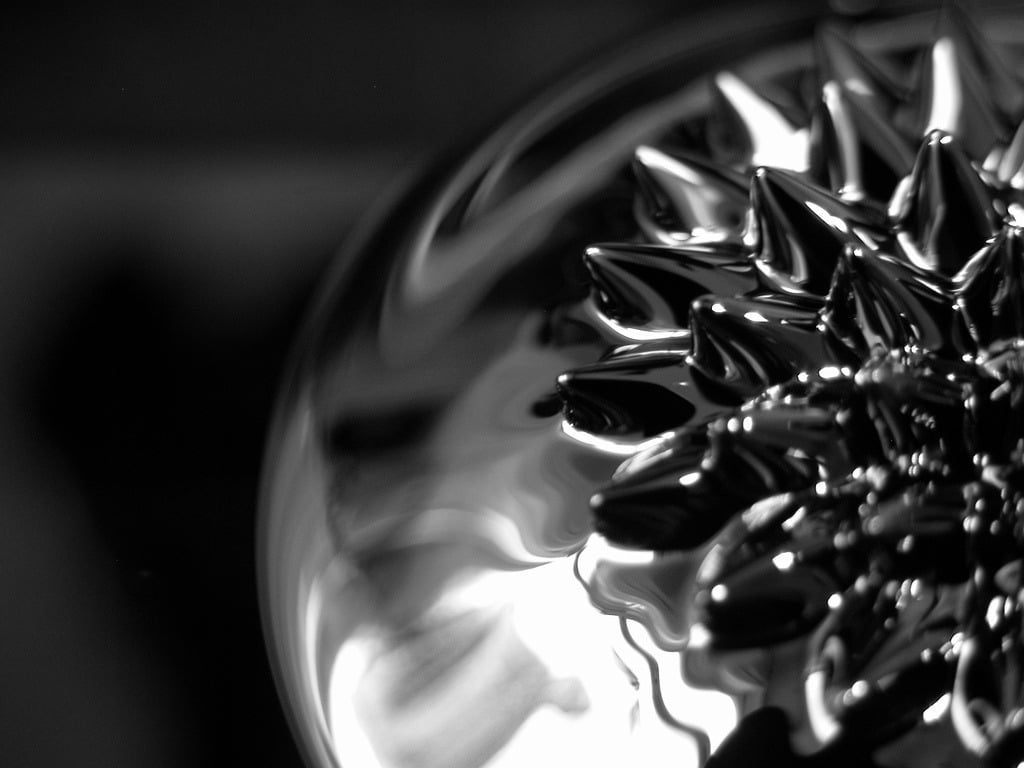
Ferrofluids consist of ferromagnetic nanoparticles suspended in a fluid. When subjected to strong magnetic fields, they develop a distinctive peak-and-valley formation due to the normal-field instability. The shape is a result of minimizing the magnetic energy of the fluid. Both gravity and surface tension resist the formation of these peaks. Ferrofluids, in addition to appearing in art exhibits, can be used as liquid seals, MRI contrast agents, and loudspeaker cooling fluids. (Photo credit: Maurizio Mucciola)
The Spinning Underwater Vortex
Vortex rings are a topic we’ve covered before with dolphins, whales, humans, volcanoes and even moss, but this video is particularly fun thanks to the addition of a bottle cap. By sticking the bottle cap next to the ring, these swimmers are able to demonstrate the forceful spinning of the fluid near the vortex. This spinning is what helps the vortex hold its shape over distances much larger than its diameter. As you can also see, though, sticking a bottle cap in the ring causes it to break up faster than it would otherwise! (submitted by Kris S)
Glorious Coronal Mass Ejection
In early June, NASA’s Solar Dynamics Observatory recorded a stunning coronal mass ejection, in which larger than usual quantities of cool (relatively speaking) plasma erupted from the surface of the sun and rained back down along magnetic field lines. Plasma is an ionized gas-like state of matter subject to the same laws that govern more familiar fluids like water or air, with the additional caveat that, being electrically conductive, plasmas also obey Maxwell’s equations. #
Computational Shock Compression
[original media no longer available]
Computational modeling can help verify and visualize experimental results, as in this video of supersonic flow. Oak Ridge National Laboratory produced the work as part of a project using shock compression and turbines to capture carbon dioxide gas. Shock waves and velocity profiles are shown throughout the computational field, and velocity isosurfaces paint a telling portrait of the complicated flow pattern. Wired Science features other award-winning simulation videos, many of which also feature fluid dynamics. #
To Splash or Not to Splash?
Hydrophobic surfaces tend to repel water while hydrophilic ones attract it. This video explores the effects that hydrophobic and hydrophilic surface coatings can have on spheres when dropped in water. There are noticeable differences in splash formation and wake shape. For more, see this research paper.

Vortex Ring Collisions
Gorgeous color schlieren photography reveals the development and interaction of ring vortices. (Photo credit: Rebecca Ing)
It’s Schlier-tastic!!
These are my invisible wonders! Gas flows and fluid interactions. Nothing but hot air, metho and acetone, yup, humble old nail polish remover.
The images were captured using a colour indicating z-system schlieren optical array, an open shutter and a flash duration of 125 microseconds.
Molecular Diffusion
This video explains molecular diffusion with demonstrations in gases and liquids. Molecular diffusion is an important process in all fluids and will occur in laminar, turbulent, or quiescent fluids. Diffusion occurs more quickly in heated fluids because molecules move more energetically at higher temperatures. (via robertlovespi)


.jpg)