FYFD will be under a brief hiatus due to a family emergency. Thank you!
Month: April 2011
How Not to Get Wet in the Rain
[original media no longer available]
Ever wonder how to minimize how wet you get if you’re caught in the rain without an umbrella? This lecture discusses just that problem and how to calculate an answer. I actually solved a version of this problem when studying for my PhD quals, only I first had to determine the terminal velocity of a rain drop (~10 m/s assuming a 4mm spherical drop) and work from there. We also had to compare moving upright to running at an angle. It makes for an interesting little diversion. (via physicsphysics)

Jet Breakup
A non-cylindrical stream falling through a slit nozzle exhibits the Plateau-Rayleigh instability, which drives a falling jet of fluid to break into droplets due to surface tension. The fingers formed off the falling stream may be a form of Rayleigh-Taylor instability. #

Seeing Blast Waves
This clip shows high-speed video footage of a blackpowder explosion. As the blast wave expands, the surrounding air is heated, which changes its index of refraction. The strength of this change is great enough that we can distinguish the edges of the expanding shock wave by the visual distortion they cause to the view beyond the explosion.

Reader Question: Locust Follow-up
omaewayowai-blog asks:
in your latest post, is that bug mounted with a yaw angle or what? because the bugs antenna and its head are not disturbing the flow. and the flow perfectly follows the surface of the bug’s aft body. how does this happen? is it something about low reynolds number?
The locust in that post is fully immersed in the flow and its antenna and head are disturbing the air, just not the smoke. The smoke generator is placed in a single vertical plane that’s offset from the bug’s midsection. According to the published paper, the smoke visualization corresponds to:
“[…] the vertical plane that intercepts the hindwing at the mid-wing position when the wing is horizontal.”
That’s why you can see perfectly smooth lines of smoke between the camera and the locust’s head.
Flow Viz of a Locust
Smoke visualization in a wind tunnel reveals the airflow over a flying locust. Researchers are unraveling the aerodynamics of insect flight in order to produce better Micro Air Vehicles (MAVs) and miniature flying robots. #

Singing Dunes
Some sand dunes can “sing”, but not because of the wind! When loose sand slides down over harder, packed sand, a standing wave is formed, causing the entire surface of the dune to vibrate on a single frequency. We hear this as a musical note – typically an E, F, or G. (via io9)
(Image credit: C. Larson)
Upside-Down Umbrellas
When a heavier fluid is suspended over a lighter fluid (as with ink or food coloring in water), the interface between fluids is subject to the Rayleigh-Taylor instability. As the heavier fluid starts to sink, it forms “fingers”, which develop into mushroom-cap shapes as the fluid continues falling. Sometimes the shear stress between the heavier fluid and lighter fluid causes secondary Kelvin-Helmholtz instabilities as well. (Photo by Leonardo Aguiar)

Happy Anniversary
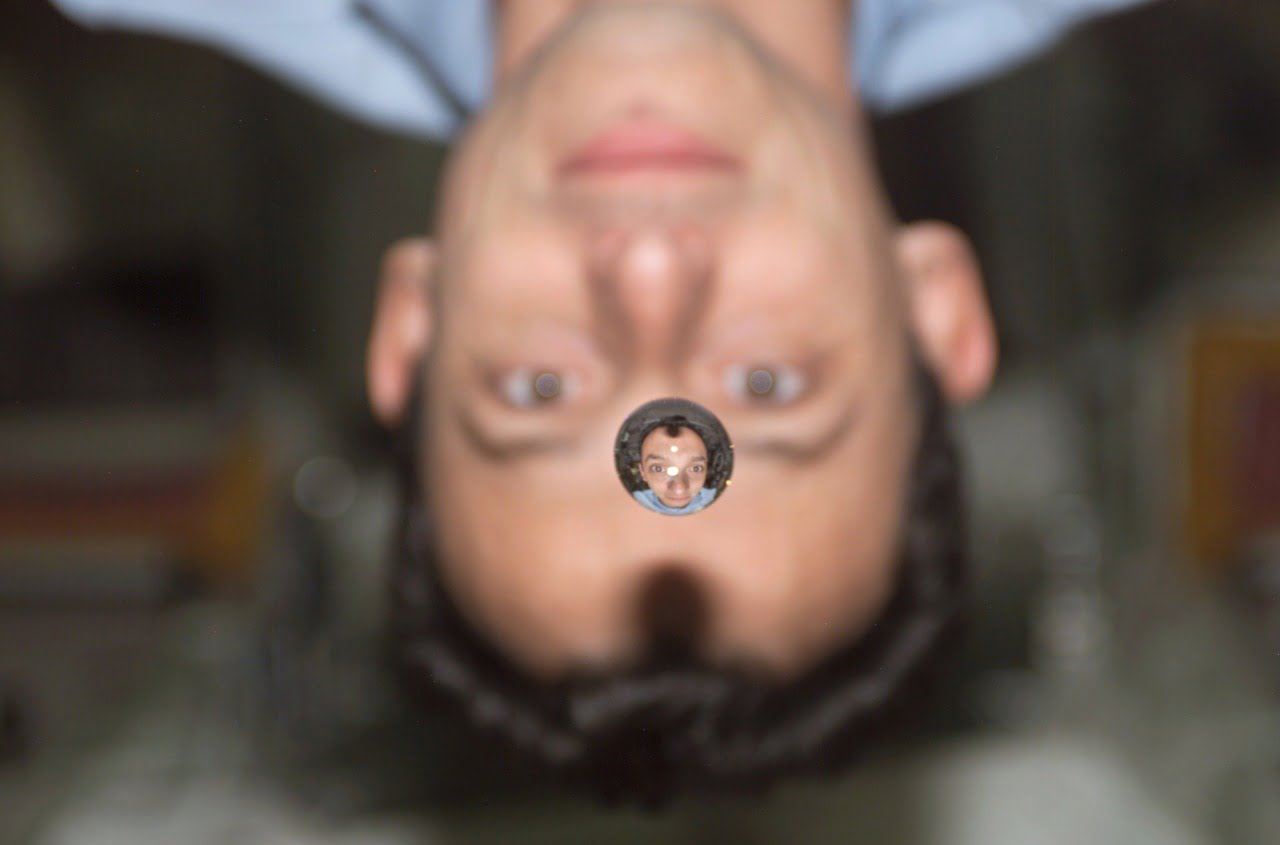
ESA astronaut Pedro Duque shown refracted through a water droplet in microgravity. Today marks the 50th anniversary of human space flight. #
Liquids Lens Breakup
A decane liquid lens floating on water (think drops of fat in chicken soup) displays different breakup and pinch-off than seen in three-dimensional droplet breakup. The pinch-off process in two dimensions relies on line tension rather than surface tension, and the quasi-2D liquid lens system is somewhere between these. The video above is a magnification of the filament connecting one liquid lens as it is broken into two smaller liquid lenses (the dark areas on the left and right of the screen). # (via scienceisbeauty)