Videos

  • Featured Video Play Icon

    Australian Fire Tornado

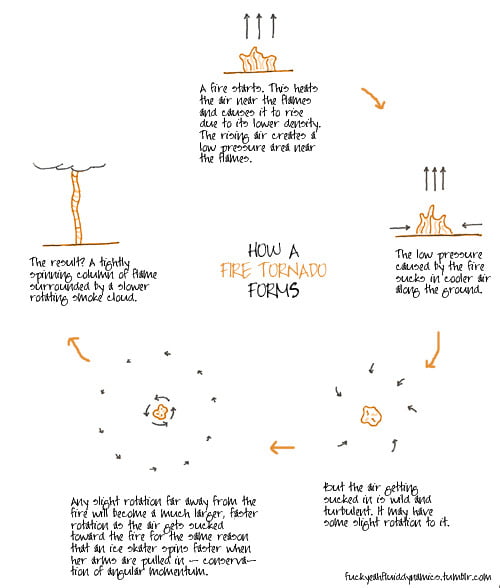
    The fire tornado is one of nature’s most impressive and terrifying examples of fluid dynamics. Although they are relatively common phenomena, it’s rare to get such a clear glimpse of them since they usually occur in the midst of giant wildfires. The fire tornado is driven by a combination of updraft from the fire and rotation from the surrounding flow. Take a look at how they form:
    There are artificial fire tornadoes as well, including homemade ones. That said, please do not try this at home without full safety measures and extreme caution. In general, watching YouTube videos is a much safer way to enjoy this phenomenon. (Video credit: C. Tangey; h/t to Flow Visualization)

  • Featured Video Play Icon

    Hawk in Flight

    For a little more than century, mankind has taken flight in fixed-wing aircraft. But other species have flown for much longer using flapping techniques, the details of which humans are still unraveling. To really appreciate flapping flight, it helps to have high-speed video, like this beautiful footage of a goshawk attacking a water balloon. The motion of the hawk’s wings is far more complex than the simple up and down flapping we imitate as children. On the downstroke, the wings and tail stretch to their fullest, providing as large an area as possible for lift. During steady flight, the bird flaps while almost horizontal for minimal drag, but as it approaches its target, it rears back, allowing the downstroke to both lift and slow the bird. In the upstroke, the bird needs to avoid generating negative lift by pushing air upward. To do this, it pulls its wings in and simultaneously rotates them back and up. Its tail feathers are also pulled in but to a lesser extent. Leaving them partially spread probably maintains some positive lift and provides stability. At the end of the upstroke, the hawk’s wings are ready to stretch again, and so the cycle continues. (Video credit: Earth Unplugged/BBC; h/t to io9)

  • Featured Video Play Icon

    When Turbulence Is Desirable

    One of the common themes in aerodynamics, especially in sports applications, is that tripping the flow to turbulence can decrease drag compared to maintaining laminar flow. This seems counterintuitive, but only because part of the story is missing. When a fluid flows around a complex shape, there are actually three options: laminar, turbulent, or separated flow. An object’s shape creates pressure forces on the surrounding fluid flow, in some cases causing an increasing, or unfavorable, pressure gradient. When this occurs, fluid, especially the slower-moving fluid near a surface, can struggle to continue flowing in the streamwise flow direction. Consider the video above, in which the flow moves from left to right. Near the surface a turbulent boundary layer is visible, where fluid motion is significantly slower and more random. Occasionally the flow even reverses direction and billows up off the surface. This is separation. Unlike laminar boundary layers, turbulent boundary layers can better resist and recover from flow separation. This is ultimately what makes them preferable when dealing with the aerodynamics of complex objects.  (Video credit: A. Hoque)

  • Featured Video Play Icon

    When Jets Collide

    When two jets of a viscous liquid collide, they can form a chain-like stream or even a fishbone pattern, depending on the flow rate. This video demonstrates the menagerie of shapes that form not only with changing flow rates but by changing how the jets collide – from a glancing impingement to direct collision. When just touching, the viscous jets generate long threads of fluid that tear off and form tiny satellite droplets. At low flow rates, continuing to bring the jets closer causes them to twist around one another, releasing a series of pinched-off droplets. At higher flow rates, bringing the jets closer to each other creates a thin webbing of fluid between the jets that ultimately becomes a full fishbone pattern when the jets fully collide. The surface-tension-driven Plateau-Rayleigh instability helps drive the pinch-off and break-up into droplets. (Video credit: B. Keshavarz and G. McKinley)

  • Featured Video Play Icon

    Soil Liquefaction

    Soil liquefaction is a rather unsettling process in which apparently solid ground begins moving in a fluid-like way after agitation. It occurs in loose sediments when the spaces between individual particles become nearly saturated with water. This can happen, for example, after heavy rains or in a place with inadequate drainage. Such cases are typically very localized, though, and require some significant agitation of the surface, like pressing with heavy machinery or jumping in a single spot. Soil liquefaction becomes a greater danger, however, in an earthquake. Even in a dry area, the earth’s shaking can force groundwater up into the surface sediment and vibrate the soil sufficiently to liquify it, causing whole buildings to sink or tip and wreaking havoc on manmade infrastructure. (Video credit: jokulhlaups)

  • Featured Video Play Icon

    Sand Ripples

    Wave motion in a bay or near a beach can cause significant sediment transport. Individual granular particles, like sand, can be lifted by the passage of a single wave, but, over time, complex patterns form as the granular bottom surface shifts due to the waves. This video shows time-lapse footage of the ripples that form and move in submerged sand during many hours of wave motion. A slight imperfection in the surface causes a network of sand ripples to grow and spread. Once formed, those ripples shift and reform depending on changes in the wave conditions. (Video credit: T. Parron et al.)

  • Featured Video Play Icon

    Knotting Vortices

    Knots have long fascinated humans, appearing in art for thousands of years and generating entire fields of study. Until recently, however, the idea of a knotted fluid was purely theoretical. To knot fluids, researchers used 3D printing to create twisted hydrofoil shapes. When towed through water, fluid travels around the shape and spins up at the trailing edge, creating a knotted vortex ring. The knotted vortices were captured with 3D imaging, allowing scientists to observe how they evolve. So far the knots they’ve created have all been unstable, deforming until two vortex lines approach one another. Upon contact, the vortices disconnect and reconnect with one another, unraveling the knot. Intriguingly, these vortex reconnections seem remarkably similar to the vortex reconnections observed between quantized vortices in superfluids. (Video credit: D. Kleckner et al.)

  • Featured Video Play Icon

    Sochi 2014: Speed Skiing

    As FYFD wraps up coverage of #Sochi2014, let’s take a look at a winter sport not currently contested at the Olympics. This year’s Winter Games featured 12 new events. Speed skiing was not among them, though it was a demonstration sport in the 1992 Olympics. Like many of the sports in Sochi, speed skiing is gravity-driven, and friction and drag serve only to slow competitors. Speed skiing is about getting from the top of the course to the bottom, in a straight line, as fast as possible. Athletes reach velocities as high as 250 kph (155 mph), and aerodynamics are of the utmost concern. The skiers’ rubberized speed suits include airfoil-shaped fairings behind their calves that mold the airflow, and athletes wear giant aerodynamic helmets to smooth flow over their heads and shoulders. They spend their entire descent in an aerodynamic tuck, arms extended ahead of them like a cyclist in a time trial. It looks a pretty crazy ride. Would you like to see it added to the Olympics? (Video credit: R. Sill/University of Cambridge)

    FYFD is celebrating #Sochi2014 with a look at fluid dynamics in winter sports. Check out the previous poss on why ice is slippery, the aerodynamics of speedskating, and how lugers slide fast.

  • Featured Video Play Icon

    Sochi 2014: Making Snow

    Much attention ahead of the Sochi Winter Olympics has been dedicated to the question of how this subtropical resort town would provide and maintain adequate snow cover for the Games. Officials promised a combination of natural snow, snow transported from elsewhere, snow stored from the previous year, and, of course, artificial snow. These days many ski resorts rely heavily on snow guns producing artificial snow. There are two main types of snow gun–those which use compressed air and those which have an electrically-driven fan–but the principles behind each are the same. The snow guns provide a continuous spray of air and water, atomizing the water into tiny droplets which freeze rapidly. The effectiveness of snow guns depends on both the temperature and humidity of the surrounding air. With sufficiently dry air, artificial snow can be made even several degrees above freezing. Sochi itself is relatively humid (72% on average for February), but most of the outdoor events are held in Krasnaya Polyana, higher in the mountains where temperatures are typically much lower and artificial snow can be manufactured. That said, temperatures have reached as high as 15 degrees Celsius during the Games so far, and athletes have complained about the changing snow conditions in several events. (Video credit: On The Snow)

    FYFD is celebrating #Sochi2014 with a look at the fluid dynamics of the Winter Games. Check out our previous posts, including how lugers slide fast, how wind affects ski jumpers, and why ice is slippery.

  • Featured Video Play Icon

    Happy Valentine’s Day!

    What can you do with a 7 x 7 grid of miniature vortex cannons? Why, make floating vortex hearts, of course. Happy Valentine’s Day from FYFD! (Video credit: D. Schulze/bitsbeauty; via Colossal)