Although engineers often consider fluid mechanics through the lens of mathematics, that’s far from the only way to understand fluid physics. Today’s video is an alternative interpretation of a classic flow — the flow around a cylinder — created in a collaboration between dancers and engineers. The result is what they call a “physics-constrained dance improvisation” that shows how the flow changes as its speed increases. I love this concept! It highlights the visual and qualitative differences between flow states and maintains space for artistic creativity. Be sure to watch the full video! (Video and submission credit: J. Capecelatro et al.)
Tag: von Karman vortex street

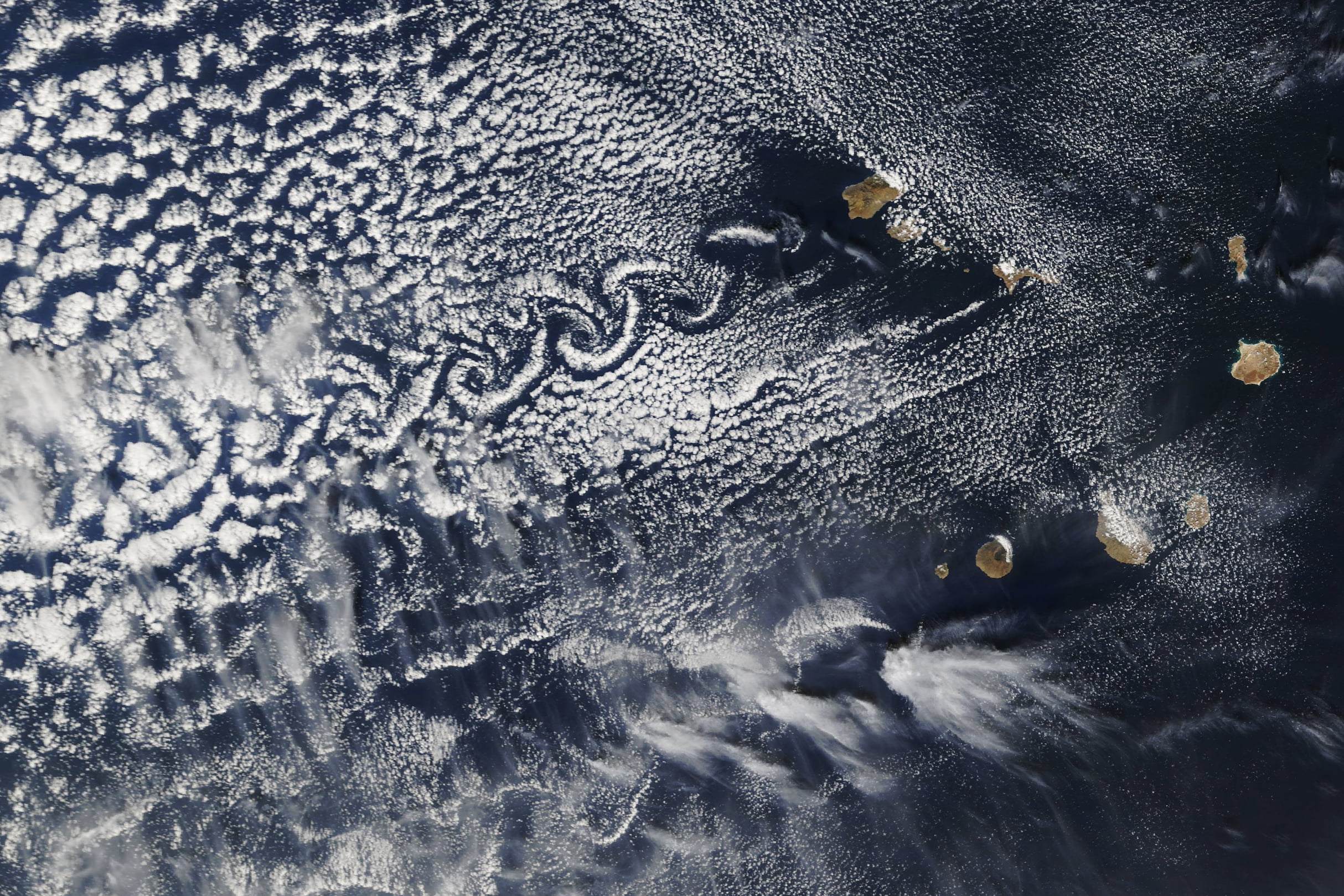
Strings of Swirls
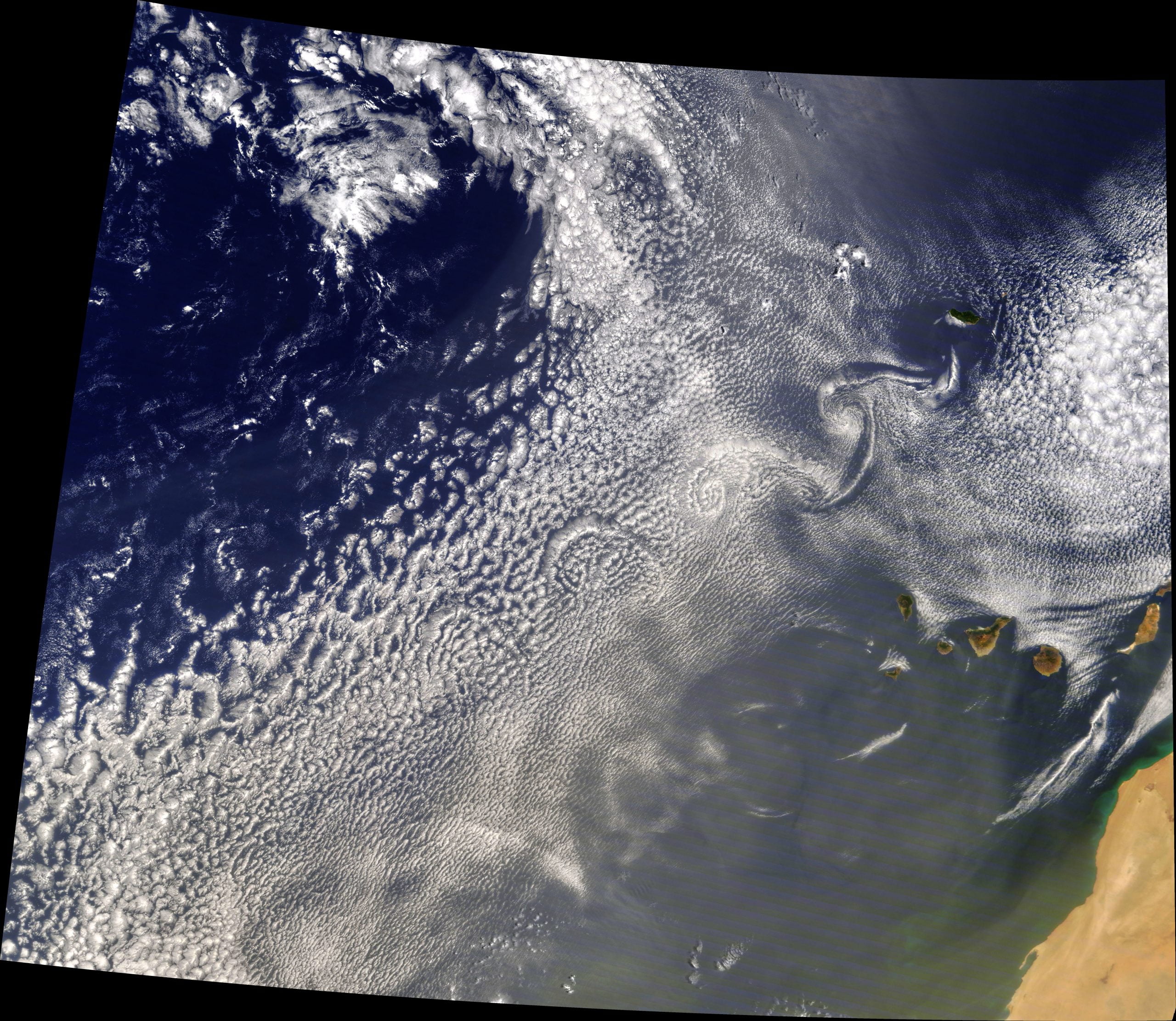
Von Karman vortex streets are the rows of alternating vortices shed off isolated objects interrupting a flow. Here, the volcanic peaks of Cabo Verde disrupt an atmospheric flow accustomed to an empty ocean. In a steady wind, air wraps around the volcanoes and detaches first on one side, creating a vortex, then from the other side, making a vortex of the opposite rotation. Although these structures are always present, we only see them when they stir up the cloud layer, leaving these strings of swirls for hundreds of kilometers behind the islands. (Image credit: L. Dauphin/NASA; via NASA Earth Observatory)

High Tide
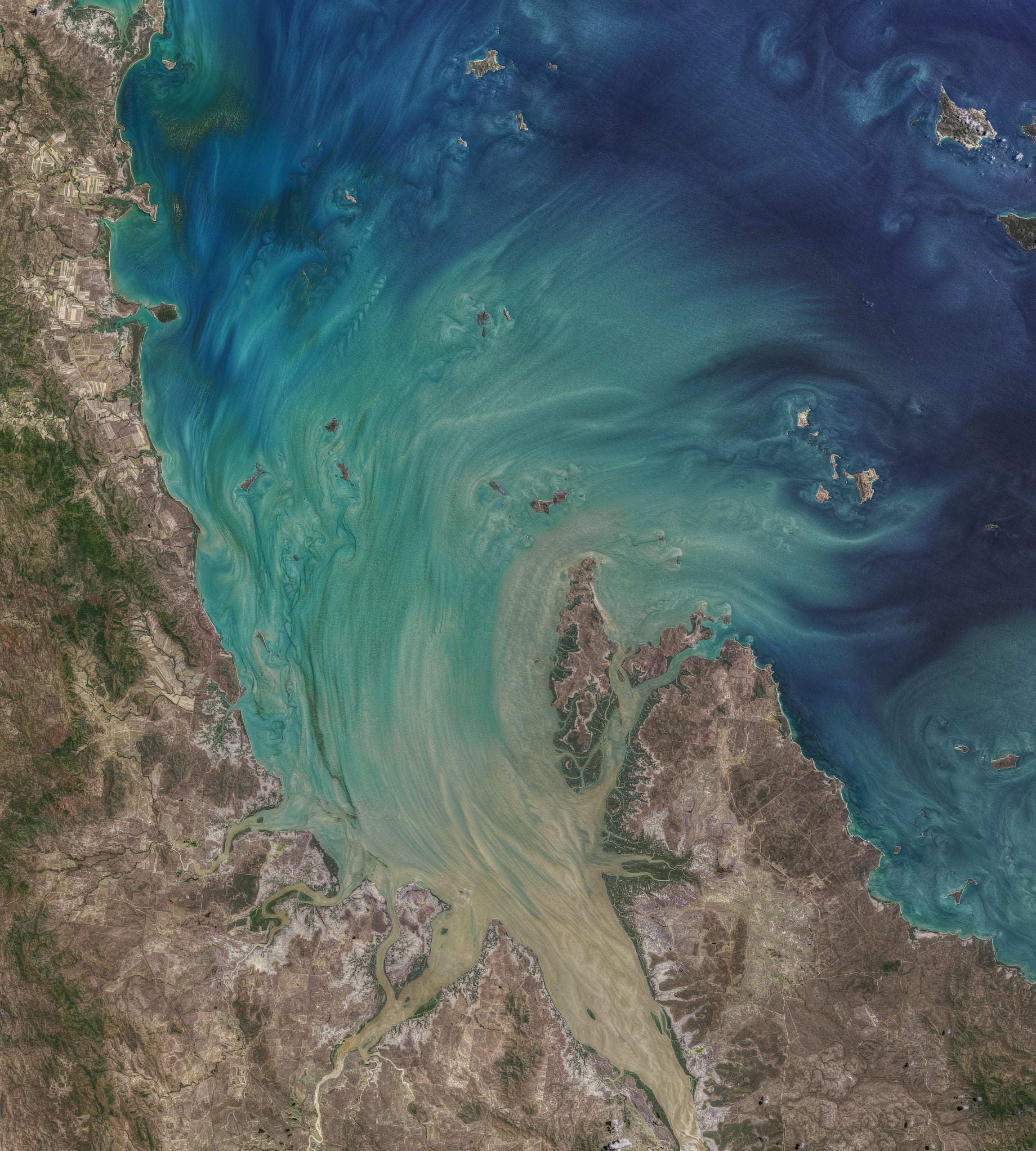
Broad Sound, in eastern Australia, is home to some of the most extreme tidal swings in the world, with more than ten meters difference between high and low tides. The bay’s peculiar geography, along with the topography of nearby reefs, combine to cause the large tides. This color-enhanced satellite image shows the bay at high tide, as phytoplankton and suspended sediments are swept into the bay and around its many islands. The level of detail is just stunning. I particularly love all the von Karman vortex streets visible in the wakes of islands. I count more than a dozen of them! (Image credit: N. Kuring/NASA/USGS; via NASA Earth Observatory)

Curls Past the Canaries
When winds flow past a solitary peak, like an island in the ocean, they’re disrupted into a series of counter-rotating curls. That’s what we see here stretching to the southwest of Madeira Island. The official name for this flow is a von Karman vortex street, and it can be found anywhere from a soap film to a starship. (Image credit: J. Stevens; via NASA Earth Observatory)

Nighttime Streets
Clouds spiral behind the islands of Tenerife and Gran Canaria in this nighttime satellite imagery. Although it’s not entirely unusual to see these von Karman vortex street clouds in the wakes of islands, this is the first time I’ve seen them at night. They form when winds off the ocean are forced up and around rocky islands. Like air moving past a cylinder, the flow forms a swirling vortex off one side of the island, which separates and moves downstream while another forms on the island’s opposite side. When the resulting flow mixes with a cloud layer, we can see the pattern from space. (Image credit: J. Stevens; via NASA Earth Observatory)

Swirls of Color
These beautiful swirls show the wake downstream of a thin plate. Here water is flowing from left to right and dye introduced on the plate (upstream and unseen in the photo) curls up into vortices. The vortices in the top row rotate clockwise, while the vortices along the bottom rotate anti-clockwise. This pattern of alternating vortices is extremely common in the wakes of objects and is known as a von Karman vortex street. Similar patterns are seen in soap films, behind cylinders, in the wakes of islands, and behind spaceships. (Image credit: ONERA, archived here)

The Swimming of a Dead Fish
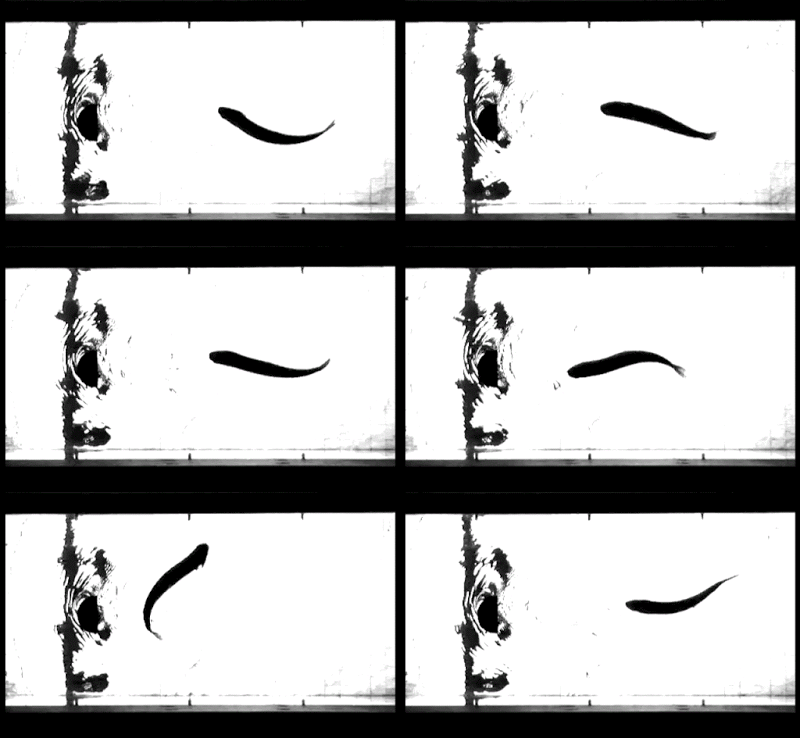
When I was a child, my father would take me trout fishing, and I spent hours marveling from the riverbank at the trouts’ ability to, seemingly effortlessly, hold their position in the fast-moving water. As it turns out, those trout really were swimming effortlessly, in a manner demonstrated above. The fish you see here swimming behind the obstacle is dead. There’s nothing powering it, except the energy its flexible body can extract from the flow around it.
The obstacle sheds a wake of alternating vortices into the flow, and when the fish is properly positioned in that wake, the vortices themselves flex the fish’s body such that its head and its tail point in different directions. Under just the right conditions, there’s actually a resonance between the vortices and the fish’s body that generates enough thrust to overcome the fish’s drag. This means the fish can actually swim upstream without expending any energy of its own! The researchers came across this entirely by accident, and one of the questions that remains is how the trout is able to sense its surroundings well enough to intentionally take advantage of the effect. (Image and research credit: D. Beal et al.; via PhysicsBuzz; submitted by Kam-Yung Soh)

Glorious Vortex Street
Satellite imagery often reveals patterns we might struggle to see from the ground. Here Gaudalupe Island off the western coast of Mexico perturbs the atmosphere into a series of vortices. Air flowing across the open ocean gets deflected around and over the rocky, volcanic island, creating a line of vortices that get shed off one side of the island, then the other. The pattern is commonly referred to as a von Karman vortex street, and it appears in the wakes of spheres and cylinders, as well as islands. The two rainbow-like bands framing the vortex street are an optical phenomenon known as a glory, which NASA Earth Observatory explains here. (Image credit: NASA Earth Observatory)

Island Wakes
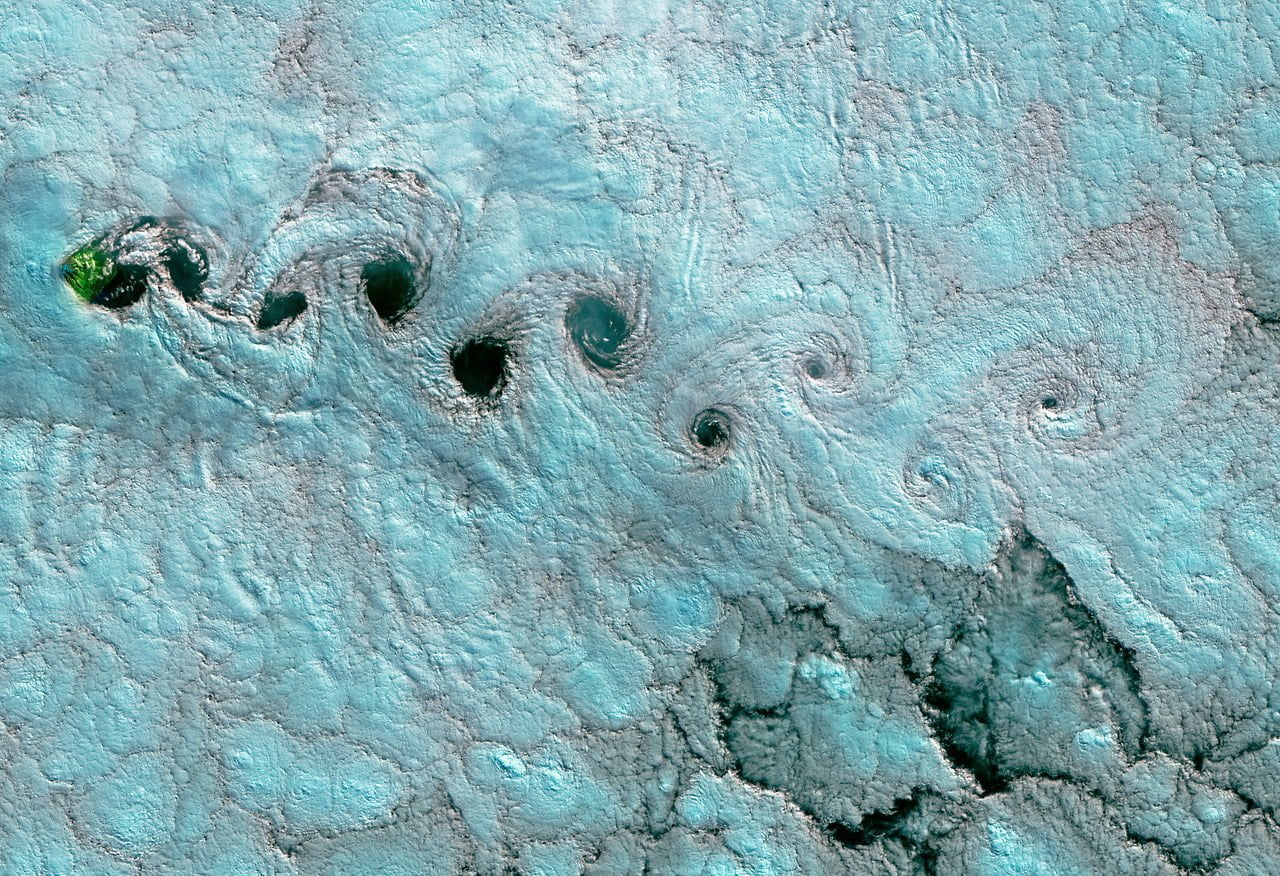
One of my favorite aspects of fluid dynamics is watching how patterns repeat at all kinds of scales. The cotton-candy-colored image above is a false-color satellite image of the island Tristan da Cunha (left), a volcanic island group in the South Atlantic. The prevailing winds, oriented roughly left to right in the image, flow over the rocky island and part in a series of swirls that alternate in their direction of rotation: clockwise for the upper set and counter-clockwise for the lower ones. This pattern is called a von Karman vortex street, named for an aerodynamicist who studied the mechanism. Von Karman vortices are frequently observed in satellite images of remote islands, but they are also common behind spherical and cylindrical objects of all sizes. Sometimes they even show up in sci-fi! (Image credit: NASA Earth Observatory; submitted by Steve G.)

Vortex Wake in Quebec
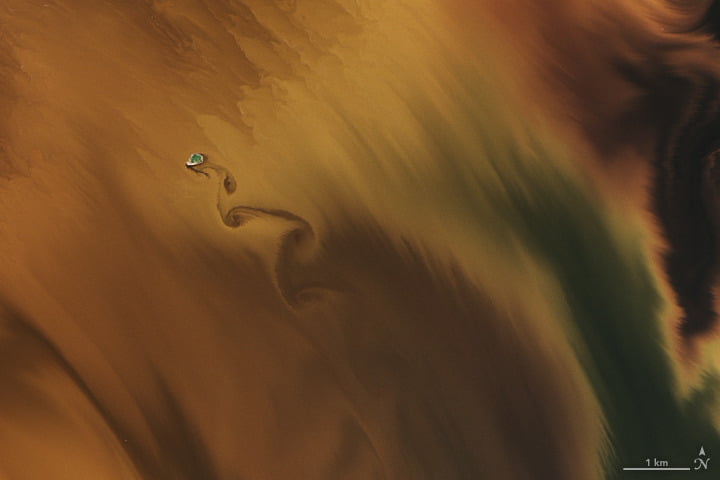
These satellite images show Rupert Bay in northern Quebec. Sediment and tannins have stained the bay’s waters various shades of brown, which helps show the dynamic flows of the area. Rivers empty into the bay, but the tide appears to be coming in from the northwest as well. The flow is just right to create a wake of alternating vortices off a tiny island near the center of the bay. This pattern is known as a von Karman vortex street and often appears in the wake of spheres, cylinders, and, yes, islands. (Image credit: NASA Earth Observatory; submitted by Adam V.)