Tag: viscous drag

  • Sensing Sound Like Spiderwebs

    Sensing Sound Like Spiderwebs

    Most microphones — like our ears — work by sensing the tiny pressure changes caused by a sound wave‘s passing. But for microphones built this way, the smaller they get, the more sensitive they are to thermal noise. That’s one reason that the tiny microphones in a laptop or webcam just don’t sound as good as larger mics.

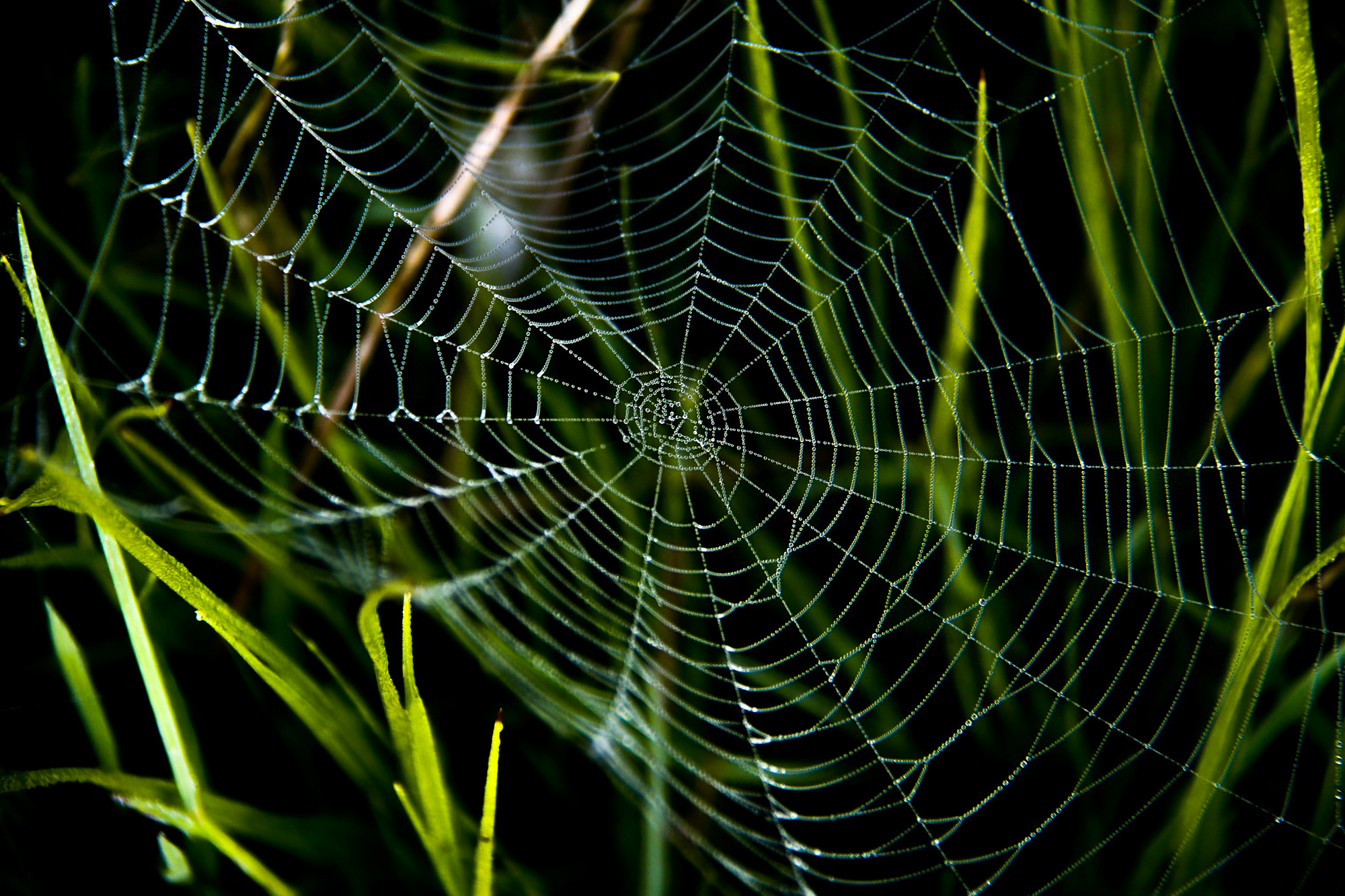
    Researchers turned to nature to look for alternative ways to measure sound and zeroed in on the mechanism spiders use. Spiders “listen” to their web’s vibrations; the tiny strands of silk quiver as air flow from a sound moves past. Instead of being pressure-based, this mechanism uses viscous drag to register a sound.

    The team fabricated an array of microbeams to test the concept of a viscosity-based microphone and found that tiny beams sensed sounds just as well as larger ones. That means these microphones can get smaller without sacrificing performance. For now, they’re not as sensitive as conventional microphones, but that’s not surprising, given that engineers have been improving pressure-based microphones for 150 years. It’s a promising start for a new technology, though. (Image credit: N. Fewings; research credit: J. Lai et al.; via APS Physics)

  • Nitro Bubble Cascades

    Nitro Bubble Cascades

    Animation of nitrogen bubbles cascading in Guinness

    Fans of nitro beers — particularly Guinness’ stout — have probably noticed the fascinating cascade of bubbles that form as the beer settles. It’s a non-intuitive behavior — bubbles rise since they’re lighter than the surrounding fluid. So why do the bubbles appear to sink in these beers?

    There are several effects at play here. Firstly, overall the bubbles in the beer are rising; even mixing nitrogen gas into a beer in place of carbon dioxide doesn’t change that. But pint glasses typically flare so that they’re wider at the top than at the bottom. Since the bubbles rise essentially straight up, this causes a bubble-less film to form near the upper walls. And as that heavier fluid sinks, it pulls some of the tiny nitrogen bubbles with it. (You don’t see this effect in typical beers because the bubbles there are larger and thus too buoyant to get pulled down by the falling fluid.)

    As for the cascading waves we see in the bubbles, this, too, comes from the shape of the glass. Hydrodynamically speaking, what’s happens as the fluid film slides down the pint glass is similar to what happens when rain runs downhill. Beyond a certain angle, the flow becomes unstable and will form rolls and waves of varying thickness instead of sinking in a thin, uniform layer. As the film goes, so go the bubbles being dragged along, giving everyone at the bar a brief but entertaining fluid dynamical show. (Image credits: pints – M. d’Itri; bubble cascade – T. Watamura et al.; research credit: T. Watamura et al.)

  • How the Hagfish Deploys Its Slime

    How the Hagfish Deploys Its Slime

    Hagfish – an eel-like species – are known for their prodigious slime production, which helps them escape predators (and, in some cases, seriously muck up highways). Part of the hagfish’s slime consists of ~10 cm fibers that the creature deploys in tiny skeins (bottom) only a hundred microns across. To form the viscoelastic slime that thwarts its predators, those skeins of fiber have to unravel and do so in only tenths of a second. A new study shows that viscous drag plays a major role in that unraveling. 

    Most fish use a suction method to catch prey. In the hagfish’s case, that does the predator more harm than good because the very flow it creates to try and catch the hagfish pulls the slime skein apart and helps the slime expand 10,000 times in volume, creating a mess that chokes the gills of the attacking fish. (Image credit: top – L. Böni et al.; bottom – G. Choudhary et al., source; research credit: G. Choudhary et al.; via Ars Technica; submitted by Kam Yung Soh)

  • Dip Coating

    Dip Coating

    Imagine dipping a rod into a liquid mixture filled with particles. When you pull the rod out, do particles stick to it? The answer depends on the relative importance of two sets of forces: the viscous drag as you lift the rod and adhesive power of surface tension. Scientists express this as a dimensionless ratio known as the capillary number.

    When the capillary number is small, viscous drag dominates, and any particles that try to stick to the rod get pulled away (upper left). But as you increase the capillary number, surface tension helps particles clump together and stick to the rod (lower left and right). If the surface tension forces are strong enough – meaning that the capillary number is high –  you can actually get multiple layers of particles adhering to the dipped surface. (Image and research credit: E. Dressaire et al.)

  • A Groovy Hovercraft

    A Groovy Hovercraft

    Not long ago, researchers discovered that droplets hovering over a hot grooved surface would self-propel. The extension to this was to investigate a hovercraft on a grooved, porous surface (top half of animation)–think an air hockey table with grooves. In that case, air inside the grooves flows from the point toward the edges, and it drags the hovercraft with it, thanks to viscosity. So the hovercraft travels in the direction opposite the points. This raised an obvious question: what happens if the hovercraft is grooved instead of the surface?

    That’s the situation we see in the bottom half of the animation. Air flows from the table and interacts with the grooves on the bottom of the hovercraft. And this time, the hovercraft propels in the direction of the points. That means there’s a completely different mechanism driving this levitation. When the grooves are onboard the hovercraft, pressure dominates over viscous effects. The air still gets directed down the grooves, but now, like a rocket, the exhaust pushes the hovercraft in the other direction – toward the points. For more on this work, check out the mathematical model of the problem and our interview with one of the researchers in the video below. (Research credit: H. de Maleprade et al.; image and video credit: N. Sharp and T. Crawford)