Tag: viscosity

  • Reducing Viscosity With Bacteria

    Reducing Viscosity With Bacteria

    Conventional wisdom – and the Second Law of Thermodynamics – require all fluids to have viscosity, with the noted and bizarre exception of superfluids, which can flow with zero viscosity. In essence, you cannot have work (i.e. flow) for free. Some effort has to be lost to resistance.

    But scientists have discovered, bizarrely, that adding bacteria to water can result in zero or even negative viscosities – meaning that effort is required to keep the flow from accelerating. Before you ask, no, this is not a recipe for a perpetual motion machine. What happens when the bacteria-filled fluid is sheared is that the bacteria align and start collectively swimming. The local effects of each bacteria combine en masse to create a fluid that seemingly flows on its own. In the end, though, it’s the bacteria that are supplying that work. It certainly raises interesting prospects, though, for harnessing the power of bacterial superfluids. See the links below for more. (Image credit: M. Copeland, source; research credit: S. Guo et al.A. Loisy et al.; via Quanta; submitted by Kam-Yung Soh)

  • Folding Fluids

    Folding Fluids

    Highly viscous liquids – like cake batter, lava, or the spider silk above – fold as they fall. Several factors impact this instability including the fluid’s density, viscosity, surface tension, and how thin the falling sheet is. As with the coiling of falling honey, this behavior is actually a form of buckling. It’s also fascinating to watch how persistent the layers are. Even out near the edge of the puddle, you can still see individual folds. This is a sign of just how incredibly viscous the spider silk is. Imagine if this were cake batter instead: we’d see folding just like we do with the spider silk proteins, but the individual folds would quickly fade as the batter flowed to fill its container. The spider silk is more viscous, so it’s more resistant to flowing. (Image credit and submission: D. Breslauer, source)

  • Wrinkling Drops

    Wrinkling Drops

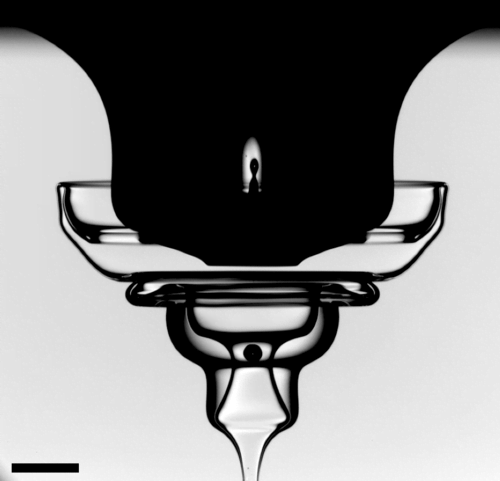
    When a viscous drop falls into a pool of a less viscous liquid, the drop can deform into some beautiful and complex shapes. Typically, shear forces between the drop and its surroundings cause a vortex ring to roll up and advect downward, thereby stretching the remainder of the drop into thin sheets that can buckle and wrinkle. Here the drop is about 150 times more viscous than the pool and impacts at 1.45 m/s, making a rather energetic entry. The vortex ring (not visible) has stretched the drop’s remains downward while a buoyant bubble caught by the impact pulls some of the drop back toward the surface. As a result, the thin sheets of the drop’s fluid are buckling and folding back on themselves like an elaborate and delicate glass sculpture. This entire paper is full of gorgeous images and videos. Be sure to check them out! (Image and research credit: E. Q. Li et al.; see supplemental info zip for videos)

  • Escaping Quicksand

    Escaping Quicksand

    Quicksand is complicated stuff. It’s typically a mixture made up of sand, clay, and water. To get those ingredients into a proper quicksand mixture, you have to liquefy the particles by saturating the spaces between them with water, as the jumping tourists in the top animation are doing. (That’s not to say that you can’t just find a patch of quicksand – just that something has to have pumped that area full of water first.)

    If you end up in quicksand, don’t panic. Quicksand is denser than a human, which means that, at the worst, you won’t sink in much further than your waist (middle image). It’s tough to move once you sink because your weight has squeezed a lot of the water out from between the sand and clay particles, thereby drastically increasing the viscosity. To get out, try putting weight on one leg and wiggling the other back and forth (bottom image). This lets water back in the mixture and hopefully lets you free that leg. Once one leg is free, try to kneel on it and work the other leg out. (Image credits: making quicksand – T. L. Nguyen, source; stuck – National Geographic, source; escape – Tech Insider, source; research credit: G. Evans et al., A. Khaldoun et al.)

  • Cavity Collapse

    Cavity Collapse

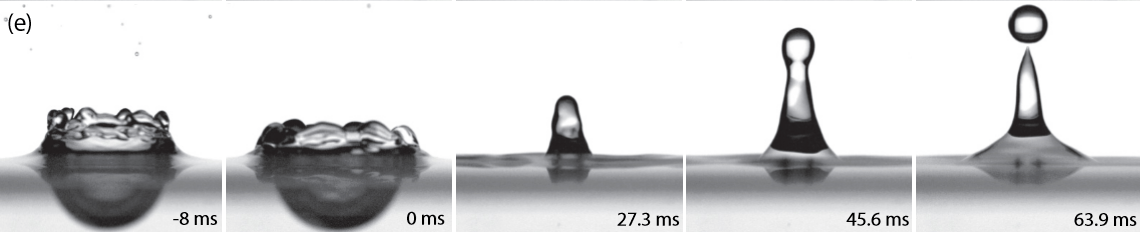
    One of the most iconic images in fluid dynamics is that of a drop impacting a liquid. When a drop hits a pool, it creates a crater, or cavity. That cavity expands and then collapses to form a jet that rebounds above the pool’s surface. If the jet is fast enough, it will eject one or more droplets before it falls back into the pool. Faster droplets, like the one that formed the cavity and jet shown above, actually create slower and fatter jets. In this regime, the complicated interplay of surface tension and gravity effects results in a jet velocity that is independent of impact speed and the liquid’s viscosity. Understanding this jet and splash dynamics is important for many industrial applications, including ink-jet printing. (Image credit: G. Michon et al.)

  • Featured Video Play Icon

    Hot Versus Cold

    Did you know that you can hear the difference between hot and cold water when they’re poured? Go ahead and give the video above a listen to try it out. I’ll wait.

    As explained in the video, the viscosity of water changes with temperature – the higher the temperature, the lower the viscosity. In fact, the viscosity of water at 10 degrees Celsius is more than 4 times higher than the viscosity at 100 degrees Celsius! That’s pretty significant, and it’s a big enough difference that we can hear it in the splash, even if we don’t see the difference when pouring. 

    Surface tension also decreases with temperature but not nearly as strongly. That 100 degrees Celsius water has 25% less surface tension than the 10 degrees Celsius water. But the combination of this change in viscosity and change in surface tension is why your cold water is more likely to dribble down the spout of your coffee pot when you’re filling the coffee machine than when you’re pouring coffee from the same pot. (Video credit: Steve Mould and Tom Scott; submitted by entropy-perturbation)

  • Swimming at Microscale

    Swimming at Microscale

    Tiny organisms live in a world dominated by viscosity. There’s no coasting or gliding. If a microorganism stops swimming, friction will bring it to a halt in less than the space of a hydrogen atom! To make matters worse, simply flapping an appendage forward and backward will get them nowhere. As we’ve seen before, these highly viscous laminar flows are reversible, meaning that a backward power stroke is simply undone by a mirrored forward recovery stroke. Instead, microorganisms like the paramecium swimming above are covered in tiny hairlike cilia which beat asymmetrically. They extend to their full length during the power stroke, but they stay bent during the forward recovery stroke. That asymmetry guarantees that they move more fluid backward than forward, thereby letting the paramecium make progress. (Image credit: C. Baroud, source)

  • Featured Video Play Icon

    Pearls of Mezcal

    Mezcal is a traditional Mexican liquor distilled from agave. (The more commonly known tequila is actually a special type of mezcal.) As a part of the production process, distillers pour a stream of mezcal into a bowl, creating a flotilla of small bubbles called pearls. Strange as it sounds, these pearls let the distiller judge the alcohol content of the liquor! When the ratio of alcohol and water in the mixture is just right, the bubbles will have a longer lifetime before they coalesce. If there’s too little or too much alcohol, the bubbles won’t last as long. The effect depends on both the viscosity and the surface tension of the liquor, but it’s the odd way that viscosity changes in water/alcohol mixtures that creates this Goldilocks behavior. It’s a fascinating demonstration of how traditional techniques often have true scientific underpinnings. (Video credit: M. Wilhelmus et al.)

  • Featured Video Play Icon

    Un-Mixing a Flow

    This video demonstrates one of my favorite effects: the reversibility of laminar flow. Intuition tells us that un-mixing two fluids is impossible, and, under most circumstances, that is true. But for very low Reynolds numbers, viscosity dominates the flow, and fluid particles will move due to only two effects: molecular diffusion and momentum diffusion. Molecular diffusion is an entirely random process, but it is also very slow. Momentum diffusion is the motion caused by the spinning inner cylinder dragging fluid with it. That motion, unlike most fluid motion, is exactly reversible, meaning that spinning the cylinder in reverse returns the dye to its original location (plus or minus the fuzziness caused by molecular diffusion).

    Aside from being a neat demo, this illustrates one of the challenges faced by microscopic swimmers. In order to move through a viscous fluid, they must swim asymmetrically because exactly reversing their stroke will only move the fluid around them back to is original position. (Video credit: Univ. of New Mexico Physic and Astronomy)

  • Viscous Droplet Impacts

    Viscous Droplet Impacts

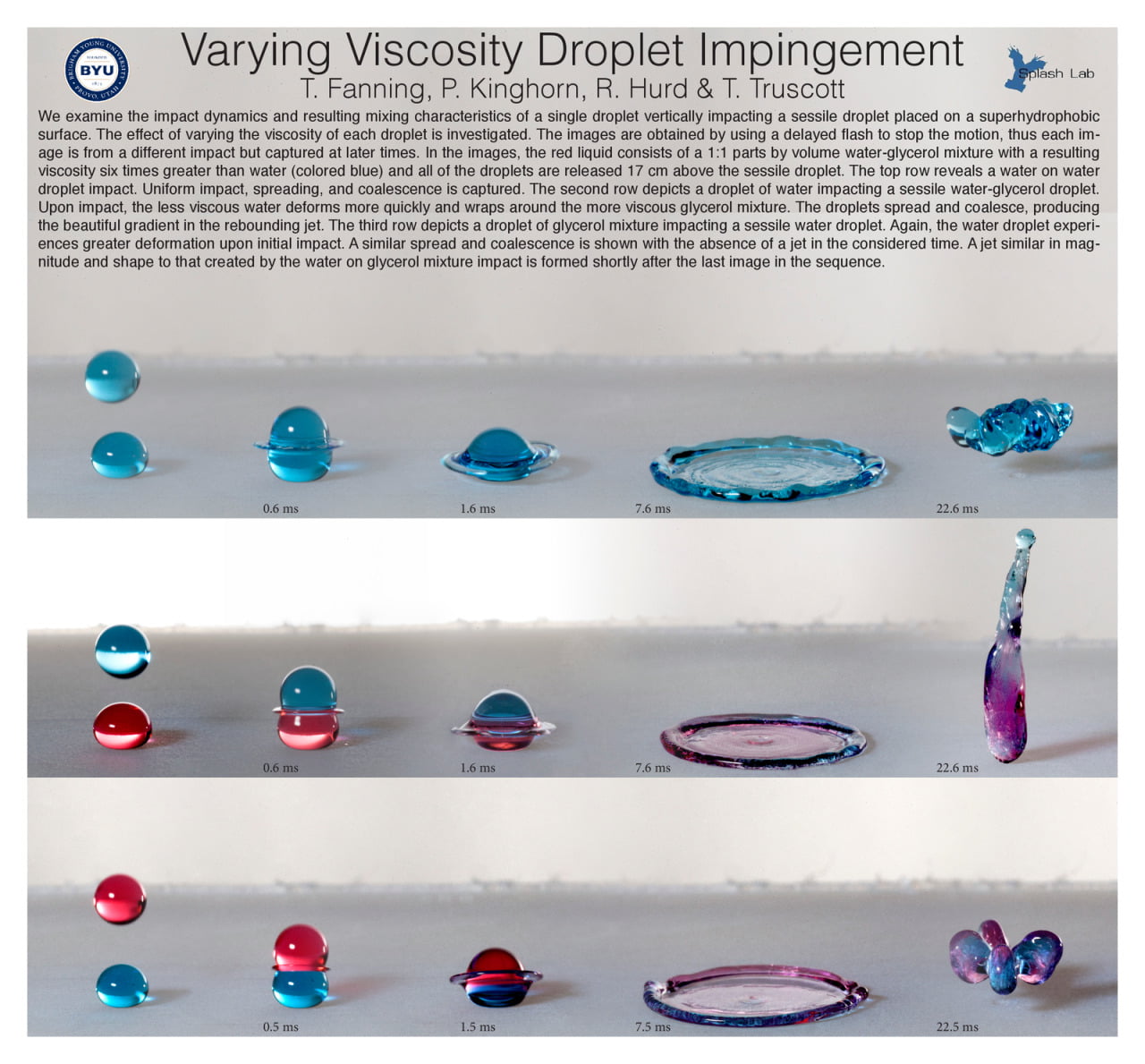
    Viscosity can have a notable effect on droplet impacts. This poster demonstrates with snapshots from three droplet impacts. The blue drops are dyed water, and the red ones are a more viscous water-glycerol mixture. When the two water droplets impact, a skirt forms between them, then spreads outward into a sheet with a thicker, uneven rim before retracting. The second row shows a water droplet impacting a water-glycerol droplet. The less viscous water droplet deforms faster, wrapping around and mixing into the other drop before rebounding in a jet. The last row switches the impacts, with the more viscous drop falling onto the water. As in the previous case, the water deforms faster than the water-glycerol. The two mix during spreading and rebound slower. In the last timestep shown, the droplet is still contracting, but it does rebound as a jet thereafter. (Image credit: T. Fanning et al.)