Mudslides and avalanches typically carry debris of many shapes and sizes. To understand how debris size affects flows like these, researchers use simplified, laboratory-scale experiments like this one. Here, researchers mix a slurry of silicone oil and glass particles of roughly two sizes. The red particles are larger; the blue ones smaller. Sitting in a cup, the mixture tends to separate, with red particles sinking faster to form the bottom layer and smaller blue particles collecting on top. And what happens when such a mixture flows down an incline? The smaller blue particles tend to settle out sooner, leaving the larger red particles in suspension as they flow downstream. (Video and image credit: S. Burnett et al.)
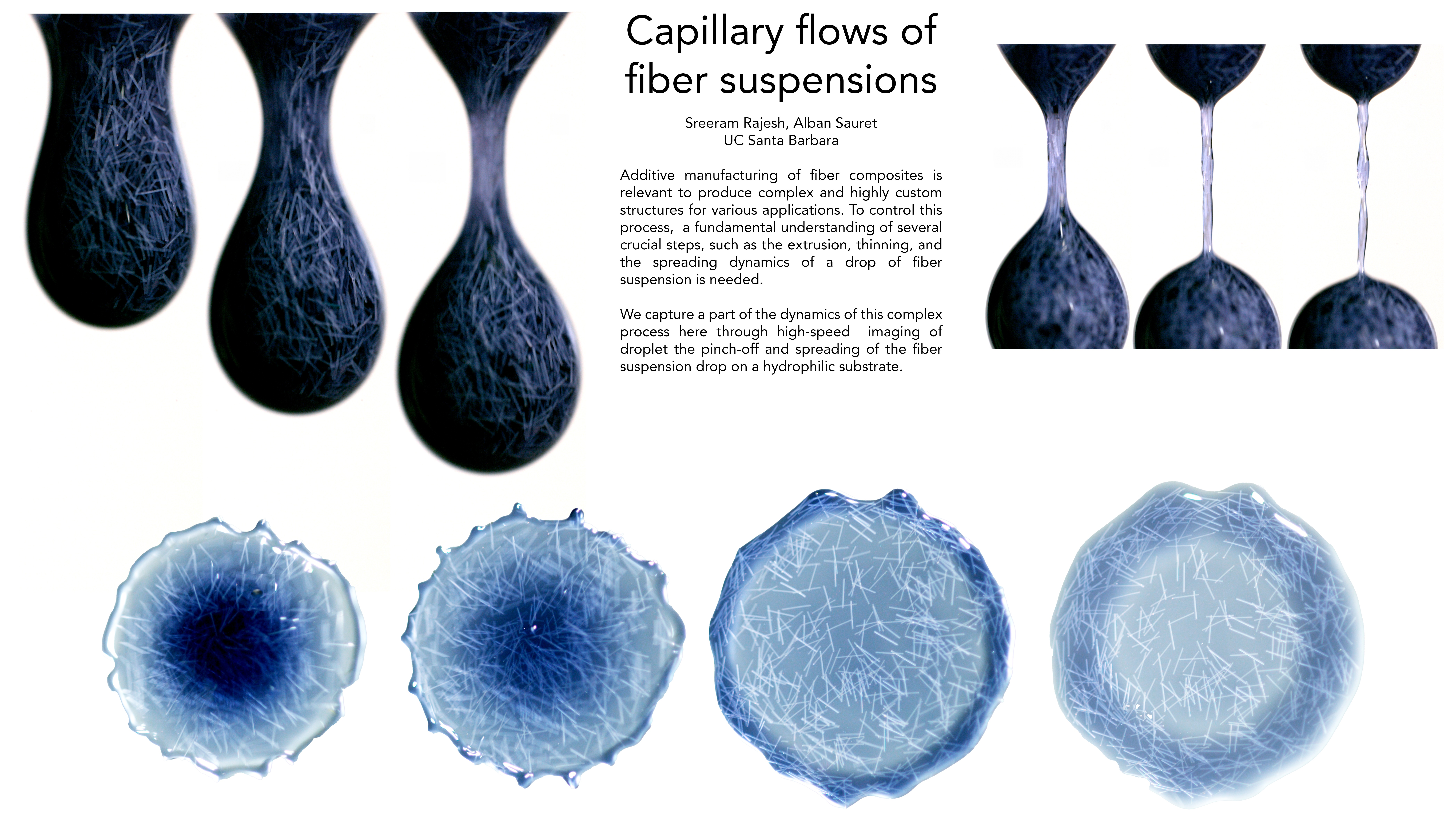
To 3D print with fiber-infused liquids, we need to understand how these drops form, break-up, and splash. That’s the subject of this research poster, which shows drops of a fiber suspension forming and pinching off along the top of the image. In the lower half of the image, drops of the suspension hit a hydrophilic surface and spread. How the drop and its fibers spread will affect the final properties of the printed material. (Image credit: S. Rajesh and A. Sauret; via GoSM)
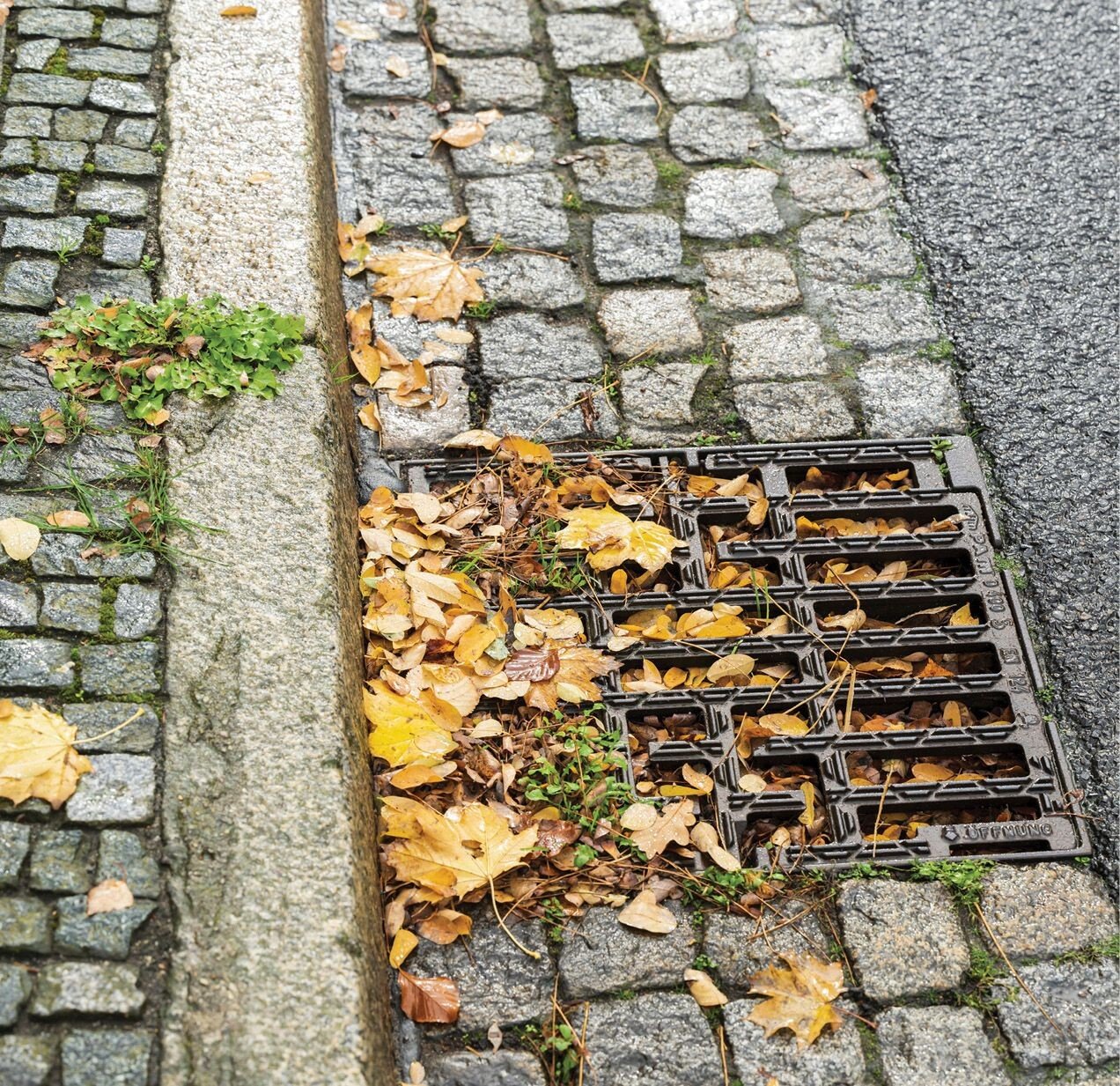
Clogging is one of those phenomenons that we encounter constantly, from overflowing storm drains to the traffic jam at the door when a lecture ends. It happens at all scales, too; ink-jet cartridges and microfluidic circuits can jam up just as thoroughly as a grain silo. Although there are many complexities to clogging, the basic mechanisms fall into three categories: sieving, bridging, and aggregation.
Of these, sieving is the most familiar; it occurs when a particle too large for the constriction gets stuck. That includes both a rock too large to fit down a storm drain and a leaf that gets caught in the wrong orientation.
Bridging, on the other hand, occurs when too many small particles reach a constriction at the same time. Although each one is small enough to fit on its own, their simultaneous arrival means that they jam together into a bridge that blocks the constriction. Given time, all flow comes to a stand still, as seen in the images below.
Sequence of images showing the formation of a particle bridge and subsequent clogging of the entire constriction.
The last mechanism, aggregation, is a more gradual blockage, formed as individual particles begin sticking to a surface, making the constriction progressively smaller. Think of those hard-water buildups that eventually block your shower head.
Some of these mechanisms are easier to prevent or clear than others, but researchers are making progress. For an overview of the field’s current standing, check out this Physics Today article. (Image credit: drain – R. Rampsch, bridging – D. Jeong et al.; see also B. Dincau et al. at Physics Today)
Oobleck is a decidedly weird substance. Made from a dense suspension of cornstarch in water, oobleck is known for its mix of liquid-like and solid-like properties, depending on the force that’s applied. In a recent study, researchers took a look at what happens when you really push oobleck to the extreme. When the force applied to oobleck is small or slowly added, the water between cornstarch particles helps keep the particles apart and free of contact. It’s when the force is large that those particles start jamming up against each other and having friction between them, and then the oobleck suddenly acts like a solid. But what happens once that force is removed?
When the force is gone, we expect the particles to repel and for water to squeeze back into the spaces between them, breaking up the friction and allowing the oobleck to relax back to a liquid-like form. But the team found that sometimes the oobleck doesn’t relax as easily as expected; instead, it seems to retain some memory of its solid-like state, due to persisting friction between particles. (Image credit: T. Cox; research credit: J. Cho et al.)
Although you may not recognize the name, you’ve probably seen Kalliroscope (top image), a pearlescent fluid that creates beautiful flow patterns when swirled. This rheoscopic fluid was invented in the mid-1960s by artist Paul Matisse and, over the following decades, became a staple of flow visualization techniques. Kalliroscope contained a suspension of crystalline guanine. Since the crystals were asymmetric, they would orient themselves depending on the flow and, from there, scatter light, creating the beautiful pearlescent effect seen above.
Unfortunately for researchers, the production of guanine crystals was expensive and difficult. The cosmetics industry was their main consumer and over time, they moved toward mica and other cheaper mineral alternatives. The company that produced Kalliroscope gave up production in 2014, leaving researchers scrambling for a suitable alternative.
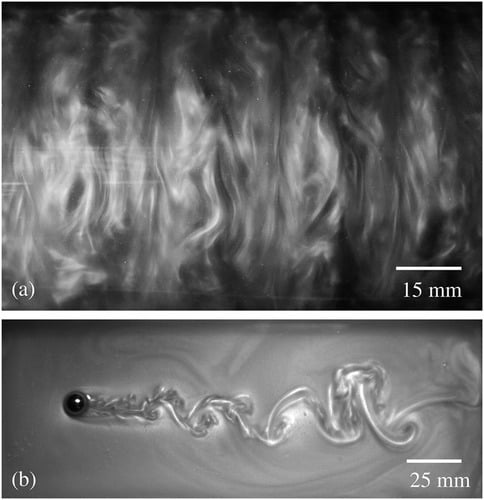
One contender for a new standard rheoscopic fluid is based on shaving cream. By diluting shaving cream 20:1 with water, researchers are able to extract stearic acid crystals, which form an admirable alternative to Kalliroscope (middle collage). Like Kalliroscope, the resulting fluid is pearlescent and reveals flow features well (bottom two images). Stearic acid crystals are also closer in density to water than guanine, so the fluid remains in suspension far better than Kalliroscope. Plus, the best shaving cream is cheap and widely available, meaning that this is a DIY project just about anyone can do! (Image credits: Kalliroscope – P. Matisse; other images – D. Borrero-Echeverry et al.; research credit: D. Borrero-Echeverry et al.)
It’s time for another JFM/FYFD collab video! April’s video brings us a taste of spring with research on how bees carry pollen, squid-inspired robotics, and understanding the physics of underwater plumes like the one that occurred in the Deepwater Horizons spill eight years ago. Check it all out in the video below. (Image and video credit: T. Crawford and N. Sharp)
Windblown snow bears a certain resemblance to desert sands or a Martian landscape. Many of the same aeolian processes–like erosion, transport, and deposition–take place in each. The animation above shows an example of suspension, where fine snowflakes are lifted and carried along near the ground. Larger snowflakes may bounce or skip along the surface in a process called saltation. For more, check out some of the crazy things snow does or learn about how dunes form. (Image credit: Redemption Designs, source video)
Oobleck, a non-Newtonian fluid made up of water and cornstarch, is a perennial Internet favorite for its ability to dance and the fact that one can run across a pool of it. It’s typically described as a shear-thickening fluid and only exhibits solid-like behavior under impact. Strictly speaking, oobleck is a suspension of solid grains of cornstarch in water. When struck, the initially compressible grains jam together, creating a region more like a solid than a liquid. From this point of impact, a solidification front expands through the suspension, jamming more grains together and enabling the fluid to absorb large amounts of momentum. The process is known as dynamic solidification. (Video credit: University of Chicago; research credit: S. Waitukaitis & H. Jaeger)