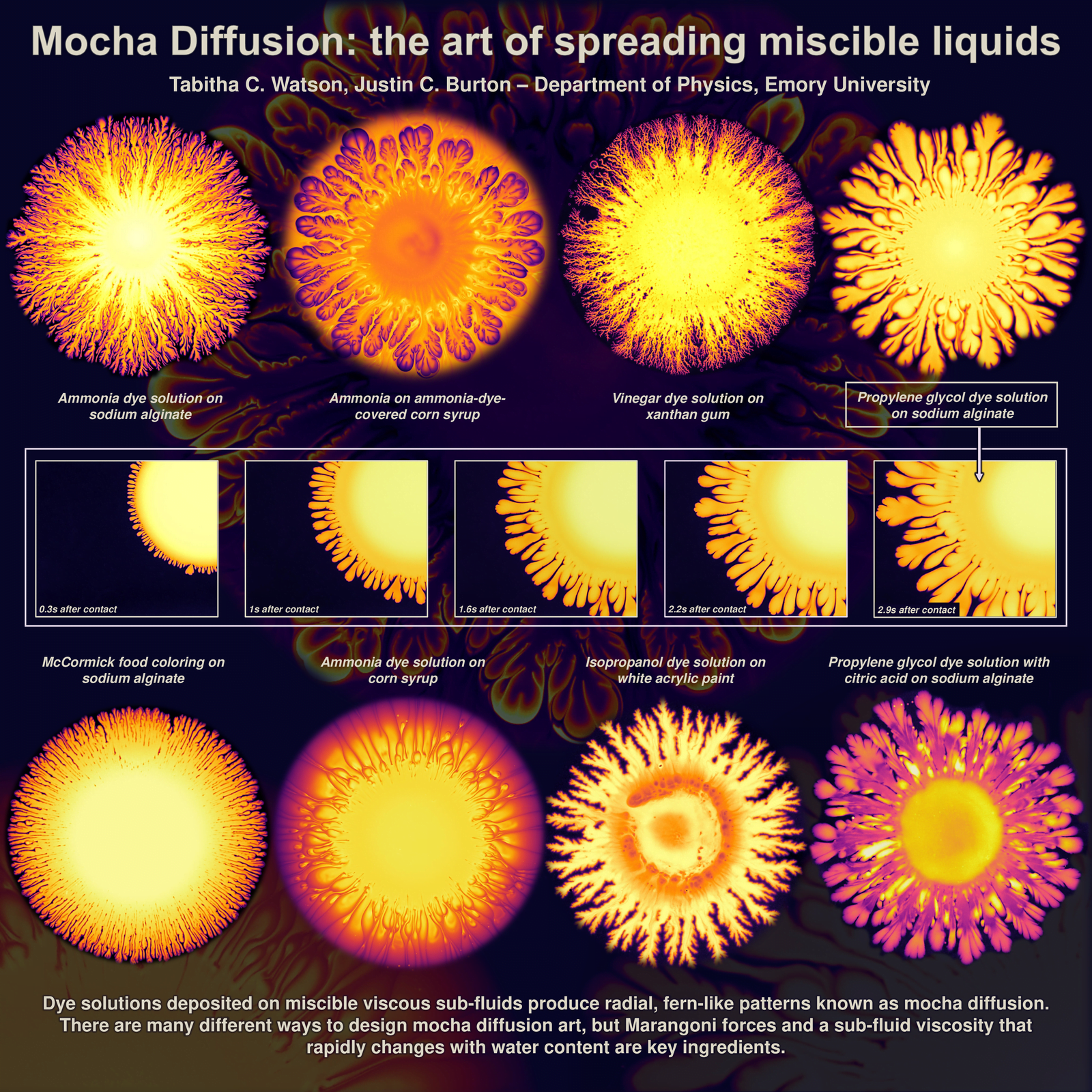
In marbling, an artist floats paints on a viscosified water bath, using various thin tools to manipulate the final image. Many cultures have developed a version of this art, but for many it will be most recognizable as a technique used to decorate book interiors. In this video, researchers consider the physics behind this beautiful practice. Surface tension helps keep the paint on the surface, even though it’s denser than the water it’s on. Variations in surface tension shape and reshape the surface as new colors are added. And then low-Reynolds-number effects help artists mix the paints without inertia or diffusion disturbing the pattern. See more examples here, here, and here. (Video credit: Y. Sun et al.)
Tag: surface tension

Dancing to Chopin
Droplets of paint whirl to Chopin’s “Nocturne Op. 9 No. 2” in this short film from artist Thomas Blanchard. The glitter particles in the paints act as seed particles that highlight the flow within and around each drop. It’s a beautiful dance of surface tension, advection, and buoyancy. (Image and video credits: T. Blanchard; via Colossal)

Enhancing the Cheerios Effect
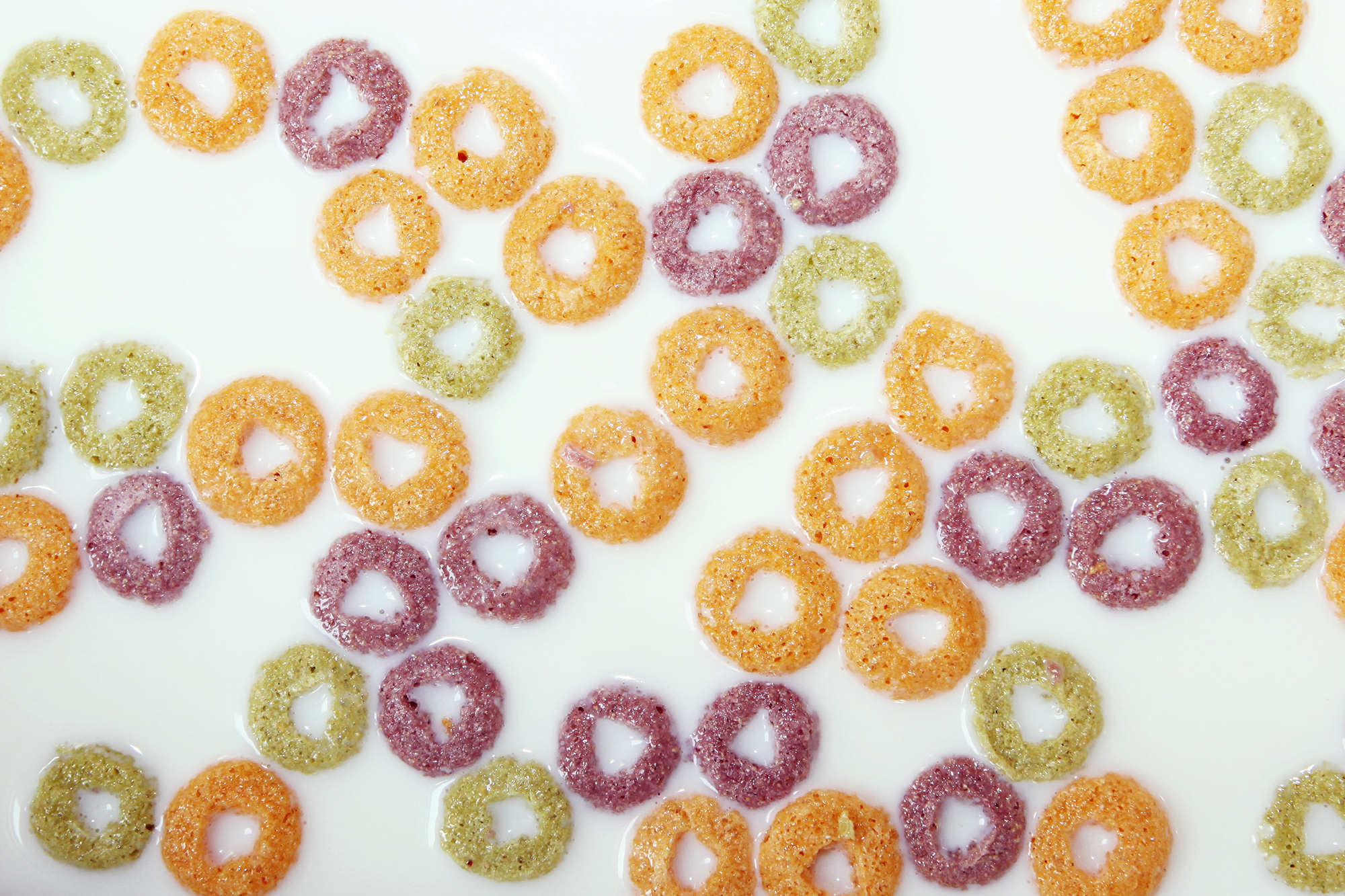
The Cheerios in your morning cereal clump together with one another and the bowl’s wall due to an attractive force caused by the curvature of their menisci. A recent study looks at how this effect changes when you’re pulling objects out of the liquid.

Snapshots show how two flexible fibers get drawn together by an attractive force as they are pulled out of silicon oil. The researchers inserted thin flexible glass fibers into silicon oil and withdrew them. As they did, they explored what lengths and retraction speeds caused the fibers to pull together. They found that a single moving rod had a taller meniscus than a stationary one, and two moving rods had a liquid bridge that superposed their individual menisci. The result was an attractive force even stronger than what the fibers experienced when still. (Image credit: Cheerios – D. Streit, experiment – H. Bense et al.; research credit: H. Bense et al.; via APS Physics)

Viscoelasticity and Bubbles
Bursting bubbles enhance our drinks, seed our clouds, and affect our health. Because these bubbles are so small, they’re easily affected by changes at the interface, like surfactants, Marangoni effects, or, as a recent study shows, viscoelasticity.

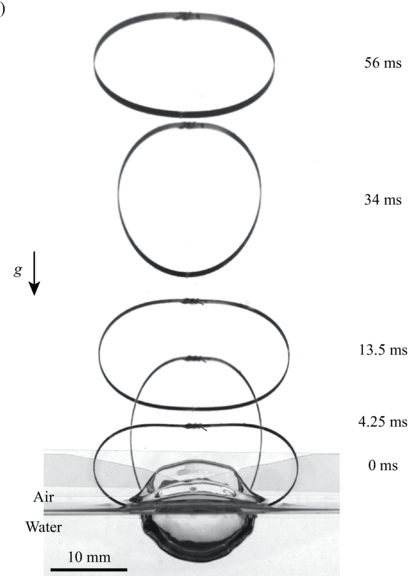
A bubble released in pure water pops at the surface, creating a rebounding jet and a daughter droplet. In clean water, a bubble’s burst generates a rebounding jet that shoots off one or more daughter droplets, as seen in the animation above. But when researchers added proteins that modify only the water’s surface, they found something very different. As seen below, the bursting bubble no longer generated a jet, and, instead of forming droplets, it made a single, tiny daughter bubble. The difference, they found, comes from the added viscoelasticity of the surface. The long protein molecules resist getting stretched, which damps out the tiny waves that surface tension usually produces on the collapsing bubble cavity. (Image and research credit: B. Ji et al.; submission by Jie F.)

When the surface of water is viscoelastic, a bursting bubble creates no jet and a daughter bubble instead of a drop. 
Why Sea Foams
Seawater froths and foams in ways that freshwater rarely does. A new study pinpoints the ocean’s electrolytes as the reason bubbles resist merging there. By studying the final moments before bubbles coalesce in both pure and salt water, researchers found that dissolved salts slow down the drainage of the thin film of liquid between two bubbles. Once the film reaches a 30-50 nanometer thickness, its electrolyte concentration causes a difference in surface tension that slows the outward flow of liquid in the film. That keeps the film in place longer and makes bubbles form foams instead of merging or popping. (Image credit: P. Kuzovkova; research credit: B. Liu et al.; via APS Physics)

Scuba-Diving Fly
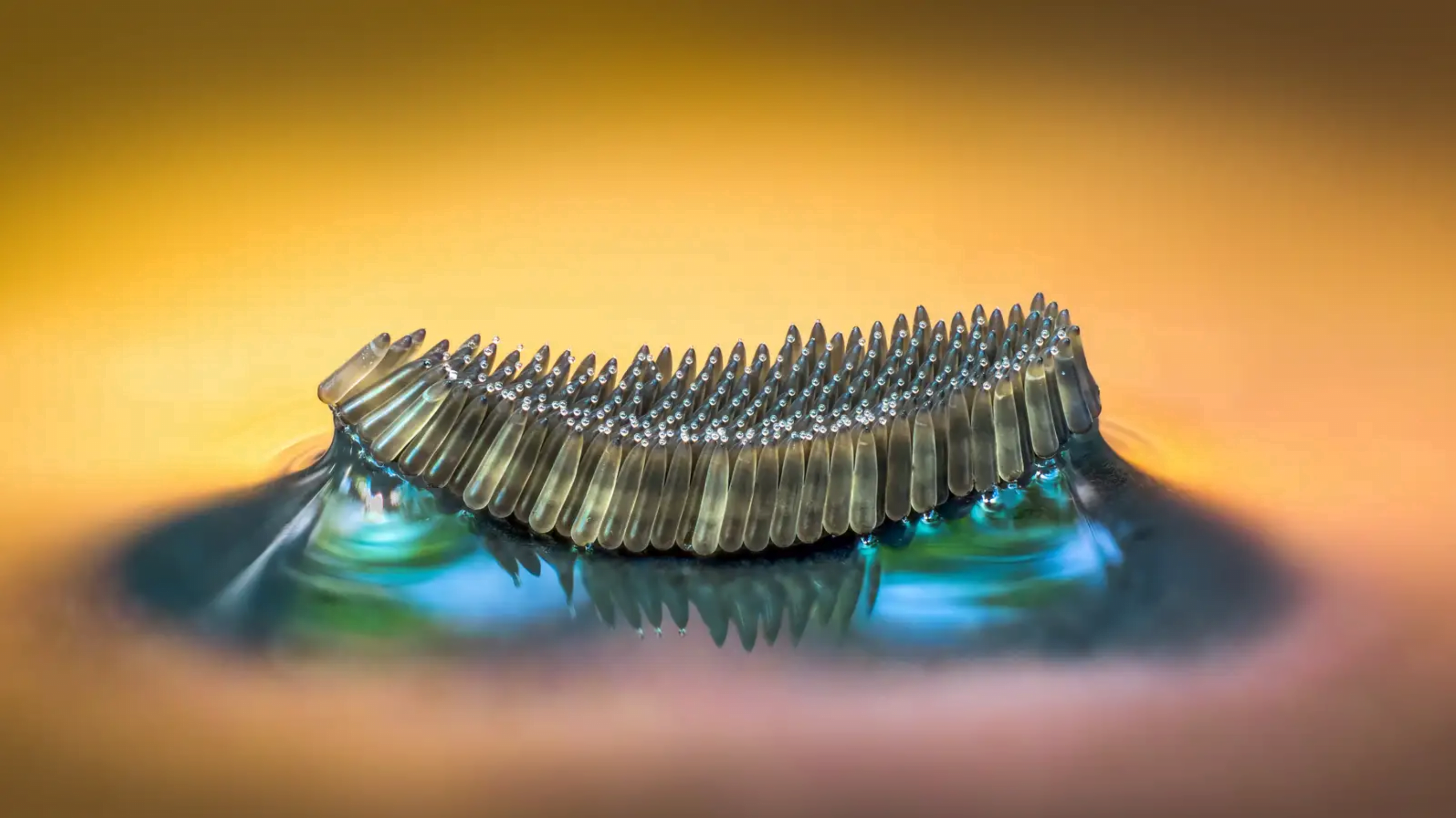
Mono Lake, three times saltier than the ocean, is an extreme environment by any measure. But for the alkali fly, it’s home. This extremophile insect dives into the lake, protected by a bubble sheath, to eat and lay eggs. The fly’s wings and body are covered in tiny, waxed hairs that repel water. That traps a bubble of air around the insect, allowing it to breathe. Fresh oxygen can diffuse into the bubble from the water, replenishing the supply. (Image and video credit: Deep Look)

Aquatic Escape Artists
Springtails are tiny hexapods found living on the air-water interface. Like other creatures living at the interface, they sometimes need to make a quick escape. For the springtail, that means a high-flying leap, driven by their fork-shaped furcula. The springtail soars into the air, where it contorts its body and uses aerodynamic forces — along with a droplet it carries on its belly — to orient itself. For landing, it uses that droplet as a sticky anchor that helps it adhere to water (or ground) instead of bouncing. Nailing that landing sets it up to make another daring escape as quickly as needed. (Video and image credit: Deep Look; research credit: V. Ortega-Jimenez et al.)

“Emerald and Stone”
“Emerald and Stone” is filmmaker Thomas Blanchard’s tribute to the music of Brian Eno. The short film is made, as Blanchard puts it, with “inks and painting,” but I suspect there’s some oil in there, too, to coat the droplets we see. Much of the movement is likely driven by surface tension variations in the background fluid. I love the effect this has on the droplets. If you watch closely, some of them appear to rotate like a miniature planet; others have counter-rotating sections within the drop. The difference, I suspect, is one of scale: I think the smaller drops rotate altogether while larger ones develop more complex internal flows. (Video and image credit: T. Blanchard)

“Discovery”
Colors stream and mix in Rus Khasanov’s short film “Discovery.” Droplet-like liquid lenses float in the mixture until ethanol or other ingredients cause them to spontaneously rupture, sending their interior flowing outward until the lens reaches a new equilibrium. Gradients in surface tension guide Marangoni flows across the screen. There’s never-ending beauty in the world of macro fluids. (Video and image credit: R. Khasanov)

“Space Iris”
Ruslan Khasanov’s “Space Iris” explores the similarities between nebulae and eyes. Made entirely with common fluids like paint, soap, and alcohol, the film shows off the gorgeous possibilities of surface-tension- and density-driven instabilities. Marangoni flows abound! I even see some hints of solutal convection, perhaps? (Video and image credit: R. Khasanov; via Colossal)