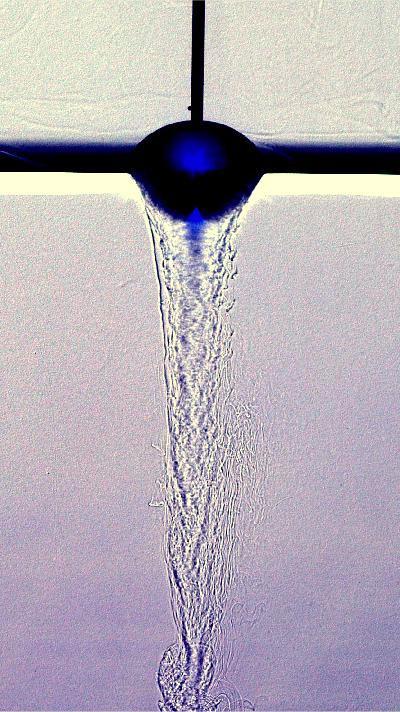
Getting wet can be a problem for many animals. A wet insect could quickly become too heavy to fly, and a wet bird can struggle to stay warm. But these animals have a secret weapon: tiny, multi-scale roughness on their wings, scales, and feathers that helps them shed water. Watch the latest FYFD video to learn how! (Image and video credit: N. Sharp; research credit: S. Kim et al.)
What happens when a foam interacts with a sliding surface? That’s the question at the heart of this study, which finds three major regimes of foam-surface interaction. On smooth surfaces (Image 1), foams will simply slide against the wall without sticking or deforming. When surface roughness is about as large as the foam’s wall thickness (Image 2), the foam will stick to individual asperities, then slip to the next rough spot as the wall moves. But when the surface roughness is large compared to the foam wall (Image 3), the foam will remain anchored to the surface and all the shear from the wall’s movement goes into deforming the bulk of the foam.
Researchers thus found they could change foam’s behavior by changing the surface roughness. They also looked at the reverse situation: a surface with fixed roughness — like, say, a human tongue — and how tuning the size of foam bubbles might alter perception and ease of swallowing. That’s what we’re looking at in the last image, where a spoon slides a foam along a surface with roughness similar to the human tongue. (Image and research credit: M. Marchand et al.)
Getting enough water in arid climates can be tough, but Western diamondback rattlesnakes have a secret weapon: their scales. During rain, sleet, and even snow, these rattlesnakes venture out of their dens to catch precipitation on their flattened backs, which they then sip off their scales.
Researchers found that impacting water droplets tend to bead up on rattlesnake scales, forming spherical drops that the snake can then drink. Compared to other desert-dwelling snakes, Western diamondbacks have a far more complicated microstructure to their scales, with labyrinthine microchannels that provide a sticky, hydrophobic surface for impacting drops. (Video and image credit: ACS; research credit: A. Phadnis et al.; via The Kid Should See This)
From butterfly wings to lotus leaves, many surfaces in nature are shaped to repel water. This typically means roughness on the scale of tens of nanometers, which helps trap air between water and the surface. Droplets can still form on these surfaces, but when they merge, the sudden excess of surface energy sends the coalesced droplet flying. With enough height, the tiny droplet can catch the wind and get carried away. It’s like a natural anti-fogging mechanism, and it’s one that engineers are keen to understand and replicate. (Image and research credit: P. Lecointre et al.)
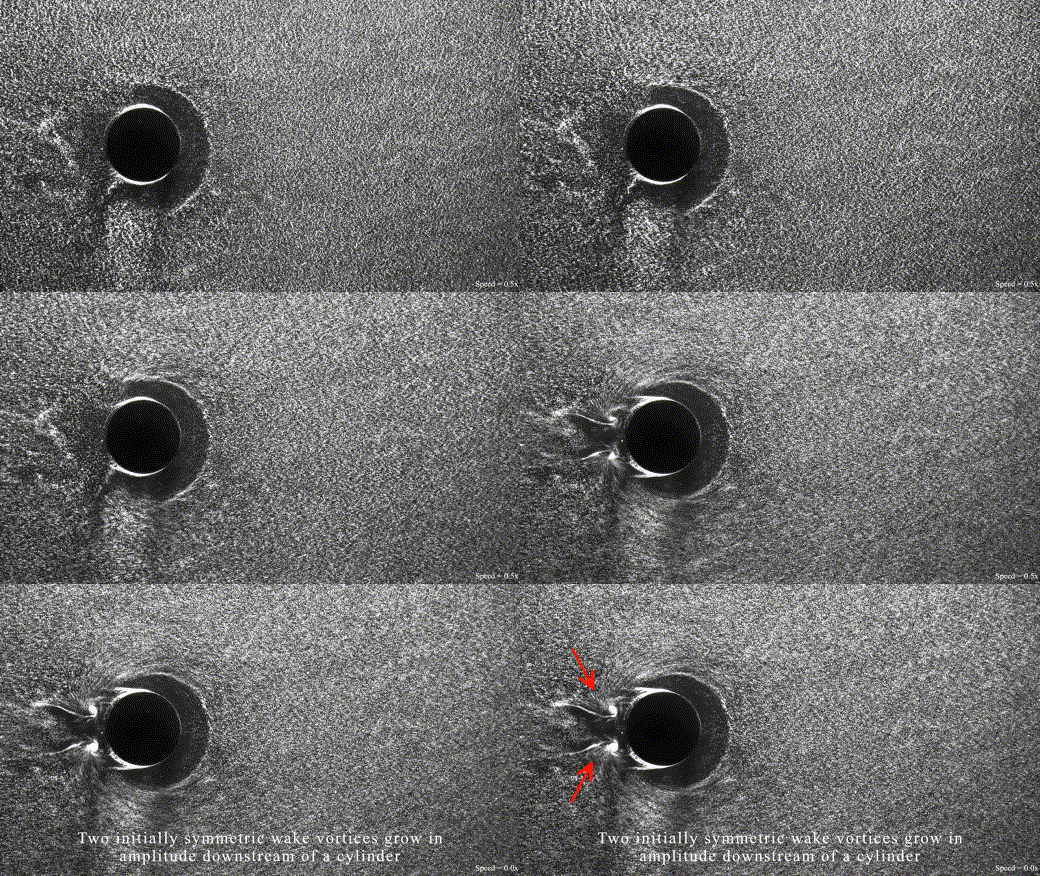
One of the great challenges in fluid dynamics is understanding how order gives way to chaos. Initially smooth and laminar flows often become disordered and turbulent. This video explores that transition in a new way using sound. Here’s what’s going on.
The first segment of the video shows a flat surface covered in small particles that can be moved by the flow. Initially, that flow is moving in right to left, then it reverses directions. The main flow continues switching back and forth in direction. This reversal tends to provoke unstable behaviors, like the Tollmien-Schlichting waves called out at 0:53. Typically, these perturbations in the flow start out extremely small and are difficult or even impossible to see by eye. So researchers take photos of the particles you see here and analyze them digitally. In particular, they are looking for subtle patterns in the flow, like a tendency for particles to clump together with a consistent spacing, or wavelength, between them. Normally, researchers would study these patterns using graphs known as spectra, but that’s where this video does something different.
Instead of representing these subtle patterns graphically, the researchers transformed those spectra into sound. They mapped the visual data to four octaves of C-major, which means that you can now hear the turbulence. When the audio track shifts from a pure note to an unsteady warble, you’re hearing the subtle disturbances in the flow, even when they’re too small for your eye to pick out.
The last part of the video takes this technique and applies it to another flow. We again see a flat plate, but now it has a roughness element, like a tiny hockey puck, stuck to it. As the flow starts, we see and hear vortices form behind the roughness. Then a horseshoe-shaped vortex forms upstream of it. Aside from the area right around the roughness, this flow is still laminar. But then turbulence spreads from upstream, its fingers stretching left until it envelops the roughness element and its wake, making the music waver. (Video and image credit: P. Branson et al.)
When you pop a hard candy in your mouth, you probably don’t give much thought to the fluid dynamics involved in dissolving it. The series above shows a hard candy suspended in water being slowly eaten away. As sugars in the candy dissolve into the water, the fluid becomes denser and falls away. This creates the downward flow visible in the center of the image. As sugar-laden water sinks, fresher water is pulled in alongside the walls of the candy. That flow helps erode the candy, creating a rougher surface. Since rough surfaces have a greater surface area exposed (than a smooth surface), they prompt further and faster dissolution. That strengthens the downward flow, pulls in more ambient water, and keeps the whole process going. (Image credit: M. Wykes)
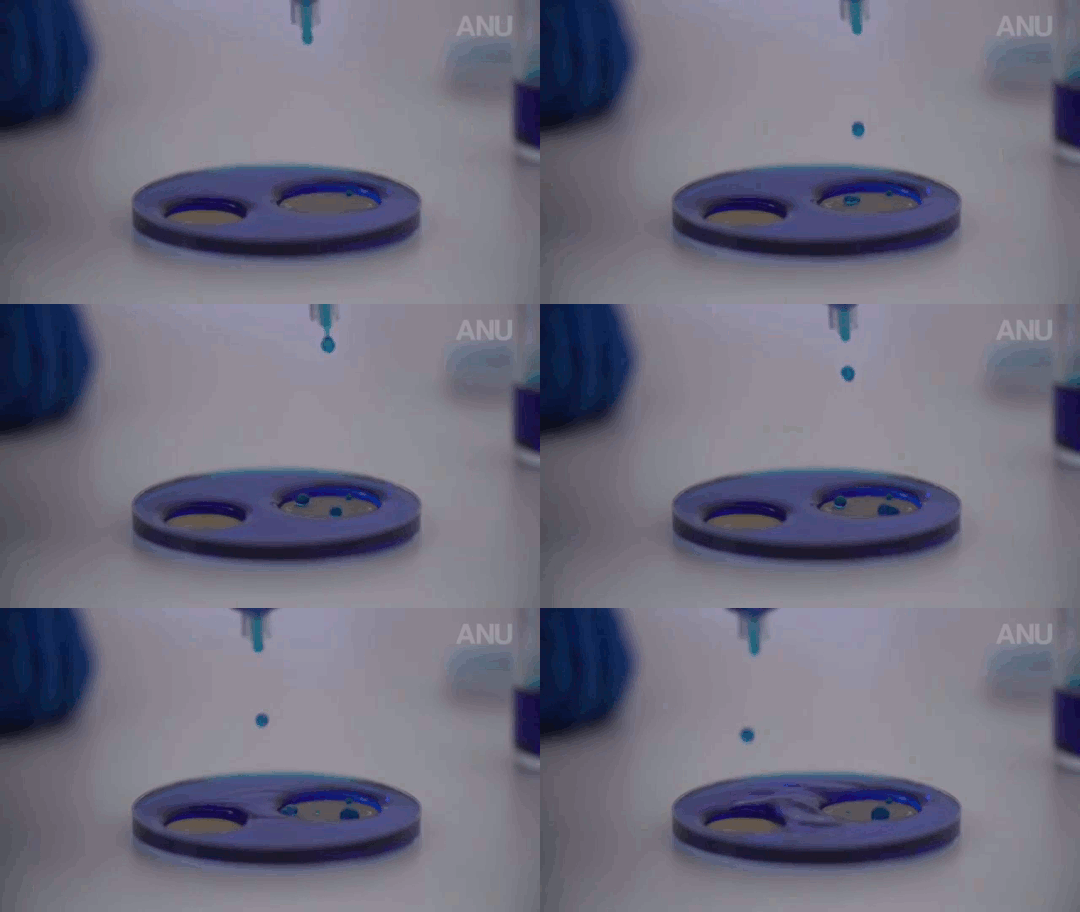
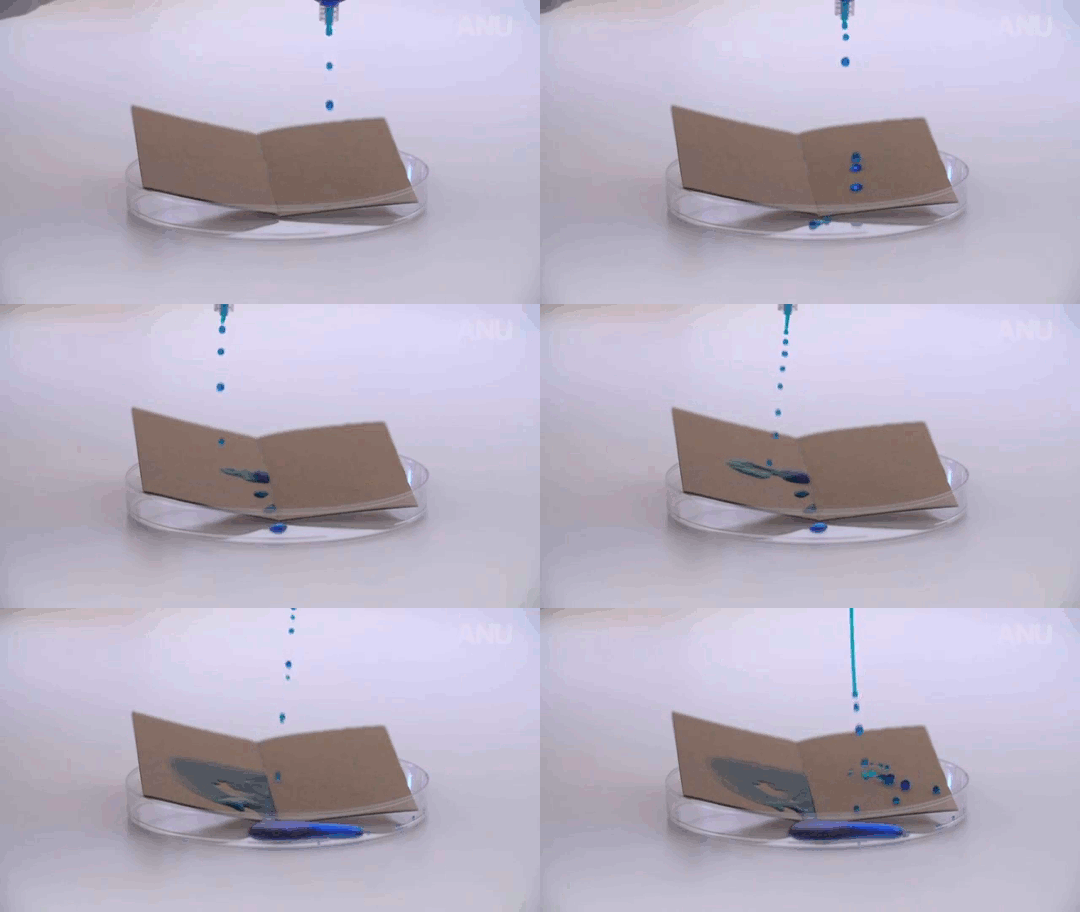
Superhydrophobic–or water repellent–materials are much sought after. Their remarkable ability to shed water is actually mechanical in nature–not chemical. Surfaces with a highly textured microstructure, like a lotus leaf or a butterfly wing, shed water naturally because air trapped between the high points prevents the water from contacting most of the solid surface. The result is that a drop sitting on the surface will have a very high contact angle and be nearly spherical. Instead of wetting the surface and spreading out, it can slide right off, as seen in the animations above. Here researchers have treated the coins and the right half of the cardboard with a spray-on coating that creates superhydrophobic microscale roughness. Similar coatings are commercially available, but such coatings are delicate and lose their hydrophobicity over time as the microstructure breaks down. (Image credits: Australian National University, source)
Look closely enough at a shark’s skin, and you will find it is covered in tiny, anvil-shaped denticles (lower left). To try and discover how and why these denticles help sharks, researchers are 3D printing denticles in different patterns onto flexible sheets to create biomimetic shark skin (lower right).
They test the artificial shark skin in a water tunnel by moving it with prescribed motions and measuring different characteristics, like the swimming speed attained and the power required. When compared to a smooth but flexible control surface, one pattern came out ahead. The staggered-overlapped denticle pattern (shown in C of the lower right figure) achieved swimming speeds 20% higher than the smooth control despite having far more surface area due to the denticles. The cost of that speed was only 13% greater than the smooth case on average, and was about equal to the smooth case for small amplitude motion. This suggests that the patterning of a shark’s skin may help it swim faster with little to no additional cost in effort.
Superhydrophobic surfaces repel water. Both naturally occurring and manmade materials with this property share a common feature: micro- or nanoscale structures on their surface. Lotus and lily leaves are coated with tiny hairs, and synthetic coatings or micro-manufactured surfaces like the one in the video above can be made in the lab. This nanoscale roughness traps air between the surface and the water, preventing adhesion to the surface and enabling the water-repelling behavior we observe at the human scale. Although effective, these nanoscale structures are also extremely delicate, which makes widespread application of superhydrophobic coatings and textures difficult. (Video credit: G. Azimi et al.)