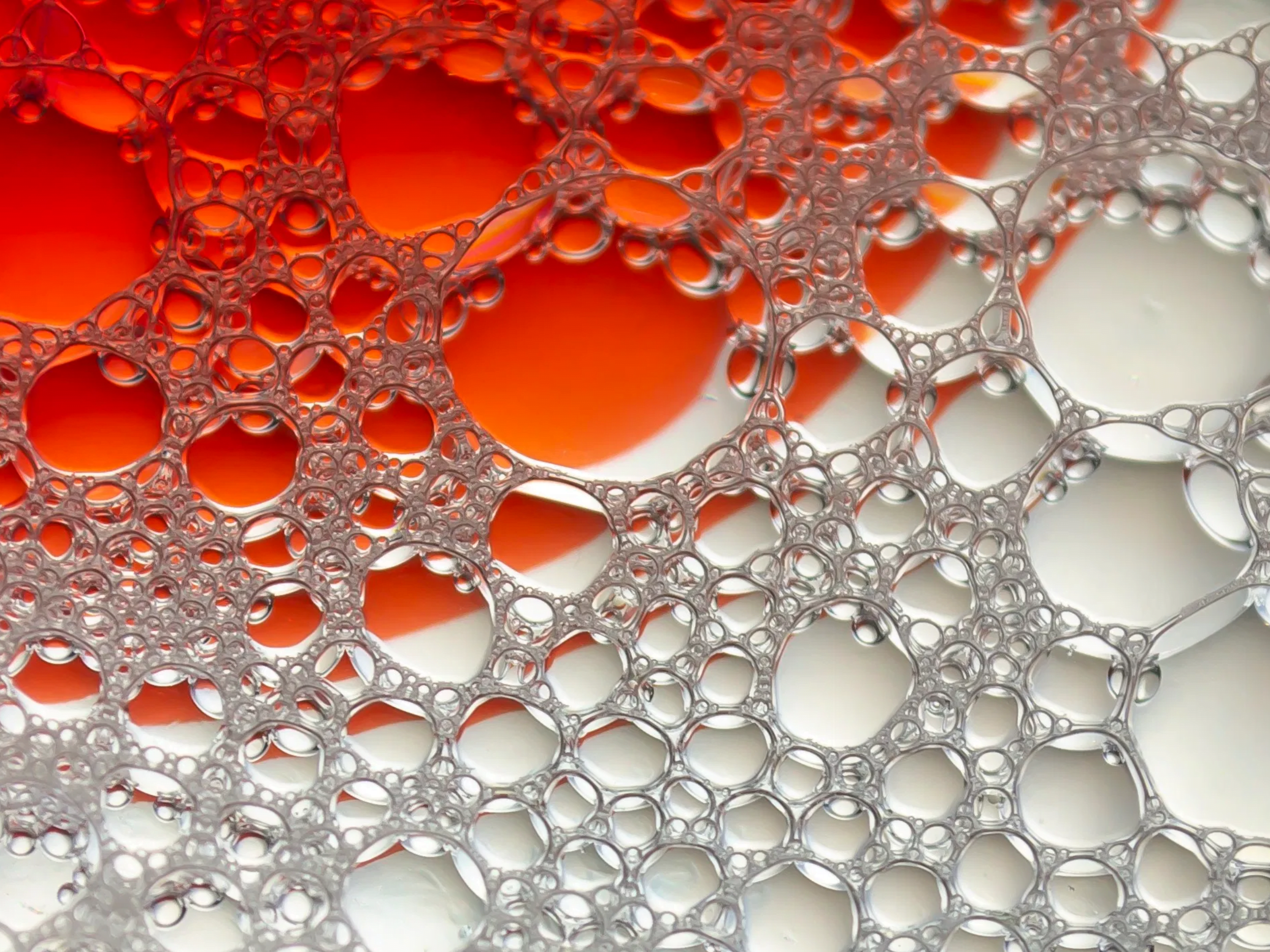
Surface tension tries to minimize a bubble‘s surface area, which is why bubbles assume a spherical shape. But when many bubbles clump together, a curved interface is not always the most energy efficient one. In this case, bubbles can take on many shapes and sizes while still minimizing the overall surface energy. Take a close look at this image and see what shapes you discover! (Image credit: M. Adil)
Tag: surface energy

Polygonal Droplets
Spheres are a special shape; they provide the smallest possible surface area necessary to contain a given volume. And since surface tension tries to minimize surface energy by reducing the surface area, drops and soap bubbles are, generally, spherical. There’s subtlety here, though: namely, what if reducing the surface area doesn’t minimize the surface energy?
That’s the issue at the heart of this study. It looks at microscale oil droplets, like the ones above, that are floating in water and stabilized by surfactants. We’d expect droplets like these to be round, and above a critical temperature, they are. But as the temperature drops, the surfactant molecules along the droplet’s interface crystallize. The drop itself is still liquid, but interface is not.
This changes the rules of the game. There’s no way for the surfactant molecules to form a sphere when solidified; they simply can’t fit together that way. So instead defects form along the interface and the drop becomes faceted. As the temperature drops further, the energy relationship between the water, oil, and surfactants continues shifting, causing the droplet to change shape – even to increase its surface area – all to minimize the overall energy. The effect is reversible, too. Raise the temperature back up above the critical point, and the interface “thaws” so that the drop becomes round again. (Image and research credit: S. Guttman et al.; via Forbes; submitted by Kam-Yung Soh)

Jumping Droplets
From butterfly wings to lotus leaves, many surfaces in nature are shaped to repel water. This typically means roughness on the scale of tens of nanometers, which helps trap air between water and the surface. Droplets can still form on these surfaces, but when they merge, the sudden excess of surface energy sends the coalesced droplet flying. With enough height, the tiny droplet can catch the wind and get carried away. It’s like a natural anti-fogging mechanism, and it’s one that engineers are keen to understand and replicate. (Image and research credit: P. Lecointre et al.)

Leaping Droplets
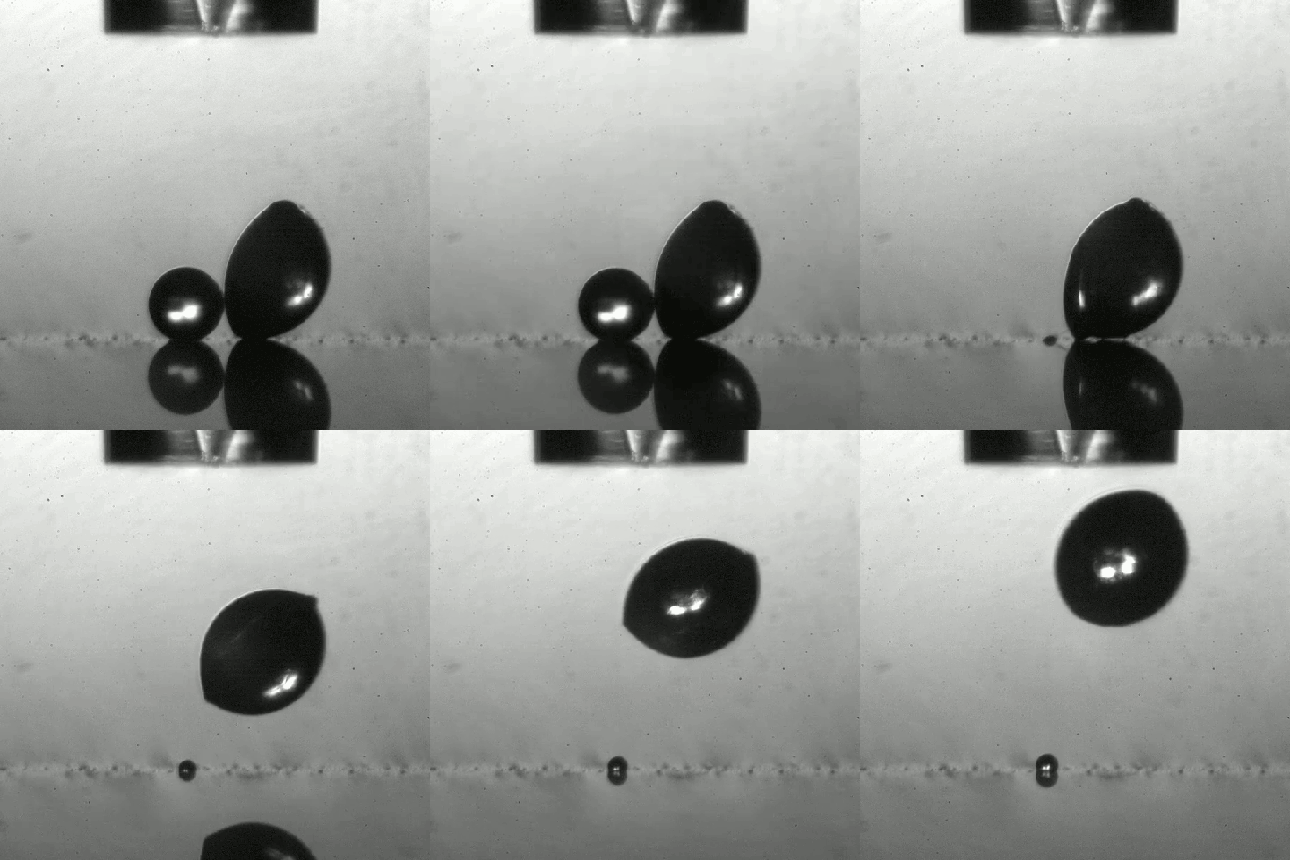
Many fungi use coalescing water droplets to launch and spread their spores. The process is recreated in the laboratory in the animation above. Initially, there is a small spherical drop and a second, flattened drop stuck to the backside of the spore. In the animation, the large object on the right is actually both spore and droplet. The spore is spherical on one side and flattened on the other and starts out tipped up on its edge. When the spherical drop gets large enough to reach the flattened drop, they merge. This reduces the total surface area of the drop and thus releases some surface energy. It’s that surface energy that drives the spore’s jump. Even launching just a centimeter away from the host fungus is enough for a breeze to carry the spore further, allowing the fungus to reproduce. (Image and research credit: F. Liu et al., source; submitted by Kam-Yung Soh)

Jumping Droplets
When droplets on a superhydrophobic surface coalesce with one another, they jump. Individually, each drop has a surface energy that depends on its size. When two smaller droplets coalesce into a larger drop, the final drop’s surface energy is smaller than the sum of the parent droplets. Energy has to be conserved, though, so that excess surface energy gets converted to kinetic energy, causing the new droplet to leap up. Smaller droplets have higher jumping velocities. For more, see the original video. (Image credit: J. Boreyko and C. Chen, source video)