Tag: superradiance

  • Superradiance in Fluids

    Superradiance in Fluids

    A group of excited atoms can collectively emit more photons than they could individually in a phenomenon known as superradiance. Now researchers have shown that vibrating fluids can produce superradiance as well.

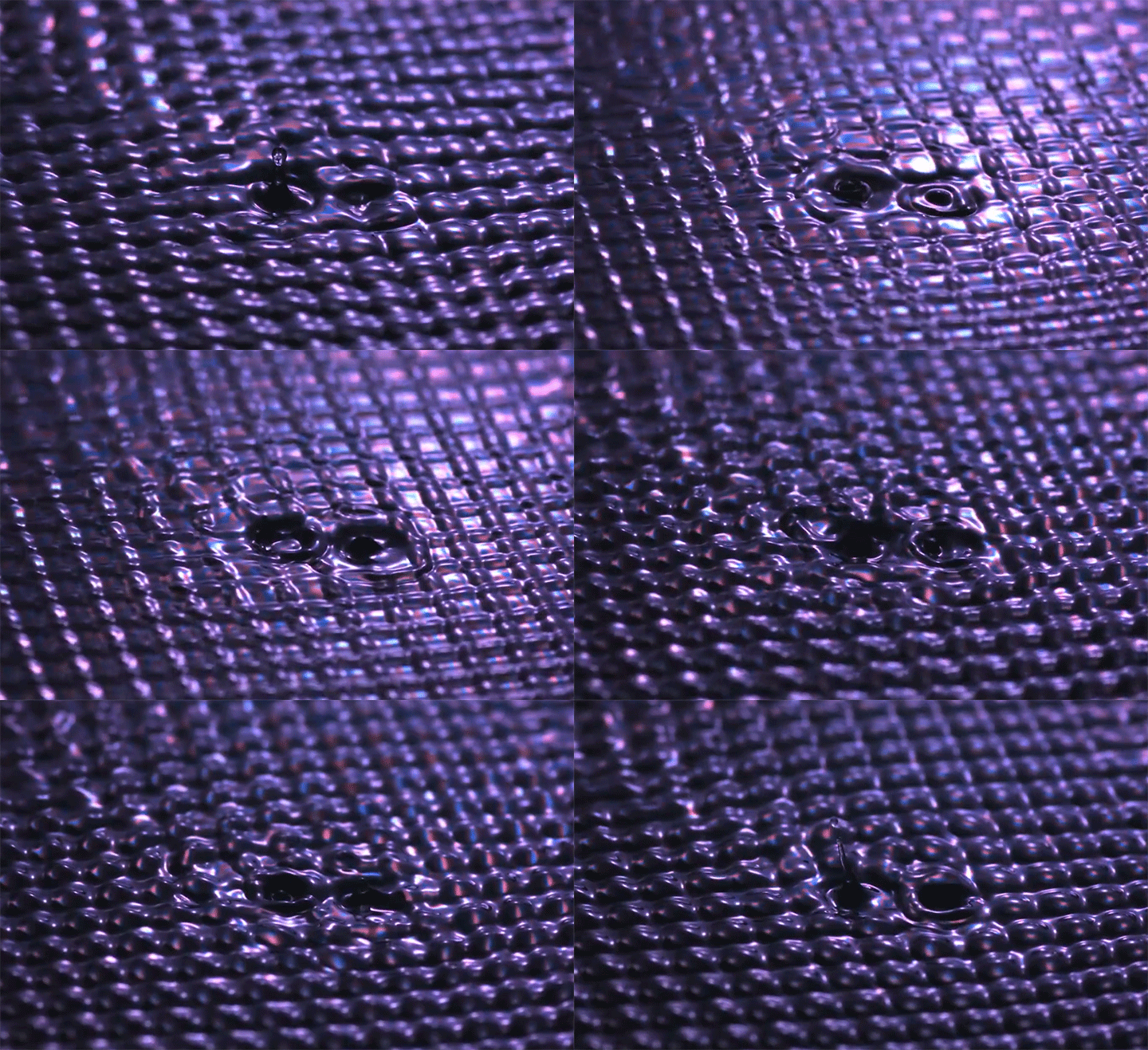
    Two different wavefields used in the experiment, each with a different distance between the circular cavities.
    Two different wave fields used in the experiment, each with a different distance between the circular cavities.

    Similar to other hydrodynamic quantum analogs, the researchers vertically vibrated a pool of liquid at a frequency that produced Faraday waves. Beneath the pool, they placed two circular wells, varying the distance between them to observe how their wave fields interacted. With a large enough vibration, the two circular wells emitted droplets (top image), and the number of droplets they produced was higher than expected for two independent wells, indicating superradiance. The results suggest that it may be possible to build even more hydrodynamic analogs of quantum systems than previously thought! (Image and research credit: V. Frumkin et al.; via APS Physics)

  • Fluid Black Holes

    Fluid Black Holes

    Fluid systems can sometimes serve as analogs for other physical phenomena. For example, bouncing droplets can recreate quantum effects and a hydraulic jump can act like a white hole. In this work, a bathtub vortex serves as an analog for a rotating black hole, a system that’s extremely difficult to study under normal circumstances. In theory, the property of superradiance makes it possible for gravitational waves to extract energy from a rotating black hole, but this has not yet been observed. A recent study has, however, observed superradiance for the first time in this fluid analog.

    To do this, the researchers set up a vortex draining in the center of a tank. (Water was added back at the edges to keep the depth constant.) This served as their rotating black hole. Then they generated waves from one side of the tank and observed how those waves scattered off the vortex. The pattern you see on the water surface in the top image is part of a technique used to measure the 3D surface of the water in detail, which allowed the researchers to measure incoming and scattered waves around the vortex. For superradiance to occur, scattered waves had to be more energetic after interacting with the vortex than they were before, which is exactly what the researchers found. Now that they’ve observed superradiance in the laboratory, scientists hope to probe the process in greater detail, which will hopefully help them observe it in nature as well. For more on the experimental set-up, see Sixty Symbols, Tech Insider UK, and the original paper. (Image credit: Sixty Symbols, source; research credit: T. Torres et al., pdf; via Tech Insider UK)