Tag: splashes

  • Particle-filled Splashes

    Particle-filled Splashes

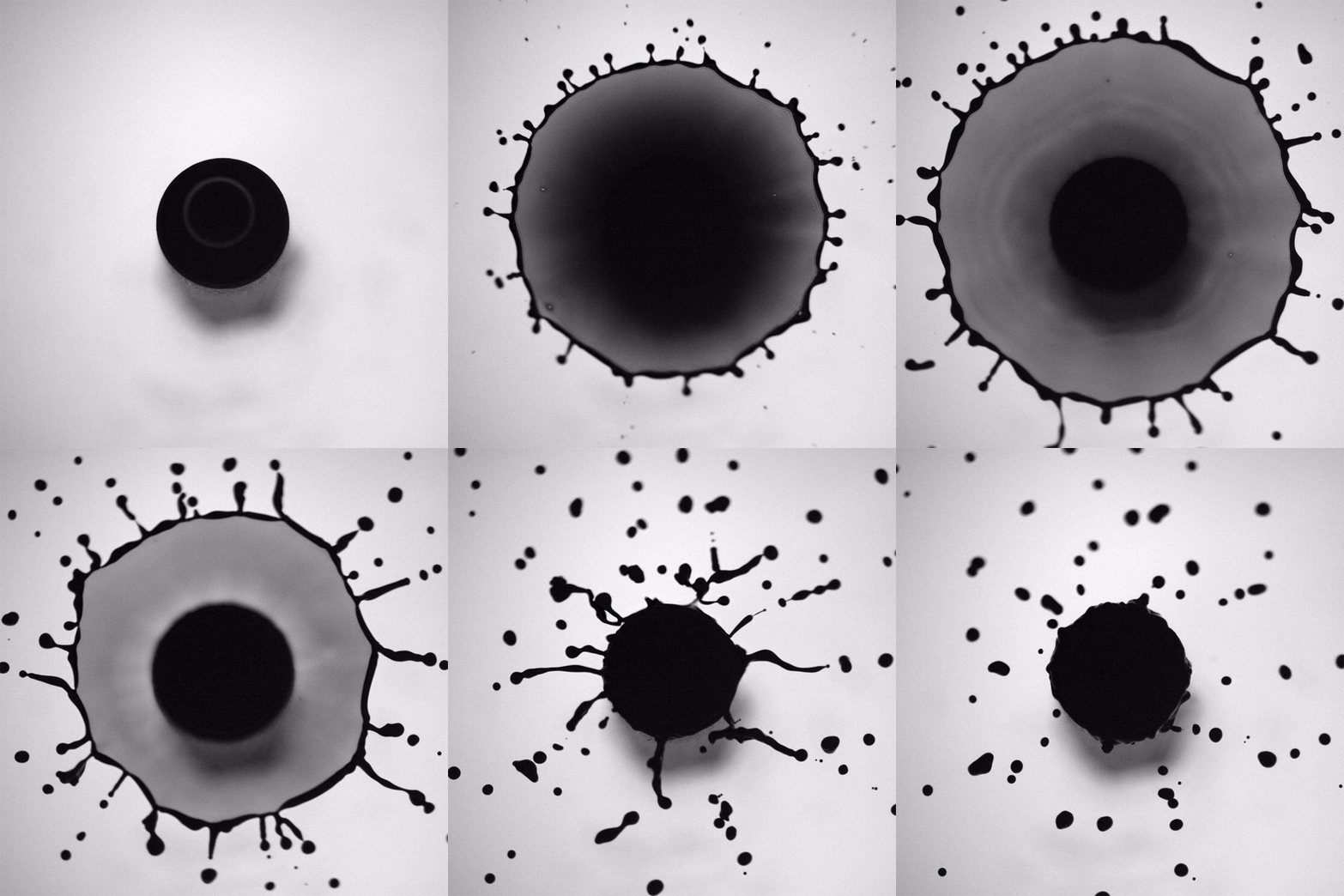
    Adding particles to a liquid can significantly alter its splash dynamics, as shown in this new study. In the first image, a purely-liquid droplet spreads on impact into a thin liquid sheet that destabilizes from the rim inward, ripping itself into a spray of droplets. At first glance, the particle-filled droplet in the second image behaves similarly; it, too, spreads and then disintegrates. But there are distinctive differences.

    During expansion, the particles increase the drop’s effective viscosity, meaning that the splash sheet does not expand as far. That apparent viscosity increase is also part of why the drops the splash sheds are bigger than those without particles. The other part of that story comes from the retraction, where the variations in thickness caused by the particles and their menisci create preferential paths for the flow. As a result, the particle-filled splash breaks up faster and into larger droplets compared to its purely-liquid counterpart. (Image and research credit: P. Raux et al.)

  • Pearls On a Puddle

    Pearls On a Puddle

    Leave a drop of coffee sitting on a surface and it will leave behind a ring of particulates once the water evaporates. But what happens to a droplet made up of multiple liquids that evaporate differently? That’s the subject of this new study. Researchers mixed a volatile drop (isopropyl alcohol) with a smaller amount of a non-volatile liquid and observed how this changed the droplet’s splash rim and evaporation pattern.

    When the surface tension difference between the two liquids was large, the researchers found that the splash formed fingers along its rim (Image 1). The fingers consist almost entirely of the non-volatile component, driven to the outskirts of the drop by Marangoni forces. The dark and light bands you see in the image are interference fringes, which the researchers used to track the film’s thickness.

    When the researchers used liquids with similar surface tensions, the droplet rim instead formed pearl-like satellite droplets. Once the volatile liquid evaporated away, the remaining liquid merged into a thick film. (Image and research credit: A. Mouat et al.; via APS Physics; submitted by Kam-Yung Soh)

  • Flowery Splashes

    Flowery Splashes

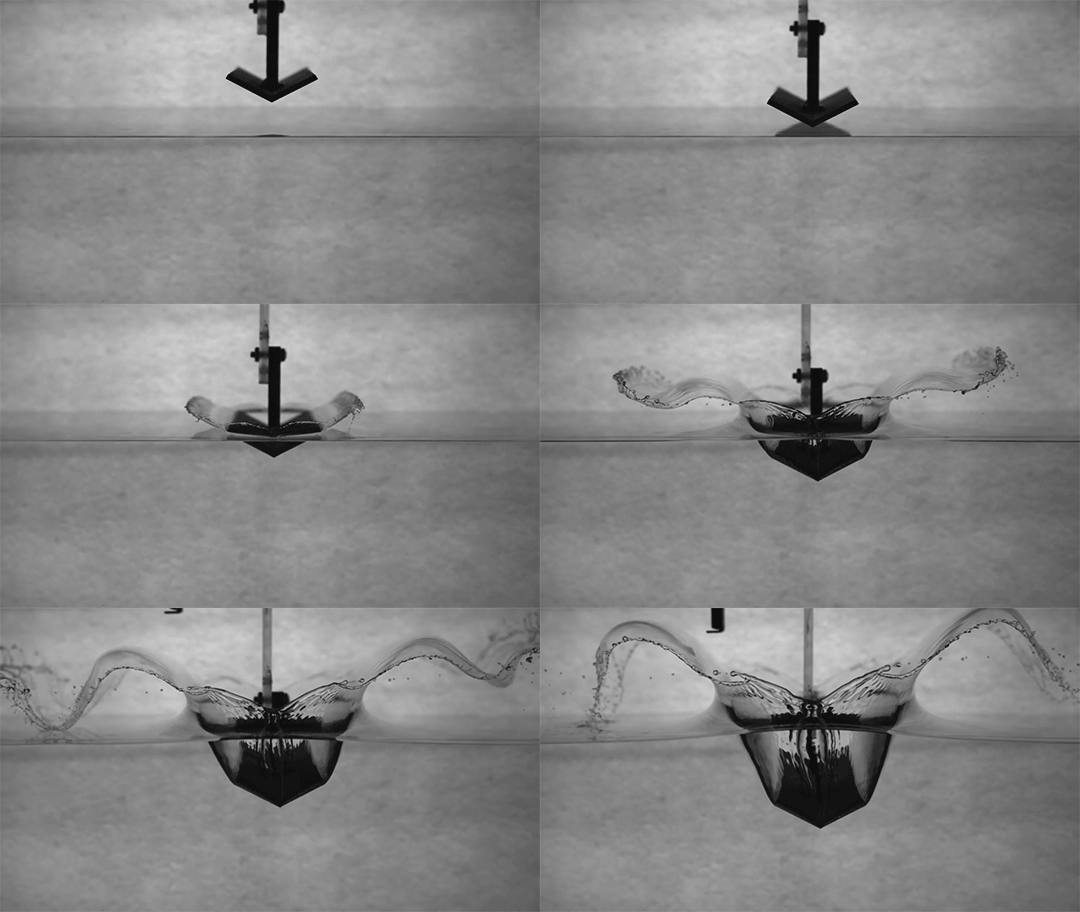
    Plunge a disk into water and you’ll get a dome-like splash that closes back on itself. But what happens when that disk has a patterned surface? In this video, researchers added a wedge-like surface pattern to the disk, creating a splash with petals like a flower. Just as the surface of disk is about to submerge completely, a jet of the remaining air spurts out the trough of each wedge. This air jet breaks up the tip of the triangular splashes focused by the wedge. (Image, research, and video credit: H. Kim et al.)

  • The Best of FYFD 2019

    The Best of FYFD 2019

    2019 was an even busier year than last year! I spent nearly two whole months traveling for business, gave 13 invited talks and workshops, and produced three FYFD videos. I also published more than 250 blog posts and migrated all 2400+ of them to a new site. And, according to you, here are the top 10 FYFD posts of the year:

    1. The perfect conditions make birdsong visible
    2. Pigeons are impressive fliers
    3. The water anole’s clever method of breathing underwater
    4. 100 years ago, Boston was flooded with molasses
    5. The BZ reaction is some of nature’s most beautiful chemistry
    6. The labyrinthine dance of ferrofluid
    7. 360-degree splashes
    8. The extraordinary flight of dandelion seeds
    9. Dye shows what happens beneath a wave
    10. Bees do the wave to frighten off predators

    Nature makes a strong showing in this year’s top posts with five biophysics topics. FYFD videos also had a good year: both my Boston Molasses Flood video and dandelion flight video made the top 10!

    If you’d like to see more great posts like these, please remember that FYFD is primarily supported by readers like you. You can help support the site by becoming a patronmaking a one-time donation, or buying some merch. Happy New Year!

    (Image credits: birdsong – K. Swoboda; pigeon take-off – BBC Earth; water anole – L. Swierk; Boston molasses flood – Boston Public Library; BZ reaction – Beauty of Science; ferrofluid – M. Zahn and C. Lorenz; splashes – Macro Room; dandelion – N. Sharp; dyed wave – S. Morris; bees – Beekeeping International)

  • Twirling Liquids

    Twirling Liquids

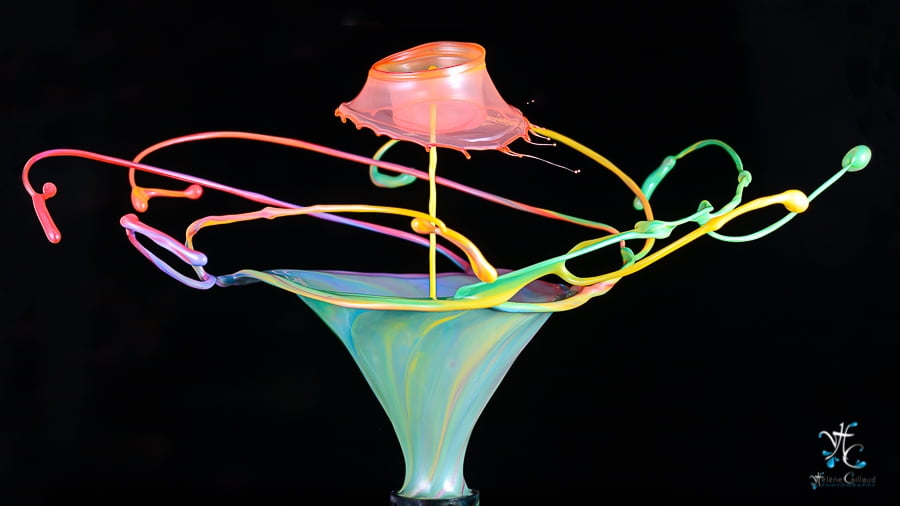
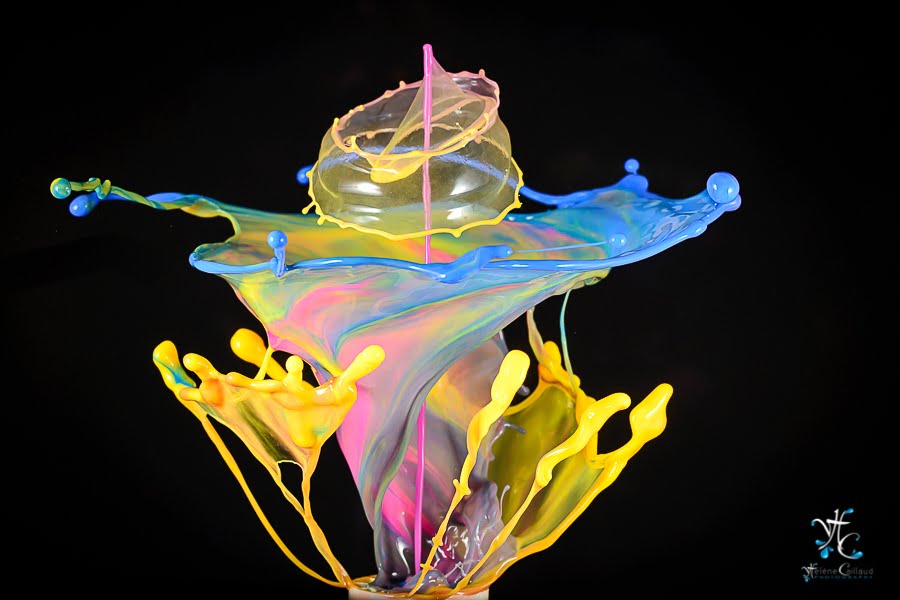
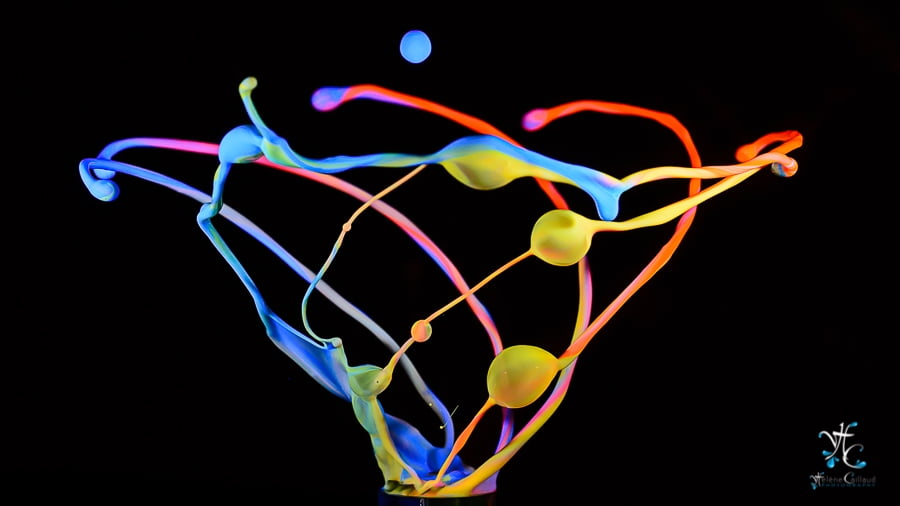
    What do you get when you spin a splash? I expect the result is a lot like these whirling fluid structures captured by photographer Hélène Caillaud. I love the fantastical shapes she creates as sheets and filaments are flung outward. These liquid sculptures look like everything from the perfect martini glass to the skirts of a flamenco dancer. Check out the full gallery of images, and be sure to look around at Caillaud’s other stunning liquid art while you’re there. (Images credit: H. Caillaud)

  • Featured Video Play Icon

    Reducing the Force of Water Entry

    As anyone who’s jumped off the high board can tell you, hitting the water involves a lot of force. That’s because any solid object entering the water has to accelerate water out of its way. This is why gannets and other diving birds streamline themselves before entering the water. But even for non-streamlined objects, like a sphere, there are ways to reduce the force of impact.

    This video explores three such techniques, all of which involve disturbing the water before the sphere enters. In the first, the sphere is dropped inside a jet of fluid. Since the jet is already forcing water down and aside when the sphere enters, the acceleration provided by the sphere is less and so is the force it experiences.

    The second and third techniques both rely on dropping a solid object ahead of the one we care about. In the second case, a smaller sphere breaks the surface ahead of the larger one, allowing the big sphere to hit a cavity rather than an undisturbed surface. Like with the jet, the first sphere’s entry has already accelerated fluid downward, so there’s less mass that the bigger sphere has to accelerate, thereby reducing its impact force.

    In the third case, the first sphere is dropped well ahead of the second, creating an upward-moving Worthington jet that the second sphere hits. In this case, there’s water moving upward into the sphere, so how could this possibly reduce the force of entry? The key here is that the water of the jet wets the sphere before it enters the pool. Notice how very little air accompanies the second sphere compared to the first one. That’s because the second sphere is already wet. It’s also been slowed down by the jet so that it enters the water at a lower speed, all of which adds up to a lower force of entry. (Image and research credit: N. Speirs et al.)

  • Oil-on-Water Impact

    Oil-on-Water Impact

    Although many people have studied droplet impacts over the years, there’s been remarkably little work done with oil-on-water impacts. One of the things that makes this situation different is that the oil and water are completely immiscible, which means we can see aspects of the impact process that are invisible with, say, water-on-water impacts.

    The animation above shows an underwater view of the oil droplet’s impact. The energy of the initial impact creates an expanding crater and an unstable crown splash. That crown splash contains both water and oil. After it ejects some droplets, the rim stabilizes, but we can still see small perturbations along its edge as it starts to retract. In the water, high surface tension damps out these perturbations. Not so for the oil! As the crater retracts, the small disturbances along the rim get stretched into mushroom-shaped fingers that point inward toward the impact site. Because the index of refraction is different between oil and water, we can see the fingers clearly near the end of the animation. (Image and research credit: U. Jain et al.; submitted by Utkarsh J.)

  • The Shape of Splashes

    The Shape of Splashes

    When a wedge falls into a pool, it creates a distinctive, doubly-curved splash. Here’s how it works. When the front of the wedge first enters the water, it creates a thin sheet of fluid that gets ejected diagonally upward. As the wedge sinks further, the sheet thickens and ejects at a more vertical angle. That creates a low pressure zone in the air beside the splash, which causes outside air to flow inward, generating a sort of Venturi effect under the splash. Because the outer part of the splash sheet is thinner, it’s more strongly affected by the air flow beneath it, and it gets pulled downward, enhancing the splash’s curvature.

    This doubly-curved splash is particular to wedges of the right angle. To see what kind of splashes other shapes make, check out the video below. (Image and video credit: Z. Sakr et al.; for more, see L. Vincent et al.)

  • Featured Video Play Icon

    Reader Question: Inside a Vortex

    Reader embersofkymillo asks:

    Hey FYFD, could you do some analysis/explanations behind the physics of this vortex stuff? I love when you do spots on Slow Mo Guys vids and figured I’d share a recent one w you 

    I enjoy doing that, too! So let’s talk a little about vortices. What Dan’s tea stirrer is doing is creating a low-pressure core for a vortex. We can see just how strong that low pressure region is by the way it sucks the air-water interface down toward the spinning arms. Eventually the interface and stirrer meet, and what was once a single, smooth(ish) surface gets torn into a myriad of bubbles. (As an aside, those bubbles get loud.) 

    I also like the sequence of sugar cube drops because they make for some very cool splashes. Notice how the orientation of the cube’s edges as it hits determines the shape of the inital splash curtain. The asymmetry borne out of that impact actually follows through all the way through the seal of the cavity behind the cube. It reminds me of this oldie-but-goodie video on drops hitting different shapes. (Video and image credit: The Slow Mo Guys; submitted by embersofkymillo)

  • Featured Video Play Icon

    360 Splashes

    Beautiful as a splash is, why only enjoy it from a single angle? In this video, the artists behind Macro Room offer a 360-degree perspective on various splashes and fluid collisions. I especially enjoy watching the splash crowns falling back over and out of the various containers they use. What’s your favorite part? (Image and video credit: Macro Room)