Tag: shear

  • Asymmetric Wakes

    Asymmetric Wakes

    When a ship moves through water, it leaves a distinctive V-shaped wake behind it. In the nineteenth century, Lord Kelvin made some of the earliest theoretical studies of this phenomenon, calculating that the arms of the V should have an angle of about 39 degrees, known as the Kelvin angle. But that theoretical result doesn’t always hold in practice.

    More recently, researchers calculated and experimentally verified an extension to Kelvin’s theory, one which accounts for what’s going on below the water. They found that any shear in the currents below the surface can strongly affect the shape of a boat’s wake, altering angles and creating asymmetry between the two sides. The results have practical consequences, too: they help predict the wave resistance ships will encounter when traversing areas with substantial subsurface shear, like near the mouths of river deltas. (Image credit: M. Adams; research credit: B. Smeltzer et al.; submitted by clogwog)
  • Storing Memory in Bubbles

    Storing Memory in Bubbles

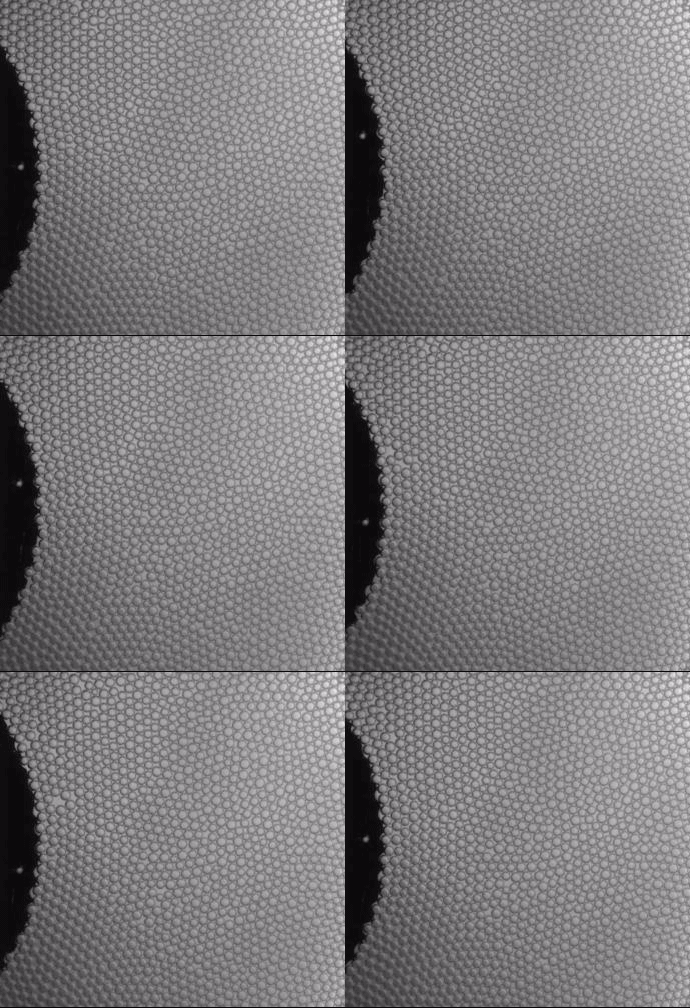
    Soft systems like this bubble raft can retain memory of how they reached their current configuration. Because the bubbles are different sizes, they cannot pack into a crystalline structure, and because they’re too close together to move easily, they cannot reconfigure into their most efficient packing. This leaves the system out of equilibrium, which is key to its memory. 

    By shearing the bubbles between a spinning inner ring (left in image) and a stationary outer one (not shown) several times, researchers found they they could coax the bubbles into a configuration that was unresponsive to further shearing at that amplitude. 

    Once the bubbles were configured, the scientists could sweep through many shear amplitudes and look for the one with the smallest response. This was always the “remembered” shear amplitude. Effectively, the system can record and read out values similar to the way a computer bit does. Bubbles are no replacement for silicon, though. In this case, scientists are more interested in what memory in these systems can teach us about other, similar mechanical systems and how they respond to forces. (Image and research credit: S. Mukherji et al.; via Physics Today; submitted by Kam-Yung Soh)

  • Floccing Particles

    Floccing Particles

    Adding particles to a viscous fluid can create unexpected complications, thanks to the interplay of fluid and solid interactions. Here we see a dilute mixture of dark spherical particles suspended in a layer of fluid cushioned between the walls of an inner and outer cylinder. Initially, the particles are evenly distributed, but when the inner cylinder begins to rotate, it shears the fluid layer. Hydrodynamic forces assemble the particles together into loose conglomerates known as flocs. Once the particles form these log-like shapes, they remain stable thanks to the balance between viscous drag on particles and the attractive forces that pull particles toward one another. (Image and research credit: Z. Varga et al.; submitted by Thibaut D.)

  • Communication Between Microswimmers

    Communication Between Microswimmers

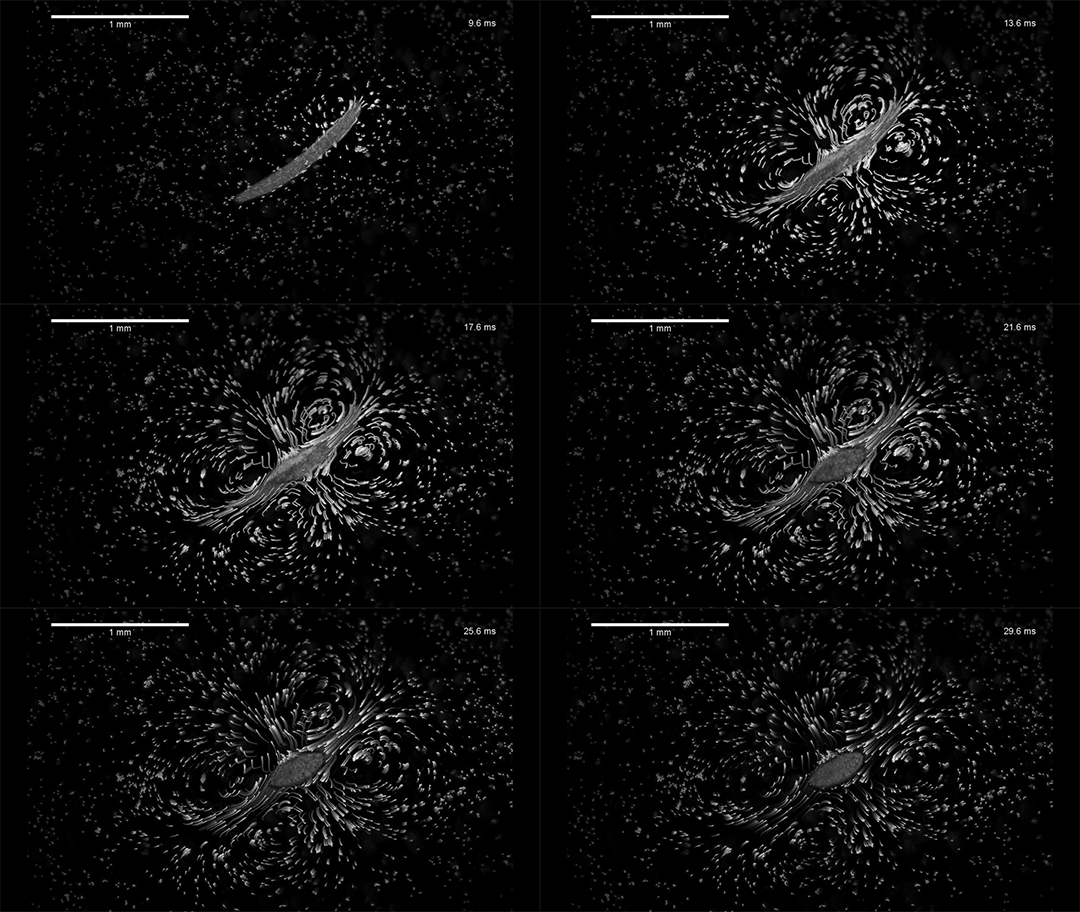
    The elongated cells of Spirostomum ambiguum swim using hair-like cilia, but when threatened, the cells contract violently, sending out long-range hydrodynamic waves, like those visualized above. Along with these waves, the cells release toxins aimed at whatever predator threatens them. In a colony, these waves act like a communication beacon. The swirl of a previous cell’s reaction tugs on its neighbors. As they contract, the message–and the toxins–spread. If the colony density is high enough, the hydrodynamic trigger waves will propagate through the entire colony, releasing enough toxins to disable even large predators. (Image and video credit: A. Mathijssen et al.)

  • A Star Drop

    A Star Drop

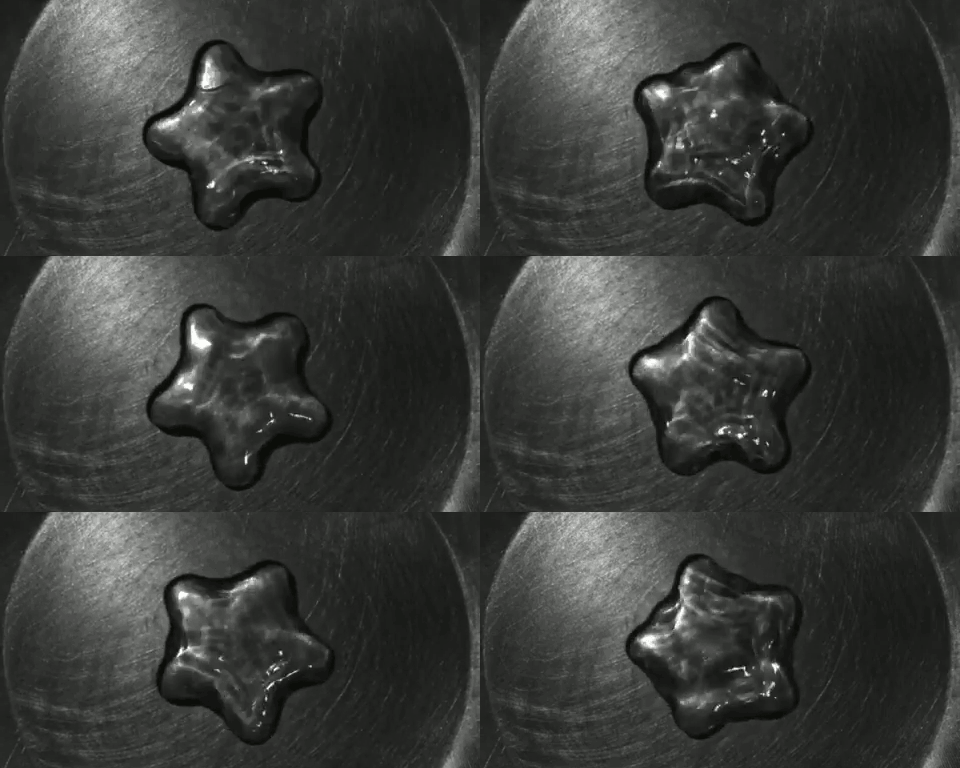
    There are many ways to make a droplet oscillate in a star-shape – like vibrating its surface or using acoustic waves to excite it – but these methods involve externally forcing the droplet’s oscillation. Leidenfrost drops – liquids levitating on a film of their own vapor caused by the extremely hot surface below – turn themselves into stars. It all starts with the constant evaporation driven by the heat below. This creates a thin, fast-moving layer of vapor flowing beneath the drop. That vapor shears the drop, causing capillary waves – essentially ripples – that travel through the drop in a characteristic way. Those ripples in turn cause pressure oscillations in the vapor layer, alternately squeezing and releasing it. Feedback from the vapor layer then drives the droplet into star-shaped oscillations. Under the right conditions, water drops can form stars with as many as 13 points! (Image and research credit: X. Ma and J. Burton, source)

  • Rain on Car Windows

    Rain on Car Windows

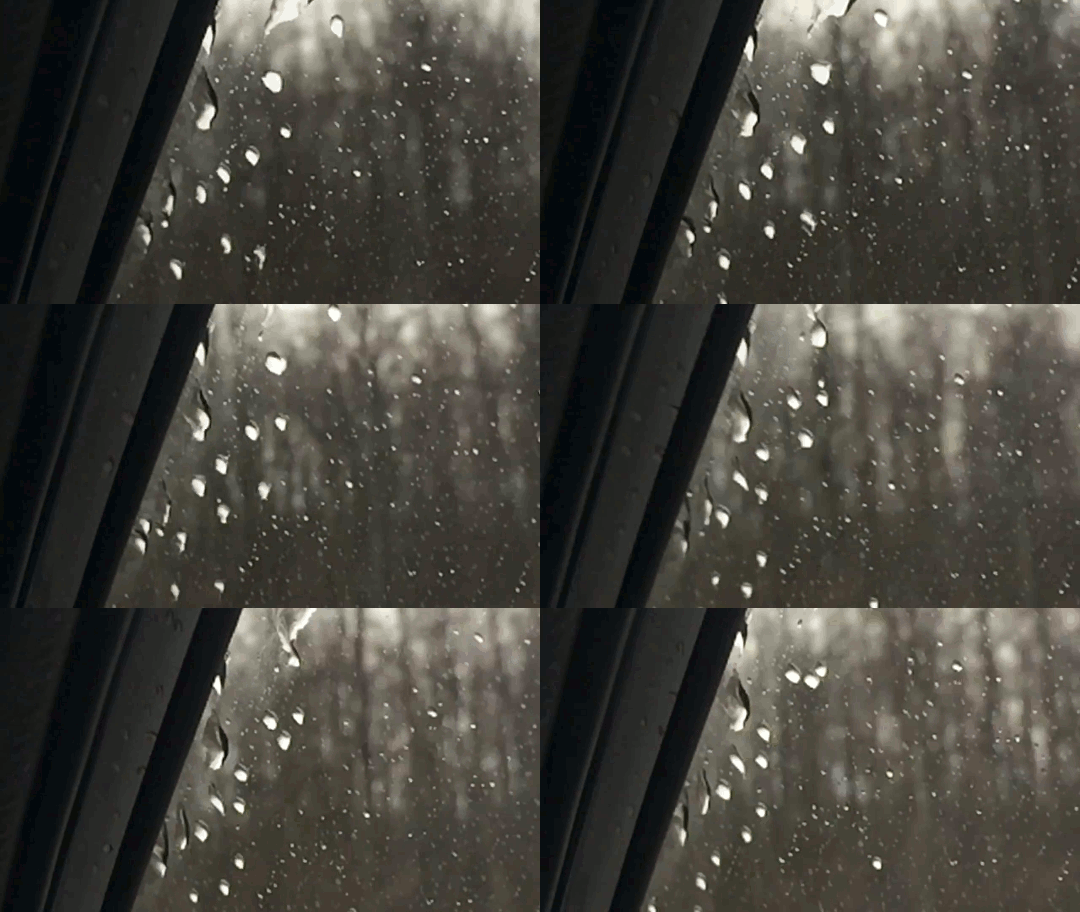
    As a child, I loved to ride in the car while it was raining. The raindrops on the window slid around in ways that fascinated and confused me. The idea that the raindrops ran up the window when the car moved made sense if the wind was pushing them, but why didn’t they just fly off instantly? I could not understand why they moved so slowly. I did not know it at the time, but this was my early introduction to boundary layers, the area of flow near a wall. Here, friction is a major force, causing the flow velocity to be zero at the wall and much faster – in this case roughly equal to the car’s speed – just a few millimeters away. This pushes different parts of large droplets unevenly. Notice how the thicker parts of the droplets move faster and more unsteadily than those right on the window. This is because the wind speed felt by the taller parts of the droplet is larger. Gravity and the water’s willingness to stick to the window surface help oppose the push of the wind, but at least with large drops at highway speeds, the wind’s force eventually wins out. (Image credit: A. Davidhazy, source; via Flow Viz)

  • Wrinkling Drops

    Wrinkling Drops

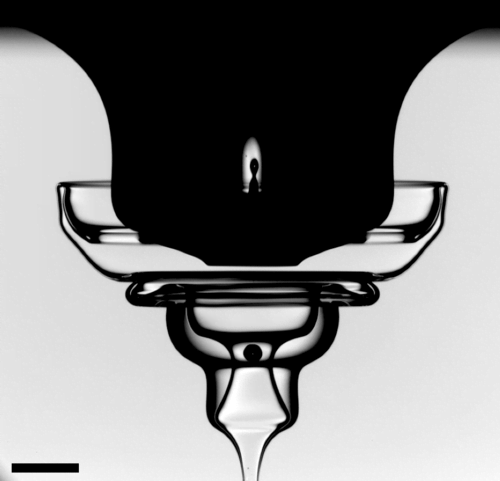
    When a viscous drop falls into a pool of a less viscous liquid, the drop can deform into some beautiful and complex shapes. Typically, shear forces between the drop and its surroundings cause a vortex ring to roll up and advect downward, thereby stretching the remainder of the drop into thin sheets that can buckle and wrinkle. Here the drop is about 150 times more viscous than the pool and impacts at 1.45 m/s, making a rather energetic entry. The vortex ring (not visible) has stretched the drop’s remains downward while a buoyant bubble caught by the impact pulls some of the drop back toward the surface. As a result, the thin sheets of the drop’s fluid are buckling and folding back on themselves like an elaborate and delicate glass sculpture. This entire paper is full of gorgeous images and videos. Be sure to check them out! (Image and research credit: E. Q. Li et al.; see supplemental info zip for videos)

  • Featured Video Play Icon

    Kelvin-Helmholtz Instability

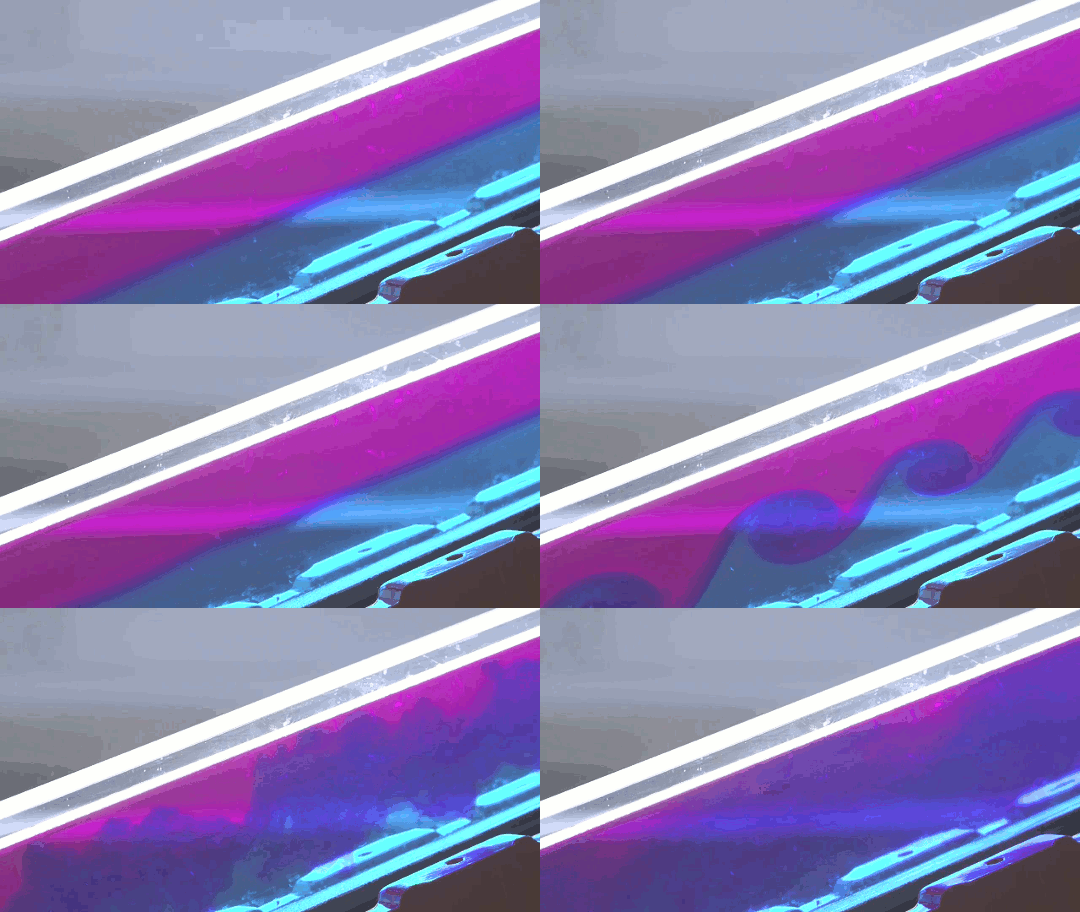
    Sixty Symbols has a great new video explaining the laboratory set-up for demoing a Kelvin-Helmholtz instability. You can see a close-up from the demo above. Here the pink liquid is fresh water and the blue is slightly denser salt water. When the tank holding them is tipped, the lighter fresh water flows upward while the salt water flows down. This creates a big velocity gradient and lots of shear at the interface between them. The situation is unstable, meaning that any slight waviness that forms between the two layers will grow (exponentially, in this case). Note that for several long seconds, it seems like nothing is happening. That’s when any perturbations in the system are too small for us to see. But because the instability causes those perturbations to grow at an exponential rate, we see the interface go from a slight waviness to a complete mess in only a couple of seconds. The Kelvin-Helmholtz instability is incredibly common in nature, appearing in clouds, ocean waves, other planets’ atmospheres, and even in galaxy clusters! (Image and video credit: Sixty Symbols)

  • Breaking Waves in the Sky

    Breaking Waves in the Sky

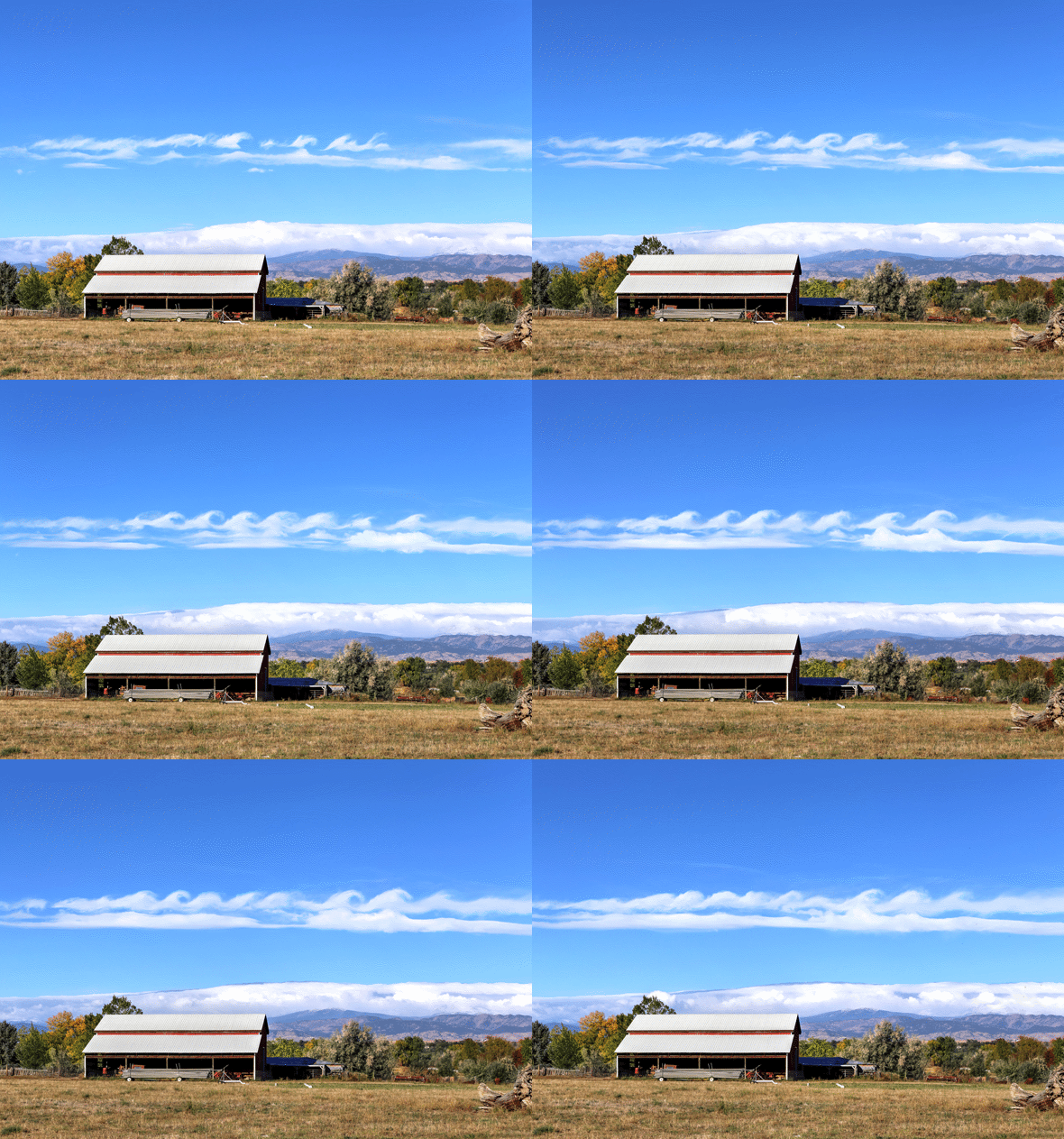
    Under the right atmospheric conditions, clouds can form in a distinctive but short-lived breaking wave pattern known as a Kelvin-Helmholtz cloud. The animation above shows the formation and breakdown of such a cloud over the course of 9 minutes early one morning in Colorado’s Front Range region. Kelvin-Helmholtz instabilities occur when fluid layers with different velocities and/or densities move past one another. Friction between the two layers moving past creates shear and causes the curling rolls seen above.

    In the background, you can also see a foehn wall cloud low to the horizon. This type of cloud forms downwind of the Rocky Mountains after warm, moist Chinook winds are forced up over the mountains, cool, and then condense and sink in the mountains’ wake. (Image credit and submission: J. Straccia, more info)

  • Saturnian Clouds

    Saturnian Clouds

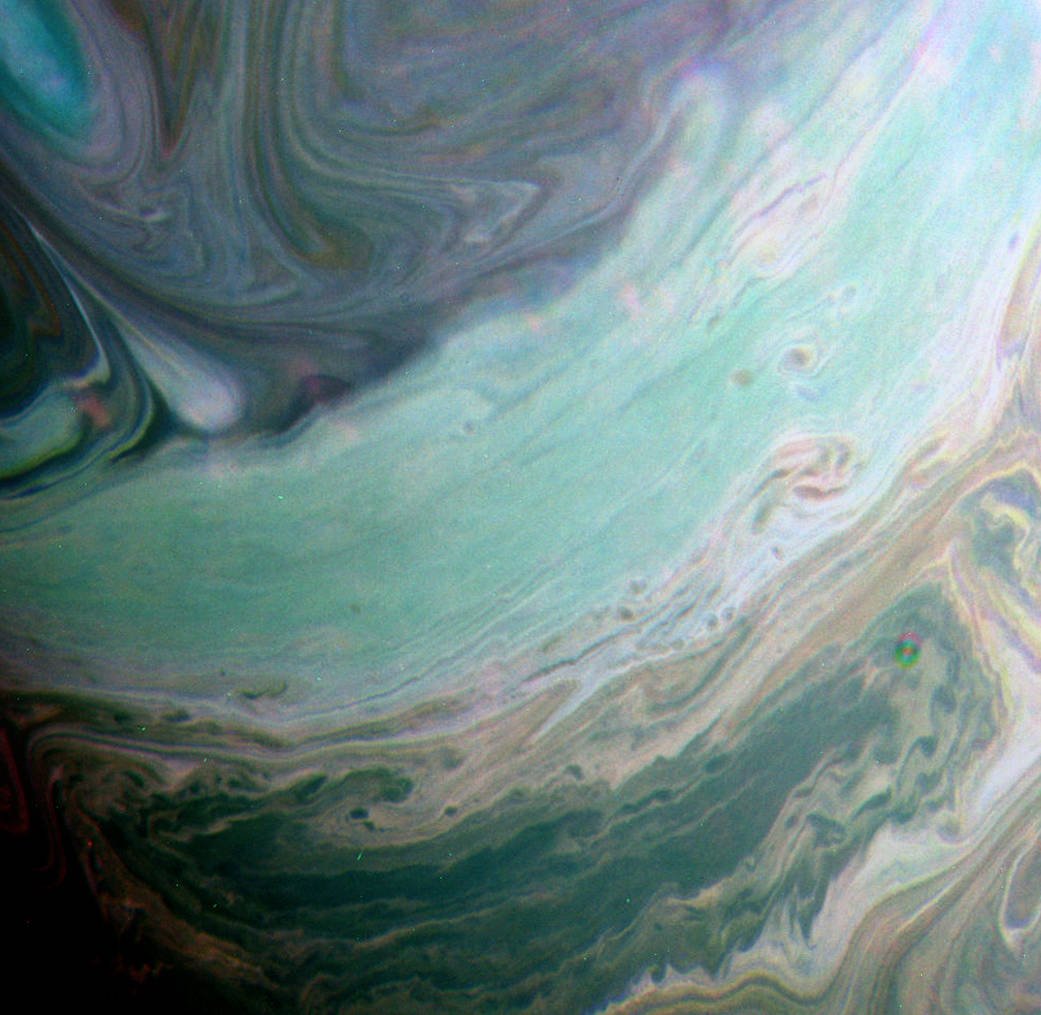
    It may look like an oil slick, but the photo above actually shows the clouds of Saturn. The false-color composite image reveals the gas giant in infrared, at wavelengths longer than those visible to the human eye. NASA uses this infrared photography to identify different chemical compositions in Saturn’s atmosphere based on how they reflect sunlight. You can see an example of how they construct these images here. This detail shot appears to show cloud bands of different compositions mixing. You can see hints of shear instabilities forming along the edges  where the light and dark bands meet. (Image credit: NASA; via Gizmodo)