Tag: rheology

  • Making Yeast-Free Pizza

    Making Yeast-Free Pizza

    Yeast is a key ingredient in many pizza doughs; as the yeast ferment sugars in the dough, they produce carbon dioxide which bubbles into the dough, creating the light and airy texture necessary for a good crust. It’s a slow process, though, often requiring several hours for the dough to rise. Recently, researchers studied an alternative pizza-making method that generates bubbles in the dough via pressurization — with no yeast required.

    The new technique is similar to the process used to carbonate sodas. The team mixed flour, water, and salt and placed the dough in an autoclave, which allowed them to control both temperature and pressure during baking. They dissolved gas into the dough at high pressure and then carefully released the pressure during baking, allowing the bubbles to grow. They used rheological measurements to compare the characteristics of yeasted and yeast-free doughs at various stages in the leavening and baking processes.

    Now that they have the methodology down, they’ve purchased a food-grade autoclave and are looking forward to taste testing their yeast-free creations — none more so than their team member who has a yeast allergy! Since the pressures required for their method are quite mild, they hope it’s a technique that restaurants will take on. (Image credit: B. Huff; research credit: P. Avallone et al.)
  • Hagfish Slime

    Hagfish Slime

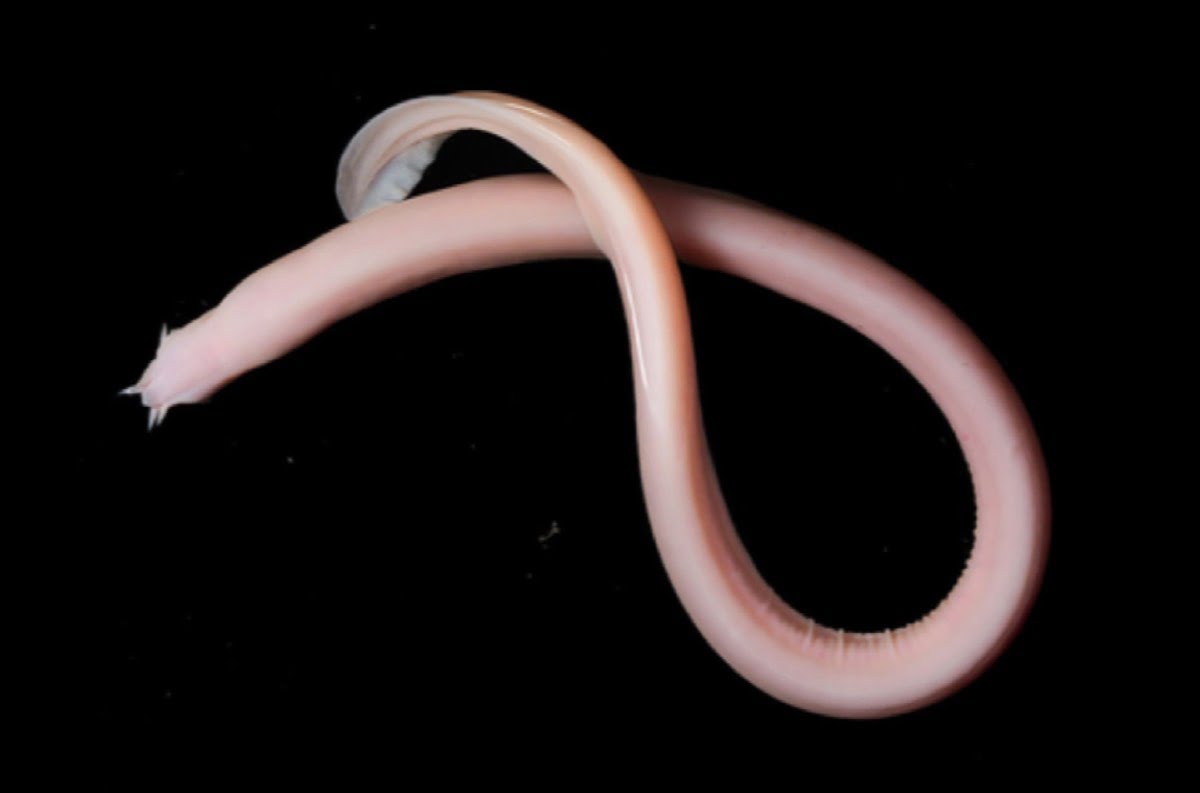
    The eel-like hagfish is a superpowered escape artist, thanks to its slime. When threatened, the hagfish releases long protein-rich threads that, when combined with turbulent sea water, unravel to form large volumes of viscoelastic slime that clog the gills of its predators. A new study shows that larger hagfish produce longer and thicker threads in their slime, enabling them to escape larger predators than their smaller brethren can.

    The properties of hagfish slime are tuned for defense. When stretched, the long protein threads resist, making the slime more viscous. Since most fish use suction methods to catch prey, that means a predator attacking a hagfish will quickly exacerbate its slimy problems. But the hagfish itself can easily escape its slime by tying itself in a knot. The threads inside the slime collapse when sheared, so the knot-tying of the hagfish slips the slime right off. (Image credit: T. Winegard; research credit: Y. Zeng et al.; via Ars Technica; submitted by Kam-Yung Soh)

  • Aging Fluids

    Aging Fluids

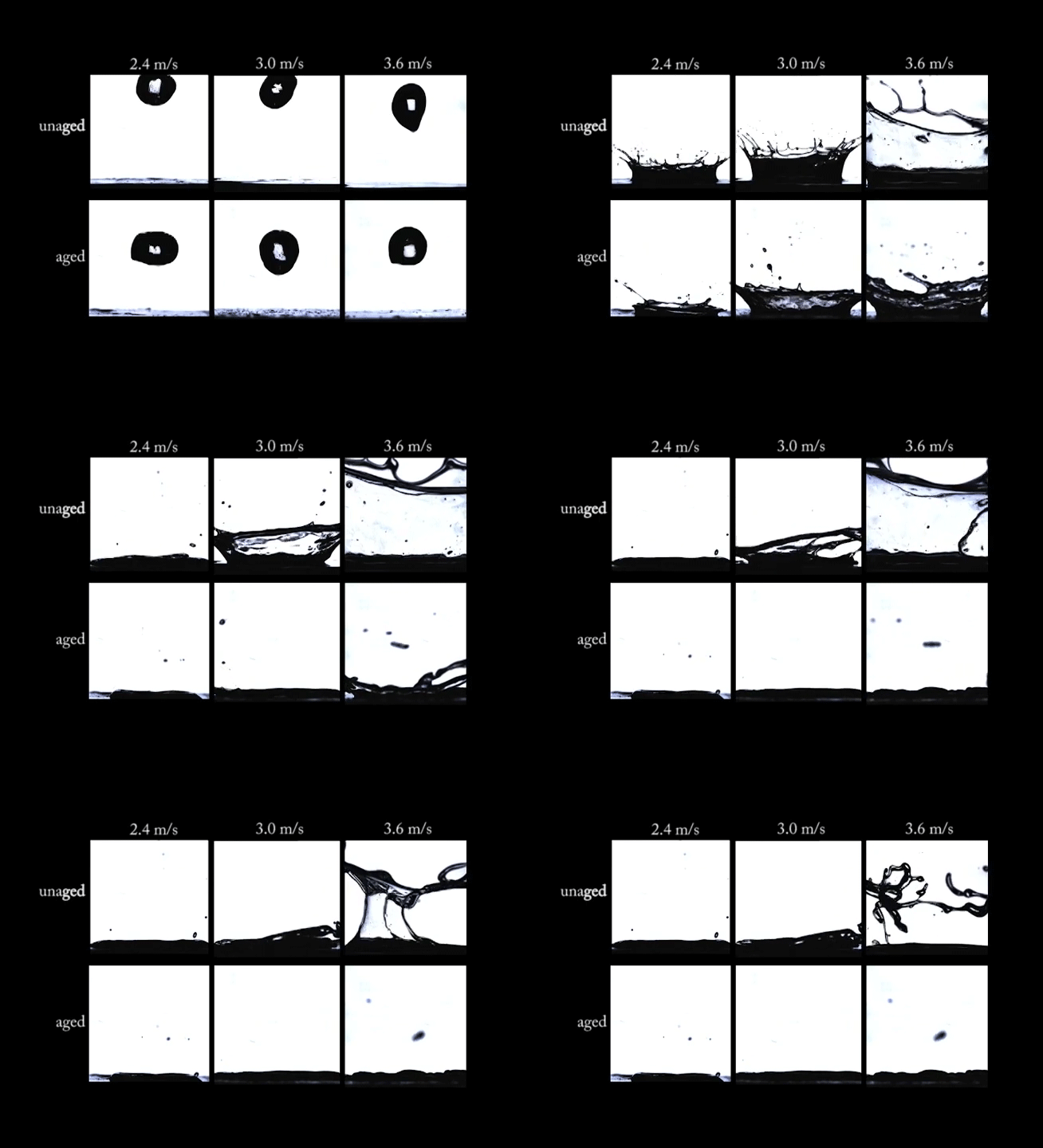
    If you’ve ever left a sealed container of Playdoh untouched for months, you know that there’s a big difference between the fresh stuff and what’s left in that can. Aging can have big effects on non-Newtonian fluids. In this video, we see drops of a synthetic clay impacting at different speeds. In the top row of images, the clay is fresh and unaged; on impact, the clay forms large crown-like splashes. In the bottom row, however, the aged clay behaves quite differently. Instead of a splash, the drops make more of a splat. (Image and video credit: R. Ewoldt et al.)

  • Studying Active Polymers Using Worms

    Studying Active Polymers Using Worms

    I’ve covered some odd studies in my time, but this might be the strangest: to understand how active polymers affect viscosity, researchers loaded drunk worms into a rheometer. Active polymers are long-chain molecules that, like worms, can move on their own using stored energy or by extracting energy from their surroundings. Their dynamics are tough to study, though, because individual polymers are almost impossible to observe while a suspension of them is being deformed.

    Enter the humble sludge worm. Often sold as fish food, these worms — like the polymers they’re meant to imitate — are individually quite wiggly but, given their size, are far easier to observe. Researchers placed them in a custom rheometer in a solution of water and observed how the worm mass responded when sheared by a spinning top plate (Image 3). Like active polymers, the worms exhibited shear-thinning; the faster the plate spun, the lower the worms’ viscosity, likely because the additional force helps align the worms.

    But how do active worms compare with passive ones? The obvious solution would be to repeat their tests with dead worms, but the researchers found a more humane method: by adding some alcohol to the water, they temporarily reduced the worms’ activity, allowing them to compare active and passive worms (Image 2). Once rinsed in water, the worms sobered up and returned to their normal activity levels.

    The researchers found that both the active and passive worms exhibited shear-thinning as the force on them increased, but the shear-thinning in the active worms was not as pronounced, presumably because the movements of individual worms prevented them from aligning smoothly. (Image and research credit: A. Deblais et al.; via Gizmodo and APS Physics)

  • Floccing Particles

    Floccing Particles

    Adding particles to a viscous fluid can create unexpected complications, thanks to the interplay of fluid and solid interactions. Here we see a dilute mixture of dark spherical particles suspended in a layer of fluid cushioned between the walls of an inner and outer cylinder. Initially, the particles are evenly distributed, but when the inner cylinder begins to rotate, it shears the fluid layer. Hydrodynamic forces assemble the particles together into loose conglomerates known as flocs. Once the particles form these log-like shapes, they remain stable thanks to the balance between viscous drag on particles and the attractive forces that pull particles toward one another. (Image and research credit: Z. Varga et al.; submitted by Thibaut D.)

  • Salty Comets

    Salty Comets

    Many of the products we use every day in our homes behave like solids until the right force is applied. These yield-stress fluids are like hand sanitizer – strong enough to suspend millimeter-sized particles when still but capable of flowing easily when pumped. In hand sanitizer, this is because the fluid is made up of swollen microgel particles that are jammed together. To rearrange, they need a certain amount of force applied. The weight of the sugars, capsules, and particulates added to the product aren’t heavy enough to move the jammed microgels, so they stay suspended.

    But researchers found that if they add a salt crystal of the same size and weight (bottom image), it sinks steadily through the gel. The salt’s velocity is constant; it doesn’t change with size as we might expect. That’s because it’s not falling by forcing the microgel particles to move. Instead, its salinity forces the microgel to release its absorbed liquid; basically, it’s collapsing the jammed particles. It falls steadily because it takes a given amount of time to collapse each gel particle.  (Image credits: microgel – N. Sharp; salt comet – A. Nowbahar et al.; research credit: A. Nowbahar et al.)

  • Giving Chocolate that Smooth Finish

    Giving Chocolate that Smooth Finish

    Anyone who’s tried to make chocolate confections at home can tell you that achieving that perfect smooth consistency isn’t easy. It was only after Rodolphe Lindt invented the process of conching in 1879 that anyone enjoyed smooth chocolate. Conching is what allows granular solids like sugar, milk and cocoa powders to mix with liquid cocoa butter into a smooth, homogeneous liquid. Although the process has been known for more than a century, it’s only recently that researchers have unraveled the underlying physics that enables it.

    One of the key parameters to conching is the a mixture’s jamming volume fraction; in other words, the point where the fraction of solid particles in the mixture is too high for it to flow freely. In the first stage of conching, the solid particulates and a small amount of liquid are stirred and slowly heated. The mechanical action of stirring breaks up aggregates and raises the jamming volume fraction. By the end of the dry conche, the mixture could flow, in theory, except that it fractures at a lower stress than what’s necessary to flow.

    At this point, chocolatiers add the remainder of the liquid ingredients. That infusion of moisture decreases the friction between solid particles and further raises the jamming volume fraction. With the system now far below that jamming point, the mixture transforms into a freely-flowing, smooth fluid. By understanding the intricacies of the process, scientists hope to reduce the energy necessary in chocolate production and similar industrial processes.  (Image credit: A. Stein; research credit: E. Blanco et al.; via Physics World; submitted by Kam-Yung Soh)

  • How the Hagfish Deploys Its Slime

    How the Hagfish Deploys Its Slime

    Hagfish – an eel-like species – are known for their prodigious slime production, which helps them escape predators (and, in some cases, seriously muck up highways). Part of the hagfish’s slime consists of ~10 cm fibers that the creature deploys in tiny skeins (bottom) only a hundred microns across. To form the viscoelastic slime that thwarts its predators, those skeins of fiber have to unravel and do so in only tenths of a second. A new study shows that viscous drag plays a major role in that unraveling. 

    Most fish use a suction method to catch prey. In the hagfish’s case, that does the predator more harm than good because the very flow it creates to try and catch the hagfish pulls the slime skein apart and helps the slime expand 10,000 times in volume, creating a mess that chokes the gills of the attacking fish. (Image credit: top – L. Böni et al.; bottom – G. Choudhary et al., source; research credit: G. Choudhary et al.; via Ars Technica; submitted by Kam Yung Soh)

  • Featured Video Play Icon

    Even Mountains Flow

    Over about 5 months of 2018, the summit of Mount Kilauea slowly collapsed as the volcano erupted. Seen in timelapse, it’s a remarkable reminder of the ancient Greek philosopher Heraclitus’s observation, “Everything flows.” All things change, so given enough time, just about everything can flow.

    Fluid dynamicists actually capture this concept in a dimensionless ratio known as the Deborah number. Named for a Biblical prophet who states, “The mountains flow before the Lord,” the Deborah number is defined as the ratio between the time needed for a material to respond applied stress and the time over which the process is observed. In practice, a lower Deborah number indicates a more fluid-like material while a higher one represents more solid-like behavior.

    Be sure to check out the full video. There’s some spectacular lava flow footage near the end – definitely a small Deborah number! (Video and image credit: USGS via Science; research credit: C. Neal et al.)

  • Swallowing Physics

    Swallowing Physics

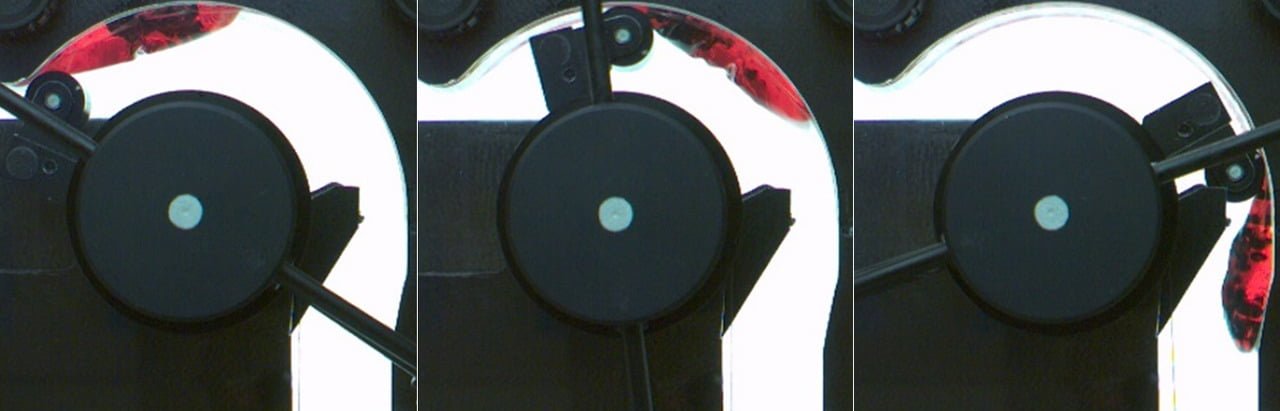
    Swallowing – whether of food, beverage, or medication – is an important process for humans, but it’s one many struggle with, especially as they age. To help study the physics behind swallowing, one research group has built an artificial mouth and throat model, shown in the bottom row of images. The model uses rollers to imitate the wave-like motion of swallowing. 

    In our mouths, chewed food typically combines with saliva to form a soft ball we can move from our tongue and down our throat with a series of reflex actions. How easily we swallow something depends on its flow properties, our saliva, shape, and more. 

    In their early studies of model swallowing, researchers have focused on what it takes to swallow pills (suspended in liquid). What they found is probably consistent with your own experience: smaller pills are easier to swallow than large ones, and elongated pills are easier to swallow than round ones of the same volume. That seems to be a function of elongated pills’ smaller cross-section when aligned with flow going down the throat. As the research continues, scientists hope to explore what can be done to make food easier to swallow for those who struggle with it. (Image credits: meal – D. Shevtsova; model – M. Marconati; via APS Physics; submitted by Kam-Yung Soh)