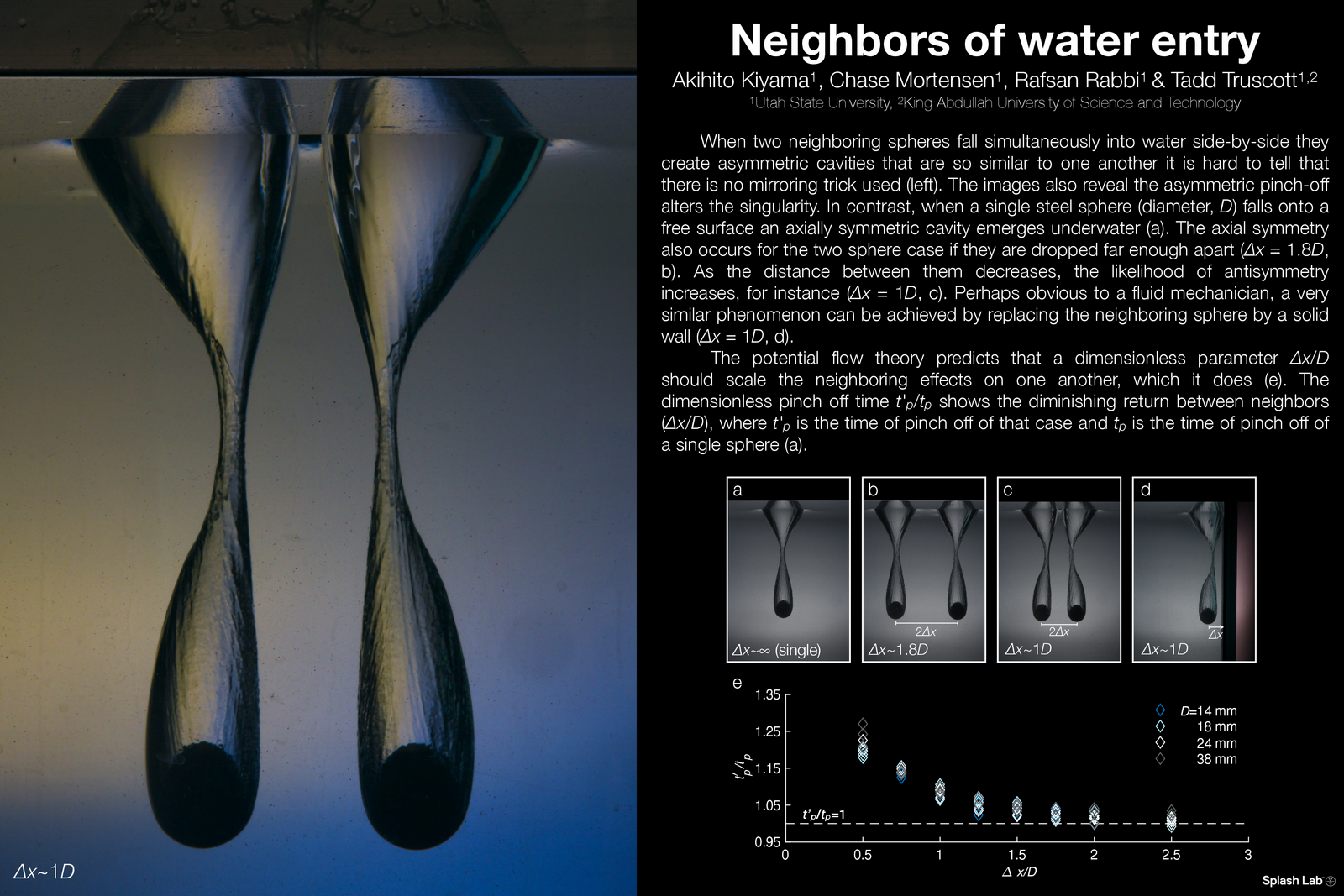
Two spheres dropped into water next to one another form asymmetric cavities. A single ball’s cavity is perfectly symmetric, and so are two spheres’, provided they are far enough apart. But for close impacts, the spheres influence one another, creating a mirror image. The same asymmetric cavity also forms when a sphere is dropped near a wall. In fluid dynamics, this trick — using two mirrored objects in place of a wall — is used to make calculating certain flows easier! (Image credit: A. Kiyama et al.)
Tag: potential flow

Happy Valentine’s Day!
Here’s a potential flow field with heart-shaped streamlines, made just for you. Thank you to everyone for having helped made FYFD such a success over these 700 posts, whether by liking, reblogging, tweeting, or telling a friend. Happy Valentine’s Day!
For the curious among you, the flow is a superposition of uniform flow, two sources, and two sinks. The Matlab code is here. Have fun!

Leapfrogging Vortices
This numerical simulation shows two pairs of vortices interacting in a leap-frogging motion. Another version shows the same situation but with a small perturbation in the rotational alignment that causes even more interesting interactions. Both simulations are of potential flow–an idealized flow without viscosity where velocity can be described as the gradient of a scalar function. The mathematics governing potential flow are notably easier than the full Navier-Stokes equations that govern fluid mechanics. (submitted by jessecaps)

