Tag: porous flow

  • Inside Drying Wood

    Inside Drying Wood

    Wood must dry before it can be used in most applications, but with its complex internal structure exactly how wood dries out has been unclear. New experiments combining MRI and x-ray imaging reveal a process quite different than expected.

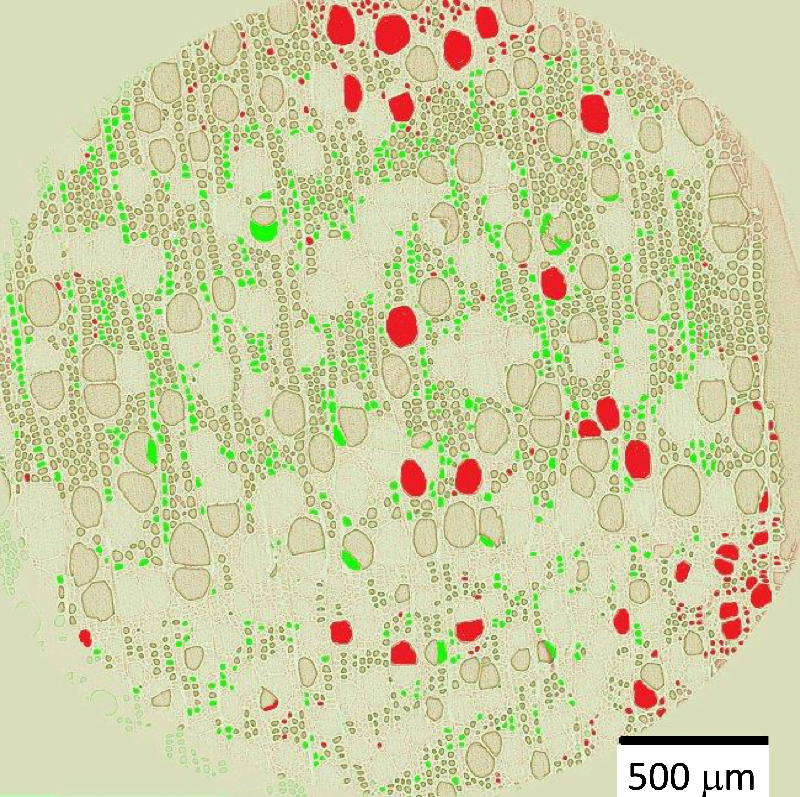
    Inside hardwoods like poplar — the species studied here — wood contains both solid structures and pores where water can gather. The pores do not form a fully interconnected network, so capillary action alone is unable to carry water through the pores and out to a surface where it can evaporate.

    Instead, researchers found that water evaporating at the surface came from so-called “bound water” in the wood’s solid structures. As the bound water evaporated, it caused water in the wood pores to diffuse into the solid walls, becoming bound and continuing to feed the evaporation. (Image and research credit: H. Penvern et al.; via APS Physics)

  • Lake Stars

    Lake Stars

    As snow-covered frozen lakes melt, stars appear on their surface. These lake stars form around holes in the ice where (relatively) warm water seeps up into the slush layer. The stars form through a competition between thermal effects and flow through the porous snow. Researchers have built mathematical models that capture the first-order effects, like predicting the number of arms a star will form. (Image and research credit: V. Tsai and J. Wettlaufer; submitted by keeonn)

  • In Search of a Better Espresso

    In Search of a Better Espresso

    Of specialty coffee drinks, espresso has the most cup-to-cup variation in quality. For those who are not coffee aficionados — such as yours truly — espresso is made by forcing hot water through a packed bed of coffee grains. Many factors can affect the final output, including the amount of dry coffee used, the fineness of the grind, water temperature and pressure, and how tightly packed the granular bed is.

    Conventional wisdom suggests that a fine grind is best since it increases the exposed surface area of coffee, but researchers found this is not, in fact, ideal. At very fine grinds, the bed of coffee becomes so tightly packed that water cannot pass through some sections, meaning that the coffee there is completely wasted since nothing is extracted.

    Instead, a slightly coarser grind provided better and more consistent extraction because water passed through the entire bed of grains. The researchers point out that this not only produces a good, consistent cup of espresso, but it does so with less waste, something that is becoming more and more important as the climate crisis affects coffee growers. (Image credit: K. Butz; research credit: M. Cameron et al.; via Cosmos; submitted by Kam-Yung Soh)

  • Peering Between Particles

    Peering Between Particles

    Turbulence is not the only way to mix fluids. Even a steady, laminar flow can be an effective mixer if geometry lends a hand. Above, two dyes, fluorescein (green) and rhodamine (red), are injected into a porous flow through packed spheres. The flow runs from bottom to top in both images. Seeing the flow in such a crowded geometry is challenging. Here researchers used spheres with an index of refraction that matches water – that helps them avoid refraction that would prevent them from looking through spheres to the flow on the other side. They also lit a narrow plane of the flow using a laser sheet to isolate it. Together, this allowed the researchers to track the mixing of the two initially separate streaks of dye as they randomly mix in the spaces between spheres. (Image and research credit: M. Kree and E. Villermaux)

  • Watching Flow Inside Rock

    Watching Flow Inside Rock

    Flow through porous substances has been a major interest in fluid dynamics for the last hundred years because rocks are porous. For most of that period, we’ve used Darcy’s law to calculate how a fluid flows through pores in a rock. (Incidentally, it can also be used for determining the perfect length of time for dunking a cookie in milk.) Often, however, there is more than one fluid in a pore – for example, both a liquid and a gas could be trapped there. In that case, researchers made a few assumptions that allowed them to extend Darcy’s law for these multiphase situations. For a long time, that was the best anyone could do because it was impossible to observe what’s actually happening in the pores inside an actual rock.

    Recently, however, scientists have begun observing these multiphase flows inside sandstone pores using x-ray imaging. They’re only able to take an image every 45 seconds or so, but even that is frequent enough to show that the flow is surprisingly unsteady. An example image is shown above. The colored areas show pores filled with nitrogen inside the rock. Brine is also being injected into the rock but not being shown. The colors indicate how connected the nitrogen-filled pores are to other pores nearby. Red areas are highly connected; blue have moderate connections; and green areas are smaller and have fewer connections. The network connections inside the rock change relatively rapidly, even with steady-state injection conditions. That varying connectivity implies that some of the injection energy is going into shifting interfaces around rather than actually moving the fluids through the pores. More work will be needed to unravel what’s really happening inside the porous network, but the results have far-reaching implications for understanding groundwater filtration, fossil fuel extraction, and, in the future, the possibility of carbon sequestration. (Image credit: C. Reynolds et al., source; submitted by Simon D.)