Tag: physics

  • Swimming in Complex Fluids

    Swimming in Complex Fluids

    Bacteria like E. coli swim using flagella, helical filaments attached to biological motors on their bodies. By rotating the flagella, the bacterium generates thrust that propels it forward. Oddly, though, researchers observed decades ago that bacteria actually travel faster through complex fluids — like those with polymers or particles in them — than they do through simple fluids like water. A new study using colloids — small particles suspended in a liquid — shows why.

    The researchers compared bacteria swimming through polymer-filled fluids and colloidal fluids and found strong overlap both qualitatively and quantitatively. They observed, for example, that bacteria swim in straighter lines — they wobble less — in complex fluids. The reason, according to the authors, is the hydrodynamic influence of the added materials. Essentially, when a bacterium swims near a colloid or piece of polymer, the particle exerts a torque on the microswimmer that reduces its wobble and enhances its speed. (Image credit: Cheng Research Group; research credit: S. Kamdar et al.; via Physics World)

  • Featured Video Play Icon

    Meet BILLY

    Many wings in nature are not rigid. Instead they flex and curve with the flow. Here researchers imitate that phenomenon with BILLY (Bio-Inspired Lightweight and Limber wing prototYpe). Using an evolutionary-style algorithm, BILLY determines its own optimal flapping characteristics to maximize performance. Its flexible membrane-style wing actually performs better than a rigid wing! Check out the end of the video for some flow visualization of the leading edge vortex. (Image and video credit: A. Gehrke et al.)

  • Featured Video Play Icon

    “Water III”

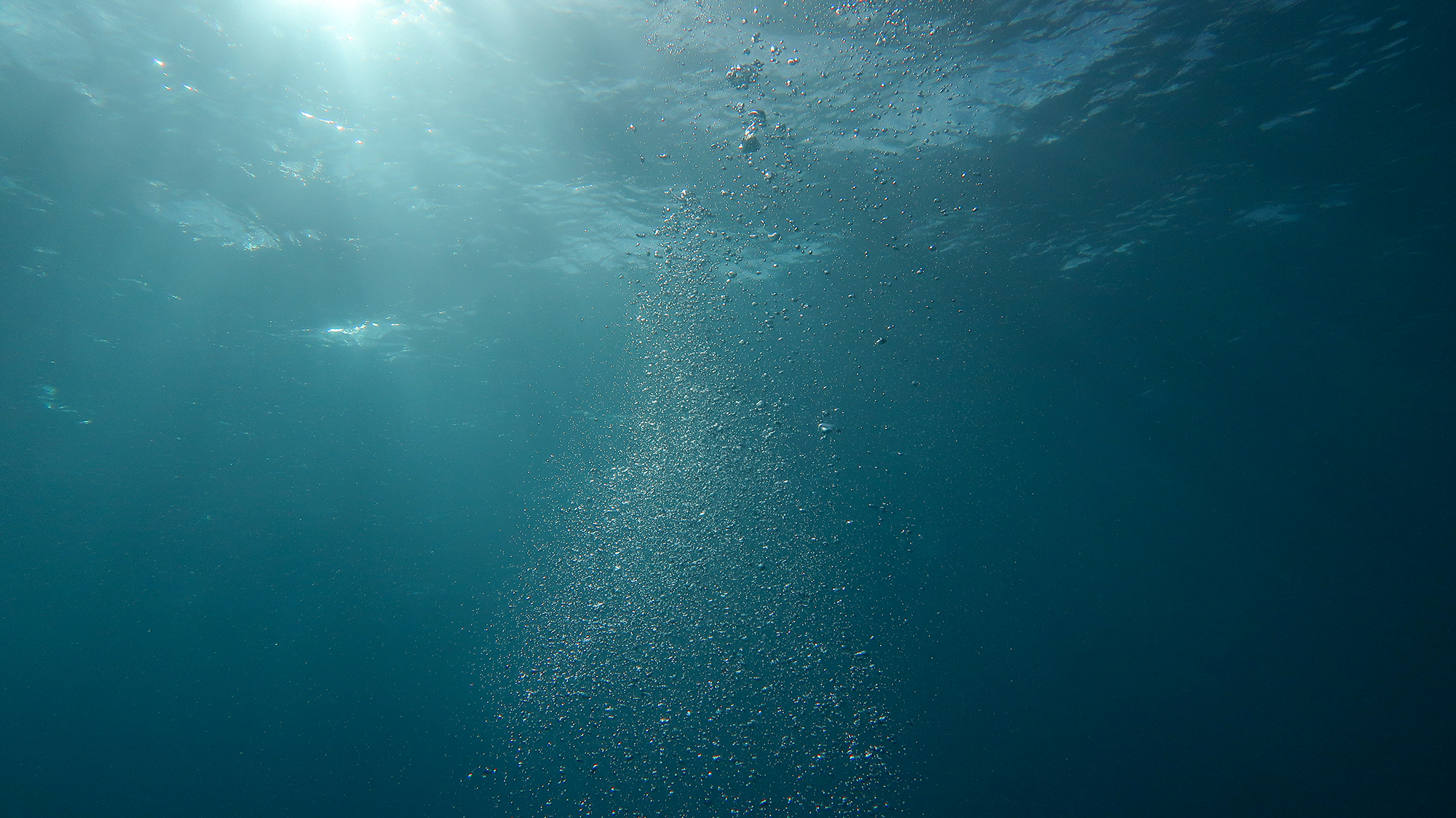
    In “Water III,” filmmaker Morgan Maassen explores the ocean from above and below. I love the sheer variety of fluid phenomena; yes, there are classic breaking barrel waves for surfing, but there are also rib vortices and bubble plumes and churning turbulence that wouldn’t be out of place in a stormy Midwestern sky. Enjoy! (Image and video credit: M. Maassen)

  • Mapping Yellowstone Underground

    Mapping Yellowstone Underground

    Yellowstone National Park is filled with geysers, hot springs, and mudpots — all geophysical features driven by the underground movement of water heated by the underlying volcano. But what does that underground plumbing look like? To find out, a team of researchers flew a 25-m diameter electromagnetic loop over portions of the park; they used the electromagnetic feedback induced in the loop to roughly map the subsurface features of the park.

    To their surprise, they found that deep hydrothermal vents in Yellowstone lie in discrete locations; previously, geologists assumed the vents were more widespread. With a better sense of what lies beneath, park officials will be able to build new infrastructure in areas better protected from one of the park’s biggest hazards: hydrothermal explosions caused by a buildup of pressure underground. (Image credits: top – I. Shturma, map – C. Finn et al.; research credit: C. Finn et al.; via Physics World)

    Editor’s Note: This article was written and scheduled prior to the historic flooding in Yellowstone in June 2022.

    Geophysical map of Yellowstone's Upper Geyser Basin, including Old Faithful.
    Geophysical map of Yellowstone’s Upper Geyser Basin, including Old Faithful.
  • Rip Currents

    Rip Currents

    Rip currents — also known as rips — are a threat to beachgoers around the world, and, unfortunately, they’re often underestimated or misunderstood. As waves crash on the shore, water must find a path back out to sea, often through deeper channels that provide a break between the waves. These flow paths are rip currents, and they can form, shift, and intensify with little warning.

    Over the years, researchers have found that efforts to educate beachgoers through signs, flags, and other methods once at the beach have done little to help visitors understand, avoid, or escape rips. Instead, it’s better to educate people long before the water is in sight. Since no one method is guaranteed success for escaping a rip, it’s better to learn to recognize and avoid these dangerous areas. Check out the video below for advice on spotting rips, and here’s a video showing rips from a surfer’s perspective, as well as one using dye flow visualization to mark a rip. Be safe and smart out there! (Image credit: P. Auitpol; video credit: Surf Life Saving Australia; via Hakai Magazine; submitted by Kam-Yung Soh)

  • Inside a Champagne Pop

    Inside a Champagne Pop

    When the cork pops on a bottle of champagne, the physics is akin to that of a missile launch in more ways than one. In this study, researchers used computational fluid dynamics to closely examine the gases that escape behind the cork. They identified three phases to the flow. In the first, the exhaust gases form a crown-shaped expansion region, complete with shock diamonds. Once the cork has moved far enough downstream, the axial flow accelerates to supersonic speeds and a bow shock forms behind the cork. Finally, the pressure in the bottle drops low enough that supersonic conditions cannot be maintained and the flow becomes subsonic. (Image credit: top – Kindel Media, simulation – A. Benidar et al.; research credit: A. Benidar et al.; via Ars Technica; submitted by Kam-Yung Soh)

    A numerical simulation showing the ejection of a champagne cork from a bottle. The colors indicate the speed of gases escaping from the bottle.
    A numerical simulation showing the ejection of a champagne cork from a bottle. The colors indicate the speed of gases escaping from the bottle.
  • Featured Video Play Icon

    Pop-Pop Boats

    I confess I’ve never heard of the pop-pop boat toys Steve Mould uses in this video. They feature a tank filled with water and a small source of heat in the form of a tea light candle. Together, these features generate propulsion and a distinctive popping sound from the toy. As he is wont to, Mould explains the physics behind the toy using a transparent version to show the water/steam oscillations that drive the boat. Having watched, I have to say that this set-up seems ready made for an undergrad fluids class and a control volume analysis! (Image and video credit: S. Mould)

  • A Forest of Ferrofluids

    A Forest of Ferrofluids

    Ferrofluids are made up of ferrous nanoparticles suspended in a carrier fluid like an oil. Under magnetic fields, they take on an array of shapes — from pointed spikes to elaborate labyrinths — depending on the field strength and what fluids they’re surrounded by. This photographic series by Linden Gledhill captures some of that fantastic variety, with ferrofluids that look like cells and nebulas in addition to mazes and tridents. See more of Gledhill’s work at his website and in previous posts. (Image credit: L. Gledhill)

  • Spinning Off-Axis

    Spinning Off-Axis

    To make a vortex in the laboratory, researchers typically set a tank on a rotating platform and allow the water to drain out a hole in the center of the tank. In that case, a vortex forms over the drain (like in your bathtub!) and remains centered over the hole. In nature, though, vortices rarely follow such a simple path.

    In this experiment, researchers moved the drainage hole so that it is not aligned with the tank’s axis of rotation. Although the vortex forms over the drain (marked by a yellow dot in the lower image), it quickly moves away, following a roughly circular path around the axis until it comes to a stop. Green dye marks fluid from the tank’s bottom boundary layer, which eventually gets entrained up into the vortex. (Image and research credit: R. Munro and M. Foster; via Physics Today)

    Timelapse animation showing the development of the vortex. The yellow dot marks the location of the drain.
    Timelapse animation showing the development of the vortex. The yellow dot marks the location of the drain.

  • Particle-Filled Coatings

    Particle-Filled Coatings

    Pulling a solid object from a liquid bath can coat it in a thin layer of liquid. The thickness of the coating layer depends on the speed at which the object is removed. Introducing particles into the liquid bath adds a new dimension to the coating problem, namely the size of the particles. In this poster, researchers demonstrate some of the coatings possible in a mixture with particles of more than one size. It’s even possible, they note, to filter out particles of a certain size by carefully selecting the removal speed. (Image credit: D. Jeong et al.)