Tag: molecular dynamics

  • Nanoconfined Water

    Nanoconfined Water

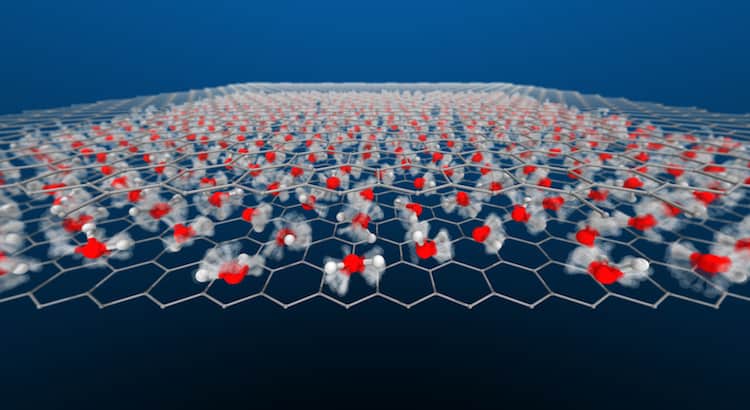
    Water is a decidedly weird substance. It’s densest above its freezing point; it has a slippery liquid-like layer on its solid form; and, in the right form, it can bend like a wire. So it’s not surprising that water demonstrates some odd behaviors when it’s confined inside a space so narrow it’s only one molecule thick.

    A new, simulation-based study finds that this nanoscale-confined water flows with a wide variety of behaviors, depending on the temperature and pressure. In some conditions, the water ceases to act molecularly, with hydrogen atoms flowing through a lattice of oxygen atoms. These superionic forms were thought only to exist in the extreme conditions of a gas giant’s interior, but these simulations suggest we can find them under far milder circumstances. (Image and research credit: V. Kapil et al.; via Physics World; submitted by Kam-Yung Soh)

  • When Shear Meets Slip

    When Shear Meets Slip

    One of the classic concepts students learn early in their fluids education is the no-slip condition. In essence, this idea says that friction between a solid object — say, a wall — and the fluid immediately next to it is such that no movement is possible where they meet. The fluid cannot “slip” along the surface, hence “no-slip”. It’s a simple concept, but one that can create a lot of complexity in practice.

    Imagine, for example, a fluid sandwiched between two surfaces: one stationary and one moving at a constant speed. This movement creates a shear flow, in which the velocity of the fluid varies from the speed of the moving plate all the way down to zero, the speed of the stationary plate. If we placed a little platelet in the middle of this flow, we’d expect it to rotate because of the faster flow on one side.

    But a new paper finds something rather different, at least when considering an extremely small nanoplatelet. With a tiny enough plate, individual molecules can slip along the surface, and when that happens, instead of rotating, the nanoplatelet aligns itself with the flow. That alignment means the added particle would disturb the flow less, creating a lower viscosity and better flowability. (Image and research credit: C. Kamal et al.; submitted by Simon G.)

  • Coalescence at the Smallest Scales

    Coalescence at the Smallest Scales

    The coalescence of two water droplets happens so quickly, it’s essentially impossible to see, even with high-speed cameras. For this reason, researchers have turned to simulating molecular dynamics – essentially building computer programs that model the actions of all the molecules contained in the water droplets. Viewed this way, the very first contact between drops comes from thermal fluctuations – the random jumping of molecules across the separating gap. Once the bridge starts to form, it continues to grow, driven by thermal forces and opposed by surface tension. Eventually, this thermal regime gives way to the more familiar hydrodynamic one, where the bridge is large enough for flow to drive its growth. (Image credits: experiment – S. Nagel et al.; simulation – S. Perumanath et al.; research credit: S. Perumanath et al.; submitted by Rohit P.)

  • Boiling with Sound

    Boiling with Sound

    Ultrasonic vibrations can boil nanoscale liquid layers, according to a new simulation-based study. Above you see a layer of water initially about 2 nm thick. When the surface it’s on vibrates at frequencies in the 100 GHz range – about a billion times faster than a hummingbird flaps – it superheats the thin layer of water. In this case, the film undergoes nucleate boiling, forming the same kinds of bubbles you see when boiling a pot of water. When the water layer gets too thin to support nucleate boiling, it stops boiling but evaporation continues. The transition occurs when van der Waals forces become significant. The technique only works with ultrathin layers of a liquid, but the authors envision broad application possibilities in industry as well as in micro- and nano-scale fluid systems. (Image and research credit, and submission: R. Pillai et al.)

  • A Molecular View of Boiling

    A Molecular View of Boiling

    All matter is made up of molecules. But most of the time we treat fluids as materials with given properties – like density, viscosity, and surface tension – without worrying about the individual molecules responsible for those material characteristics. Now that we have much more powerful computers, though, we can begin to simulate fluid behavior in terms of molecules.

    The animations above show some examples of this. In the top animation, we see a gas condensing into a liquid. As the temperature decreases, molecules start clumping together, and eventually settle into a droplet on the solid surface. The lower animation shows the opposite situation – boiling – in which bubbles of vapor nucleate next to the solid surface and grow as more liquid changes phase. To see more examples, including droplets pinching off, check out the full video.   (Image credit: E. Smith et al., source; submitted by O. Matar)