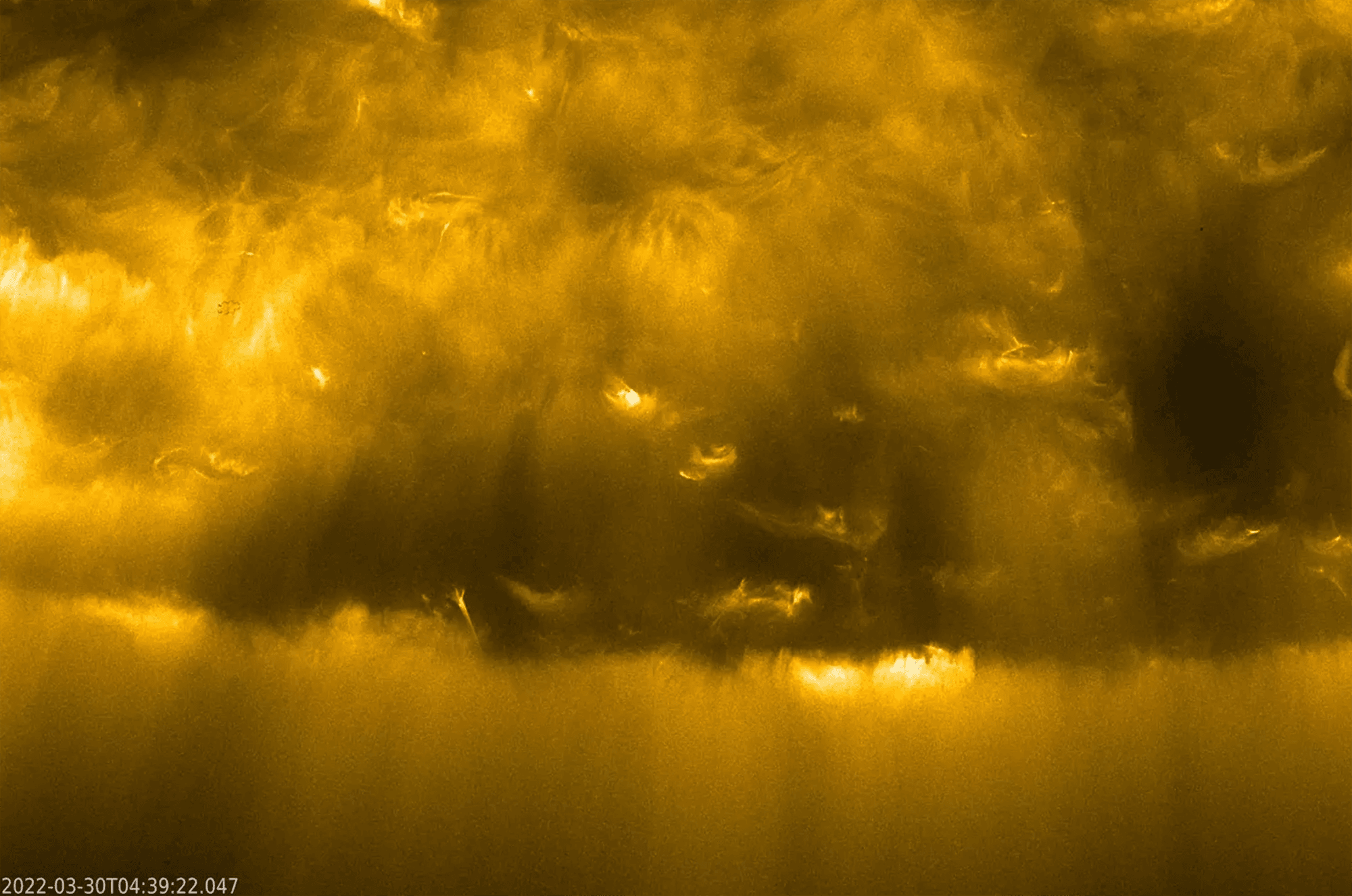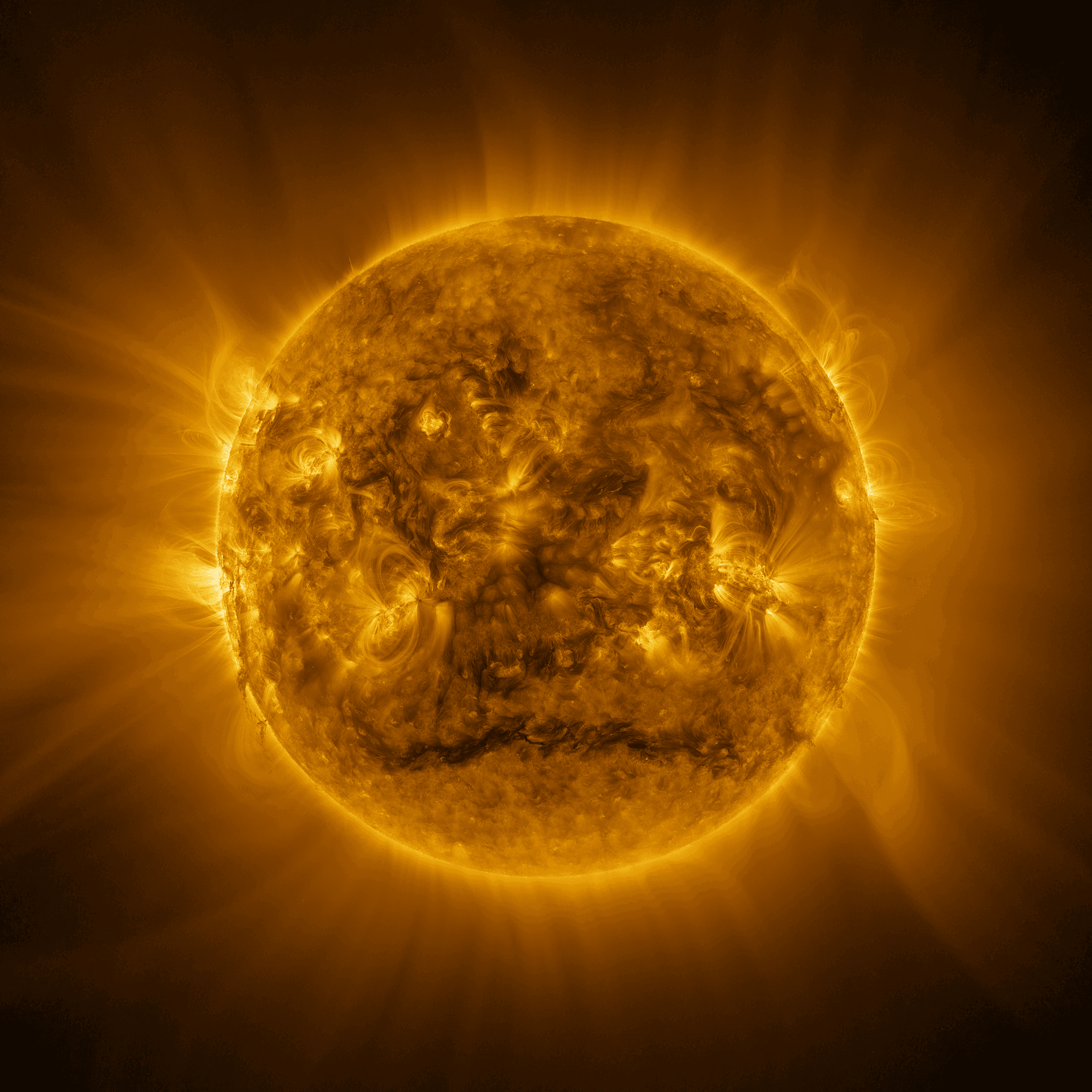
Fall into our nearest star in this gorgeous high-resolution view of the Sun. Taken by Solar Orbiter, a joint NASA-ESA mission, the image stretches from the fiery photosphere — full of filaments and prominences — to the wispy yet unbelievably hot corona. It’s well worth clicking through to zoom in and around the full size image. (Image credit: ESA & NASA/Solar Orbiter/EUI Team, E. Kraaikamp; via Gizmodo)
Tag: magnetohydrodynamics

Striations on the Sun
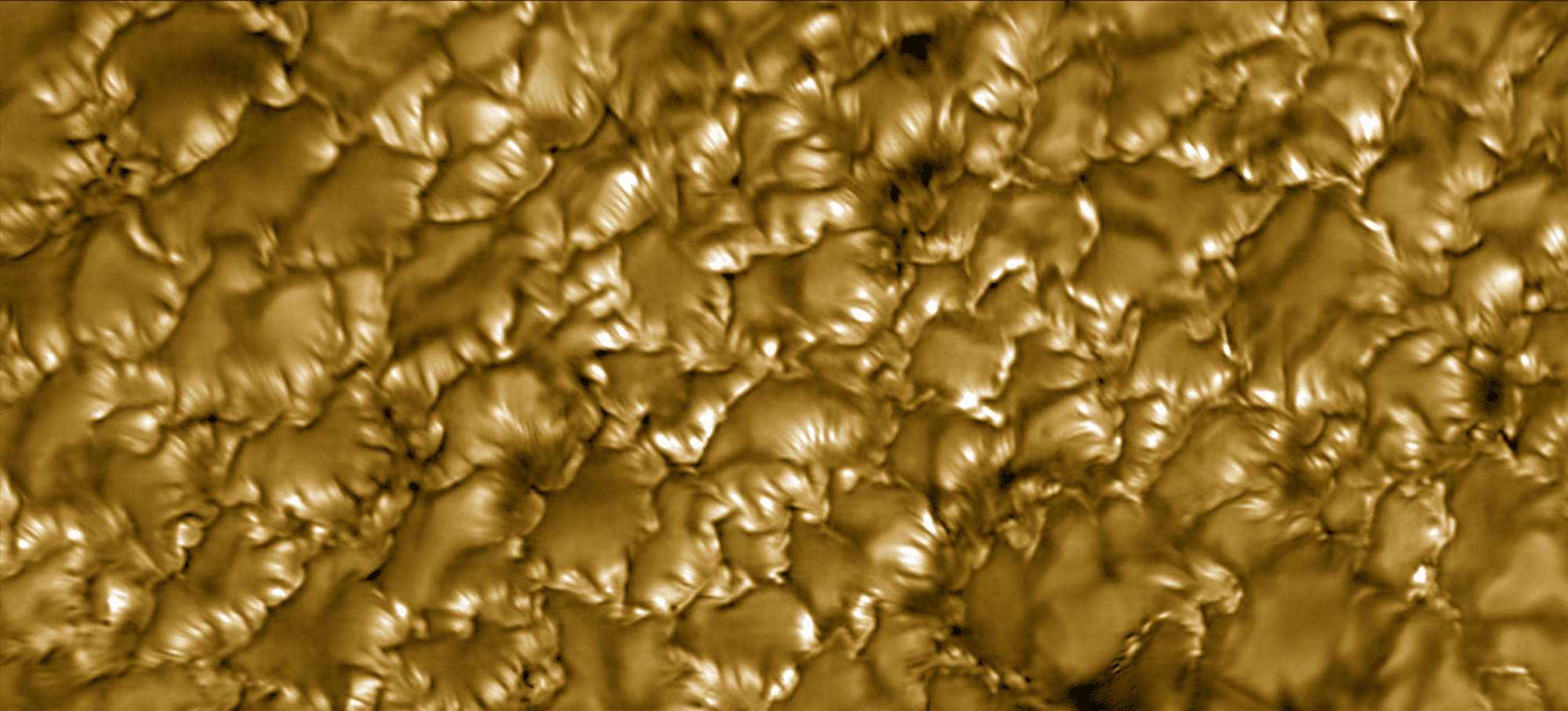
One of the perpetual challenges for fluid dynamicists is the large range of scales we often have to consider. For something like a cloud, that means tracking not only the kilometer-size scale of the cloud, but the large eddies that are about 100 meters across and smaller ones all the way down to the scale of millimeters. In turbulent flows, all of these scales matter. That problem is even harder for something like the Sun, where the sizes range from hundreds of thousands of kilometers down to only a few kilometers.
It’s those fine-scale features that we see captured here. This colorized image shows light and dark striations on solar granules. Scientists estimate that each one is between 20 and 50 kilometers wide. They’re reflections of the small-scale structure of the Sun’s magnetic field as it shapes the star’s hot, conductive plasma. (Image credit: NSF/NSO/AURA; research credit: D. Kuridze et al.; via Gizmodo)
Fediverse Reactions
-

Compressing Jupiter’s Magnetosphere
Shaped by its strong internal magnetic field and the incoming solar wind, Jupiter has the largest magnetosphere in the solar system. It also has highly active aurorae at its poles, though they are most visible in ultraviolet wavelengths. A new analysis of Juno’s data shows that on 6-7 December 2022, Jupiter’s magnetosphere got compressed, coinciding with aurorae six times brighter than usual. The compression itself came from a shock wave in the incoming solar wind. (Image credit: NASA/JPL; research credit: R. Giles et al.; via Eos)
Fediverse Reactions
-

A Glimpse of the Solar Wind
In December 2024, Parker Solar Probe made its closest pass yet to our Sun. In doing so, it captured the detailed images seen here, where three coronal mass ejections — giant releases of plasma, twisted by magnetic fields — collide in the Sun’s corona. Events like these shape the solar wind and the space weather that reaches us here on Earth. The biggest events can cause beautiful auroras, but they also run the risk of breaking satellites, power grids, and other infrastructure. (Image credit: NASA/Johns Hopkins APL/Naval Research Lab; video credit: NASA Goddard; via Gizmodo)
Fediverse Reactions
-

A New Plasma Wave for Jupiter
Jupiter‘s North Pole has a powerful magnetic field combined with plasma that has unusually low electron densities. This combination, researchers found, gives rise to a new type of plasma wave.
Ions in a magnetic field typically move parallel to magnetic field lines in Langmuir waves and perpendicularly to the field lines in Alfvén waves — with each wave carrying a distinctive frequency signature. But in Jupiter’s strong magnetosphere, low-density plasma does something quite different: it creates what the team is calling an Alfvén-Langmuir wave — a wave that transitions from Alfvén-like to Langmuir-like, depending on wave number and excitation from local beams of electrons.
Although this is the first time such plasma behavior has been observed, the team suggests that other strongly-magnetized giant planets — or even stars — could also form these waves near their poles. (Image credit: NASA / JPL-Caltech / SwR I/ MSSS/G. Eason; research credit: R. Lysak et al.; via APS)
Fediverse Reactions
-

See the Solar Wind
After a solar prominence erupts, strong solar winds flow outward from the sun, carrying energetic particles that can disrupt satellites and trigger auroras if they make their way toward us. In this video, an instrument onboard the ESA/NASA’s Solar Orbiter captures the solar wind in the aftermath of such an eruption. The features seen here extended 3 solar radii and lasted for hours. The measurements give astrophysicists their best view yet of this post-eruption relaxation period, and the authors report that their measurements are remarkably similar to results of recent magnetohydrodynamics simulations, suggesting that those simulations are accurately capturing solar physics. (Video and image credit: ESA; research credit: P. Romano et al.; via Gizmodo)
Fediverse Reactions
-

Bright Night Lights
A coronal mass ejection from the Sun set night skies ablaze in mid-October 2024. This composite panorama shows a busy night sky over New Zealand’s South Island. A widespread red aurora was joined by a green picket-fence aurora and a host of other magnetohydrodynamic phenomena. To the left shines a bright Stable Auroral Red (SAR) arc. On the right near the Moon hangs the purple arc of a STEVE — strong thermal emission velocity enhancement. All of these auroras (and aurora-adjacent phenomena) take place when high-energy particles from the solar wind interact with molecules in our atmosphere. Which molecules they encounter determines the color of the aurora, and the shape depends, in part, on which magnetic lines the particles get funneled down. With strong solar storms like this one, auroras can reach far from the poles, and, as seen here, can show up in many varieties. (Image credit: T. McDonald; via APOD)
Fediverse Reactions
-

Glimpses of Coronal Rain
Despite its incredible heat, our sun‘s corona is so faint compared to the rest of the star that we can rarely make it out except during a total solar eclipse. But a new adaptive optic technique has given us coronal images with unprecedented detail.

These images come from the 1.6-meter Goode Solar Telescope at Big Bear Solar Observatory, and they required some 2,200 adjustments to the instrument’s mirror every second to counter atmospheric distortions that would otherwise blur the images. With the new technique, the team was able to sharpen their resolution from 1,000 kilometers all the way down to 63 kilometers, revealing heretofore unseen details of plasma from solar prominences dancing in the sun’s magnetic field and cooling plasma falling as coronal rain.
The team hope to upgrade the 4-meter Daniel K. Inouye Solar Telescope with the technology next, which will enable even finer imagery. (Image credit: Schmidt et al./NJIT/NSO/AURA/NSF; research credit: D. Schmidt et al.; via Gizmodo)
Fediverse Reactions
-

Seeing the Sun’s South Pole For the First Time
The ESA-led Solar Orbiter recently used a Venus flyby to lift itself out of the ecliptic — the equatorial plane of the Sun where Earth sits. This maneuver offers us the first-ever glimpse of the Sun’s south pole, a region that’s not visible from the ecliptic plane. A close-up view of plasma rising off the pole is shown above, and the video below has even more.
Solar Orbiter will get even better views of the Sun’s poles in the coming months, perfect for watching what goes on as the Sun’s 11-year-solar-cycle approaches its maximum. During this time, the Sun’s magnetic poles will flip their polarity; already Solar Orbiter’s instruments show that the south pole contains pockets of both positive and negative magnetic polarity — a messy state that’s likely a precursor to the big flip. (Image and video credit: ESA & NASA/Solar Orbiter/EUI Team, D. Berghmans (ROB) & ESA/Royal Observatory of Belgium; via Gizmodo)
Fediverse Reactions
-

Stunning Interstellar Turbulence
The space between stars, known as the interstellar medium, may be sparse, but it is far from empty. Gas, dust, and plasma in this region forms compressible magnetized turbulence, with some pockets moving supersonically and others moving slower than sound. The flows here influence how stars form, how cosmic rays spread, and where metals and other planetary building blocks wind up. To better understand the physics of this region, researchers built a numerical simulation with over 1,000 billion grid points, creating an unprecedentedly detailed picture of this turbulence.
The images above are two-dimensional slices from the full 3D simulation. The upper image shows the current density while the lower one shows mass density. On the right side of the images, magnetic field lines are superimposed in white. The results are gorgeous. Can you imagine a fly-through video? (Image and research credit: J. Beattie et al.; via Gizmodo)
Fediverse Reactions
-



























































![[empty]](https://files.mastodon.social/accounts/avatars/106/887/462/825/018/571/original/52e5d4364f73668f.jpg)