Ground effect vehicles (a.k.a. wing-in-ground-effect vehicles) rely on their proximity to a flat surface to inhibit the wingtip vortices that create lift-induced drag. This effectively increases the lifting capabilities of the vehicle in comparison to regular flight, but only so long as the vehicle remains close enough to the ground. This video features many model gliders that rely on ground effect.
Tag: lift

Wind Tunnel Testing
This photo shows a prototype of the X-48C blended wing body aircraft being tested in NASA Langley’s 12-Foot Low-Speed Tunnel. Blended wing bodies have many advantages over conventional tube-and-wing designs: the entire surface of the craft can generate lift; the usable cargo/passenger area of the craft is increased; and, structurally, the craft is easier to manufacture. Flight tests of a remote-controlled version of the craft have also taken place.

Wright Brothers’ Wind Tunnel
A large part of the Wright Brothers’ ultimate success in creating the first powered heavier-than-air craft came as a result of work done in their homemade wind tunnel, shown above. In the aftermath of the failure of their 1901 Glider, the brothers decided that the lift and drag data they had used from Otto Lilienthal must be inaccurate. They built this wind tunnel and its force balances to measure lift and drag on two hundred different airfoils themselves and were rewarded with far more successful flights with their 1902 Glider, which led directly to the Wright Flyer in the following year. #

Tubercles and Turbines
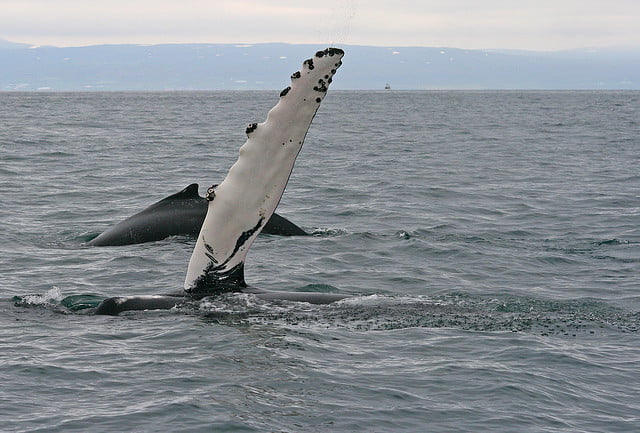
The flippers of humpback whales include bumps–called tubercles–on their leading edges. The tubercles create vortices that prevent the boundary layer from separating, which causes stall and a loss of lift. New research shows that adding similar bumps to the leading edge of tidal turbine blades results in greater energy production at low flow speeds compared to conventional designs. See Scientific American for more. #

Pterosaur Aerodynamics
The pterosaur was an enormous prehistoric reptile that flew with wings of living membrane stretched over a single long bone, unlike any of today’s flying creatures. New research using carbon fiber wing analogues and wind tunnel testing suggests that the pterosaur would have been a slow, soaring flyer well adapted to using thermals for lift. Once on a thermal, the pterosaur could coast, perhaps for hours at a time, with little to no flapping necessary. See the research paper or the Scientific American article for more. #

Flying Snake Video
A follow-up on the flying snakes. This video shows researchers filming the actual snakes gliding and performing maneuvers. See also the Scientific American article on their work. #

Flying Snakes Draft off Themselves
Some snakes in Southeast and South Asia are known to glide some 100 m between trees. Researchers filmed snakes, constructed computational models of their flights, and tested plastic models in a water tunnel. They found that the snakes angled their bodies such that they generate lift to counteract their fall and that the S-configuration they assume increases lift much the way flying in a V-formation does for geese. The wake from the forward portion of the snake interacts with the flow around the back of the snake and reduces downwash, which increases lift. In effect, the back of the snake is drafting off the front. #

Bell’s Powered Kite
Inventor Alexander Graham Bell is best known for the telephone but also made many contributions to early aeronautics. This man-carrying kite, the Cygnet III, was a powered kite with a “wing” made of 3,393 tetrahedral cells; it managed enough lift to fly on March 1, 1912. National Geographic is featuring photos from the early days of flight courtesy of the Smithsonian National Air and Space Museum. They’re well worth checking out. #

xkcd and Lift
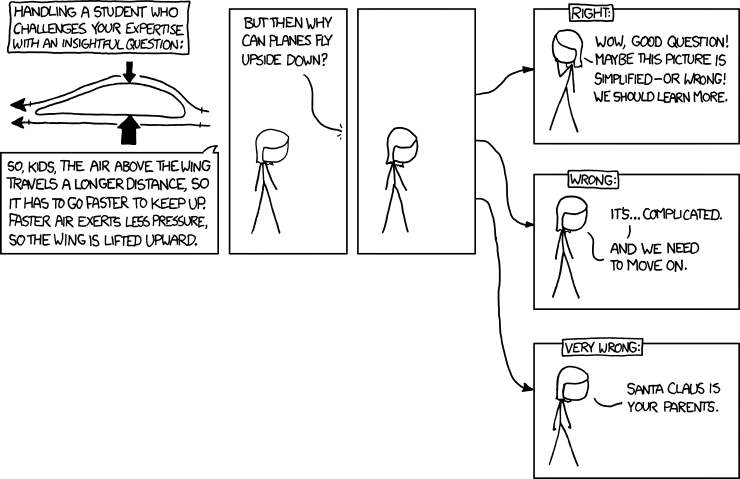
xkcd identifies a very common misconception about how airfoils work! (via Vinnchan and jasonas14) #

Jet-Based Control
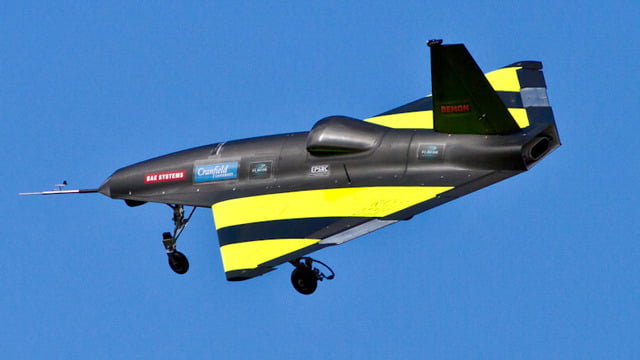
Researchers have flown the first aircraft designed to maneuver without conventional control surfaces like ailerons and flaps. Instead of changing the wing geometry to alter the lift on different parts of the craft, the UAV uses strategically placed jets of air along the wing to control its flight. The plane can also alter the direction of its thrust, not by turning the nozzle as is conventionally done, but by modifying the thrust vector by directing and firing a secondary jet into the exhaust. #