Tag: hydrophobic

  • Anoles Revisited

    Anoles Revisited

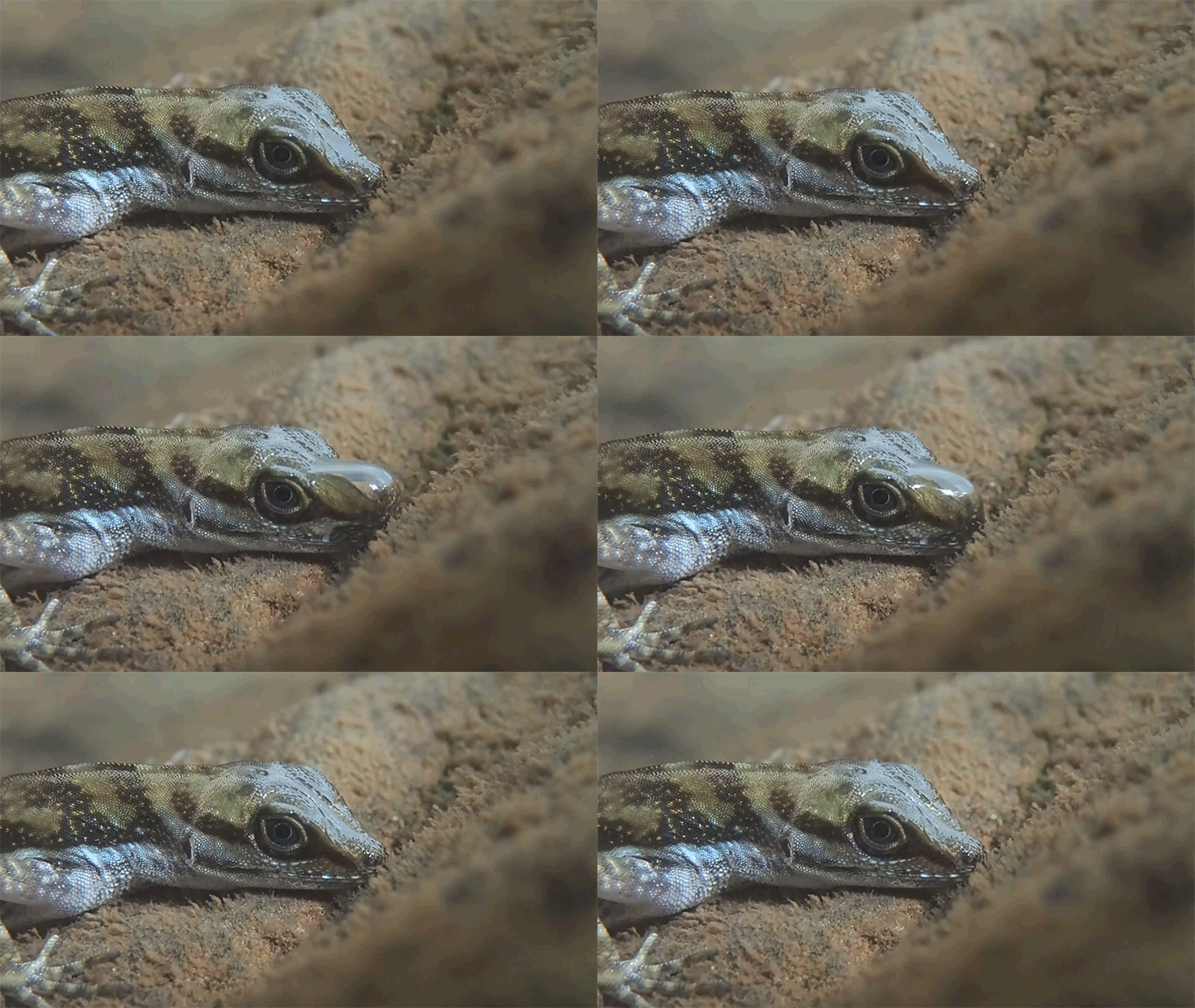
    Longtime readers may recall seeing this little bubble-crowned anole previously. This species dives underwater to escape predators and will breathe and rebreathe a bubble of air for as much as 18 minutes before resurfacing. At the time of my original post, I speculated that the reptile’s hydrophobic skin might provide a large enough bubble surface area to provide some diffusion of fresh oxygen from the surrounding water.

    Since then, there’s been at least one study of this anole rebreathing process. Researchers found that many anole species share this behavior, but aquatic species use it more regularly. They noted that the plastron — that flat, silvery bubble that’s spread over the lizard’s skin — helps hold the bigger, exhaled bubble in place and might facilitate a little of the diffusion I speculated about but the results are unclear on that last point. The authors note that it’s unlikely that the anoles could support their full metabolism through rebreathing and diffusion but that the plastron may yet support some rejuvenation of oxygen, which would help prolong anoles’ dives. (Image and research credit: C. Boccia et al.)
  • Hydrophobic Ice

    Hydrophobic Ice

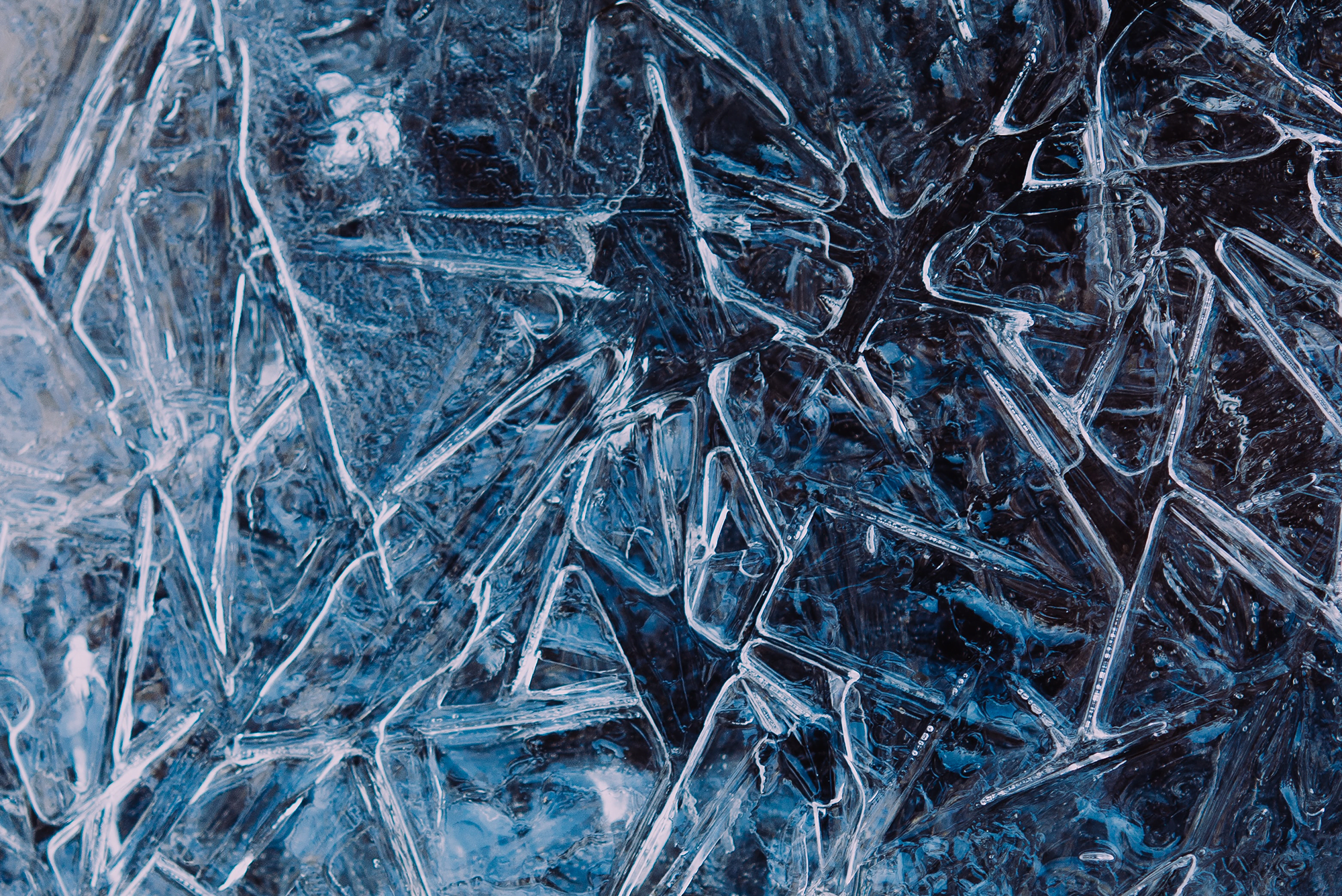
    Water is an endlessly peculiar substance, eager to adopt many configurations. Each molecule can form up to four, highly-directional bonds. In this study, researchers found an unexpected configuration, a 2D type of ice known as bilayer hexagonal ice, on a corrugated gold surface. Bilayer hexagonal ice has been known since the late 1990s, but it was thought to be comparatively rare. In this form, water molecules assemble in an ice only two molecular layers thick, with hydrogen bonds between neighboring molecules taking up nearly all possible binding sites. With nowhere to bind, additional water cannot add to the ice’s thickness, making the ice as a whole hydrophobic or “water-fearing”.

    Illustration of 2D hydrophobic ice.
    This illustration shows a type of 2D ice, known as bilayer hexagonal ice, as it forms on a corrugated gold surface. From above (top half), the water molecules align to the surface with some molecules (red) in the troughs and others (pink) along the ridges. Viewed from the side (lower half), most of the molecules bind with their neighbors, leaving few H-bond sites available where more water layers of water could attach. This inability to add more vertical layers is why the ice appears hydrophobic.

    Previously, this type of ice had only been found on hydrophobic, flat surfaces. In the latest research, though, researchers found that surface corrugations allowed the ice to form, even on a surface that was only slightly hydrophobic. Observations like these help theorists modeling water and its interactions with surface. (Image credit: top – E. McKenna, illustration – APS/A. Stonebraker; research credit: P. Yang et. al.; via APS Physics; submitted by Kam-Yung Soh)

  • The Two-Faced Splash

    The Two-Faced Splash

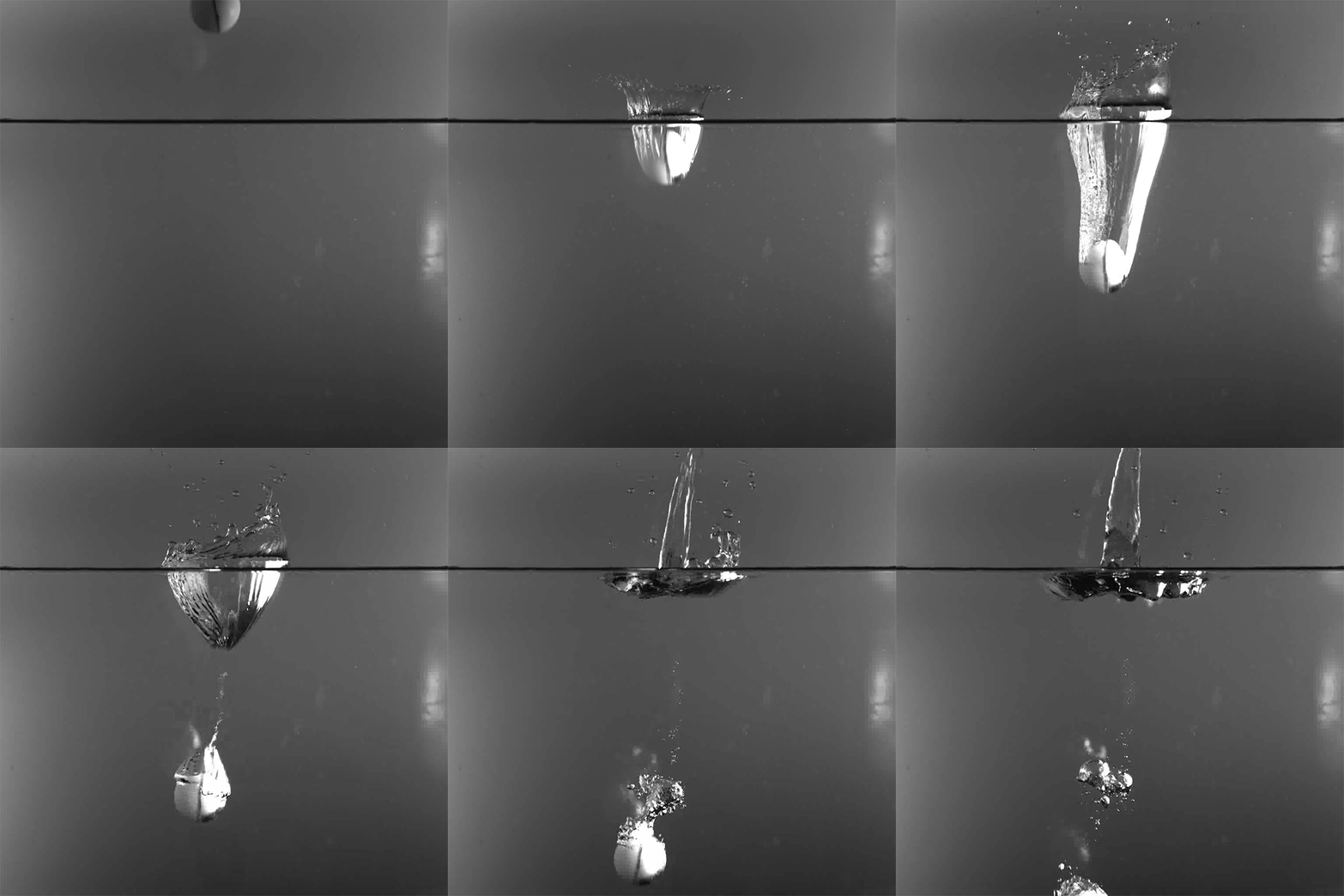
    The way a sphere enters water depends on its size, speed, and surface properties. A hydrophilic (water-attracting) sphere behaves differently than a hydrophobic (water-repelling) one. But what happens when the object’s surface properties aren’t uniform?

    That’s the situation we see above. The dark line marks the two hemispheres of the sphere and their differing surface properties. To the left, the sphere is hydrophilic; to the right, it is hydrophobic. When the sphere hits the water, both the splash and underwater cavity quickly become asymmetric. On the hydrophobic side, the cavity wall is smooth, but the cavity is rough on the hydrophilic side. In the end, the asymmetries create a horizontal force that pushes the sphere sideways. (Image and research credit: D. Watson et al.)

  • Featured Video Play Icon

    How Animals Stay Dry in the Rain

    Getting wet can be a problem for many animals. A wet insect could quickly become too heavy to fly, and a wet bird can struggle to stay warm. But these animals have a secret weapon: tiny, multi-scale roughness on their wings, scales, and feathers that helps them shed water. Watch the latest FYFD video to learn how! (Image and video credit: N. Sharp; research credit: S. Kim et al.)

  • Kicking Droplets

    Kicking Droplets

    Moving the surface a droplet sits on creates some interesting dynamics, especially if the surface is hydrophobic. That’s what we see here with these droplets launched off an impulsively-moved plate.

    On the left, the drop has some limited contact with the plate and it takes time for the droplet to completely detach. When accelerated, the droplet first flattens into a pancake, the rim of which quickly leaves the plate. The center of the droplet is slower to detach, stretching the drop into a vase-like shape. When the drop does finally lose contact, it creates a fast-moving jet that shoots upward at several meters per second!

    In contrast the image on the left shows a levitating Leidenfrost droplet. Since this drop has no physical contact with the plate, the kick makes it leave the surface all at once, launching a pancake-like drop that quickly forms unstable lobes. (Image and research credit: M. Coux et al.)

  • Featured Video Play Icon

    Rattlesnakes Sip Rain From Their Scales

    Getting enough water in arid climates can be tough, but Western diamondback rattlesnakes have a secret weapon: their scales. During rain, sleet, and even snow, these rattlesnakes venture out of their dens to catch precipitation on their flattened backs, which they then sip off their scales.

    Researchers found that impacting water droplets tend to bead up on rattlesnake scales, forming spherical drops that the snake can then drink. Compared to other desert-dwelling snakes, Western diamondbacks have a far more complicated microstructure to their scales, with labyrinthine microchannels that provide a sticky, hydrophobic surface for impacting drops. (Video and image credit: ACS; research credit: A. Phadnis et al.; via The Kid Should See This)

  • Featured Video Play Icon

    The Sharpshooter Insect

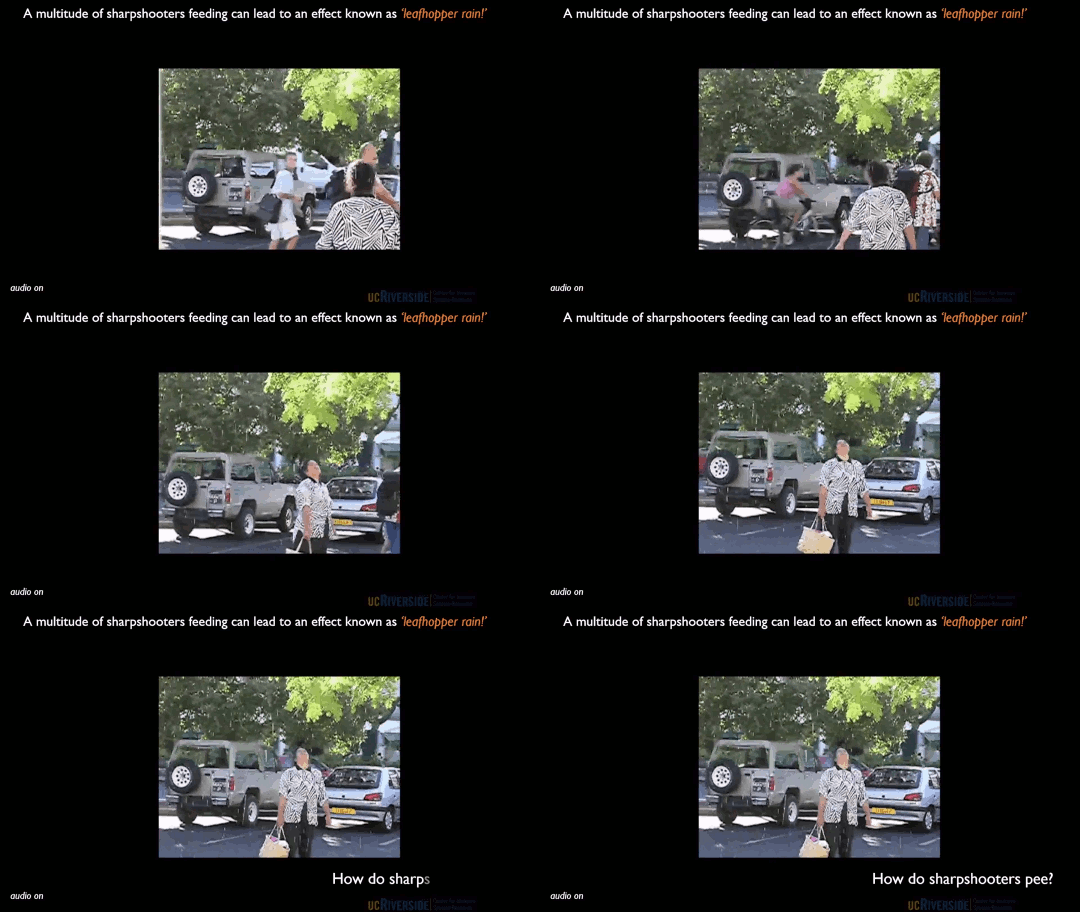
    The sharpshooter is a small, sap-sucking insect capable of consuming more than 300 times its body weight in fluid each day. To sustain that level of intake, the insect also has to have a robust mechanism for expelling excess fluid, and that particular talent has earned the insect the nickname of the “pissing fly”. Together a group of sharpshooters can expel enough fluid to imitate rain (top).

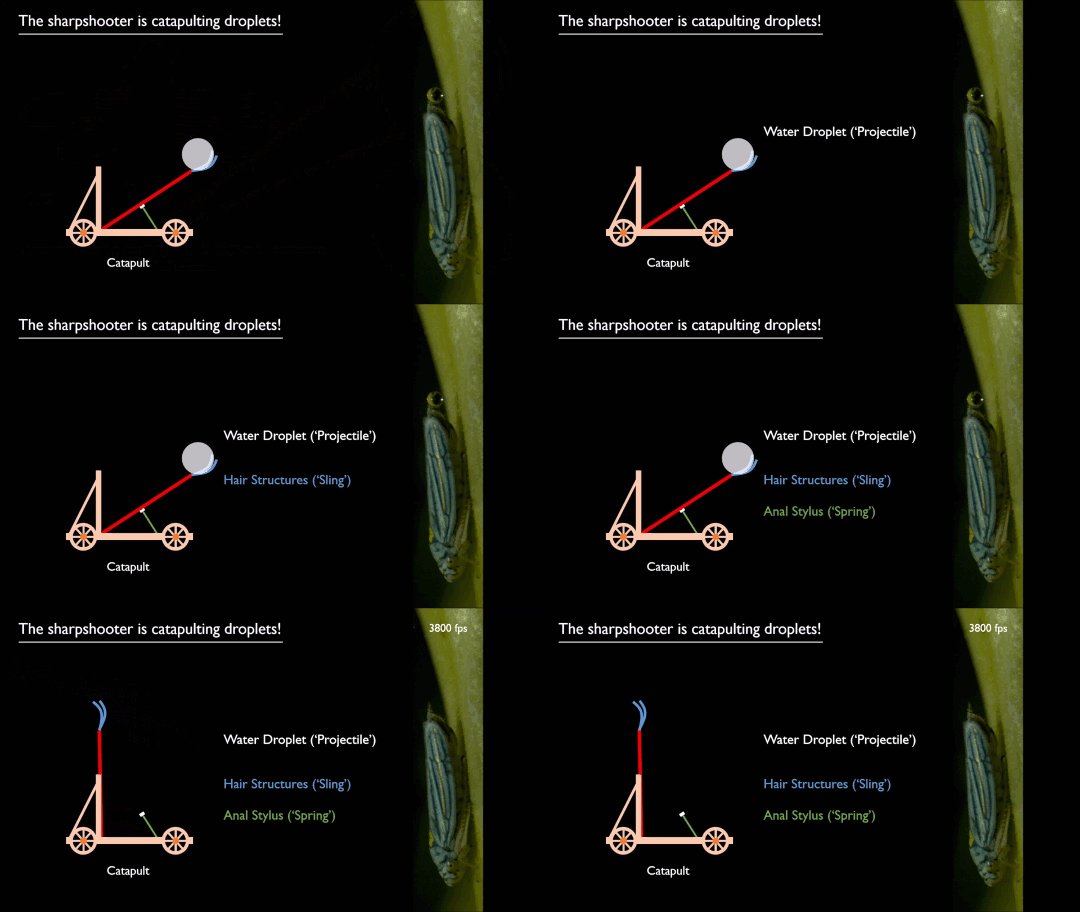
    Individually, the insects form a droplet on hydrophobic hairs near their anus. Once the droplet is large enough, those hairs bend like a spring, and the droplet gets catapulted off the insect with an acceleration greater than 20g. That makes it among the fastest reactions in the natural world – more than twenty times the acceleration of a cheetah. Understanding this mechanism is valuable for engineers building robotics as well as for finding ways to counter the agricultural menace the sharpshooters present when it comes to spreading diseases among infected crops. (Image and video credit: E. Challita et al.; via WashPo; submitted by Marc A.)

  • Featured Video Play Icon

    Bouncing, Floating, and Jetting

    Get inside some of the latest fluid dynamics research with the newest FYFD/JFM video. Here researchers discuss oil jets from citrus fruits, balls that can bounce off water, and self-propelled levitating plates. This is our third entry in an ongoing series featuring interviews from researchers at the 2017 APS DFD conference. Missed one of the previous ones? Not to worry – we’ve got you covered. (Video and image credit: N. Sharp and T. Crawford)

  • Corrugating Water

    Corrugating Water

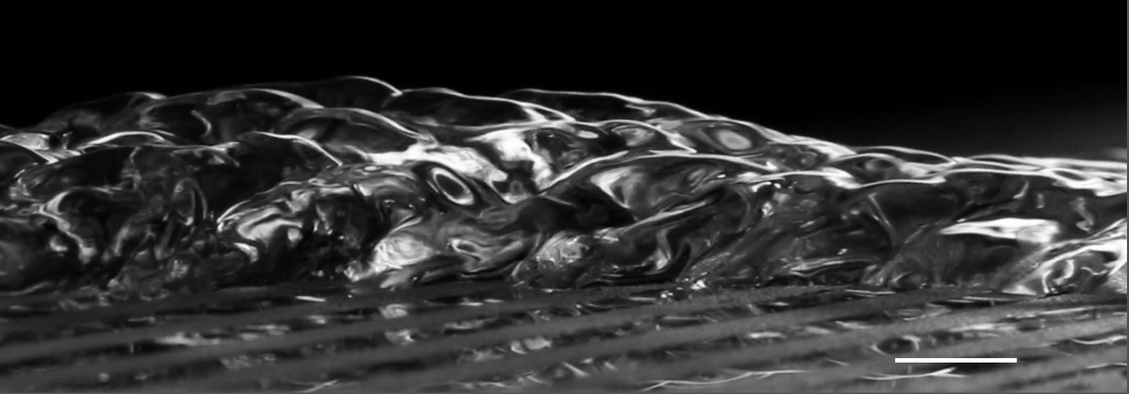
    The characteristics of a surface can have a major impact on the form a flow takes. The photo above shows a corrugated, almost pinecone-like water surface. It’s the result of a sheet of water flowing over a surface with alternating bands of hydrophobic (water-repelling) and hydrophilic (water-loving) properties. The water sheet narrows over hydrophobic sections and expands over hydrophilic ones. Gravity, inertia, and surface tension compete to create the overall braided appearance. You can see a top-down view of the flow in the original poster. (Image credit: M. Grivel et al., source)

  • Featured Video Play Icon

    When Fire Ants are a Fluid

    Substances don’t have to be a liquid or a gas to behave like a fluid. Swarms of fire ants display viscoelastic properties, meaning they can act like both a liquid and a solid. Like a spring, a ball of fire ants is elastic, bouncing back after being squished (top image). But the group can also act like a viscous liquid. A ball of ants can flow and diffuse outward (middle image). The ants are excellent at linking with one another, which allows them to survive floods by forming rafts and to escape containers by building towers. 

    Researchers found the key characteristic is that ants will only maintain links with nearby ants as long as they themselves experience no more than 3 times their own weight in load. In practice, the ants can easily withstand 100 times that load without injury, but that lower threshold describes the transition point between ants as a solid and ants as a fluid. If an ant in a structure is loaded with more force, she’ll let go of her neighbors and start moving around.

    When they’re linked, the fire ants are close enough together to be water-repellent. Even if an ant raft gets submerged (bottom image), the space between ants is small enough that water can’t get in and the air around them can’t get out. This coats the submerged ants in their own little bubble, which the ants use to breathe while they float out a flood. For more, check out the video below and the full (fun and readable!) research paper linked in the credits. (Video and image credits: Vox/Georgia Tech; research credit: S. Phonekeo et al., pdf; submitted by Joyce S., Rebecca S., and possibly others)

    ETA: Updated after senoritafish rightfully pointed out that worker ants are females, not males.