Although eyes are common at the center of large-scale cyclones, scientists are only now beginning to understand how they form. Since real-world cyclogenesis is complicated by many competing effects, researchers look at simplified model systems first. A typical one uses a shallow, rotating cylindrical domain in which heat rises from below. The rotation provides a Coriolis force, which shapes the flow. In particular, it causes a boundary layer along the lower surface of the domain, creating a thin region where the flow moves radially inward. (Its opposite forms at the upper surface of the domain, sending flow radiating outward.) Like an ice skater spinning, the flow’s vorticity intensifies as it approaches the central axis of rotation. When the conditions are right, this intensely swirling boundary layer flow lifts up into the main flow, forming an eyewall. The eye itself, it turns out, is merely a reaction to the eyewall’s formation. (Image credit: S. Cristoforetti/ESA; research credit: L. Oruba et al.)
Tag: hurricanes

Atmospheric Aerosols
Recently, NASA Goddard released a visualization of aerosols in the Atlantic region. The simulation uses real data from satellite imagery taken between August and October 2017 to seed a simulation of atmospheric physics. The color scales in the visualization show concentrations of three major aerosol particles: smoke (gray), sea salt (blue), and dust (brown). One of the interesting outcomes of the simulation is a visualization of the fall Atlantic hurricane season. The high winds from hurricanes help pick up sea salt from the ocean surface and throw it high in the atmosphere, making the hurricanes visible here. Fires in the western United States provide most of the smoke aerosols, whereas dust comes mostly from the Sahara. Tiny aerosol particles serve as a major nucleation source for water droplets, affecting both cloud formation and rainfall. With simulations like these, scientists hope to better understand how aerosols move in the atmosphere and how they affect our weather. (Image credit: NASA Goddard Research Center, source; submitted by Paul vdB)

CYGNSS


Yesterday marked the launch of a new constellation of eight microsatellites, the Cyclone Global Navigation Satellite System (CYGNSS), designed to monitor hurricanes in Earth’s tropics. The constellation will provide unprecedented capability to monitor conditions inside hurricanes–information that will hopefully help scientists improve hurricane prediction models. Each CYGNSS microsat monitors GPS signals that it receives from the GPS satellite system and from the reflection of that signal off the Earth. By comparing these signals, the satellites can determine wave heights in the ocean, and from that wave information, they can measure surface wind speeds. By peering inside the hurricane as it forms and travels, scientists hope they will be better able to estimate not only a hurricane’s path but how strong it will be when it makes landfall. (Image credits: NASA)

Fluids Round-up
Here’s to another fluids round-up, our look at some of the interesting fluids-related stories around the web:
– Above is a music video by Roman Hill that relies on mixing and merging different fluids and perturbing ferrofluids for its visuals as it re-imagines the genesis of life.
– GoPro takes viewers inside a Category 5 typhoon with 112 mph (180 kph; 50 m/s) winds.
– Astronaut Scott Kelly demonstrates playing ping pong with a ball of water in space. (via Gizmodo)
– See fluid dynamics on a global scale with Glittering Blue. (via The Atlantic)
– To make a taller siphon, you have to find a way to avoid cavitation.
– Speaking of siphons, Randall Munroe tackles the question of siphoning water from Europa over at What If? (submitted by jshoer)
– The Mythbusters make a giant tanker implode using air pressure.
– Sixty Symbols explores how tiny things swim.
– What happens when you bathe in 500 pounds of putty? Let’s just say that bathing in an extremely viscous non-Newtonian fluid is not recommended. (via Gizmodo)
(Video credit and submission: R. Hill et al.)
Don’t forget to check out our Patreon page. Please help support FYFD by becoming a patron.

Jovian Dynamics
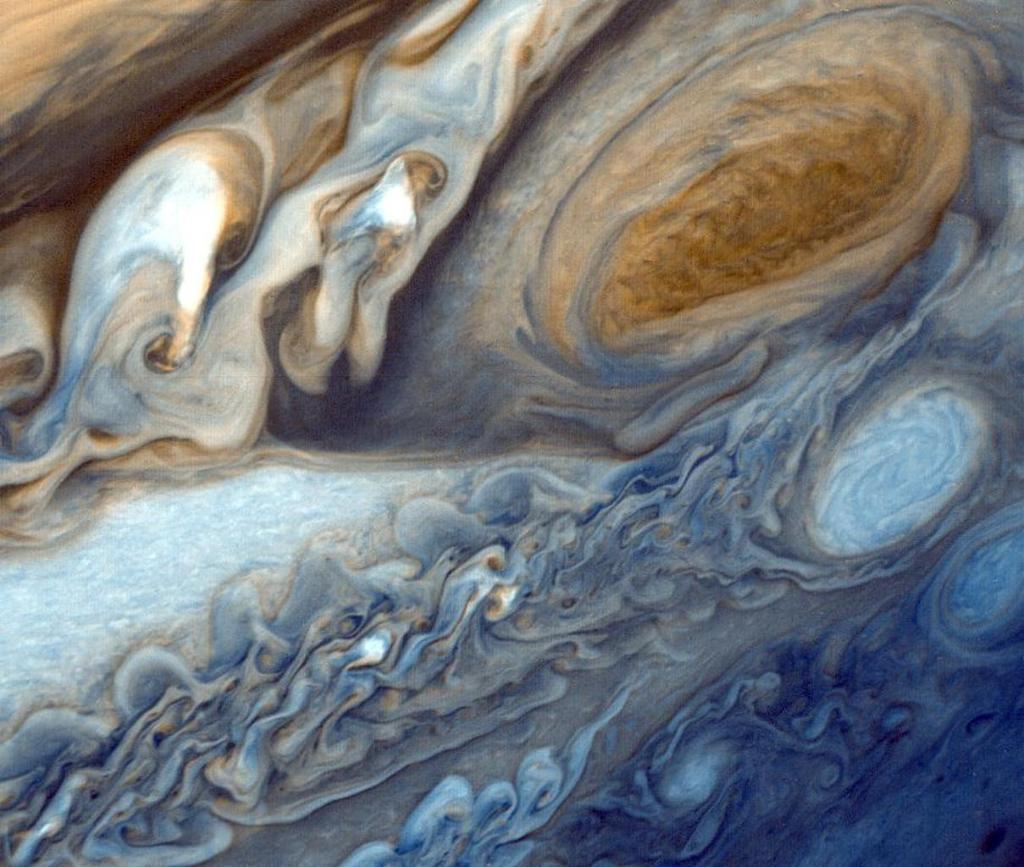
Our solar system’s largest planet is a mysterious and majestic font of fluid dynamics. Unlike rocky Earth, Jupiter is made entirely of fluids. Beneath its massive gaseous atmosphere lies an ocean of liquid hydrogen. The lack of solid ground to weaken storms may explain some of the longevity of Jupiter’s Great Red Spot, a hurricane that’s been raging on the planet for more than a hundred and fifty years. Part of the challenge of understanding Jupiter’s dynamics is that most of our data consists of observations of the uppermost layer of the atmosphere. It’s kind of like trying to describe an entire ocean based on the surface alone; what we see is part of the story, but it’s only a small portion of a much greater whole. (Image credit: NASA; submitted by jshoer)
——————
FINAL CALL: FYFD reader survey closes TODAY! I’ve teamed up with researcher Paige Brown Jarreau to create a survey of FYFD readers. By participating, you’ll be helping me improve FYFD and contributing to novel academic research on the readers of science blogs. It should only take 10-15 minutes to complete. You can find the survey here.

Recreating Hurricanes


Hurricane-related winds and storm surge cause massive damage every year. Understanding and being able to predict the impact of these storms on coastal structures can help save lives and properties. Until recently the most ferocious of hurricanes–category 5 storms that feature winds above 250 kph (150 mph)–could not be recreated in a laboratory scale. Now the University of Miami’s SUSTAIN (SUrge-STructure-Atmosphere INteraction) facility can produce category-5 equivalent winds, waves, and surge in a controlled environment. The massive test section measures 18 m x 6 m x 2 m and can be filled with over 140,000 liters of saltwater. The acrylic walls of the facility let researchers use optical flow diagnostics like particle image velocimetry (PIV) to measure flow anywhere in the test section. Some of their planned studies include experiments on how oil spills behave in storms and how strong aquaculture nets must be to maintain their catch through a storm. It will also be used to study interactions between buildings and storm surge. For more, check out their website or this video from the Weather Channel. (Image credits: Gort Photography, AFP/K. Sheridan, AP Photo/W. Lee; SUSTAIN Laboratory)

Coriolis
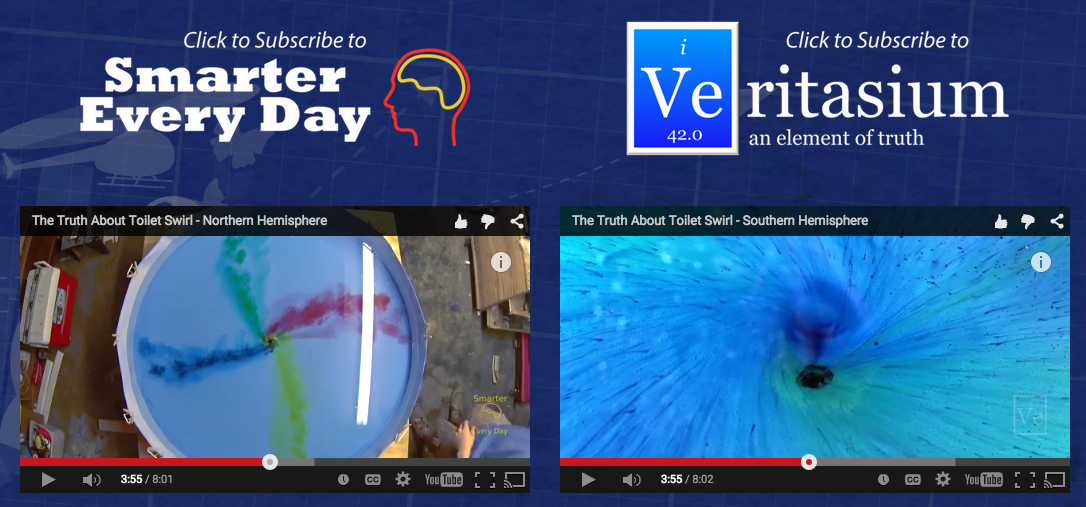
There’s an infamous supposition about drains swirling one way in the Northern Hemisphere and the other way in the Southern Hemisphere. Destin from Smarter Every Day and Derek from Veritasium have put the claim to the test with experiments on either side of the globe. First, go here and watch their synchronized videos side-by-side. (To synchronize, start the left video and pause it at the sync point. Then start the second video and unpause the first video when the second video hits the sync point.) I’ll wait here.
…
That was awesome, right?! The demonstration doesn’t work with toilets because they’re driven by the placement of jets around the circumference. And your bathtub doesn’t usually work either because any residual vorticity in the tub gets magnified by conservation of angular momentum as it drains. It’s like a spinning ice skater pulling their arms in; the rotation speeds up. So, to get around that problem, Destin and Derek let their pools sit for a day to damp out any motion before draining. At that point, the Coriolis effect is strong enough to cause the pools to rotate in opposite directions when drained. You may wonder why the effect is so slight for the pools when it’s pretty stark with hurricanes and cyclones. The answer is a matter of scale. The pools are perhaps 2 meters wide, which means that the difference in latitude across the the pool is very slight and therefore, the differential speed imparted by the Earth’s rotation is also very small. Because hurricanes and cyclones are much larger, they experience stronger influence from the Coriolis effect. (Image credits: Smarter Every Day/Veritasium; via It’s Okay To Be Smart)

The Free Surface of a Typhoon

Gazing across the top of of Typhoon Maysak highlights the three-dimensionality of the storm. Like a swirling vortex seen in a bathtub, hurricanes are a kind of free surface vortex with a surface indentation near their eye. To understand this shape, imagine spinning a container of water on a rotating plate. Like the vortex, the water’s surface would take on a parabolic shape. The two forces acting on the rotating water are gravity in the downward direction and centrifugal force in the radial direction. By taking on a parabolic shape, the fluid remains perpendicular to the combination of these two forces at every point along the surface, thereby ensuring that pressure is a constant across the free surface of the fluid. (Image credits: S. Cristoferreti/ESA/NASA; T. Virts/NASA)

Typhoon Neoguri


Astronaut Reid Wiseman has been posting photos of Typhoon Neoguri in his Twitter feed this week. From our perspective on the ground, it’s easy to forget how three-dimensional the typhoons and hurricanes in our atmosphere are. But Wiseman’s photos capture the depth in the storm, especially the depression of the eye. From the top, the typhoon looks much like a vortex in a bathtub, or what’s more formally known as a free surface vortex. To understand why a vortex dips in the middle, imagine a container of water on a rotating plate. As the water is spun, its interface with the air takes on a paraboloid shape. Two external forces are acting on the fluid: gravity in the downward direction and a centrifugal force in the radial direction. The free surface of the fluid adopts a shape that is always perpendicular to the combination of these two forces. This ensures that the pressure along the free surface is a constant. (Photo credits: R. Wiseman 1,2,3)
Fluids Round-up – 13 October 2013
There were so many good fluids links this week that I decided for an off-week fluids round-up. Here we go!
- Jefferson Lab has a cool demo on how to make a cloud chamber using dry ice, isopropyl alcohol, and a radioactive source. There is all kinds of fun physics to explain in this one!
- io9 has a great article and videos on the efficiency of jellyfish propulsion (spoiler alert: there are vortex rings).
- Half-blimp, half-jet transport option could change shipping landscape. In a similar vein, Jalopnik takes a look back at the golden age of the dirigible.
- For the armchair daredevils, check out this 360-degree view of BASE jumping with a wingsuit off a Swiss mountain. (via Janeen M)
- Also from io9, an article on my favorite fluids demo: reversible laminar flow. If you’d like to try this at home, here’s a DIY version.
- National Geographic talks about the differences between hurricanes, cyclones, and typhoons.
- Finally, our lead video comes from #5facts and Sesame Street’s Grover who bring us 5 DIY science experiments, 4 of which are fluids demos. Sit back and enjoy!
(Video credit: #5facts/Sesame Street)