When a solid object is driven into a quiescent liquid, a cavity is formed. As the cavity collapses jets–a type of singularity–form. In this video, researchers explore the effect of the geometry of a disk being driven into water on the shape of the cavity formed and how it collapses. As in this video of droplet impacts on posts of different geometries, there’s a lovely symmetry in the results. (Video credit: O. Enriquez et al)
Tag: high-speed video
Seed-Ejection via Raindrop
[original media no longer available]
We don’t often think of plants as using fluid dynamics aside from capillary action drawing water from their roots, but many plants also use fluid dynamics to disperse reproductive materials. This high-speed video explores the efficacy of splashing raindrops at ejecting seeds from different blossoms. (Video credit: G. Amador et al)

Stone-Skipping Physics
Many people have learned to throw skipping stones across a pond or lake, but how many have considered the physics of how it happens? In this video, researchers use high-speed video to explore the skipping of various balls across water. The deformation of the ball as well as the shape of the cavity its impact creates determines whether it rebounds off the water’s surface.
High-Speed Droplet Collisions
This high-speed video shows the apparatus often used by photographers for fluid sculptures created from droplet collisions. As amazing as these formations are in still images, seeing their evolution at 5,000 fps is even more lovely.
Sewer Combustion
Enjoy a little high-speed video of combustion (the safe way!) this Thanksgiving holiday. For non-U.S. folks, have a great Thursday!
High-Speed Ferrofluid
High-speed video captures the behavior of a ferrofluid trapped between two magnets. Ferrofluids contain tiny ferromagnetic particles suspended in a carrier fluid like oil or water. The distinctive peaks and valleys of a ferrofluid subject to a strong magnetic field is due to the normal-field instability and is a result of the fluid minimizing its magnetic energy.
Diesel Ignition
In a diesel engine, ignition of the injected fuel occurs due to the heat caused by the compression of the fuel/air mixture. (In petrol/gasoline engines, spark plugs are used for ignition.) The subsequent expansion of gases drives the pistons of the engine downward, creating mechanical energy. This high-speed video shows the in-cylinder combustion within a diesel engine. Note the symmetry and vorticity of the flow.
Mapping Flames
Combustion remains a fascinating and only partially understood phenomenon. Here scientists work to map a flame in three dimensions using high-speed cameras and digital reconstruction. (submitted by Chi M)

Jump Rope Aerodynamics
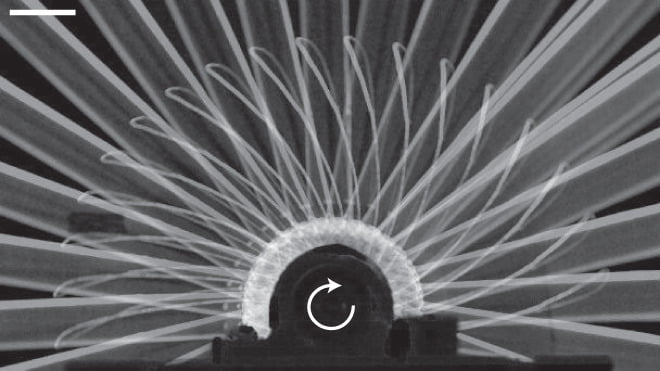
Researchers have used high-speed video and numerical simulation to capture the effects of aerodynamics on jump roping. After videoing an athlete jumping rope and constructing a jump roping robot (shown above imaged multiple times with a strobe light), they found that the U-shaped tip of the jump rope bends away from the direction of motion. When they built a computer model capable of deforming the jump rope based on its drag, they found the same behavior. They concluded that the “best” jump ropes are lightweight, short, and have small diameters to maximize speed and minimize the drag. #
Bullet Shock Wave and Cavitation
A 9mm bullet impacts a falling jet of water. High-speed video reveals the formation of a shock wave inside the jet. Because this shock wave is confined inside the jet, it causes strong secondary cavitation–the bubble that seems to explode in front of the bullet.