Tag: Helmholtz theorems

  • Vortex Reconnection

    Vortex Reconnection

    In slow motion, vortex rings can be truly stunning. This video shows two bubble rings underwater as they interact with one another. Upon approach, the two low-pressure vortex cores link up in what’s known as vortex reconnection. Note how the vortex rings split and reconnect in two places – not one. According to Helmholtz’s second theorem a vortex cannot end in a fluid–it must form a closed path (or end at a boundary); that’s why both sides come apart and together this way. After reconnection, waves ripple back and forth along the distorted vortex ring; these are known as Kelvin waves. Some of those perturbations bring two sides of the enlarged vortex ring too close to one another, causing a second vortex reconnection, which pinches off a smaller vortex ring. (Image source: A. Lawrence; submitted by Kam-Yung Soh)

    Note: As with many viral images, locating a true source for this video is difficult. So far the closest to an original source I’ve found is the Instagram post linked above. If you know the original source, please let me know so that I can update the credit accordingly. Thanks!

  • Featured Video Play Icon

    Half Vortex Rings

    Vortices are one of the most common structures in fluid dynamics. In this video, Dianna from Physics Girl explores an unusual variety of vortex you can create in a pool. Dragging a plate through the water at the surface creates a half vortex ring, which can be tracked either by the surface depressions created or by using food dye for visualization. Vortex rings are quite common, but a half vortex ring is not. The reason is that, ignoring viscous effects, a vortex filament cannot end in a fluid. The vortex must close back on itself in a loop, or, like the half vortex ring, the ends of the vortex must lie on the fluid boundary. It is possible to break vortex lines like those in smoke rings, but the lines will reattach, creating new vortex rings–just as they do in these vortex knots. (Video credit: Physics Girl; submitted by Tom)

  • Smokestack Plumes

    Smokestack Plumes

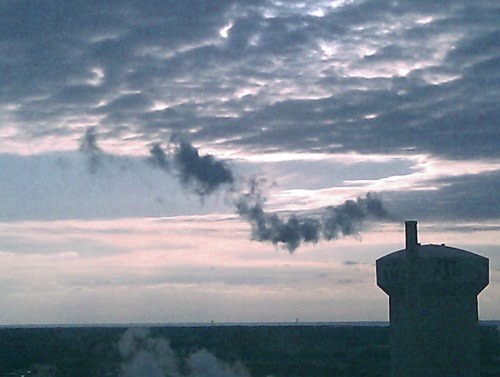
    On a cold and windy day, the plume from a smokestack sometimes sinks downstream of the stack instead of immediately rising (Figure 1). This isn’t an effect of temperature–after all, the exhaust should be warm compared to the ambient, which would make it rise. It’s actually caused by vorticity.

    Figure 2: Simple geometry (side view)

    In Figure 2, we see a simplified geometry. The wind is blowing from right to left, and its velocity varies with height due to the atmospheric boundary layer. Mathematically, vorticity is the curl of the velocity vector, and because we have a velocity gradient, there is positive (counterclockwise) vorticity generated.

    Figure 3: Vortex lines (top view)

    According to Helmholtz, we can imagine this vorticity as a bunch of infinite vortex lines convecting toward the smokestack, shown in Figure 3. Those vortex lines pile up against the windward side of the smokestack–Helmholtz says that vortex lines can’t end in a fluid–and get stretched out in the wake of the stack. If we could stand upstream of the smokestack and look at the caught vortex line, we would see a downward velocity immediately behind the smokestack and an upward velocity to either side of the stack. It’s this downward velocity that pulls the smokestack’s plume downward.

    Figure 4: Vortex wrapped around stack

    Now Helmholtz’s theories actually apply to inviscid flows and the real world has viscosity in it–slight though its effects might be–and that’s why this effect will fade. The vortex lines can’t sit against the smokestack forever; viscosity dissipates them.