Tag: gliding

  • Sochi 2014: Ski Jump

    Sochi 2014: Ski Jump

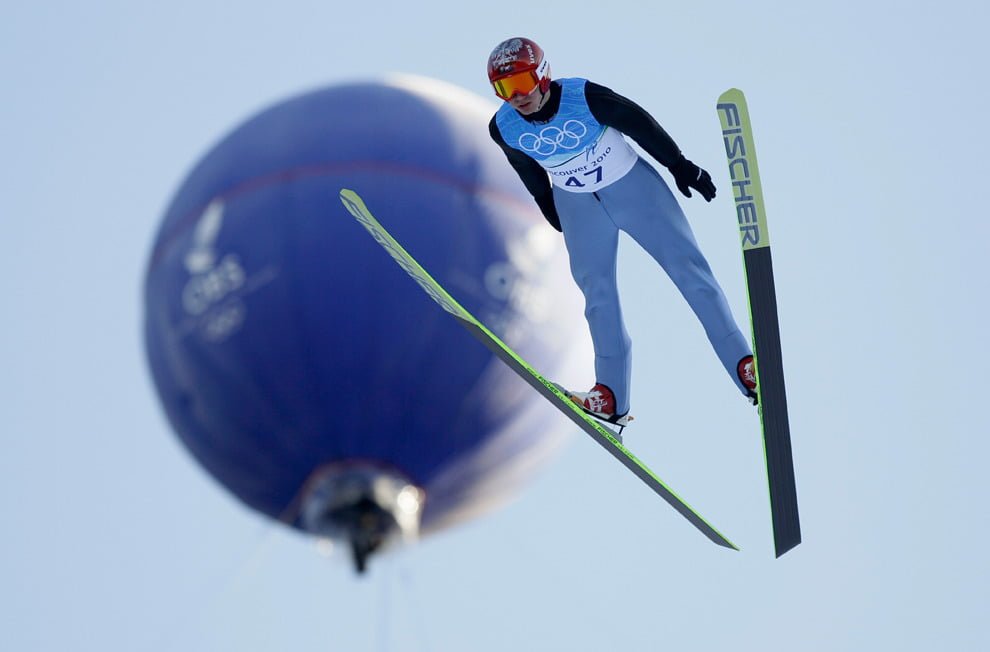
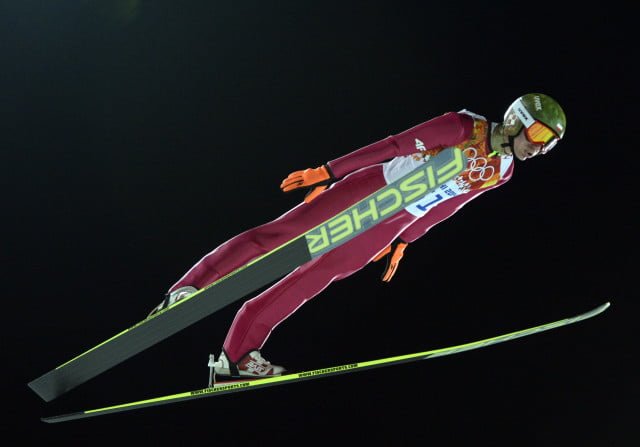
    Great ski jumpers are masters of aerodynamics. There are four main parts to a jump: the in-run, take-off, flight, and landing. An athlete’s aerodynamics are most vital in the in-run and, naturally, the flight. During the in-run, the athlete is trying to gain as much speed as possible, so she tucks down and pulls her arms behind her back to streamline her body and keep her frontal area as small as possible. This limits her drag so that she can maximize her speed at take-off. Once in the air, though, the jumpers act like gliders. In flight, there are three forces acting on the the jumper: gravity, lift, and drag. Gravity pulls the jumper down, and drag tends to push her backwards up the hill, but lift, by counteracting gravity, helps keep jumpers aloft for a greater distance. To maximize lift, a jumper angles her skis outward in a V and holds her arms out from her sides. This configuration turns the jumper’s body and skis into a wing. The best jumpers will tweak their positions with training jumps and wind tunnel time to maximize their lift while minimizing their drag in flight and on the in-run. Technique is critical in ski jumping, but conditions play a significant role as well. Tomorrow’s post will discuss why and how judges account for changing conditions. (Photo credits: L. Baron/Bongarts/Getty Images; D. Lovetsky/AP; E. Bolte/USA Today)

    FYFD is celebrating the Games with a look at fluid dynamics in the Winter Olympics. Check out our previous posts on the aerodynamics of speed skatingwhy ice is slippery and how lugers slide so fast.

  • Featured Video Play Icon

    Wind Tunneling Testing for BASE Jumpers

    While we usually think of wind tunnel testing airplane models, the truth is that wind tunnels today test a much wider array of subjects. From oil rigs and skyscrapers to athletes and police sirens, if you can imagine it, it’s probably been stuck in a wind tunnel. This video shows some wind tunnel testing of a tracking suit used for BASE jumping. The primary focus seems to be on lift and drag at angle of attack–which can be used to determine glide ratios for the pilot–but there is also some study of localized turbulence generation, as evidenced by the use of smoke generators and the streamers attached to the suit’s arms and legs. (submitted by Jason C)

  • Featured Video Play Icon

    Feathering on SpaceShipTwo

    Virgin Galactic and Scaled Composites recently performed their first feathered flight with SpaceShipTwo, which is on track to be the first commercial spaceship. Feathering is a re-entry technique devised by Scaled Composites founder Burt Rutan:

    Once out of the atmosphere the entire tail structure of the spaceship can be rotated upwards to about 65º. The feathered configuration allows an automatic control of attitude with the fuselage parallel to the horizon. This creates very high drag as the spacecraft descends through the upper regions of the atmosphere. The feather configuration is also highly stable, effectively giving the pilot a hands-free re-entry capability, something that has not been possible on spacecraft before, without resorting to computer controlled fly-by-wire systems. The combination of high drag and low weight (due to the very light materials used to construct the vehicle) mean that the skin temperature during re-entry stays very low compared to previous manned spacecraft and thermal protection systems such as heat shields or tiles are not needed. During a full sub-orbital spaceflight, at around 70,000ft following re-entry, the feather lowers to its original configuration and the spaceship becomes a glider for the flight back to the spaceport runway. #

    Though it works well for decelerating from sub-orbital speeds, feathering is sadly not useful for orbiting spacecraft due to the much higher kinetic energies that have to be dissipated.

  • Featured Video Play Icon

    Flying Snake Video

    A follow-up on the flying snakes. This video shows researchers filming the actual snakes gliding and performing maneuvers. See also the Scientific American article on their work. #

  • Flying Snakes Draft off Themselves

    Flying Snakes Draft off Themselves

    Some snakes in Southeast and South Asia are known to glide some 100 m between trees. Researchers filmed snakes, constructed computational models of their flights, and tested plastic models in a water tunnel. They found that the snakes angled their bodies such that they generate lift to counteract their fall and that the S-configuration they assume increases lift much the way flying in a V-formation does for geese. The wake from the forward portion of the snake interacts with the flow around the back of the snake and reduces downwash, which increases lift. In effect, the back of the snake is drafting off the front. #

  • Flying Fish Aerodynamics

    Flying Fish Aerodynamics

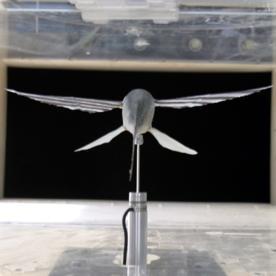
    New research using wind tunnel measurements of (dead) flying fish is giving new insight into how these fish are able to fly over the waves. Lift and drag data indicates that flying fish have a gliding ability comparable to soaring birds like hawks! #

  • Happy Anniversary, Enterprise!

    Happy Anniversary, Enterprise!

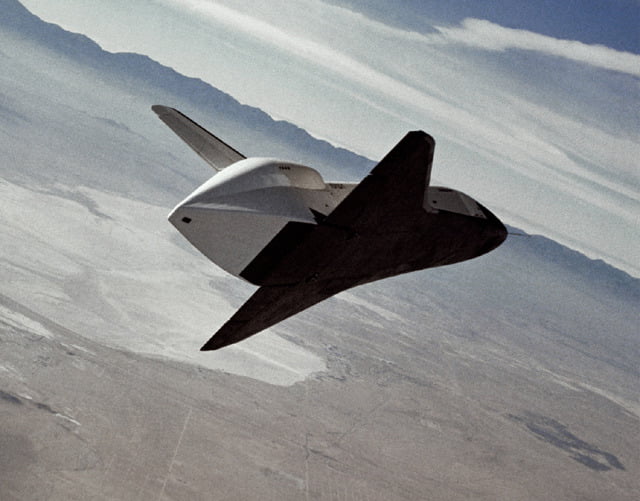
    Wind tunnels are great, but there’s nothing like a flight test to learn about the aerodynamics of a new vehicle. Today in 1977, the space shuttle prototype Enterprise flew on its own for the first time. Enterprise was built purely to test the shuttle’s aerodynamic behavior during gliding and landing. Check out this video of one of Enterprise’s gliding and landing tests.