Tag: gliding

  • Morphing Wings Using Real Feathers

    Morphing Wings Using Real Feathers

    Although humanity has long been inspired by bird flight, most of our flying machines are nothing like birds. Engineers have struggled to recreate the ease with which birds are able to morph their wings’ characteristics as they change from one shape to another. Now researchers have built a biohybrid robot, PigeonBot, that uses actual pigeon feathers as part of its morphing design.

    Many species of birds, including pigeons, have Velcro-like hooks in the microstructure of their feathers. These hooks help the flight feathers stick to one another and create a continuous wing surface that air cannot easily slip through, even as the wing drastically changes shape. By using actual feathers, PigeonBot shares this advantage.

    PigeonBot also has a somewhat minimalist design in its articulation, using only a wrist and finger joint in each wing to control shape. The feathers are connected through an elastic ligament, which — along with their microstructure — allows them to smoothly change shape under aerodynamic loads. The end result is a remarkably capable and agile biorobot researchers can use to better understand how birds control their flight. (Image and research credit: L. Matloff et al. and E. Chang et al.; via NPR and Gizmodo)

  • Dandelion Flight, Continued

    Dandelion Flight, Continued

    Not long ago, we learned for the first time that dandelion seeds fly thanks to a stable separated vortex ring that sits behind their bristly pappus. Building on that work, researchers have now published a mathematical analysis of flow around a simplified dandelion pappus. Despite their simplifications, the model captures the flow observed in the previous experiments (bottom image: experiments on left; model on right). 

    The model also allowed researchers to test various features – like the number of filaments in the pappus – and see how they affected the flow. Interestingly, they found that dandelion flight was most stable with about 100 filaments, which is right around the number of a typical pappus! (Image credits: dandelion – Pixabay, figure – P. Ledda et al.; research credit: P. Ledda et al.; via APS Physics; submitted by Kam-Yung Soh and Marc A.)

  • Featured Video Play Icon

    Martian Bees, Canopies, and Dandelion Seeds

    The latest FYFD/JFM video is out! May brings us a look at the incredible flight of dandelion seeds, numerical simulations that reveal the flow above forest canopies, and a look at bee-inspired flapping wing robots being developed for exploring Mars! Learn about all this in the video below, and, if you’ve missed other videos in the series, you can catch up here. (Image and video credit: N. Sharp and T. Crawford)

  • Fly Away!

    Fly Away!

    Spiders are often among the first colonists on newly formed volcanic islands. Thanks to their aerial skills, they are able to travel nearly anywhere by ballooning on strands of their own silk. Exactly how spiders as large as 20 milligrams manage this is still relatively known. A new study shows that crab spiders, like any careful aviator, use a foreleg to monitor wind conditions for 5 or more seconds before attempting take-off. The spiders will only spool out ballooning threads if the wind is warm and gentle. Wind speeds higher than 3 meters per second are an automatic no-go. When the spider decides conditions are favorable, they release as many as 60 nanoscale fibers that are several meters in length. The wind catches the silks and lifts them away to their next adventure. (Image credit: Science Magazine, source; research credit: M. Cho et al.)

  • PyeongChang 2018: Ski Jumping

    PyeongChang 2018: Ski Jumping

    No winter sport is more aerodynamically demanding than ski jumping. A jump consists of four parts: the in-run, take-off, flight, and landing. The in-run is where an athlete gains her speed, and to keep drag from slowing her down, she descends in a streamlined tuck that minimizes frontal area. The biggest aerodynamic challenge comes during flight, when the jumper wants to maximize lift while minimizing drag. The athlete spreads her skis in a V-shape and flattens her body, using her hands to adjust her flight. Flying the farthest requires careful management of forces while in the air. Wind plays a major role as well, with headwinds helping athletes fly farther. To compensate, scoring includes a wind factor calculated based on conditions for each jump. (Image credit: B. Pieper, Reuters/K. Pfaffenbach, PyeongChang 2018)

  • Gliding Lizards

    Gliding Lizards

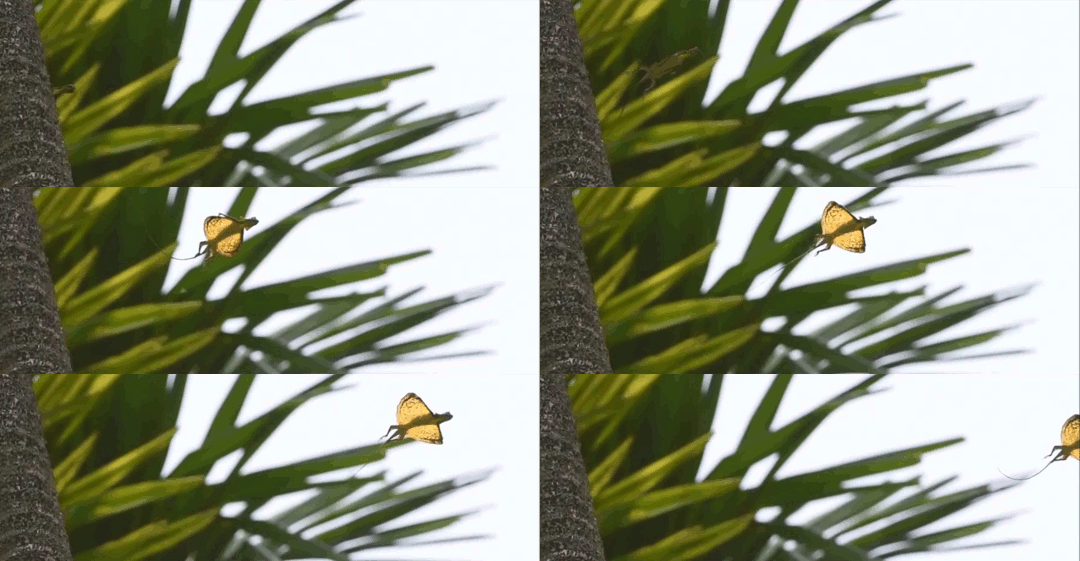
    Flying lizards are truly gliders, but that doesn’t mean they’re unsophisticated. Newly reported observations of the species in the wild show that flying lizards don’t simply hold their forelimbs out a la Superman. Instead, they reach back with their forelimbs, pressing their arms into the underside of the thin patagium that serves as their flight surface while rotating their hands to grasp the upper side of the patagium. This forms a composite wing with a thicker leading edge and seems to be how the lizards control their glide. Close observation of their flight shows that, while holding their patagium, the lizards actively arch their backs to camber their composite wing. This can increase their maximum lift coefficient, allowing them to glide longer distances. (Image and research credit: J. Dehling, source)

  • Flying Fish Aerodynamics

    Flying Fish Aerodynamics

    Flying fish, strange as it sounds, have aerodynamic prowess comparable to hawks. The fish aren’t true fliers, but they do glide for hundreds of meters using their large pectoral and pelvic fins as wings. Wind tunnel research shows the fish have their maximum lift at an angle of attack around 30-35 degrees, matching their typical take-off angle (top). Their best gliding performance occurs when they’re roughly parallel to the water (middle). The researchers even found that the fish use ground effect to enhance their lift. Although their aerodynamics allow flying fish to get out of reach of their aquatic predators, the fish must be wary of flying too high, as this makes them a target for frigatebirds (bottom). These acrobatic seabirds can’t get wet, but they have some impressive aerodynamics of their own to help make up for it.  (Image credit: BBC Earth, source; research credit: H. Park and H. Choi; see also SciAm)

  • Soaring Pelicans

    Soaring Pelicans

    Earlier this summer, I looked up on a bright, sunny day and saw a quartet of black and white figures soaring overhead. Initially, I thought it might be a formation of kites or unmanned aerial vehicles (UAVs) because I saw no flapping as the group wheeled about. With the help of the Cornell Lab of Ornithology’s awesome Merlin app, I was able to identify the soarers as American white pelicans – not a species I’d expected to find flying along the Front Range of the Rocky Mountains! (Turns out, they breed on lakes around here.)

    The reason I saw so little flapping is that the birds were riding thermals. As the sun heats the ground, air near the surface warms up and begins to rise due to its buoyancy. Pelicans interested in flying between breeding and foraging grounds will start testing the thermals early in the day, as soon as they begin to form. As the heating continues, the intensity of thermals strengthens and they extend higher into the atmosphere. This is where the birds can really excel at using atmospheric energy for their flight. Pelicans will circle within a thermal until they reach roughly the middle of its height. Then they will glide, gradually losing altitude until they reach another thermal where they can climb without expending their own energy. With a 2.7 meter wingspan and a relatively low drag coefficient, the pelicans can glide and soar remarkably well. Researchers have even suggested using them as a sort of biological UAV for studying atmospheric dynamics! (Image credits: D. Henise, M. Stratmoen; research credit: H. Shannon et al., pdfs – 1, 2)

  • Featured Video Play Icon

    The Flying Draco

    Nature includes many animals that are so-called fliers: flying squirrels, flying snakes, and draco lizards, to name a few. These animals aren’t true fliers like birds, bats, or insects, though. Instead, they are expert gliders, able to produce enough lift to control their descent and land safely at a distance far greater than a normal leap could carry them. Like the flying squirrel, the draco lizard extends a thin membrane that acts as its wings. The additional area provides enough lift that the lizards can glide as far as 60 m (200 ft) while only losing 10 m (33 ft) in altitude. That’s an impressive glide ratio – about 3 times better than the Northern flying squirrel and twice as good as a wingsuit. (Video credit: BBC/Planet Earth II)

  • The Seabird That Can’t Get Wet

    The Seabird That Can’t Get Wet

    Unlike most seabirds, the frigatebird does not have waterproof feathers. Landing in the water during a transoceanic flight would quickly drown the bird, so instead they stay aloft. But until recently, scientists did not realize just how adept the birds are. Studying tagged frigatebirds in flight, researchers found that the birds could reach altitudes of 4000 meters and that they could soar without flapping for up to 64 kilometers! They achieve these heights by seeking out clouds, which mark strong atmospheric updrafts. The birds ride these thermals up to the cloud tops – well into freezing conditions – and then glide slowly back down.

    Their bodies are impressively built for slow glides. Frigatebirds boast a low body weight for their large wing area. This ratio is known as wing loading, and it’s a fundamental characteristic of any flier, avian or otherwise. Low wing loading is key to gliding longer because it reduces the speed at which a glider loses altitude. (Image credit: D. Brossard; research credit: H. Weimarskirch et al.; via @skunkbear)