Tag: Faraday waves

  • Featured Video Play Icon

    Chinese Spouting Bowl Physics

    In their newest video, the Slow Mo Guys recreated one of my favorite effects: vibration-driven droplet ejection. For this, they use a Chinese spouting bowl, which has handles that the player rubs after partially filling the bowl with water. By rubbing, a user excites a vibrational mode in the bowl. Watch the GIFs above and you can actually see the bowl deforming steadily back and forth. This is the fundamental mode, and it’s the same kind of vibration you’d get from, say, ringing a bell. 

    Without a high-speed camera, the bowl’s vibration is pretty hard to see, but it’s readily apparent from the water’s behavior in the bowl. In the video, Gav and Dan comment that the ripples (actually Faraday waves) on the water always start from the same four spots. That’s a direct result of the bowl’s movement; we see the waves starting from the points where the bowl is moving the most, the antinodes. In theory, at least, you could see different generation points if you manage to excite one of the bowl’s higher harmonics. The best part, of course, is that, once the vibration has reached a high enough amplitude, the droplets spontaneously start jumping from the water surface! (Video and image credits: The Slow Mo Guys; submitted by effyeah-artandfilm)
  • Psychedelic Cymatics

    Psychedelic Cymatics

    image

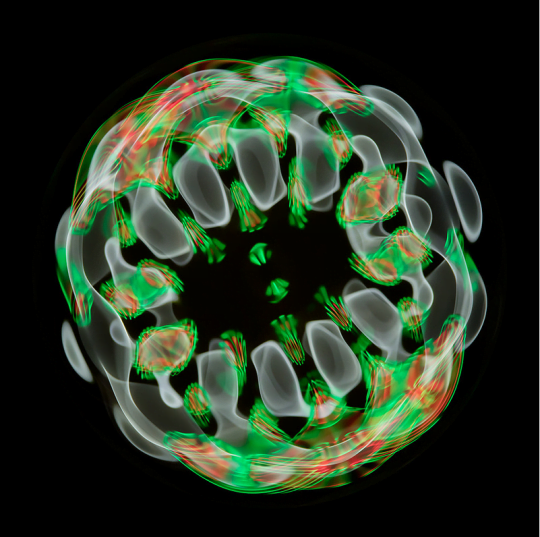
    Cymatics are the visualization of vibration and sound. Here photographer Linden Gledhill has taken a simple speaker vibrating a dish of water and turned it into some incredible art. When you vibrate liquids like water up and down, it disturbs the usually flat air-water interface and creates waves on the surface. These Faraday waves are a standing wave pattern that differs depending on which sound is being played. By combining the wave patterns with LED lighting and strobe effects, Gledhill creates some remarkable images that combine sound, light, and fluid dynamics all in one. If you watch the video (make sure to hit the HD button!), you’ll see the patterns in motion and hear the sounds used to generate them. In the last clip (around 0:19), he’s added glitter to the set-up, which highlights the circulation within the vibrating fluid. As you can see, there are strong recirculating regions in each lobe of the pattern, but other areas, like the center region are almost entirely stationary. You can see more photos from the project in his Flickr feed. Special thanks to Linden for letting me post the video of his work, too! (Video and image cred

    its and submission: L. Gledhill)

    If you enjoy FYFD, please consider becoming a patron to help make sure the Internet keeps getting its daily dose of fluid dynamics!

  • Alligators Water Dancing

    Alligators Water Dancing

    Amorous alligators call to mates with a behavior known as water dancing. Their audible bellows are accompanied by infrasonic soundvibrations below the 20 Hz limit of human hearing. These vibrations from their lungs excite Faraday waves in the water near the alligator’s back and make the surface explode in a dance of jets and atomized droplets. I’ve seen similar results in other instances of vibration, but this may be the only example of this I’ve seen in the wild. Researchers studying the phenomenon noted that the frequency of sound the alligators emit corresponds to a wavelength equal to the spacing of the raised scales, or scutes, on the alligators’ backs. They hypothesize that the shape of the scutes helps males create the display.  (Image credit: N. Marven, source; research credit: P. Moriarty and R. Holt; h/t to io9)

    ——————

    Don’t forget about our FYFD survey! I’ve teamed up with researcher Paige Brown Jarreau to create a survey of FYFD readers. By participating, you’ll be helping me improve FYFD and contributing to novel academic research on the readers of science blogs. It should only take 10-15 minutes to complete. You can find the survey here. Please take a few minutes to participate and share!

  • The Dance of the Droplets

    The Dance of the Droplets

    Milk and juice vibrating on a speaker can put on a veritable fireworks display of fluid dynamics. Vibrating a fluid can cause small standing waves, called Faraday waves, on the surface of the fluid. Add more energy and the instabilities grow nonlinearly, quickly leading to tiny ligaments and jets of liquid shooting upward. With sufficiently high energy, the jets shoot beyond the point where surface tension can hold the liquid together, resulting in a spray of droplets. (Image credit: vurt runner, source video; h/t to @jchawner)

  • Featured Video Play Icon

    “Cymatics”

    Nigel Stanford’s new “Cymatics” music video is full of stunning science-inspired visuals. The entire video is set up around various science demos–many of which will be familiar to readers–that translate sound or vibration into visual elements. The video uses ferrofluids, vibrates vodka on a speaker to create Faraday waves, and visualizes resonant sound waves with a Rubens’ tube. I don’t want to give away all the awesome effects, so watch it for yourself, and then check out their behind-the-scenes page where they talk about how they created each effect. (Video credit: N. Stanford; submitted by buckitdrop)

    Also, today is the final day of voting for the Vizzies, an NSF-sponsored contest for the best science and engineering visuals. Head over to their website to check out the finalists and choose your favorites!

  • Featured Video Play Icon

    “Cymatic Sun”

    “Cymatic Sun” from artist Lachlan Turczan uses vibrating fluids to generate mesmerizing and surreal visuals. At some points distinct Faraday waves are visible on the surface. At other times, there is simply a blur of motion and refracted light. Check out my “fluids as art” tag for many more great examples of fluid dynamics and art merging. (Video credit and submission: L. Turczan)

  • Featured Video Play Icon

    “Becoming Harmonious”

    Much as I try to keep from getting repetitious, this was just too neat to pass up. This new music video for The Glitch Mob’s “Becoming Harmonious” is built around the standing Faraday waves that form on a water-filled subwoofer. The vibration patterns, along with judicious use of strobe lighting, produce some fantastic and kaleidoscopic effects. (Video credit: The Glitch Mob/Susi Sie; submitted by @krekr)

  • “Wallwave Vibration”

    “Wallwave Vibration”

    Loris Cecchini’s “Wallwave Vibration” series is strongly reminiscent of Faraday wave patterns. The Faraday instability occurs when a fluid interface (usually air-liquid though it can also be two immiscible liquids) is vibrated. Above a critical frequency, the flat interface becomes unstable and nonlinear standing waves form. If the excitation is strong enough, the instability can produce very chaotic behaviors, like tiny sprays of droplets or jets that shoot out like fountains. In a series of fluid-filled cells, the chaotic behaviors can even form synchronous effects above a certain vibration amplitude. (Image credit: L. Cecchini; submitted by buckitdrop)

  • Featured Video Play Icon

    Tuning Fork Fluids

    This high-speed video shows a liquid crystal fluid vibrating on a tuning fork. As the surface moves, tiny jets shoot upward, sometimes with sufficient energy that the fluid column is stretched beyond surface tension’s ability to keep it intact, resulting in droplet ejection. The jets and surface waves create a mesmerizing pattern of fluid motion. (Video credit: J. Savage) 

  • Featured Video Play Icon

    Bouncing in a Corral

    About a year ago, we featured a video in which a fluid droplet bouncing on a vibrating pool demonstrated some aspects of the wave-particle duality fundamental to quantum mechanics. Work on this system continues and this new video focuses on studying some of the statistics of such a bouncing droplet–called a walker in the video–when it is confined to a circular corral. Using strobe lighting and capturing one frame per bounce, the vertical motion of these droplets is filtered out and the walking motion and the surface waves that guide it are captured. When the droplet is allowed to walk for an extended time, its path appears complicated and seemingly random, but it is possible to build a statistical picture and a probability density field that describe where the walker is most likely to be, much the way one describes the likelihood of locating a quantum particle. Parallels between the physical macroscale system and quantum-mechanical theory are drawn. (Video credit: D. Harris and J. Bush; submission by D. Harris)