Although dunes are usually associated with scorching climates, they can form in any desert, including in the frozen steppes of western Mongolia. This sunrise photo, taken by an astronaut aboard the ISS, shows Ulaagchinii Khar Nuur. The ice-covered Khar Nuur Lake surrounds two islands, Big and Small Avgash, and cold dunes form textured streaks on either side. The low sun angle accentuates the dunes, making every rippling crest clear. (Image credit: NASA; via NASA Earth Observatory)
Tag: dunes

Dune Invasion
Migrating sand dunes can encounter obstacles both natural and manmade as they move. Dunes — both above ground and under water — have been known to bury roads, pipelines, and even buildings. A recent experimental study looks at which obstacles a dune will cross and which will trap it in place. Their set-up consists of a narrow channel built in a ring, essentially a racetrack for dunes. Flow is driven by a series of paddles that rotate opposite the tank’s rotation.
The team studied obstacles of different shapes and sizes relative to their dunes, and they found that dunes were generally able to cross obstacles that were smaller than the dune. Obstacles larger than the dune would trap it in place, and, for obstacles close to the same size as the dune, round obstacles were easier to cross whereas sharp-angled ones tended to trap the dune.
The idealized nature of their experiment means that their results aren’t immediately applicable to the complex dunes of the outside world, but the study will be an important touchstone for those predicting dune behavior through numerical simulation. Studies like those require experimental cases to validate their baseline simulations. (Image credit: top – J. Bezanger, figure – K. Bacik et al.; research credit: K. Bacik et al.; via APS Physics)


Blue Dunes
This false-color image shows a Martian dune field near the northern polar cap. The image itself covers an area 30 kilometers wide, but the dune field stretches over an area the size of Texas. In the photo cooler areas have been rendered in bluer tints, while warm areas are shown in yellow and orange. The sun warms the wind-sculpted dunes more than in the valleys that lie between. Complex dune networks like these build up over time as consistent winds push sand and create interactions between individual dunes. (Image credit: NASA/JPL-Caltech/ASU; via Colossal)

An Oasis Among Dunes
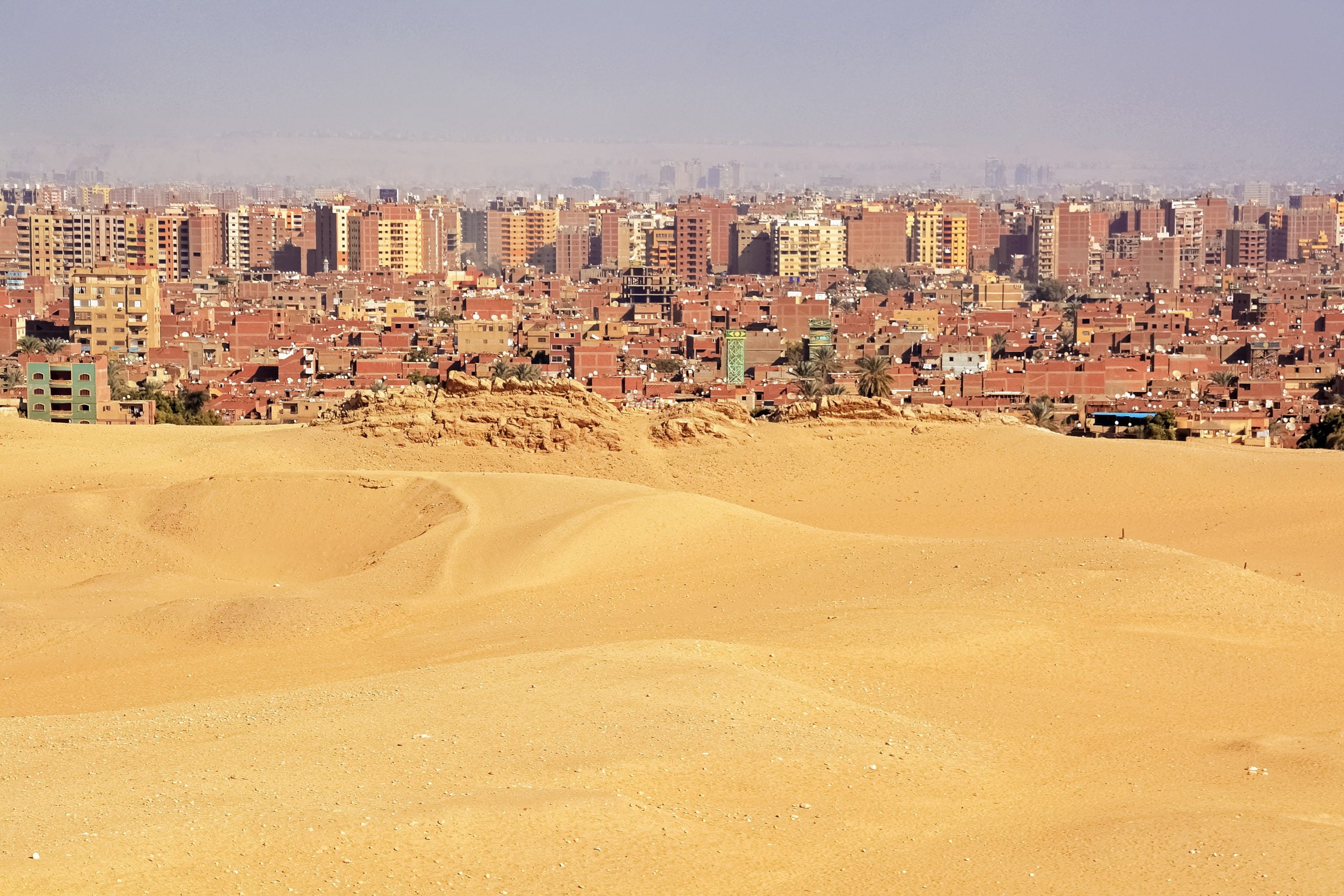
The Saudi Arabian oasis of Jubbah sits in the bed of an ancient lake. It’s protected from the westerly winds that sculpt the surrounding dunes by the wind shadow of the mountain Jabel Umm Sinman. The long, skinny shape of the settlement reveals the shape of the mountain’s wake! (Image credit: NASA; via NASA Earth Observatory)

Dunes Avoid Collisions


The speed at which a dune migrates depends on its size; smaller dunes move faster than larger ones. That speed differential implies that small dunes should frequently collide into and merge with larger dunes, eventually forming one giant dune rather than a field of smaller separate ones. But that’s not what we observe in nature.
To figure out why dunes aren’t colliding that often, researchers built a dune field of their own in the form of a rotating water tank. Inside the tank, their two artificial dunes can chase one another indefinitely while the researchers observe their interactions. What they found is that the dunes “communicate” with one another through the flow.
As flow moves over the upstream dune, it generates turbulence in its wake, which the downstream dune then encounters. All that extra turbulence affects how sediment is picked up and transported for the downstream dune, ultimately changing its migration speed. For two dunes of initially equal size and close spacing, these interactions push the downstream dune further away until the separation between the dunes is large enough that they both migrate at the same speed. Even between dunes of unequal sizes, the researchers found that these repulsive interactions force the dunes away from collision and into migration at the same speed. (Image credit: dune field – G. Montani, others – K. Bacik et al.; research credit: K. Bacik et al.; via Cosmos; submitted by Kam-Yung Soh)
The Sand Sea’s End
The northern extent of Africa’s Namib Sand Sea ends where the reddish dunes meet the Kuiseb River and the hard, rocky land on its other side. Within the sand sea, dunes stretch as high as 300 meters while the prevailing winds create and march them across the desert. Although dunes rarely occur in isolation, the mechanisms that regulate dune-dune interactions are still poorly understood, though new experiments are beginning to shed light on the processes. (Image credit: USGS/NASA Earth Observatory)

Namibia From Above
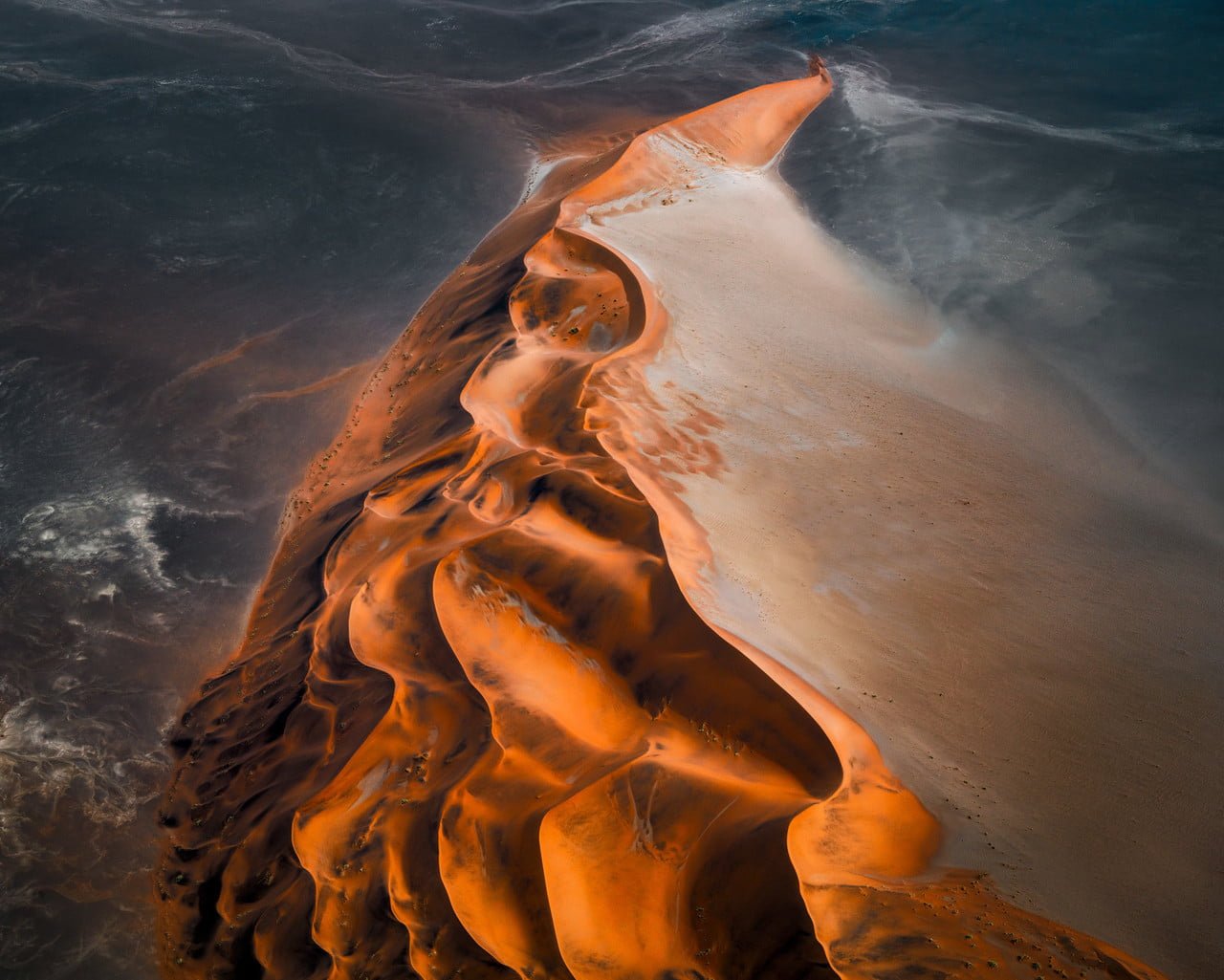

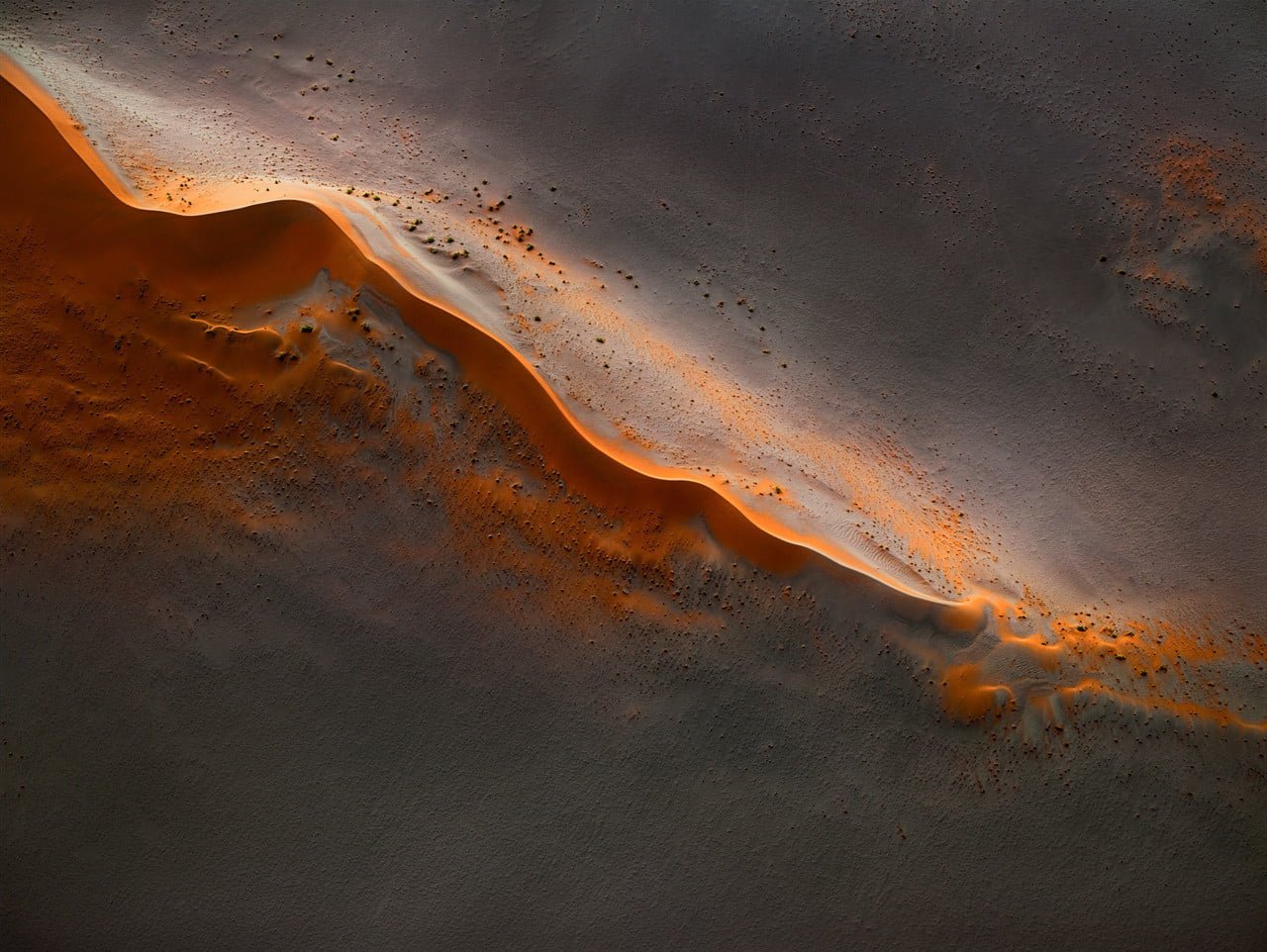
From above, we see an all-new perspective on the flows of air and water that shape our world. Although they look like abstract art, these aerial photographs of Namibia by Leah Kennedy show rippling dunes and spreading fingers of water. Linear dunes like these grow when the prevailing winds are always from the same direction. Over time, rivers meander, always seeking new drainage paths. Patterns like these are probably driven by periodic flooding. (Image credit: L. Kennedy; via Colossal)

Dune Networks
In sandy deserts, winds can build a vast network of dunes whose shapes depend on the winds that built them. This photograph, taken by an astronaut aboard the International Space Station, shows part of a Saharan dune field known as the Grand Erg Oriental. Of the five basic types of sand dunes, this field features all but one. The predominant winds of the region build most of the dunes into long, straight chains separated by interdune flats some 150 meters lower in elevation. Within the chains, there are linear dunes, created by winds blowing nearly parallel to the dune’s long axis. In places where winds tend to change directions, several linear dunes may merge to form star dunes, like the one just below and right of center in the image. Transverse dunes form perpendicular to the predominant wind direction. The one shown in the upper left of this image may have formed when multiple crescant-shaped barchan dunes merged. (Image credit: NASA, via NASA Earth Observatory)
Linear Dunes
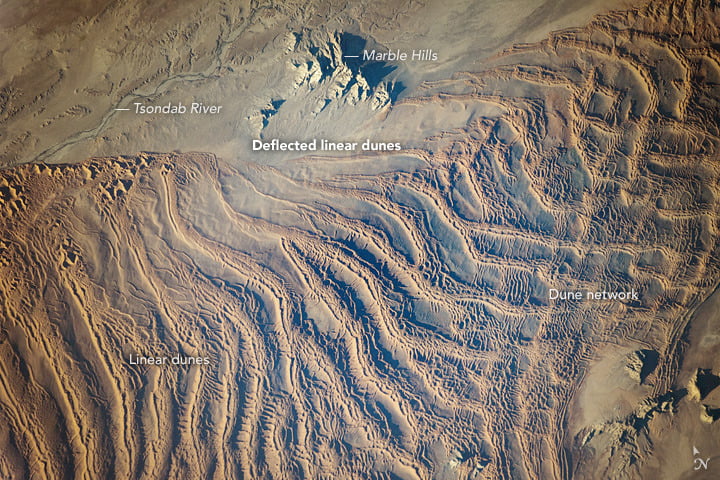
The Namib desert of southern Africa is home to some of the most stunning dunes on Earth. They are primarily linear dunes, which form parallel to the winds that form them. On the left side of the image, the dunes are aligned north-to-south along the direction of the southerly winds that blow through this area. Toward the center of the image, however, the dunes are deflected by strong seasonal winds blowing from the east. On the far right, the dunes break from a linear pattern to one with rectangular criss-crossings. This is a mixture of old and new dunes, evidence that the dominant direction of the wind has shifted over time. (Image credit: NASA Earth Observatory)

Martian Ripples
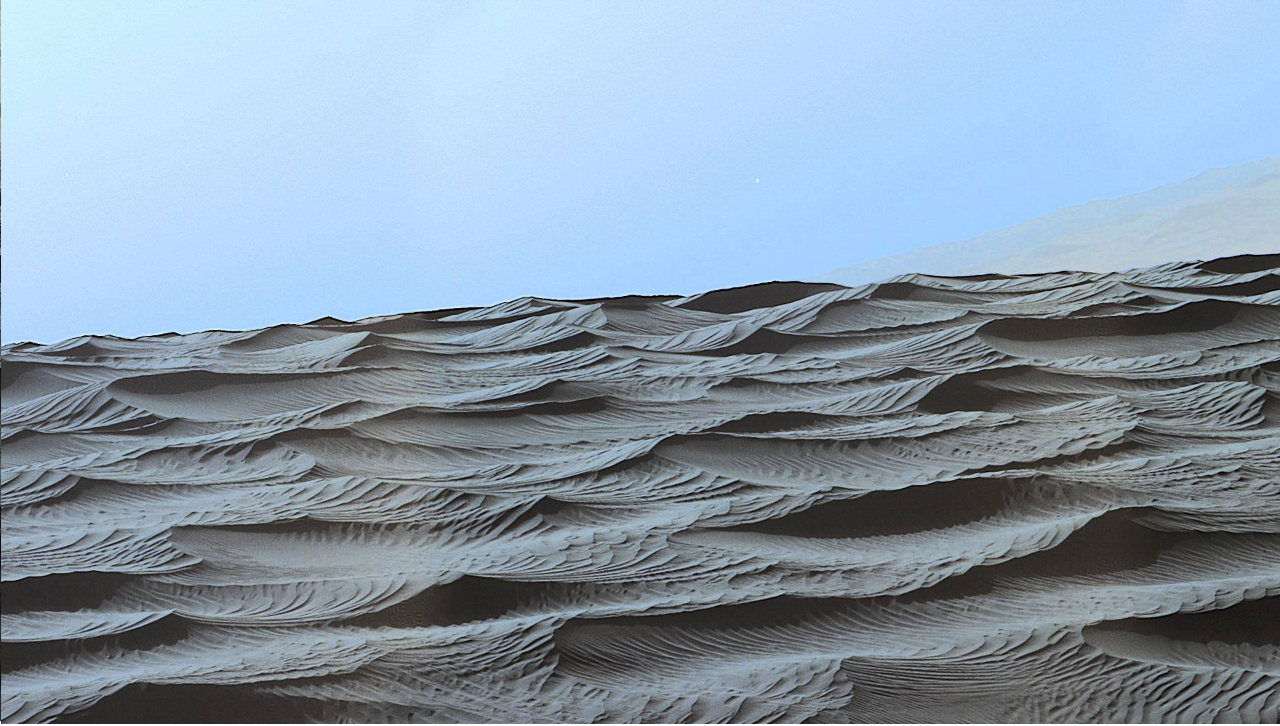
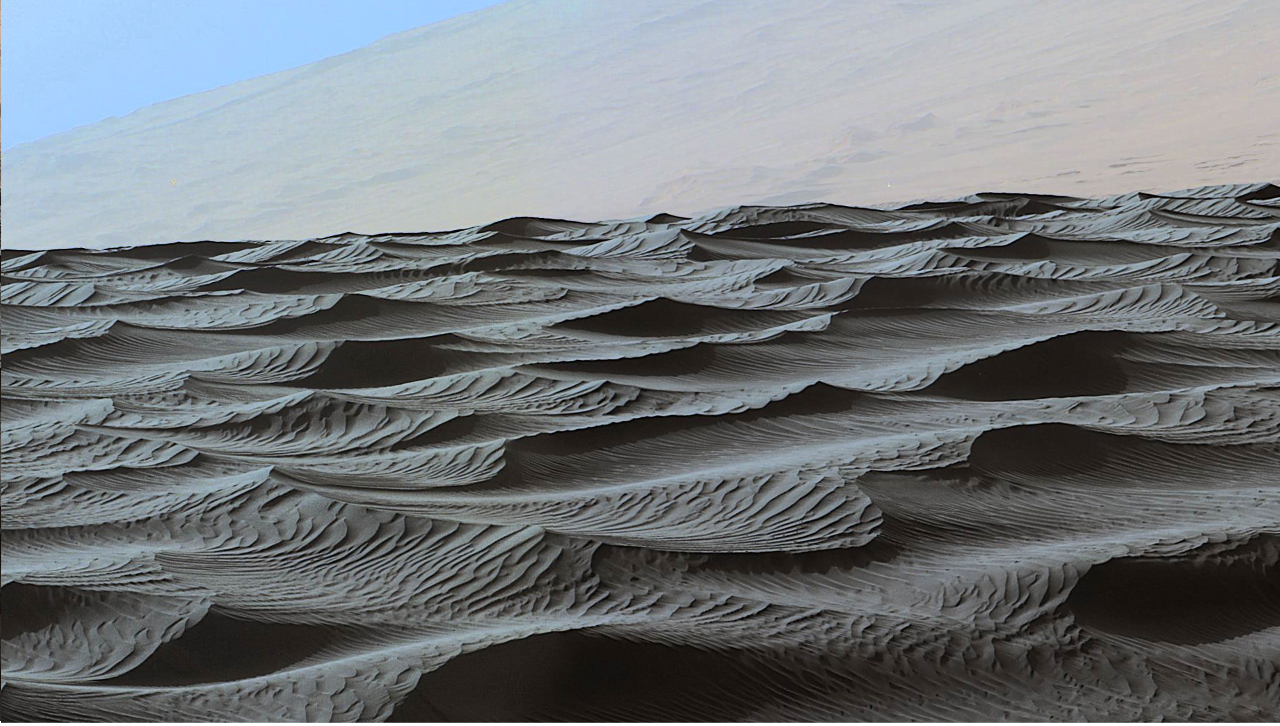
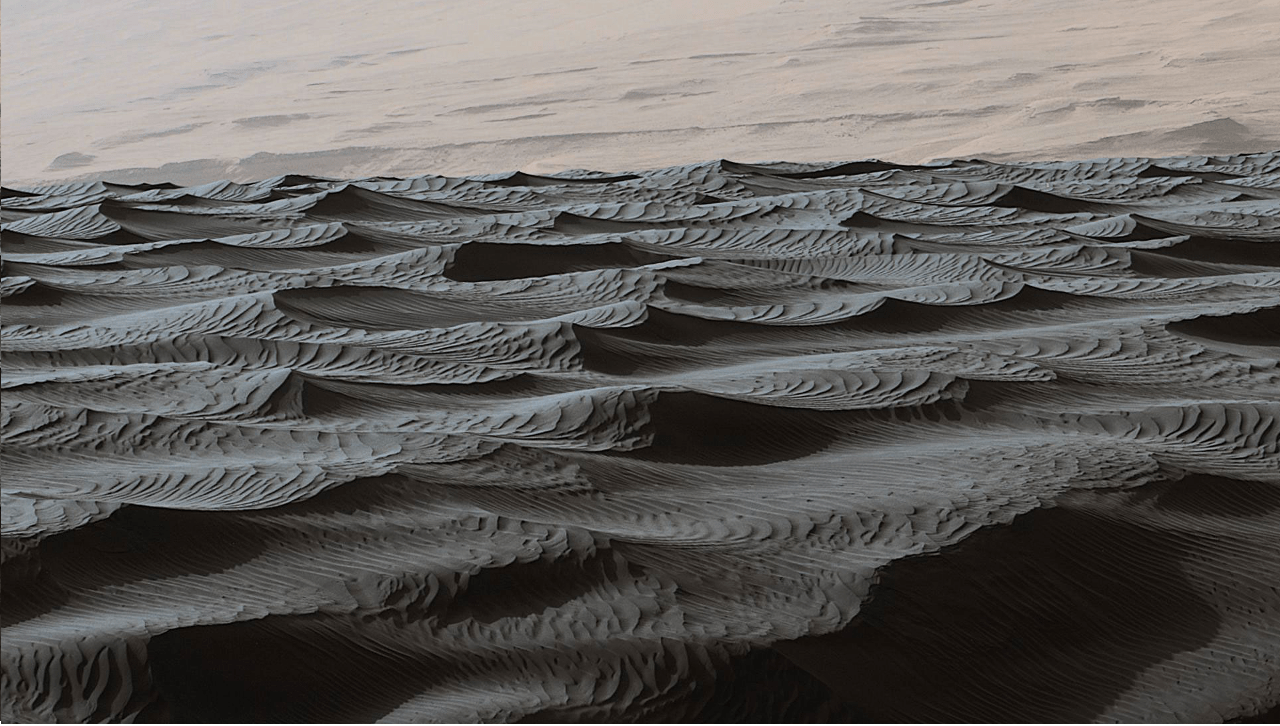

Earth and Mars both feature fields of giant sand dunes. The huge dunes are shaped by the wind and miniature avalanches of sand, and their surface is marked by small ripples less than 30 centimeters apart. These little ripples are formed when sand carried by the wind impacts the dunes. But Martian dunes have a second, larger kind of ripple, too. These sinuous, curvy ripples lie about 3 meters apart and cast the dark shadows seen in the images above. On Earth we see ripples like these underwater, where water drags sand along the surface. On Mars, the same process is thought to play out with the wind, and so scientists have named these wind-drag ripples. (Image credit: NASA/JPL/MSSS; via APOD, full-res; submitted by jshoer)