Sand dunes form with a gentle incline facing the wind and a steeper slip face pointing away from the wind. Most slip faces are angled at about 30 to 34 degrees–called the angle of repose. The shape is determined by the dune’s ability to support its own weight; add more sand and it will cascade down the slip face in a miniature avalanche. Similarly, if you disturb sand on the slip face by digging a hole at the base, you get the cascading collapse seen in this video. By removing sand, the dune’s equilibrium is broken and it can no longer support its weight. This makes sand flow down the slip face until enough is shifted that the dune can support itself. Being a granular material, the sand itself appears to flow much like a fluid, with waves, ripples and all. (Video credit: M. Meier; submitted by Boris M.)
Tag: dunes

Barchan Dunes

Crescent-shaped barchan dunes are common on both Earth (top image) and Mars (bottom image). They form in areas where the wind comes predominantly from one direction. As the wind blows, it deposits sand on the gently sloping windward face of the dune. The leeward face of the dune is steeper; its shape is set by the sand’s angle of repose–essentially the steepest angle the sand can maintain without an avalanche. Barchan dunes are very mobile, moving between one and a hundred meters per year. They have also been seen moving through one another or moving along in formation. (Image credits: Google Earth, NASA/JPL/University of Arizona)

Martian Barchans
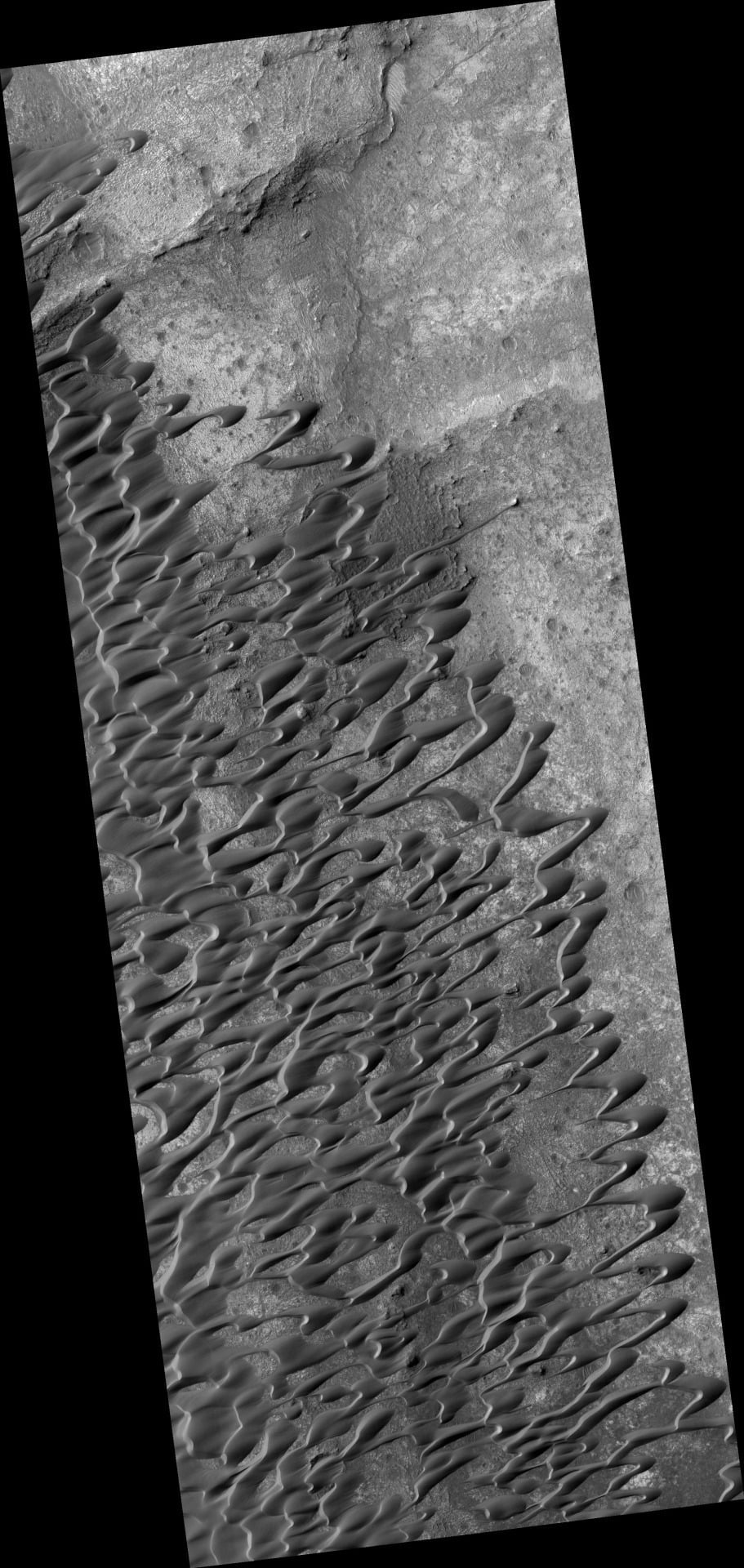
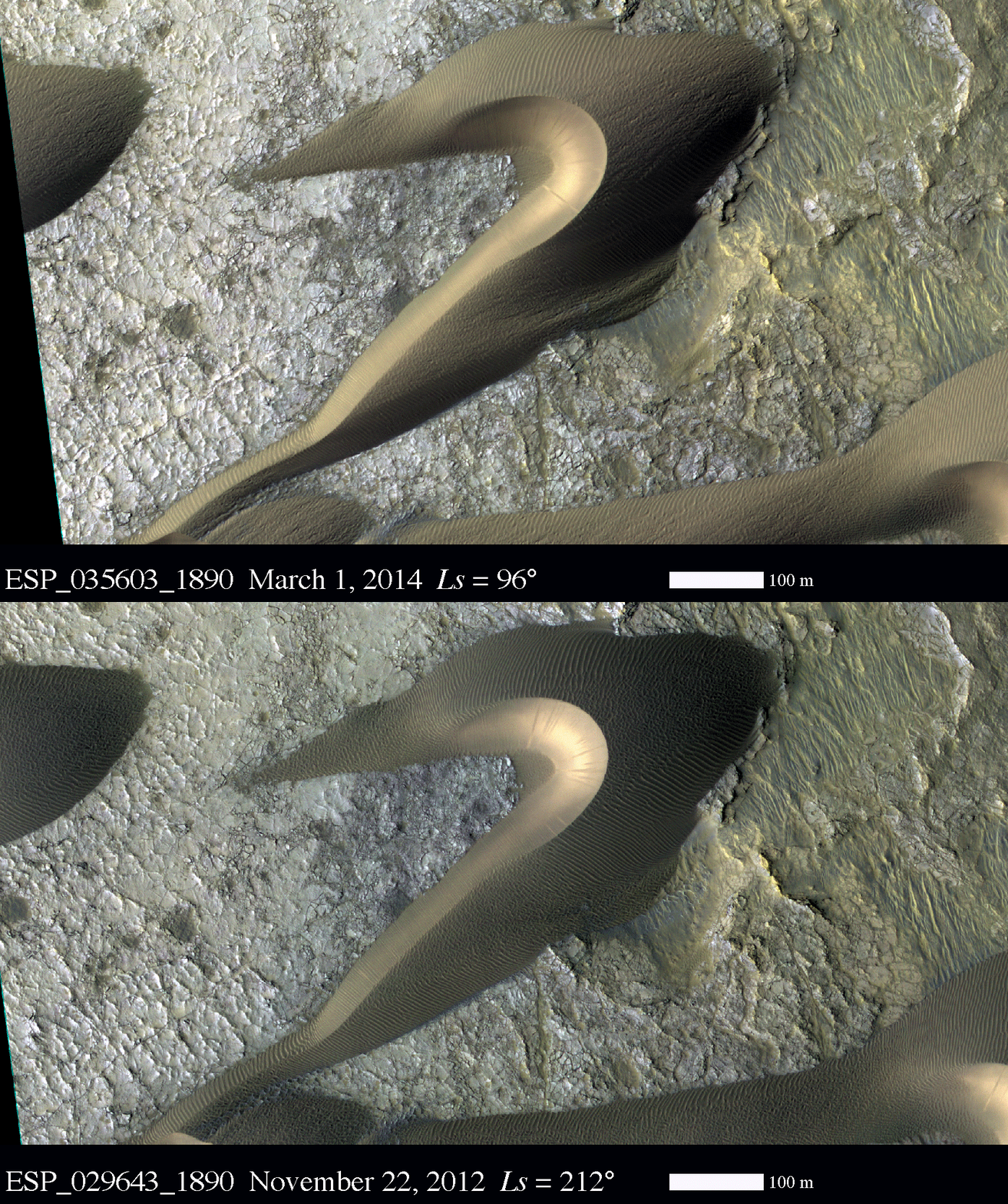
Dunes are a fascinating interplay between fluid and granular flow. This satellite photo shows a dune field on Mars, Nili Patera. The dominant direction of wind flow is from the upper right, pushing the dunes themselves slowly toward the left. Many of the dunes along the edge are barchans, crescent-shaped dunes with a long, gradual slope facing the wind and a steeper leeward side. As the wind blows, it erodes the sand on the windward slope and deposits it on the leeward side. This is how the dune migrates. Check out this close-up of a barchan to see the changes in its ripples and shape over the past couple months. (Photo credit: NASA/JPL/Univ. of Arizona)

Barchan Dunes
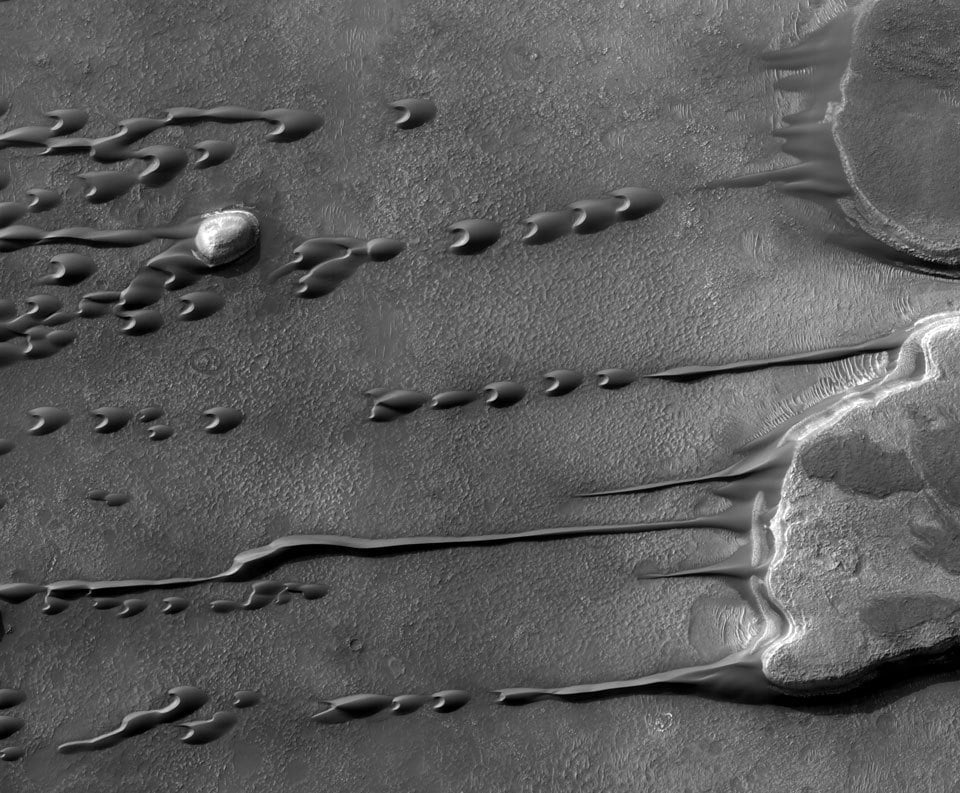
The winds of Mars create sand dunes that seem to flow like a liquid across the planet’s surface. Here the wind blows from right to left around the flat top mesas on the right side of the image. The dark, arc-shaped dunes formed in the wake of the mesas are called barchans and can move downstream remarkably intact, even able to cross paths with other dunes. (Photo credit: MRO, NASA; via APOD)