Tag: botany

  • Plant Week: Bunchberry Dogwood

    Plant Week: Bunchberry Dogwood

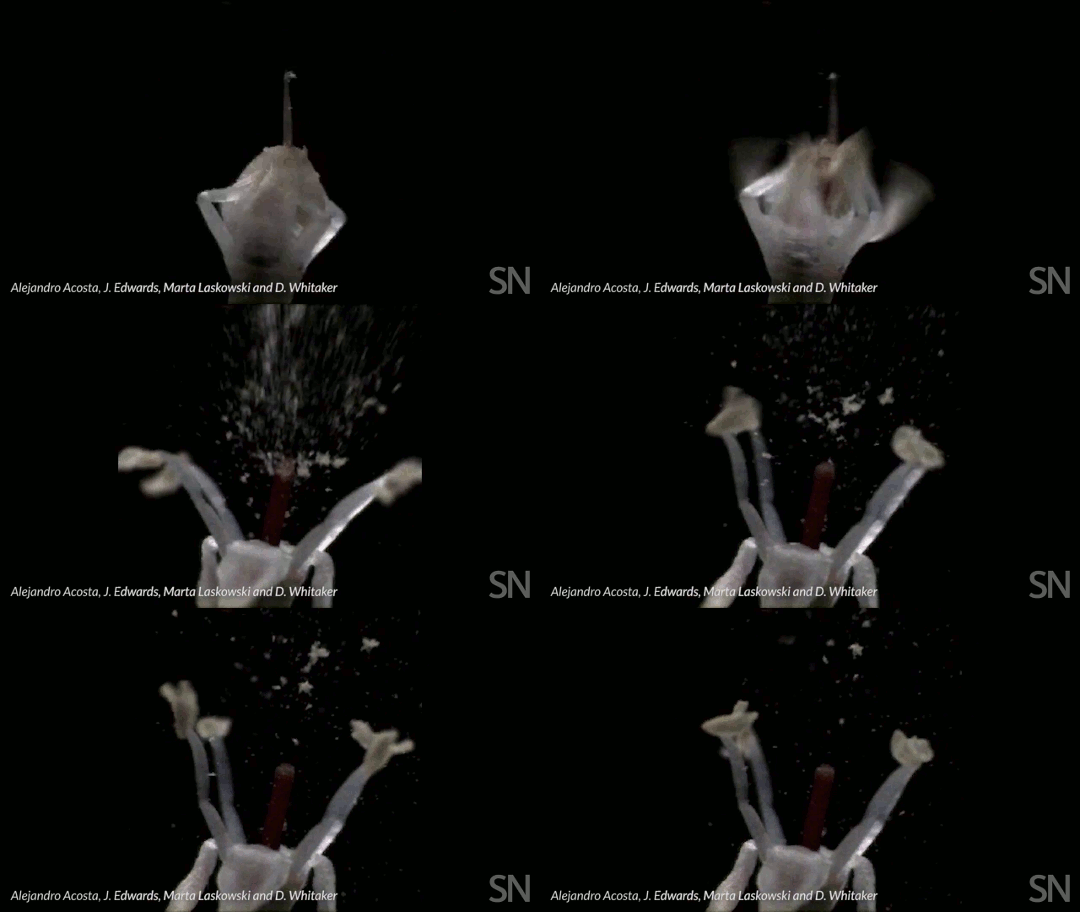
    The bunchberry dogwood, unlike its taller relatives, is a low-lying subshrub that spreads along the ground. But it sports some of the fastest action of any plant, requiring 10,000 frames per second to capture! When young buds form in the bunchberry flower, their four petals are fused, completely hiding the stamens. As the plant matures, the pollen-carrying stamens grow faster than the petals, causing them to peek out the sides of the bud. But the petals stay attached at the tip, holding the stamens in while pressure inside the stamens creates a store of elastic energy.

    When disturbed, the petals break loose and the stamens spring up and out. The anthers at their tips hold the pollen in place until the stamen reaches its maximum vertical velocity, at which point the anthers swing out to release the pollen upward. In essence, the flower works in the same manner as a trebuchet, flinging pollen with an acceleration 2,400 times greater than gravity. That’s enough to coat pollen onto nearby insects and to launch the remainder high enough for the wind to catch it. (Image and research credit: D. Whitaker et al., source; via Science News; submitted by Kam-Yung Soh)

    And with that, FYFD’s Plant Week is a wrap! Missed one of the previous posts? You can catch up with them here.

  • Plant Week: Jumping Spores

    Plant Week: Jumping Spores

    You might think that plants are pretty stationary, but they have evolved a myriad of ways of moving, especially when it comes to spreading their seeds and spores. Shown above is the spore of the horsetail plant, a spherical pod with four, ribbon-like elators that are moisture-sensitive. When exposed to water, the elators curl around the spore, but as they dry out, they unfurl (top). Repeated cycles of this allows the spores to “walk” short distances (middle). And, if the elators deploy quickly, the spore can even “jump” (bottom). Researchers recorded jumps high enough for the spores to catch a breeze and disperse further. For similar moisture-driven plant action, check out this seed that buries itself! (Image and research credit: P. Marmonttant et al., source; via Science News; submitted by Kam-Yung Soh)

    We’re celebrating botanically-based physics all this week with Plant Week. Check out our previous posts on the ultra-fast suction of carnivorous bladderworts and the incredible flight of dandelion seeds.

  • Plant Week: Bladderworts

    Plant Week: Bladderworts

    Carnivorous plants live in nutrient-poor environments, where clever techniques are necessary to keep their prey from getting away. The aquatic bladderwort family nabs their prey through ultra-fast suction. This starts with a slow phase (top) in which water is pumped out of the trap. Because the internal pressure is lower than the external hydrostatic pressure, this compresses the walls of the trap, and it leaves the trap’s door narrowly balanced on the edge of stability. A slight perturbation to the trigger hairs around the door will cause it to buckle. 

    That’s when things get fast. As the door buckles and the trap expands to its original volume, water gets sucked in, pulling whatever prey was nearby with it. The door reseals as the pressure inside and outside the trap equalizes, and, in only a couple milliseconds total, the bladderwort has its snack. It secretes digestive enzymes to break down what it’s caught, and over many hours, it pumps out the trap to reset it. (Image and research credit: O. Vincent et al.; submitted by David B.)

    All this week, FYFD is celebrating Plant Week. Check out our previous post on how dandelion seeds fly tens of kilometers.

  • Featured Video Play Icon

    Plant Week: Dandelions in Flight

    To kick off Plant Week here on FYFD, we’re taking a closer look at that ubiquitous flower: the dandelion. Love ‘em or hate ‘em, these little guys manage to get just about everywhere, thanks in part to their amazing ability to stay windborne for up to 150 km! To do that, the dandelion uses a bristly umbrella of tiny filaments, known as a pappus, that can generate more than four times the drag per area of a solid disk. Its porosity – all that empty space between the filaments – is also key to its stability; it helps create and stabilize a separated vortex ring that the seed uses to stay aloft. Check out the full video below! (Image and video credit: N. Sharp)

  • Plant Week: Introduction

    Plant Week: Introduction

    Spring has sprung! The trees have leaves, the flowers are in bloom, and snow is (almost) a distant memory.* And here at FYFD, we’re getting ready to kick off a full week of celebrating the intersection of fluid dynamics and plants.

    To get you into the mood, here’s a look at some previous plant-filled posts:

    How trees use negative pressure to hydrate
    The catapulting seeds of the hairyflower wild petunia
    Seeds that self-dig
    How desert moss drinks from the air
    The swimming of zoospores

    Stay tuned all next week for lots more plant physics!

    *Confession: it’s still snowing at my house as I type this. But the trees do have leaves and there are flowers blooming. Poor things. – Nicole

    (Original image: Pixabay)

  • Featured Video Play Icon

    Flying Beetles, Stinging Nettles, and Jellyfish

    In the latest JFM/FYFD video, we tackle some of the less pleasant aspects of summer weather: stopping invasive insects, understanding how plants dispense poison, and looking at the physics behind jellyfish stings. And if you’ve missed any of our previous videos, we’ve got you covered. (Image and video credit: T. Crawford and N. Sharp)

  • Featured Video Play Icon

    “Flowers and Colors”

    Many children have done the simple experiment of placing a cut flower in dyed water and watching as it changed color. The latest video from Beauty of Science relies on some related physics. Since the color of flowers typically depends on acidity, immersing a flower in dilute acid will change its color from pinks and purples to yellows and greens. Watching this transformation, we can learn about how fluids get transported through flowers.

    Like the leaves on a tree, flowers are covered in tiny cells called stomata that can open and close. In the daytime, stomata are typically open to allow carbon dioxide to diffuse into the plant. (At the same time, water pulled up from the roots is evaporating out the stomata, as seen previously.) Once immersed in acid, the open stomata are no longer bringing in carbon dioxide; instead, the acid is diffusing in and slowly spreading through the petals. In the timelapse video, some areas of the petal change faster than others. This could indicate more open stomata in the regions that change first or even that some areas inside the petal transport water (and acid) better than others. (Video and image credit: Beauty of Science; see also Making Of)

  • Withstanding Windstorms

    Withstanding Windstorms

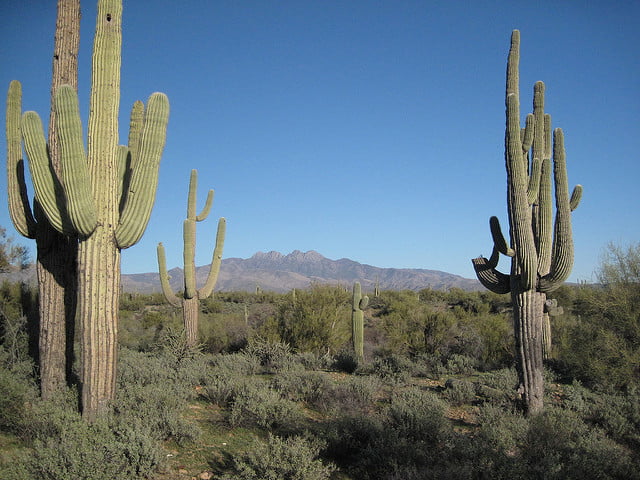
    Saguaro cacti can grow 15 meters tall, and despite their shallow root systems can withstand storm winds up to 38 meters per second without being blown over. Grooves in the cacti’s surface may contribute to its resilience, by adding structural support and/or through reducing aerodynamic loads. The latter theory mirrors the concept of dimples on a golf ball; namely, grooves create turbulence in the flow near the cactus, which allows air flow to track further around the cactus before separating. The result is less drag for a given wind speed than a smooth cactus would experience.

    Indeed, recent experiments on a grooved cylinder with a pneumatically-controlled shape showed exactly that; the morphable cylinder’s drag was consistently significantly lower than fixed samples. Cacti do change their shapes somewhat as their water content changes, but they don’t have the ability for up-to-the-minute alterations. Nevertheless, their adaptations can inspire engineered creations that morph to reduce wind impact. (Image credit: A. Levine; research credit: M. Guttag and P. Reis)

  • Drawing Up Dew

    Drawing Up Dew

    Desert plants have evolved to efficiently collect and capture whatever water they can. Each leaf of the moss Syntrichia caninervis ends in a hairlike fiber called an awn (seen in white in the top image). Tiny as they are, awns are vital to the moss’s water collection, correlating to more than 20% of their dew collection. Extremely tiny grooves on the surface of the awn provide nucleation sites where dew condensed from fog collects. Once a droplet forms on the awn, it grows larger as more fog condenses (middle image). When the droplet grows large enough, the conical shape of the awn will cause surface tension to draw the droplets along the awn and toward the leaf (bottom image).

    (Credits: Syntrichia caninervis moss image – M. Lüth; videos and research – Z. Pan et al., Supplementary Videos 3 and 4; h/t to T. Truscott)