The world’s most powerful artificial tornado is part of the Mercedes-Benz Museum in Stuttgart, Germany. Though popular enough with visitors that the staff will bring out smoke generators to make it visible, the tornado was not built as an attraction – It’s actually part of the building’s fire protection system. The modern open design of the museum meant that conventional smoke removal systems were inadequate. Instead vorticity is generated in the central lobby with 144 wall-mounted jets. The angular velocity created by the jets is strongest at the middle, in the vortex core, due to conservation of angular momentum – exactly the way a spinning ice skater speeds up by pulling his arms in. The core of the vortex is a low pressure area, which draws outside air toward it – this is how the tornado pulls in smoke when there is a fire. The fan on the ceiling provides the pressure draw necessary for the smoke to be pulled up and out of the building at a supposed rate of 4 tons per minute. See the tornado in action here. (Photo credit: Mercedes-Benz Passion; submitted by Ivan)
Tag: angular momentum

Tornado in a Bubble
In this video, a miniature tornado-like vortex is created inside a soap bubble. Here’s how it works: after the first bubble is formed and the smoke-filled bubble is attached to the outside, he blows into the main bubble, creating a weak angular velocity, before breaking the interface between the two bubbles. As the smoke mixes in the main bubble, note how it is already spinning slowly due to the free vortex he created. Then, when the top of the bubble is popped, surface tension pulls the bubble’s surface inward. Because the bubble radius is decreasing, conservation of angular momentum causes the angular velocity of the fluid inside to increase, pulling the smoke into a tight vortex, much like a spinning ice skater who pulls her arms inward.

Steam Devils
The formation of the ethereal steam devil is quite similar to the formation of a fire tornado. In this case, the first frost of the season cooled air temperatures substantially below the temperature of the water of the lake, creating conditions for steam and for updrafts of rising, warmer air. A slight breeze across the lake is enough to create pockets of vorticity, which stretch due to the updrafts and intensify due to conservation of angular momentum. This creates the narrow spinning vortex filaments that pull steam up and dance across the lake’s surface. #

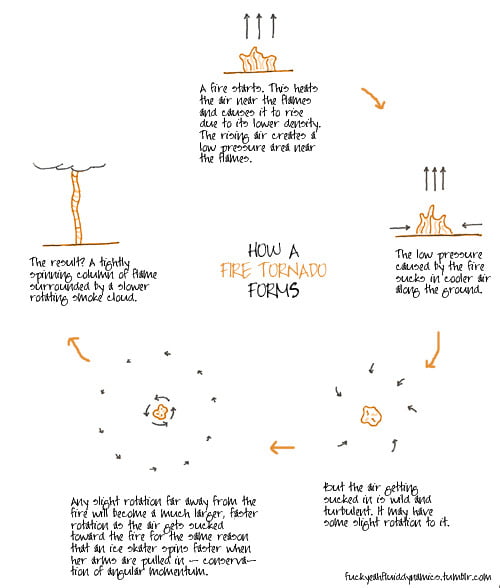
Fire Tornado Formation
The phenomenon of a fire tornado caught our attention recently after the BBC published footage of one in Brazil. While it may look like the fiery wrath of a god, the fluid dynamics of a fire tornado are relatively simple (see figure above). Still, they make for some pretty wild video.