What’s shown in this video are some pretty spectacular demonstrations of fluidization, where a gas is introduced at the bottom of a bed of granular particles–like sand. At the critical gas velocity, the aerodynamic forces exerted on each particle by the gas will balance the gravitational force on the particle and it will become suspended. All of a sudden, the macroscopic behavior of the solid particles will be like that of a fluid; you can even make it “boil”!
Tag: aerodynamics

The Silence of Owls
Owls are among the most silent hunters in nature, thanks to their feathers. The leading edge of the wing, shown in the bottom part of the photo, has a serrated comb-like edge, which breaks flow over the wing into small vortices, which are quieter than larger ones. The fringe-like trailing edge breaks the flow up further and helps absorb the sound produced by the turbulence. The fluffy feathers along the owl’s body can also help muffle noise. Researchers are investigating ways to use these techniques to quiet aircraft. # (via jshoer)

xkcd and Lift
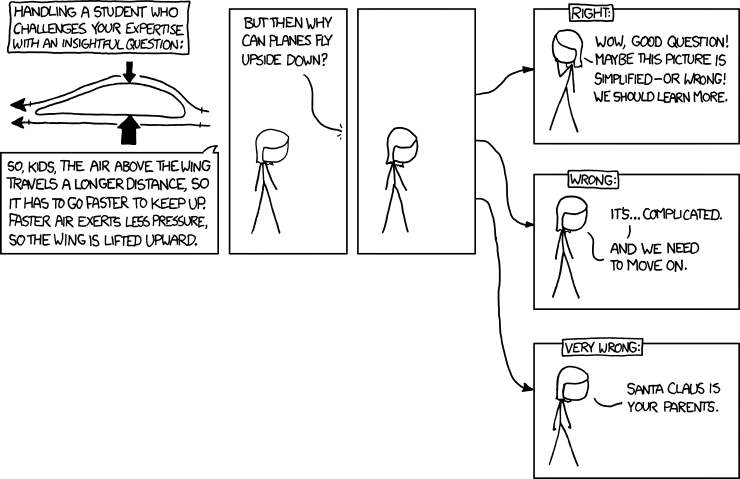
xkcd identifies a very common misconception about how airfoils work! (via Vinnchan and jasonas14) #

Jet-Based Control
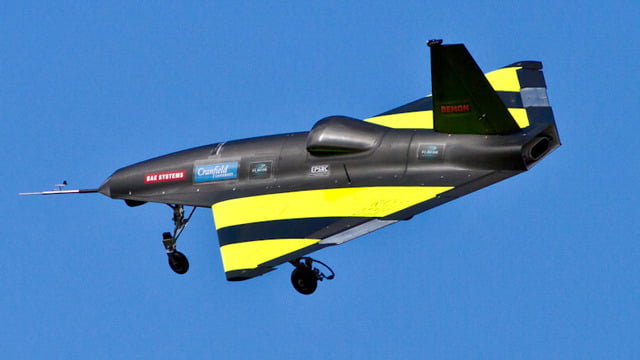
Researchers have flown the first aircraft designed to maneuver without conventional control surfaces like ailerons and flaps. Instead of changing the wing geometry to alter the lift on different parts of the craft, the UAV uses strategically placed jets of air along the wing to control its flight. The plane can also alter the direction of its thrust, not by turning the nozzle as is conventionally done, but by modifying the thrust vector by directing and firing a secondary jet into the exhaust. #
Paper Plane Physics
[original media unavailable]
It’s a little surprising that this would be so stable, but I don’t have any reason to believe it impossible. #

Human-Powered Ornithopter
A team at the University of Toronto has flown the world’s first human-powered ornithopter, an aircraft that flies by flapping its wings like a bird. The concept dates back all the way to Da Vinci in the 15th century. Part of why it’s taken centuries to realize the dream is that bird flight is much more complicated than simply flapping up and down. Flapping a wing up and down will produce lift equally upward and downward. In order to create usable lift and thrust, it’s necessary to change the angle of attack during each stroke by twisting the wing while flapping. Watch the U of T craft carefully, and you can see this happening. #
Sailing Faster than the Wind
Is it possible to create a vehicle that uses the wind to move itself directly downwind faster than the wind does? Strangely enough, it is. The concept has been the subject of debate for years, but one team has confirmed the physics by building a vehicle that uses wind but can travel 2.8x faster than the wind does. See their article on Wired. #

Flying Fish Aerodynamics
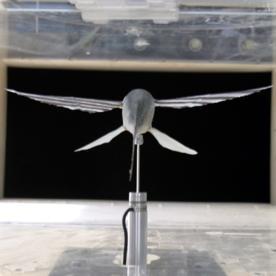
New research using wind tunnel measurements of (dead) flying fish is giving new insight into how these fish are able to fly over the waves. Lift and drag data indicates that flying fish have a gliding ability comparable to soaring birds like hawks! #
How Wings Create Lift
One of the topics in fluid dynamics almost everyone has come across is the explanation of how airplanes produce lift. Using Bernoulli’s principle–which relates velocity and pressure–and a picture of an airfoil, your average science text will say that a bit of air going over the top of the airfoil has to travel farther than a bit of air going under the airfoil, and that, therefore, the air over the top travels faster than the air under the airfoil.
Unfortunately, this is misleading and, depending on the wording, outright wrong! The hidden assumption in this explanation is that air that goes over the top and air that goes under the bottom have to reach the trailing edge of the airfoil at the same time. But why would that be? (As one of my profs once said, “There is nothing in physics that says there is Conservation-Of-Who-You-Were-Sitting-Next-To-When-You-Started.”)
Take a look at the video above. It shows an airfoil in a wind tunnel using smoke visualization to show how the air moves. Around the 0:25 mark, the video slows to show a pulse of smoke traveling over the airfoil. What happens at the trailing edge? The smoke going over the top of the airfoil is well past the trailing edge by the time the smoke going under the airfoil reaches the trailing edge!
It’s true that air goes faster over the top of the airfoil than the bottom and that this causes a lower pressure on top of the airfoil (as Bernoulli tells us it should) and that this causes an upward force on the airfoil. But which causes which is something of a chicken-and-egg problem.
A more straightforward way, in my opinion, of explaining lift on an airplane is by thinking about Newton’s 3rd law: for every action, there is an equal and opposite reaction. Take a look at the air’s movement around the airfoil as the angle of attack is increased around 1:00 on the video. Just in front of the airfoil, the air is moving upward. Just after the airfoil, the air is pointed downward. A force from the airfoil has pushed the air down and changed its direction. By Newton’s 3rd law, this means that the air has pushed the airfoil up by the same amount. Voila! Lift!