Tag: absorption

  • Calming the Waves

    Calming the Waves

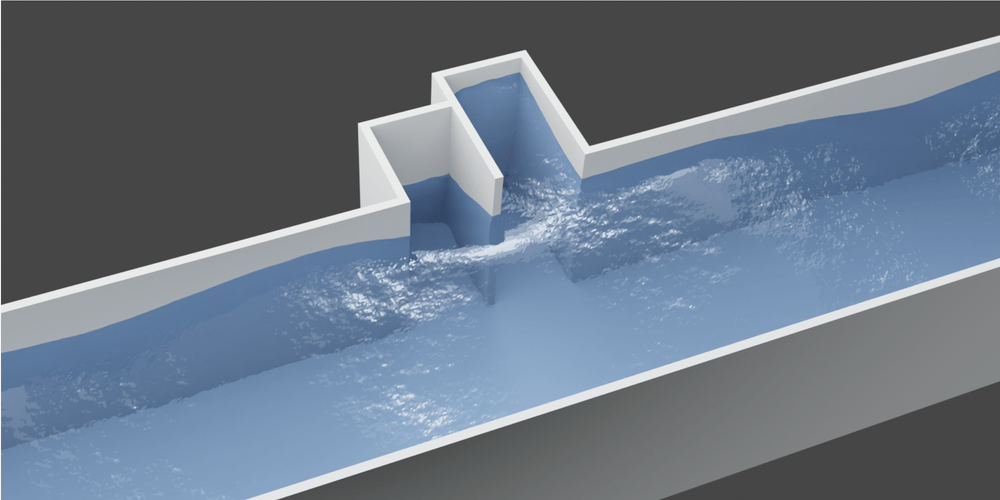
    Wave action can be a major source of erosion along riverbanks and shorelines. But in a recent study, scientists were able to perfectly absorb incoming waves to create a downstream region with calm, wave-free waters.

    Experimental data shows that waves approaching from the left interact with the resonant chambers and get perfectly absorbed, leaving the water on the right side still.
    Experimental data shows that waves approaching from the left interact with the resonant chambers and get perfectly absorbed, leaving the water on the right side still.

    The group began with a narrow channel that waves could move down. They added two small, side-by-side cavities perpendicular to the channel; as waves travel down the channel, they resonate with the cavities, which reflect and transmit their own waves back into the channel. With the right tuning to the size and spacing of the cavities, the team was able to make the cavities’ waves perfectly cancel the channel’s waves. The group demonstrated this absorption theoretically, numerically, and experimentally.

    Currently, they’ve only managed perfect absorption with a single wave frequency, but an array of cavities should be able to absorb a range of incoming waves. The authors hope their work will one day help protect coastal structures and prevent erosion by countering incoming waves. (Image and research credit: L-P. Euvé et al.; via APS Physics)

  • Vanishing Spirits: Aging

    Vanishing Spirits: Aging

    The necessary ingredients for scotch whisky’s evaporation patterns are alcohol, surfactants, and polymers; some of those components are absorbed during the spirit’s aging in oak casks. Photographer Ernie Button explored how long it takes for whisky to absorb enough of these chemicals by photographing the stains left by samples aged between 1 and 5 weeks in an oak cask. He found that it takes about 5 weeks for the scotch patterns to begin emerging.

    The aging process for scotch and other cask-aged spirits depends on the fluid’s flow through the porous grain of the oak. Evaporation plays a significant role in the process, so the aging process differs based on environmental conditions. For example, distillers in the dry, high-altitude climate of Colorado must use climate-controlled storage, whereas Scottish distillers use a more humid natural climate to their advantage.

    Another major factor in the aging process is the charred oak cask itself. Some whiskys, like American bourbon, always use a brand new barrel, whereas scotch is often aged in a previously-used cask. With older casks, absorption of molecules from the wood takes longer, which is why scotch is typically aged for much longer than some other types of whisky. (Image, research, and submission credit: E. Button; see also)

  • Featured Video Play Icon

    Alien Eggs? A Virus?

    Nope, they’re hydrogel beads! The team at Chemical Bouillon seem to have once again coated them in something like paint before placing them in water. As the gel beads absorb water, they expand, tearing through their coating. The result is weirdly mesmerizing and kind of creepy. It’s no wonder that special effects artists have historically turned to fluids for sci-fi films! (Image and video credit: Chemical bouillon)

  • Featured Video Play Icon

    Expanding Water Beads

    In this timelapse, we see hydrogel beads expanding as they absorb water. There are some interesting subtleties to the physics here. Notice how, in the Petri dish segments, the beads shift from a single crystalline structure to several smaller structures. I suspect those shifts are driven by the dropping water level, which changes how surface tension interacts with the beads’ shape to create attractive forces between beads.

    Another interesting point comes as the beads expand through and out of the glass of water. Initially, the water level doesn’t change in the glass. This is because the water beads are taking up the same volume as the water that they’ve absorbed. But once the beads emerge past the water’s initial height, the water level drops dramatically. That’s because the beads are still absorbing what little water is left and continuing to expand in volume. (Image and video credit: Temponaut)

  • Featured Video Play Icon

    Paint Versus Hydrogel

    In this bizarre short film, we get to see a battle between dissolution and absorption. I think the Chemical Bouillon team has coated hydrogel beads in a layer of paint and then immersed them in water. As the beads absorb water, they expand and grow, tearing their fragile outer layer of paint to smithereens.

    One thing that struck me when watching several of the sequences is just how regular the hole spacing in the paint is for the round hydrogels. That hints at an orderly breakdown in the solid paint layer while the interior hydrogel polymer symmetrically expands. It’s a little like watching holes grow in a splash curtain. (Video and image credit: Chemical Bouillon)