Tag: 2018gofm

  • Keeping Bubbles Around

    Keeping Bubbles Around

    Bubbles don’t stick around in pure water. Surfactants are needed to stabilize the thin liquid film for longer than the blink of an eye. But that’s not necessarily the case for other liquids. As the video below shows, a bubble in isopropyl alcohol is quite stable. This is because of the alcohol’s volatility – its ability to evaporate easily.

    As the alcohol in the bubble film evaporates, it cools the film, creating a difference in surface tension that pulls fresh alcohol up into the bubble film. It’s so efficient at pulling alcohol up that the alcohol can’t evaporate fast enough to use it all. Once the excess alcohol is heavy enough, it slides back down the side of the bubble. Overall, though, the process is enough to keep a bubble in pure isopropyl alcohol from rupturing for minutes to hours at a time. (Image and video credit: M. Menesses et al.)

  • Featured Video Play Icon

    Swirling Polygons

    We don’t usually think of fluids forming corners, but they can. Here you see liquid nitrogen in a simple pot. Since the pot is much hotter than the boiling point of the nitrogen, the liquid nitrogen is floating on a layer of its own vapor. This is called the Leidenfrost effect. That nearly frictionless contact with the pot means that stirring the nitrogen conveniently spins it up into these rotating polygons, visible in high-speed footage. The faster you stir the nitrogen, the more points you get. 

    Check out the full video below for instructions on how the researchers constructed their set-up. If you try it, though, remember to have plenty of ventilation. When the nitrogen vaporizes, its volume increases dramatically, and if you’re not careful, it will displace too much oxygen and make it hard to breathe. (Image and video credit: A. Duchesne et al., source)

  • Featured Video Play Icon

    Dripping Down the Rivulet

    If you’ve ever watched water running down the side of the street, you’ve probably noticed that it doesn’t flow smoothly. Instead, you’ll see waves, rivulets, and disturbances that form. That’s because the simple action of flowing down an incline is unstable. Water and other viscous liquids can’t flow downhill smoothly. Any disturbances – an uneven surface, the rumble of passing cars, a pebble in the way – will create a disruption that grows, often until the entire flow is affected. This video shows some of the complex and beautiful patterns you get then. (Video and image credit: G. Lerisson et al.)

  • Inside a Heart

    Inside a Heart

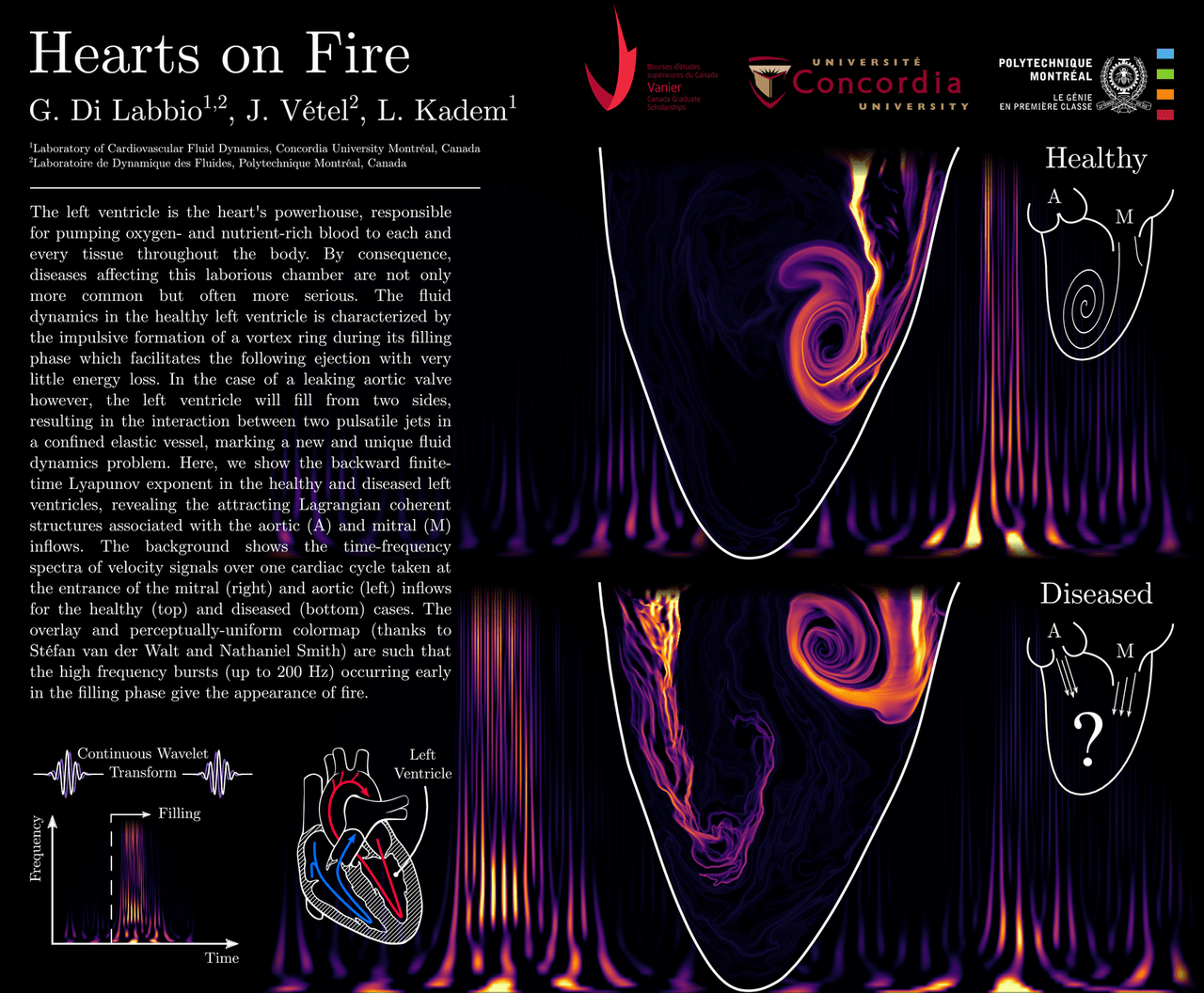
    You may not give it much thought, but there is important fluid dynamics happening inside you every moment of every day, especially inside your heart. Of the four chambers of the heart, the left ventricle has the thickest walls, reflecting its important task: pumping oxygenated blood throughout the body. In a healthy heart (top of poster; click here for the full-size version), a vortex ring and trailing jet fill the ventricle when the mitral valve opens. Then the ventricle contracts and pumps blood out the aortic valve and into the rest of the body.

    But for individuals with a leaking aortic valve (bottom of poster), things look different. Blood leaks back through the aortic valve at the same time that the mitral valve opens to allow freshly oxygenated blood back in. The two inflows disrupt mixing in the chamber, and, instead of pumping fully-oxygenated blood into the body, the left ventricle has to struggle to pump a less-oxygenated mixture into the body. (Image credit: G. Di Labbio et al.)

    ETA: (Research paper: G. Di Labbio et al., arXiv)