Tag: 2018gofm

  • Adapting to the Flow

    Adapting to the Flow

    Simulating fluid dynamics computationally is no simple task. One of the major challenges is that flows typically consist of many different lengthscales, from the very large to the extremely tiny. In theory, correctly capturing the physics of the flow requires computing all of those scales, and that means having a very close, dense grid of points at which the physics must be calculated during every time step of a simulation. Even for a relatively simple flow, this quickly balloons into a prohibitively expensive problem. It simply takes a computer far too long to calculate solutions for so many points.

    One technique that’s been developed to save time is Adaptive Mesh Refinement. You can see an example of it above. The background is a grid of points that are far from one another in places where the flow isn’t changing and are tightly spaced in areas where the rising flames are most changeable. Adaptive Mesh Refinement algorithms automatically change these grid points on the fly, adding more where they’re needed and subtracting them where they aren’t. The end result is a much faster computational result that doesn’t sacrifice accuracy. Check out the videos below for some examples of this technique in action. (Video and image credit: N. Wimer et al.)

  • Whiskey Stains

    Whiskey Stains

    Complex fluids leave behind fascinating stains after they evaporate. We’ve seen previously how coffee forms rings and whisky forms more complicated stains as surface tension changes during evaporation drive particles throughout the droplet. Now researchers are considering the differences between traditional Scottish whisky, which ages in re-used, uncharred barrels, and American whiskeys like bourbon, which are required to age in new, charred white oak barrels.

    When diluted, the American whiskeys form web-like patterns – seen above – that vary from brand to brand, like a fingerprint. The charring of the barrels allows American whiskeys to pick up more water-insoluble molecules compared to whisky aged in uncharred barrels. Since the webbed patterns form in American whiskey but not Scotch whisky, it’s likely those molecules play an important role in the evaporation dynamics and subsequent staining. (Image credit: S. Williams et al.; research credit: S. Williams et al.; via APS Physics; submitted by Kam-Yung Soh)

  • Cavitation Collapse

    Cavitation Collapse

    The collapse of a bubble underwater doesn’t seem like a very important matter, but when it happens near a solid surface, like part of a ship, it can be incredibly destructive. This video, featuring numerical simulations of the bubble’s collapse, shows why. 

    When near a surface, the bubble’s collapse is asymmetric, and this asymmetry creates a powerful jet that pushes through the bubble and impacts the opposite side. That impact generates a shock wave that travels out toward the wall. As the bubble hits its minimum volume, a second shock front is generated. Both shock waves travel toward the wall and reflect off it, generating high pressure all along the surface. (Image and video credit: S. Beig and E. Johnson)

  • Featured Video Play Icon

    Reducing the Force of Water Entry

    As anyone who’s jumped off the high board can tell you, hitting the water involves a lot of force. That’s because any solid object entering the water has to accelerate water out of its way. This is why gannets and other diving birds streamline themselves before entering the water. But even for non-streamlined objects, like a sphere, there are ways to reduce the force of impact.

    This video explores three such techniques, all of which involve disturbing the water before the sphere enters. In the first, the sphere is dropped inside a jet of fluid. Since the jet is already forcing water down and aside when the sphere enters, the acceleration provided by the sphere is less and so is the force it experiences.

    The second and third techniques both rely on dropping a solid object ahead of the one we care about. In the second case, a smaller sphere breaks the surface ahead of the larger one, allowing the big sphere to hit a cavity rather than an undisturbed surface. Like with the jet, the first sphere’s entry has already accelerated fluid downward, so there’s less mass that the bigger sphere has to accelerate, thereby reducing its impact force.

    In the third case, the first sphere is dropped well ahead of the second, creating an upward-moving Worthington jet that the second sphere hits. In this case, there’s water moving upward into the sphere, so how could this possibly reduce the force of entry? The key here is that the water of the jet wets the sphere before it enters the pool. Notice how very little air accompanies the second sphere compared to the first one. That’s because the second sphere is already wet. It’s also been slowed down by the jet so that it enters the water at a lower speed, all of which adds up to a lower force of entry. (Image and research credit: N. Speirs et al.)

  • Featured Video Play Icon

    Active Foam

    Geometrically, biological tissues and two-dimensional layers of foam share a lot of similarities. To try and understand how active changes in one cell affect neighbors, researchers are studying how foams shift when air is injected (below) at one or more sites. When a foam cell expands, it forces topological changes in neighboring cells, which researchers built an algorithm to track in real-time. 

    With some processing, they can actually visualize the radially-expanding waves of strain that pass through the foam (bottom image). This allows them to visualize the effects and interaction of multiple injection sites at once, hopefully helping unlock the mechanics behind both the foam’s shifts and those that occur in tissues. (Image and video credit: L. Kroo and M. Prakash)

  • Featured Video Play Icon

    Breaking

    As waves fold over and break, they trap air, creating bubbles of many sizes. The smallest of these bubbles can be only a few microns across and persist for long times compared to larger bubbles. When they burst, they create tiny droplets that can carry sea salt up into the atmosphere to seed rain. Understanding how these bubbles form and how many there are of a given size is key to predicting both oceanic and atmospheric behaviors. Numerical simulations like the one featured in the video above reveal the dynamic collisions that create these tiny bubbles and help researchers learn how to model the tiniest bubbles so that future simulations can be faster. (Image and video credit: W. Chan et al.)

  • Featured Video Play Icon

    Fizzy Droplets

    Leidenfrost drops surf on a layer of their own vapor, created by the high temperature of a nearby surface relative to their boiling point. These Leidenfrost drops can self-propel and skitter and skate across a surface, but they’re not the only droplets that do this. In this video, researchers show how a drop of carbonated water on a superhydrophobic (water-repelling) surface also avoids contact. As long as the drop has carbon dioxide to expel, it will maintain a gap relative to the surface and can even surf over a ratcheted surface the way that their Leidenfrost cousins do. (Image and video credit: D. Panchanathan et al., source)

  • Featured Video Play Icon

    The Shaky Life of a Droplet

    An evaporating drop of ouzo goes through several stages due to the interactions of oil, alcohol and water. If you turn the situation around by placing a drop of (blue-dyed) water in a mixture of alcohol and anise oil (top image), you get some similarly odd behavior. The drop of water shimmies and grows as alcohol dissolves into it, carrying the occasional oil droplet with it. Eventually, the droplet grows large enough and buoyant enough that part of it detaches and floats to the surface (middle image). If you increase the alcohol ratio in the surrounding fluid, you speed up this process, causing droplets to stream up to the surface (bottom image). (Image and video credit: O. Enriquez et al., source)

  • Water Impacts

    Water Impacts

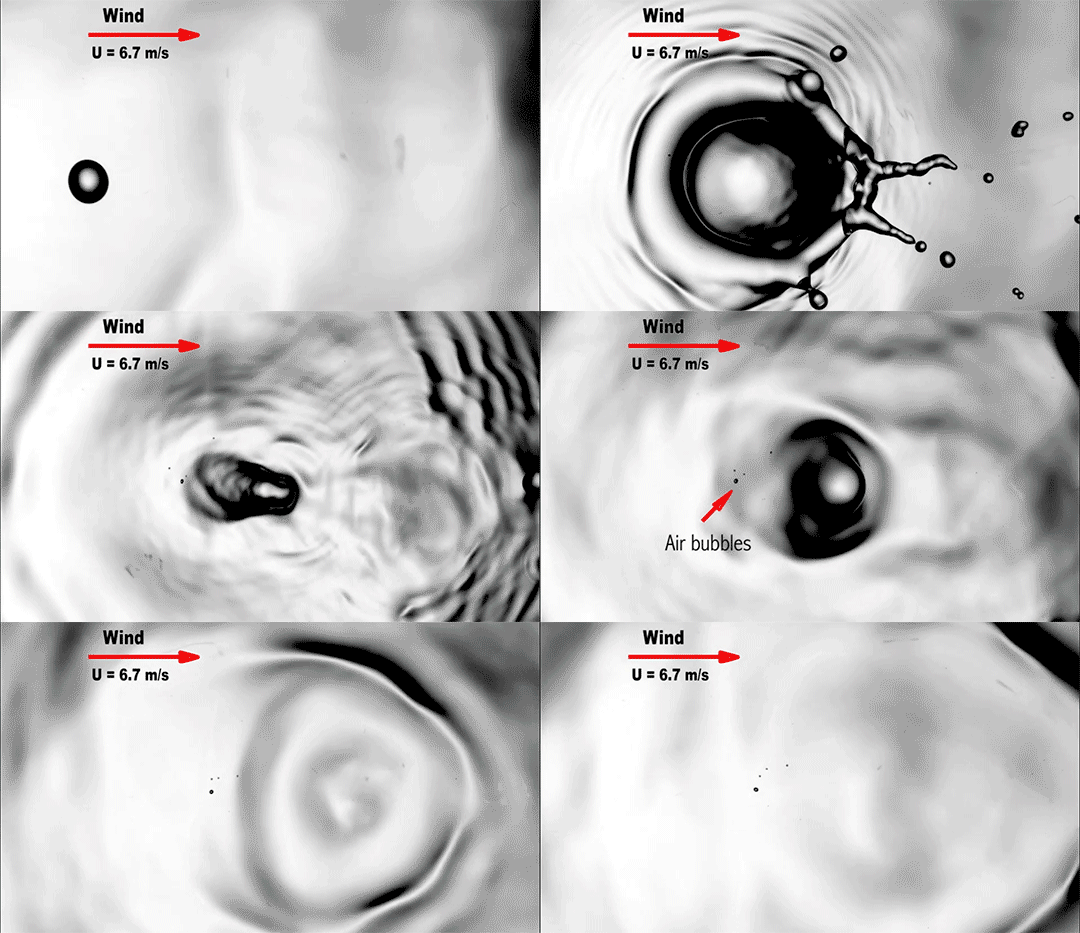
    In the clean and simplified world of the laboratory, a droplet’s impact on water is symmetric. From a central point of impact, it sends out a ring of ripples, or even a crown splash, if it has enough momentum. But the real world is rarely so simple.

    Here we see how droplets impact when the wind is blowing against them. The drops fall at an angle, creating an oblique cavity. Rings of ripples spread from the impact, but the ligaments of a splash crown form only on the leeward side. As the wind speed increases, so does the violence of the impact, eventually beginning to trap tiny pockets of air beneath the surface. Those miniature bubbles can spray droplets and aerosols into the air when they finally pop. (Image and video credit: A. Wang et al.)

  • Featured Video Play Icon

    Freezing Drop Impact

    At the altitudes where aircraft fly, it’s often cold enough for water drops to freeze in seconds or less. Once attached to a wing, such frozen drops disrupt the flow, reducing lift and increasing drag. To help understand how such droplets freeze, scientists study droplet impact on cold surfaces. Starting at room temperature (counter-clockwise from upper left), a drop will spread on the surface, then retract. When the temperature is colder, parts of the droplet freeze before retraction completes, leaving a thin sheet with a thicker center. At even colder temperatures, the droplet’s rim destabilizes and freezing occurs before the droplet has time to retract fully. And at the coldest temperatures, the droplet breaks apart into a frozen splash. (Image and video credits: V. Thievenaz et al.)