Tag: 2017gofm

  • Using Instabilities for Manufacturing

    Using Instabilities for Manufacturing

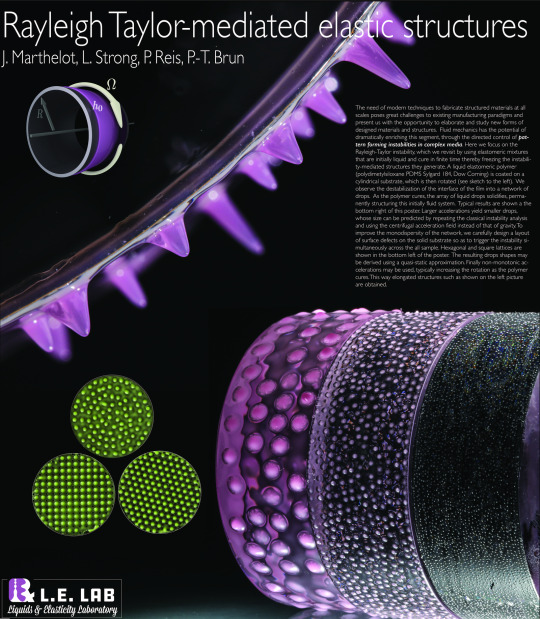
    Manufacturing textured, flexible surfaces can be difficult, but researchers are exploring ways to use fluid dynamical instabilities to make the process easier. They begin with a pourable polymer mixture that cures and solidifies over time. By putting the mixture on a cylinder and rotating it, engineers trigger the Rayleigh-Taylor instability – the same instability that makes dense fluids sink into lighter ones. Here, the instability is driven not only by gravity but by the added acceleration caused by centrifugal force. It causes the fluid film to drain and form arrays of droplets, which then cure into dimples. The researchers can control the size, shape, and spacing of the droplets by changing parameters like the spin rate. And by repeating the process multiple times on the same piece, they can build up spikier shapes, like the ones shown on the poster below. (Image and research credit: J. Marthelot et al., poster)
    image

    Reminder for those at the APS DFD meeting! My talk is tonight at 5:10PM in Room B206. You’ll probably want to come early if you want a seat!
  • Visualizing Turbulence

    Visualizing Turbulence

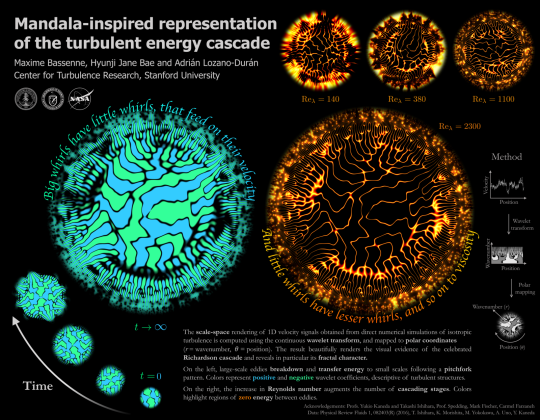
    Turbulence, the seemingly random and chaotic state that fluids often tend toward, can be difficult to wrap one’s head around. Turn your faucet on high or pour milk into your coffee, and the flow just looks like a completely unpredictable mess. But there are important patterns to be found.These flows have many different lengthscales and timescales to them. Think of a cloud. There are very large-scale motions that are close to the size of the entire cloud, but there are also very small ones that may be only a centimeter or so in size. 

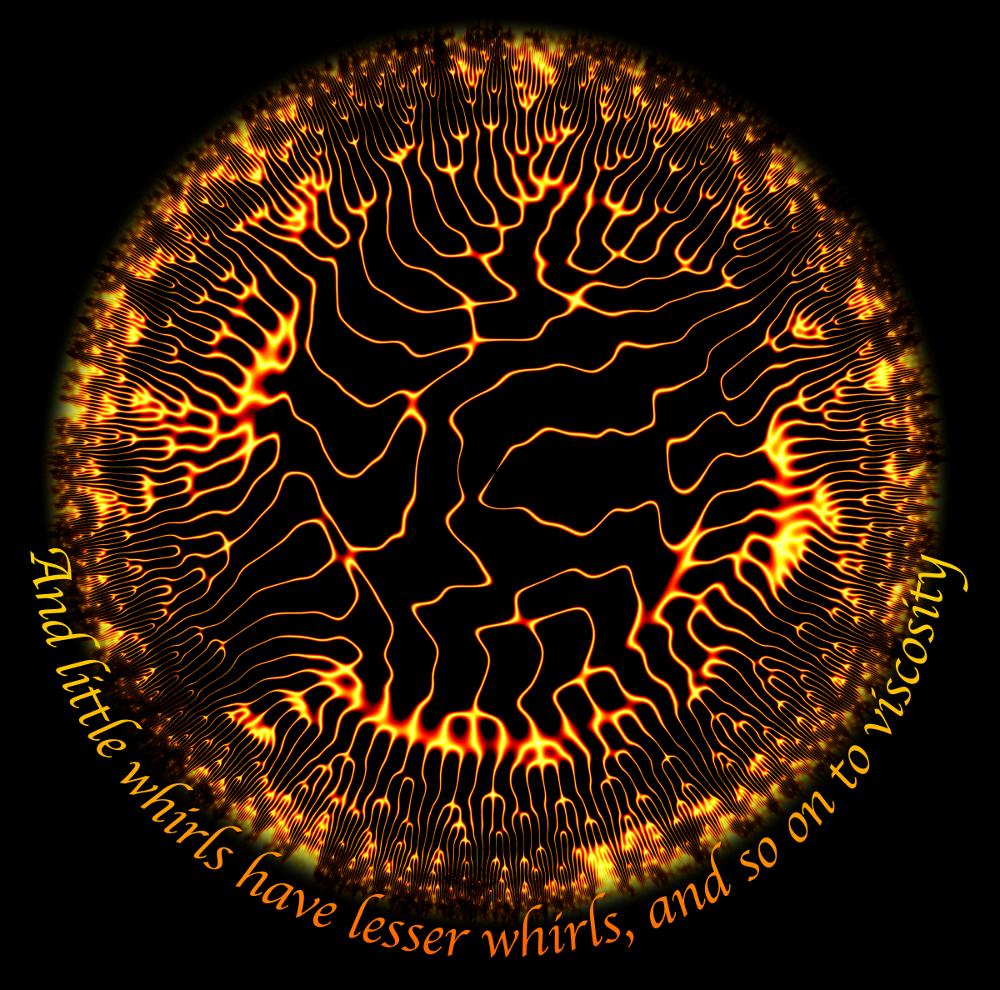
    Our best understanding of turbulence so far says that energy starts out in these large scales and slowly works its way down to the smaller ones, where viscosity (essentially friction, in this case) can transform that motion into heat. Above you see a creative way to display this fact. Using data from a numerical simulation, the authors transformed velocity information into these mandala-like patterns. The center of the image represents the large lengthscales, where energy is added. Moving around the circle, like a clock’s hand does, shows different positions in space. Moving radially from the center outward takes you through different lengthscales from large to small. 

    Notice how the large lengthscales break into smaller and smaller ones as you move outward. The pattern looks like a set of fractal pitchforks, with each lengthscale fracturing into smaller and smaller ones as the turbulence breaks down further. There’s lots more to see in the original poster, below, but you should really click here for the glorious full-size original. The poem, by the way, is the work of physicist Lewis Richardson, who wrote it to summarize how turbulence works. (Image credit: M. Bassenne et al.)

    image
  • Giving Droplets a Kick

    Giving Droplets a Kick

    Giving droplets a kick by accelerating the surface they sit on creates elaborate shapes as the drops respond. As the surface accelerates upward, the droplet flattens into a pancake. When the plate slows down, the droplet continues rising, stretching into a cone as its rim flies upward and its lower surface adheres to the surface. The rim retracts with a constant acceleration while the drop detaches with a constant velocity. That velocity depends on how well it adheres to the surface. The interplay between those two variables determines how conical or cylindrical the drop appears. See more in the full video below. (Image and video credit: P. Chantelot et al.)

  • Featured Video Play Icon

    The Coexistence of Order and Chaos

    One of the great challenges in fluid dynamics is understanding how order gives way to chaos. Initially smooth and laminar flows often become disordered and turbulent. This video explores that transition in a new way using sound. Here’s what’s going on.

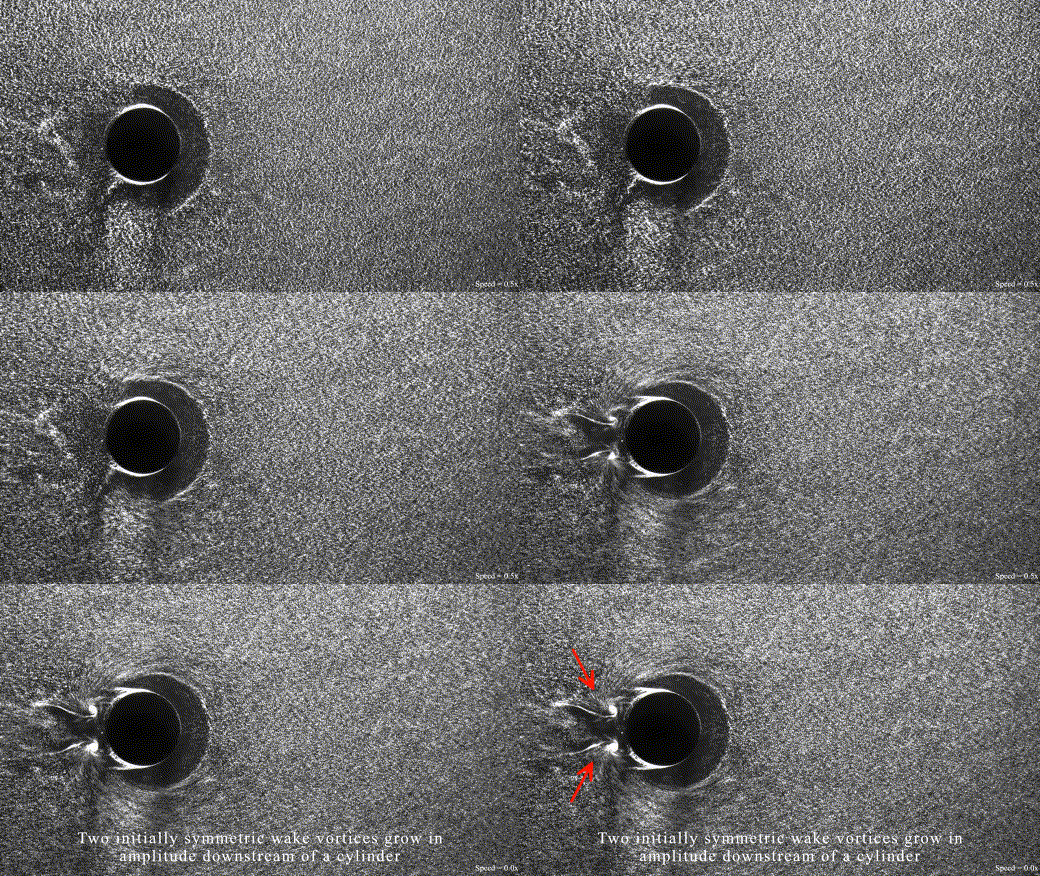
    The first segment of the video shows a flat surface covered in small particles that can be moved by the flow. Initially, that flow is moving in right to left, then it reverses directions. The main flow continues switching back and forth in direction. This reversal tends to provoke unstable behaviors, like the Tollmien-Schlichting waves called out at 0:53. Typically, these perturbations in the flow start out extremely small and are difficult or even impossible to see by eye. So researchers take photos of the particles you see here and analyze them digitally. In particular, they are looking for subtle patterns in the flow, like a tendency for particles to clump together with a consistent spacing, or wavelength, between them. Normally, researchers would study these patterns using graphs known as spectra, but that’s where this video does something different.

    Instead of representing these subtle patterns graphically, the researchers transformed those spectra into sound. They mapped the visual data to four octaves of C-major, which means that you can now hear the turbulence. When the audio track shifts from a pure note to an unsteady warble, you’re hearing the subtle disturbances in the flow, even when they’re too small for your eye to pick out.

    The last part of the video takes this technique and applies it to another flow. We again see a flat plate, but now it has a roughness element, like a tiny hockey puck, stuck to it. As the flow starts, we see and hear vortices form behind the roughness. Then a horseshoe-shaped vortex forms upstream of it. Aside from the area right around the roughness, this flow is still laminar. But then turbulence spreads from upstream, its fingers stretching left until it envelops the roughness element and its wake, making the music waver. (Video and image credit: P. Branson et al.)

  • Impressionist Foams

    Impressionist Foams

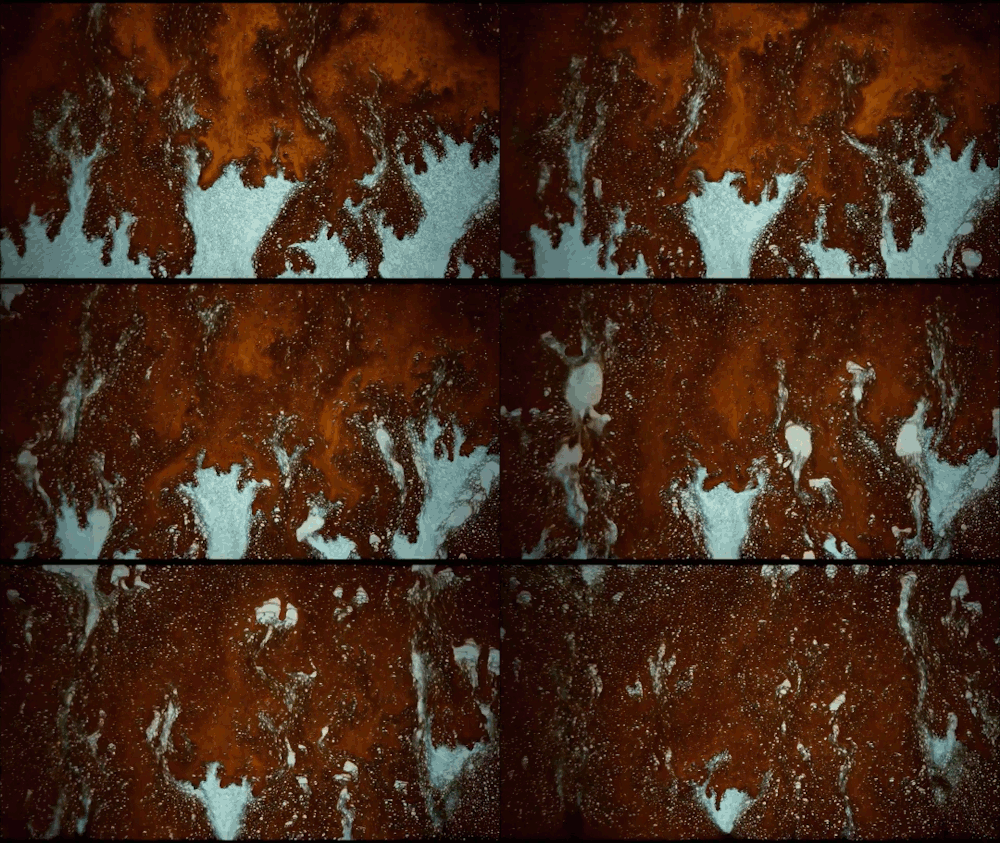
    Imagine taking two panes of glass and setting them in a frame with a small gap between them. Then partially fill the gap with a mixture of dye, glycerol, water, and soap. After turning the frame over several times, the half of the frame will be filled with foamy bubbles. When you flip it again, the dyed glycerol-water will sink and penetrate the bubble layer, creating complex and beautiful patterns as it mixes. Some of the bubbles may get squeezed together until they coalesce into larger bubbles that shoot upward thanks to their increased buoyancy. Other smaller bubbles will wend their way upward as neighboring fluid shifts. If you examine the tracks left by individual bubbles, you can find patterns reminiscent of Impressionist paintings, as seen at the end of this Gallery of Fluid Motion video. (Image credit: A. Al Brahim et al., source)

  • Surfaces That Scrape Off Ice

    Surfaces That Scrape Off Ice

    Ice can be a terrible pest, freezing to surfaces like roads and airplane wings and causing all sorts of havoc. Some surfaces, though, can actually prompt a freezing drop to scrape itself off. There are a couple key effects in play here. The first is that the surface is nanotextured – in other words, it has extremely small structures on its surface. This makes it hydrophobic, or water-repellent. The second key ingredient is that the drop is cooling evaporatively; that means heat is escaping along the air-water interface instead of conducting through the solid surface. As a result, the freezing front forms at the interface and pushes inward. Water expands as it freezes, which tries to force the interior liquid out, toward the bottom of the drop. On a normal surface, this would force the contact line – where air, water, and surface meet – to push outward. But the nanotexture of the hydrophobic surface pins that line in place. So the expanding ice pushes the frozen drop upward, scraping it off the surface! (Video and image credit: G. Graeber et al., source)

  • Featured Video Play Icon

    Water Walking, Exploding Droplets, and Colliding Vortices

    Every year I look forward to the APS DFD conference in November. It brings thousands of researchers together to share the latest in fluid dynamics. So much goes on in those three days that it’s impossible to capture, but last year I teamed up with Tom Crawford and the Journal of Fluid Mechanics to attempt just that. We interviewed 50 researchers on their projects, and we’ll be bringing you their work, in their words, each month leading up to the 2018 APS DFD meeting.

    This first video focuses on some of the awesome entries to the 2017 Gallery of Fluid Motion. Watch to learn about oil droplets that go flying everywhere when you’re cooking, balls that walk on water, the water music of Vanuatu and more! To see the videos we discuss and all the other entries, go to gfm.aps.org. (Video credit: N. Sharp and T. Crawford)

  • Breaking Up Turbulence

    Breaking Up Turbulence

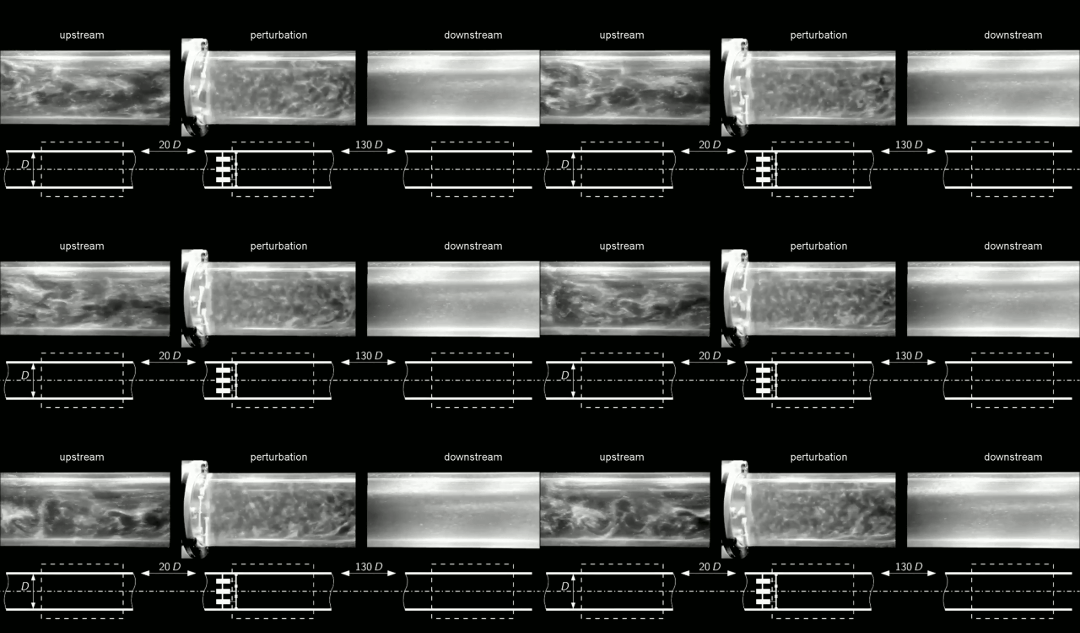
    Under most circumstances, we think about flows changing from ordered and laminar to random and turbulent. But it’s actually possible for disordered flows to become laminar again. This is what we see happening in the clip above. Upstream, the flow in this pipe is turbulent (left). Then four rotors are used to perturb the flow (center). This disrupts the turbulence and causes the flow to become laminar again downstream (right). To understand how this works, we have to talk about one of the fundamental concepts in turbulence: the energy cascade.

    Turbulent flows are known for their large range of length scales. Think about a volcanic plume, for example. Some of the turbulent motions in the plume may be a hundred meters across, but there are a continuous range of smaller scales as well, all the way down to a centimeter or less in size. In a turbulent flow, energy starts at the largest scales and flows further and further down until it reaches scales small enough that viscosity can extinguish them.

    That should offer a hint as to what’s happening here. The rotors are perturbing the flow, yes, but they’re also breaking the larger turbulent scales down into smaller ones. The smaller the largest lengthscales of the flow are, the more quickly their energy will decay to the smallest lengthscales where viscosity can damp them out. This is what we see here. Once the turbulent energy is concentrated at the smallest scales, viscosity damps them out and the flow returns to laminar. Check out the full video below for a cool sequence where the camera moves alongside the pipe so you can watch the turbulence fading as it moves downstream. (Image and video credit: J. Kühnen et al.)

    ETA: As it turns out, there’s more going on here than I’d originally thought. Simulations show that breaking up length scales is not the primary cause of relaminarization in this case. Instead, the rotors are modifying the velocity profile across the pipe in such a way that it tends to cause the turbulence to die out. The full paper is now out in Nature Physics and on arXiv.

  • Rolling Along

    Rolling Along

    Leidenfrost drops – droplets deposited onto a surface much hotter than their boiling point – are known for their mobility. With the right surface, they can be propelled, trapped, and even guided through a maze, typically by directing the vapor layer that cushions them. But new work shows that these drops have internal dynamics that also contribute to their propulsion.

    By adding tracer particles to each droplet, researchers can visualize flows inside the droplet. Large drops tend to have a flatter shape and contain two or more rotating vortices. Such drops won’t propel themselves without another force in play. But smaller droplets are more spherical and contain only a single rotating flow. Once these drops detach, they roll away! Despite the similarity to wheels, these liquid drops aren’t moving the same way. Remember that the drop is not actually in contact with the surface. To see what sets the drop’s direction, researchers examined the shape of the bottom of the drop. They found that it sits at a slant on its vapor cushion. That pushes evaporating gases out one side, propelling the drop the other way. (Image and video credit: A. Bouillant et al., source)

  • Featured Video Play Icon

    Water Music of Vanuatu

    In the Pacific Island nation of Vanuatu, women have a tradition of water music, accompanying their singing with a percussive use of water. This video explores the physics behind this music. Performers use three basic motions – a slap, a plunge, and a plow – that each have distinctive acoustics thanks to the interaction of hand, water, and air. High pitches come from the initial impact on the water, whereas lower pitches come mostly from the collapse of the air cavity in the hand’s wake. By altering the rhythms and patterns of these three building blocks, the musicians create a rich harmony to accompany their singing. (Video credit: R. Hurd et al.)