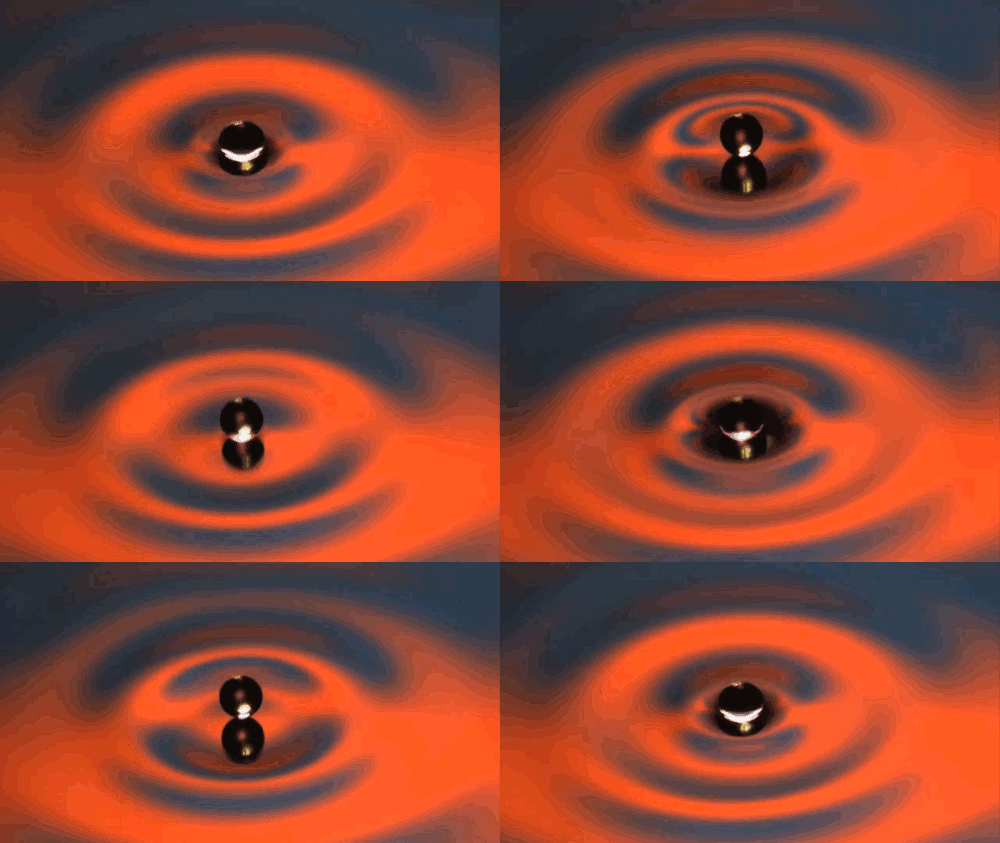
Capturing refracted images in a droplet is a popularpastimeamonghigh-speedphotographers, and in this solo Slow Mo Guy outing, we get to see that process in video. Physically, the subject is a simple drop of water, which on impact with a pool, rebounds into a Worthington jet and ejects one or more droplets from its tip. Despite hundreds of years of study, it’s still a joy to watch, especially at 12,000 frames per second.
It’s also not the easiest image to capture, and one thing I rather enjoy about this video is how it gives you a sense of the trial and error involved in capturing just the right view. Even without having to worry about the timing issues, there is a lot of fiddling with lenses, focus, lights, and positioning — something familiar not just to photographers and videographers but to many researchers as well! (Image and video credit: The Slow Mo Guys)
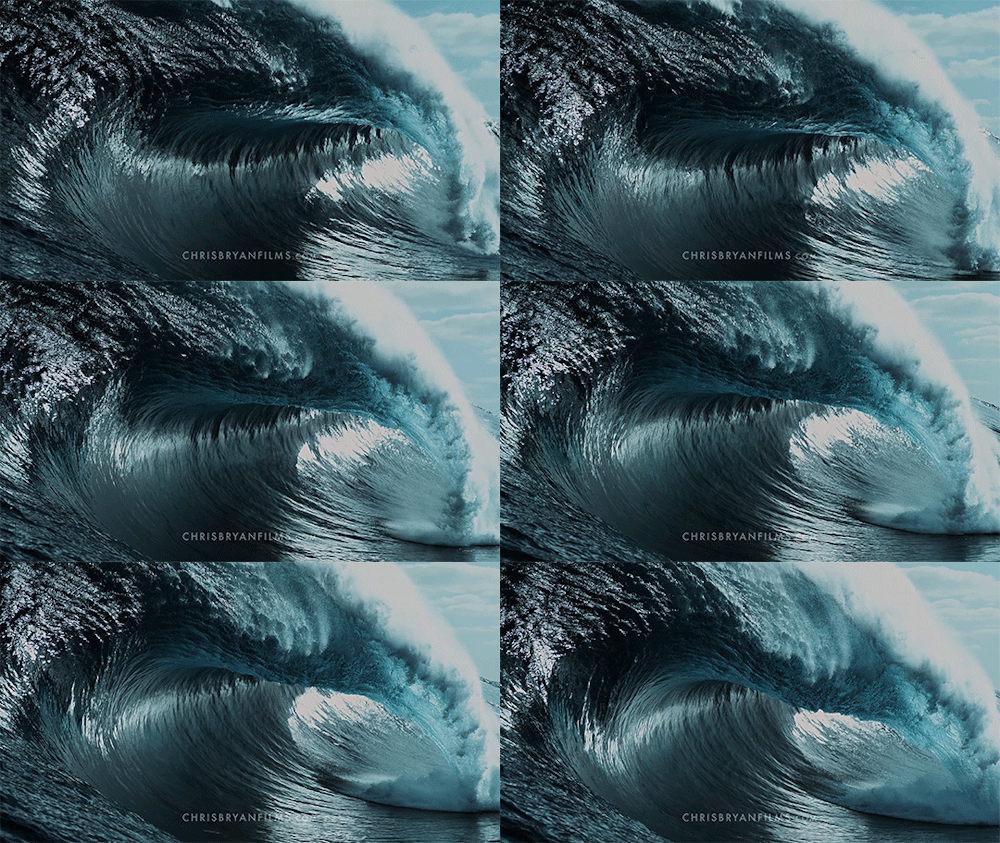
Ocean waves are endlessly fascinating to watch. In “Mocean,” cinematographer Chris Bryan captures them in ways few ever see, thanks to his high-speed camera. Honestly, this film is so gorgeous that I don’t want to distract you with the science, so just go watch!
Occasionally, FYFD will feature a series of posts on a special theme. This page serves as an archive of these themed series. Got an idea for theme? You can always suggest one via Tumblr, Twitter, or email.
Anyone who’s felt the sting of a fire ant knows it only takes an instant for this species to deliver a painful blow. Scientists are uncovering why that is using some of the first-ever high-speed footage of ant stingers in action. Stingers are actually made up of multiple separate pieces, including a central stylet and a pair of lancets that move up and down along the stylet. This lancet motion pulls the stinger deeper and helps form and deliver droplets of venom. The back-and-forth motion helps ants release up to 13 venom droplets per second, a level of speed that’s key for some of its high-speed, small-scale battles. (Image and video credit: Ant Lab; research credit: A. Smith)
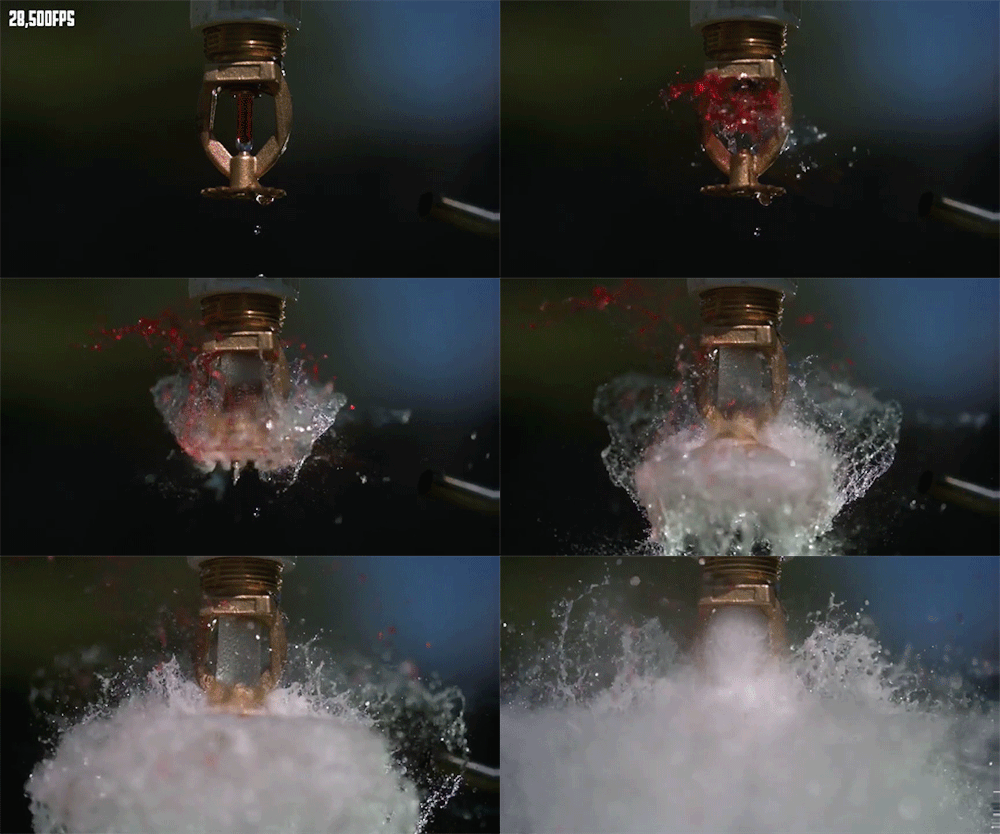
Most of us have probably never given much thought to how a fire sprinkler works, but fortunately, the Slow Mo Guys have used their high-speed skills to answer that question anyway. Sprinkler systems of this variety are constantly pressurized by a full pipe line of water that’s held back by a thin metal disk and a colored glass ampule containing a fluid like alcohol. The color of ampule indicates the temperature at which the system is designed to activate. As the ampule heats up, the fluid inside expands, breaking the ampule at or near the critical temperature. That allows the metal disk to fall away and releases a torrent of water, which falls onto the gear-like disk at the bottom of the sprinkler and gets flung out over a wider area. Despite appearances, that bottom disk is stationary, not spinning; its shape alone is what distributes the water. (Image and video credit: The Slow Mo Guys)
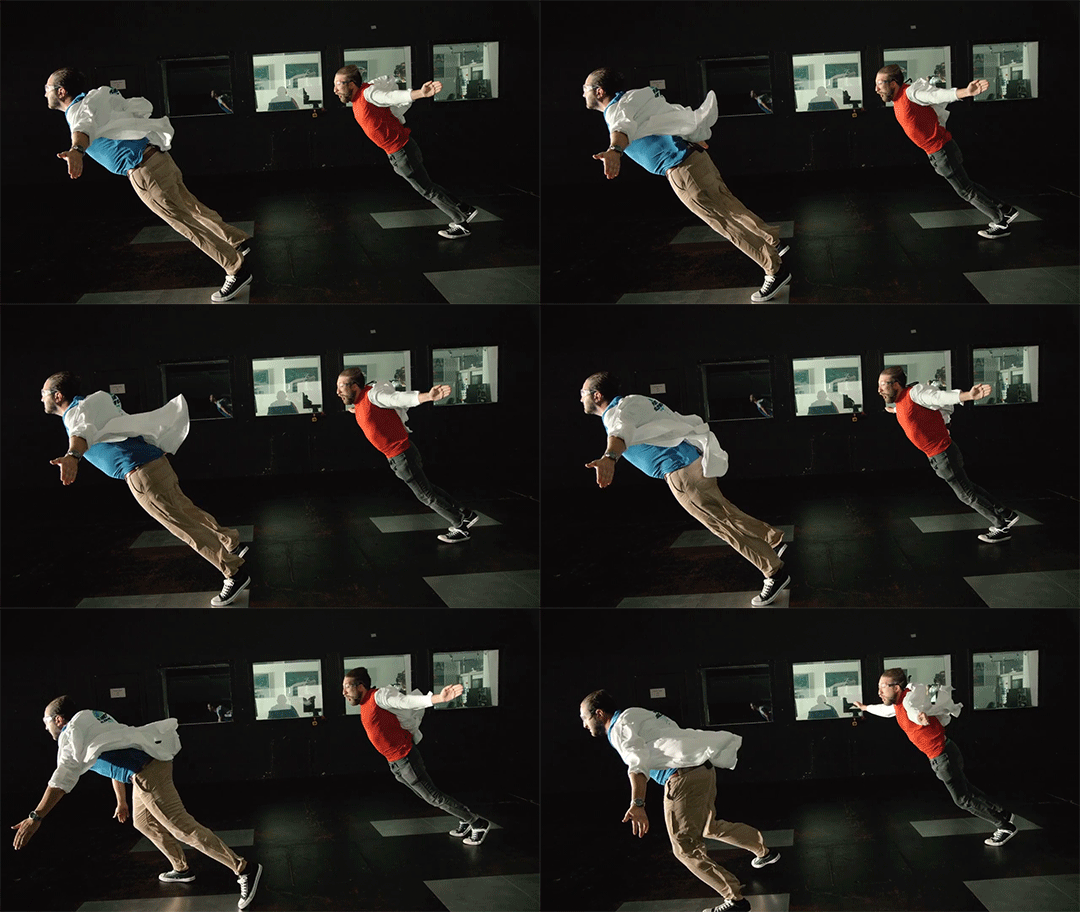
When I was in graduate school, I worked in a facility known as the High-Speed Wind Tunnel Lab. We were located next door to the Low-Speed Wind Tunnel, and every few months we’d receive a phone call asking whether we could film someone in the high-speed wind tunnel. This was impossible for several reasons – the size of human beings and the necessity of drawing the hypersonic tunnels down to vacuum-like pressures before initiating flow being only two of them – but what it really did was highlight the difference in definitions.
What these (usually) weather forecasters wanted was to simulate hurricane force winds on a human being. And to an aerodynamicist, that hundred mile-an-hour flow is still low-speed. Because we’re comparing it to the speed of sound, not the normal range of wind speeds a human experiences. That said, watching humans struggle inside a wind tunnel is always entertaining.
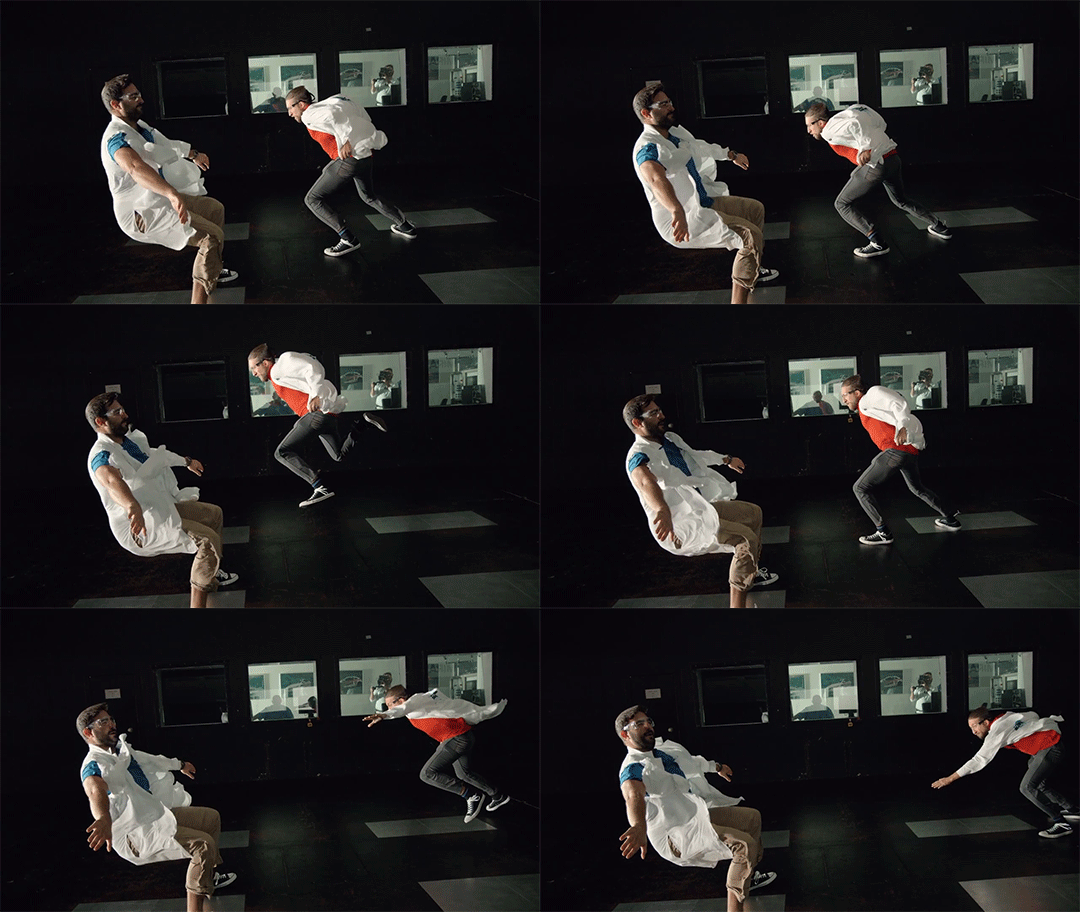
As you can see from the Slow Mo Guys here, counteracting the lift and drag forces from these wind speeds is tough. On the bottom left, Dan has managed to balance his weight and the drag forces to hold himself in a virtual chair. Meanwhile, Gav’s attempt to jump forward against the wind just pushes him backward as his lab coat parachutes behind him. (Image and video credit: The Slow Mo Guys)
The FloWave facility in Scotland is one of the coolest ocean simulators out there. Equipped with 168 individual wave makers and 28 submerged flow-drive units, it’s capable of recreating almost any ocean conditions imaginable. So naturally the Slow Mo Guys used it to create a giant spike wave.
Essentially, this is an oversized Worthington jet, the same as the ones you see after a droplet hits the surface. But with several thousand tonnes of crystalline clear water, the effect of that wave focusing is pretty spectacular. When you’re watching the high-speed footage, be sure to pay attention to the details, like the glassy surface of the collapsing jet, or the way holes open and expand as the splash curtain comes down around Dan’s head (above). Longtime readers will recognize manyfamiliarfeatures. (Image and video credit: The Slow Mo Guys)
We don’t usually think of fluids forming corners, but they can. Here you see liquid nitrogen in a simple pot. Since the pot is much hotter than the boiling point of the nitrogen, the liquid nitrogen is floating on a layer of its own vapor. This is called the Leidenfrost effect. That nearly frictionless contact with the pot means that stirring the nitrogen conveniently spins it up into these rotating polygons, visible in high-speed footage. The faster you stir the nitrogen, the more points you get.
Check out the full video below for instructions on how the researchers constructed their set-up. If you try it, though, remember to have plenty of ventilation. When the nitrogen vaporizes, its volume increases dramatically, and if you’re not careful, it will displace too much oxygen and make it hard to breathe. (Image and video credit: A. Duchesne et al., source)
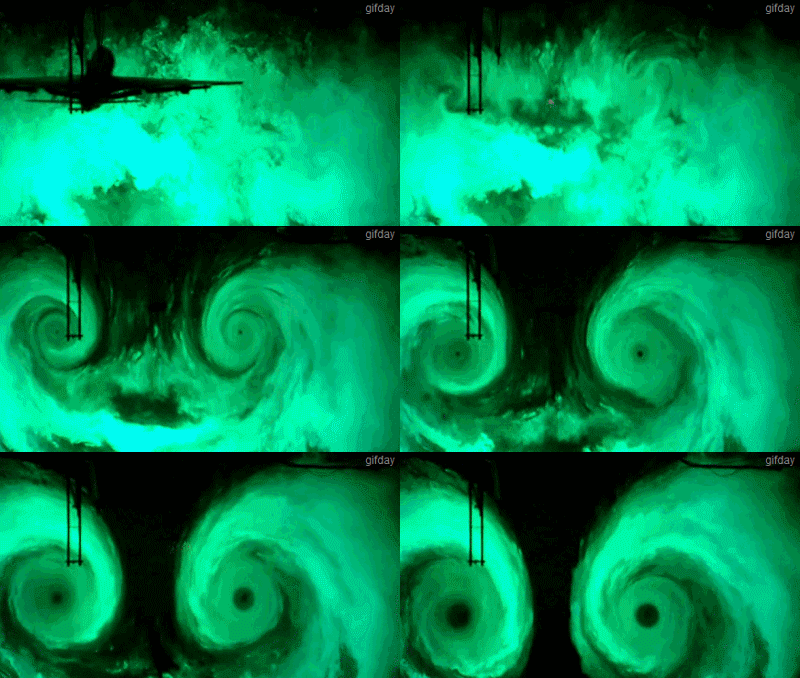
Are you staring into the eye of a hurricane or watching the spin of a simple desk toy? Part of the beauty of fluid dynamics is recognizing how similar they both are. This is high-speed footage of a toy known as a “Vortex Dome,” which contains a fluid filled with tiny mica particles that react to local forces and allow users to “see” the flow. Before the video begins, the toy has been spinning for long enough that the fluid inside rotates as if it were a solid body. Then an unseen hand sets the disk spinning in the opposite direction and we observe what happens.
Fluid at the outer edge of the toy has to immediately change direction due to friction with the wall. That change in momentum slowly passes from the wall inward as viscosity between one layer of fluid to the next passes that signal. This creates the rolls we see in the first animation. Initially, those rolls are smooth, but they quickly roughen as disturbances in them grow into full-blown turbulence. Meanwhile, viscosity continues to pass the change in rotation inward, ultimately swallowing the entire interior of the toy. Left spinning indefinitely, the disturbances will eventually quiet out and the entire fluid will spin as one. (Image and video credit: D. van Gils)
One of the most enduringly popular submissions I receive is T. Lim’s experimental footage of two vortex rings colliding head-on. It’s an devilishly tough experimental set-up to master because perfectly aligning the rings is incredibly difficult. The pay-off, however, is huge because the breakdown of the colliding rings and their transformation into secondary rings is breathtaking. Destin at Smarter Every Day and his team have worked hard to recreate the experiment (top video), but they’re not the only ones – nor are they the first in decades – to do so.
Ryan McKeown and a team at Harvard have a set-up of their own for vortex ring collisions, and you can see a little of it in action in the middle video. Ryan’s set-up is, frankly, incredible. It scans a light sheet through the vortex rings at high-speed, allowing him to capture the collision and break-up in minute detail in both space and time. What you see in the latter half of his video is a digital reconstruction of that data – not a simulation but real data! His work is capturing vortex collisions in unprecedented detail, allowing researchers to probe the smallest scales of the phenomenon.
When two vortex rings approach one another, they can undergo what’s known as a vortex reconnection event. Bubbles rings are a great place to see this. The vortex cores get distorted when they’re close to one another due to the influence of the other vortex ring’s velocity field. This often stretches and flattens the vortex core. It’s impossible for the rings to simply break apart, though, (per Helmholtz’s second theorem). So when the original vortex rings thin to the point of breaking, they immediately reconnect to a piece of the other ring, creating a series of small vortex rings around the remains of the originals. The exact details of how this works are what investigators like Ryan and his colleagues are trying to understand. You can hear a little more about their work in my interview with Ryan in the bottom video, starting at ~2.54. (Video credits: Smarter Every Day, R. McKeown et al., and N. Sharp and T. Crawford; submission credit: a huge number of readers)