
Citrus fruits like oranges house tiny pockets of oil in their peels. When squeezed, the oils jet out in tiny micro-jets that are about the width of a human hair. Despite their small size, the jets reach speeds of about 30 m/s and quickly break into a stream of droplets. When exposed to the flame of a lighter, like in the animation above, those microdroplets combust easily, creating a momentary fireball used to augment some cocktails. For more on how the citrus peel generates these jets, check out this previous post. (Image credit: Warped Perception, source; research credit: N. Smith et al.)
Search results for: “art”

Doing the Wave
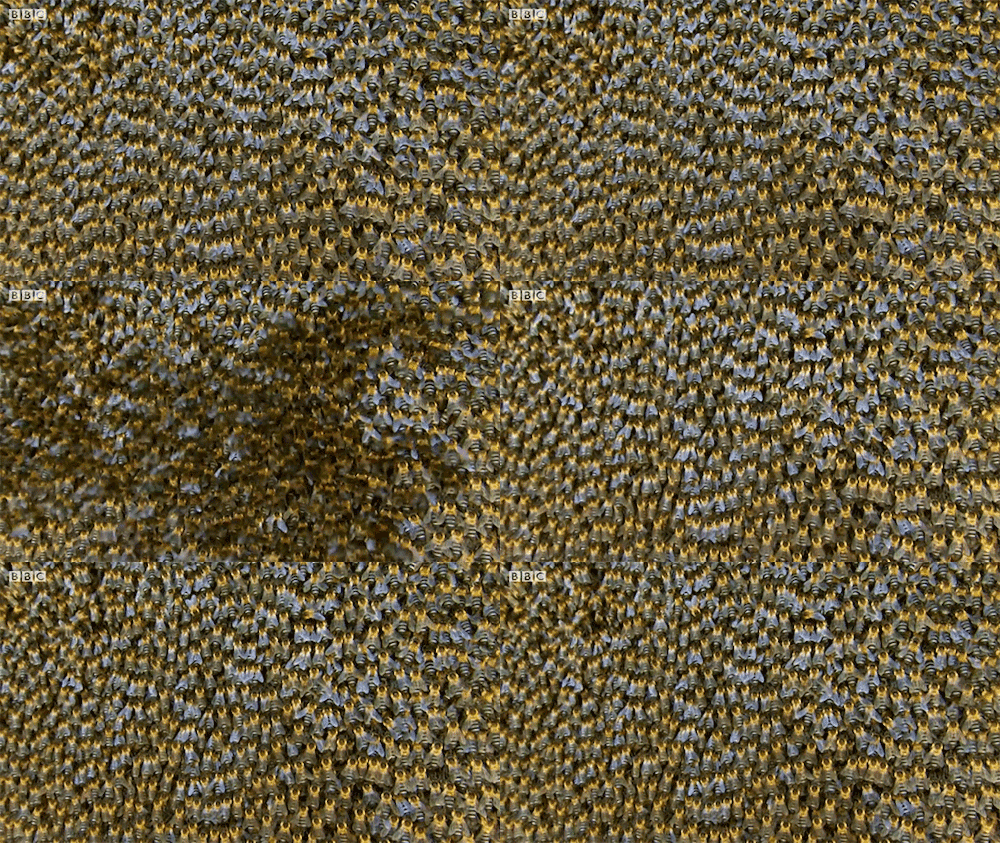
Not everything that behaves like a fluid is a liquid or a gas. In particular, groups of organisms can behave in a collective manner that is remarkably flow-like. From schools of fish to fire-ant rafts, nature is full of examples of groups with fluid-like properties.
One of the most mesmerizing examples are these giant honeybee colonies, which essentially do “the wave” to frighten away predators like wasps. Researchers are still trying to understand and mimic the way these groups coordinate such behaviors. Can even complicated patterns be generated by a simple set of rules an individual animal follows? That’s the sort of question active matter researchers investigate. Check out the video above to see a whole cliff’s worth of bee colonies shimmering. (Image and video credit: BBC Earth)
Striped Clouds
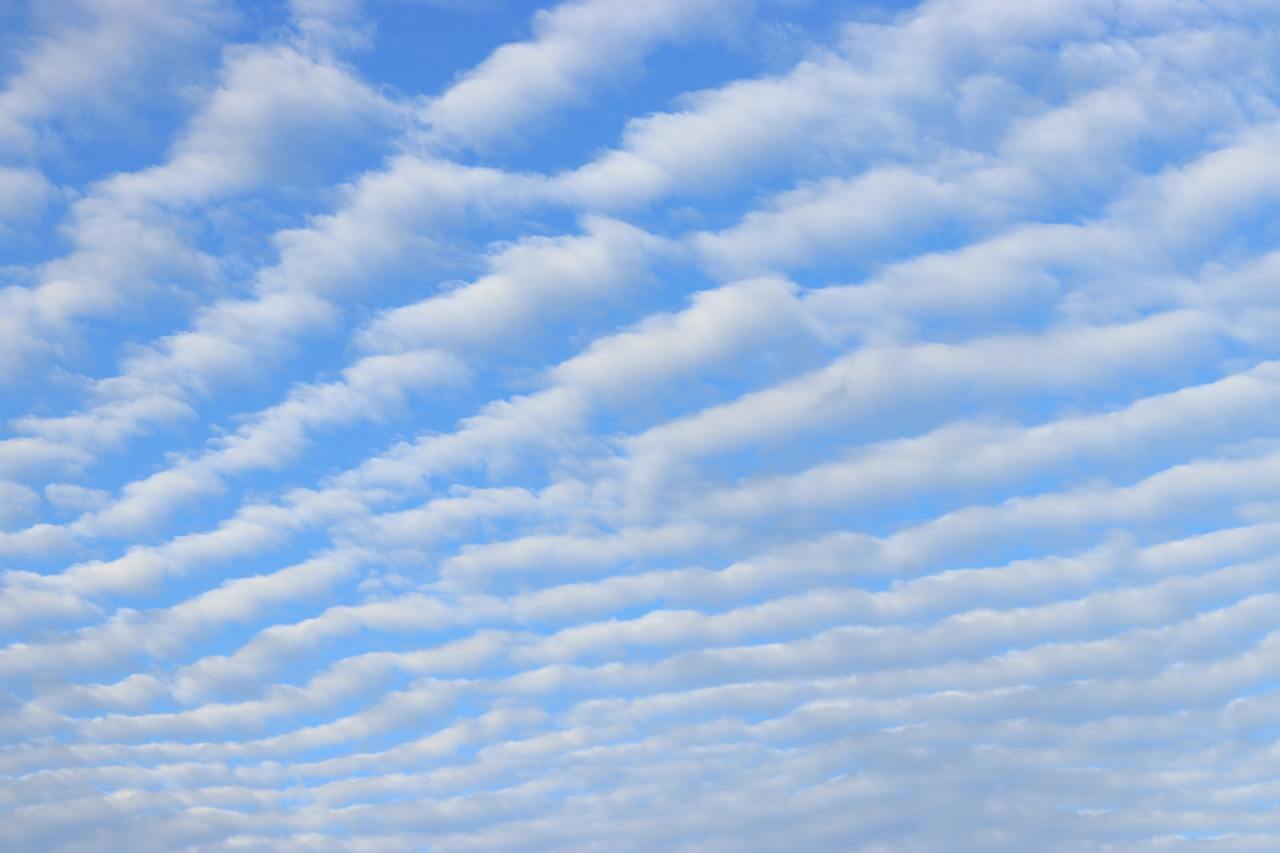
Living near the Rocky Mountains, it’s not unusual to look up and find the sky striped with lines of clouds. Such wave clouds are often formed on the lee side of mountains and other topography. But even in the flattest plains, you can find clouds like these at times. That’s because the internal waves necessary to create the clouds can be generated by weather fronts, too.
Imagine a bit of atmosphere sitting between a low-pressure zone and a high-pressure zone. This will be an area of convergence, where winds flow inward and squeeze the fluid parcel in one direction before turning 90 degrees and stretching it in the perpendicular direction. The result is a sharpening of any temperature gradient along the interface. This is the weather front that moves in and causes massive and sudden shifts in temperature.
On one side of the front, warm air rises. Then, as it loses heat and cools, it sinks down the cold side of the front. The sharper the temperature differences become, the stronger this circulation gets. If the air is vertically displaced quickly enough, it will spontaneously generate waves in the atmosphere. With the right moisture conditions, those waves create visible clouds at their crests, as seen here. For more on the process, check out this article over at Physics Today. (Image credit: W. Velasquez; via Physics Today)
“Aurora”


In “Aurora”, artist Rus Khasanov uses fluids to create a short film full of psychedelic color and cosmic visuals. As in a soap bubble, the bright colors – as well as the pure black holes – come from the interference of light rays. The colors directly relate to the thickness of fluid, and they allow us to see all the subtle flows caused by variations in surface tension. (Video and image credit: R. Khasanov)

Magnetic Storms
Periodically, our sun releases plasma in a coronal mass ejection. Afterwards, the local magnetic field lines shift and reorganize. We can see that process in action here because charged particles spin along the magnetic lines, outlining them as bright loops in this imagery. This sequence – one of the best examples of this phenomenon to date – was captured by NASA’s Solar Dynamics Observatory in early 2017. To understand behaviors like these, scientists use magnetohydrodynamics, a marriage of the equations of fluid mechanics with Maxwell’s equations for electromagnetism. (Image credit: NASA SDO, source)
Condensing Halos
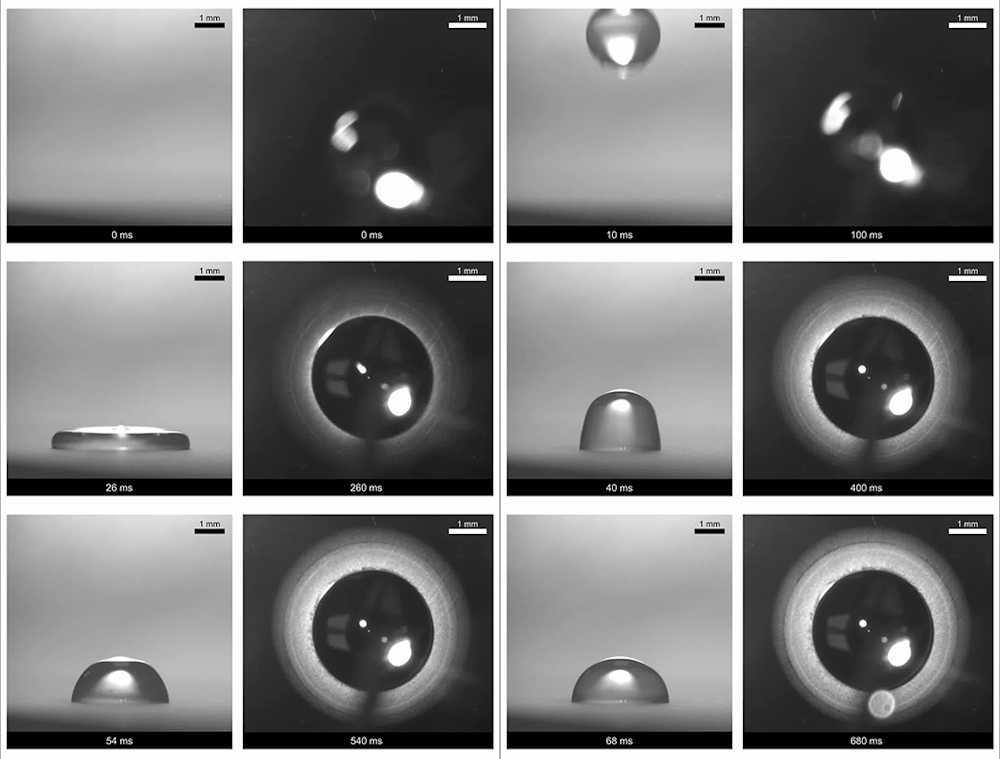
Drops that impact a very hot surface will surf on their own vapor, and ones that hit a very cold surface will freeze almost immediately. But what happens when the temperature differences aren’t so extreme? Scientists explored this (above) by dropping room-temperature water droplets onto a cool surface – one warmer than the freezing point but cooler than the dew point at which water condenses.
They found that impacting drops formed a triple halo of condensate (right). The first and brightest ring forms at the radius of the drop’s maximum extent during impact. The second band forms from water vapor that leaves the droplet at impact. As that vapor cools, it condenses into a second band. The final, dimmest band forms as the droplet stabilizes and cools. It’s the result of water vapor near the droplet continuing to cool and condense. (Image and research credit: Y. Zhao et al.; via Nature News; submitted by Kam-Yung Soh)

Prehistoric Filter Feeders


Earth’s earlier ages are filled with enduring mysteries about the plants and creatures that lived and died long before humanity. Many of these organisms, like the aquatic Ernietta shown above, are known only from scattered fossil remains. Yet fluid dynamics is helping us understand how Ernietta lived and fed some 545 million years ago.
Ernietta were sack-like organisms consisting of stitched-together tubular elements. They had no way to move around and no obvious method for transporting nutrients into their bodies. Scientists hypothesized that they likely used one of two feeding methods: either Ernietta relied on its surface area to extract nutrients directly from the water or its shape enabled it to trap larger particles to feed on from the flow. To decide between these modes, scientists turned to computational fluid dynamics.
By modelling both single Ernietta and small groups, they found that the shape of the organism generates a rotating current inside the bag that pulls flow down along one side and back up the other. Moreover, being near one another enhanced this effect, helping downstream Ernietta catch more particles than they otherwise would. All in all, the results suggest not only Ernietta’s likely feeding method but also that they lived in colonies and practiced one of the earliest known examples of communal feeding! (Image credit: D. Mazierski, source; research credit: B. Gibson et al.; via ArsTechnica; submitted by Kam-Yung Soh)

Titan’s Dragonfly
Last week, NASA announced its next New Frontiers mission: a nuclear-powered drone named Dragonfly heading to Titan. This astrobiology mission is set to search our solar system’s second largest moon for signs of life. It’s exciting aerodynamically, as well, since Titan’s thick atmosphere makes it uniquely suited for heavier-than-air flight. Therefore, rather than using wheeled rovers like we have on Mars, Dragonfly is a rotorcraft. It will be capable of traveling up to 8km per flight, which will quickly surpass the fewer than 21km the Curiosity Rover has managed on Mars!
Like Earth, Titan has rainfall and open liquid bodies on its surface. I, for one, can’t wait to see the alien vistas Dragonfly sends back as it cruises over methane lakes. (Image and video credit: NASA)
Fingers of Clay
Take a mixture of a viscous liquid – like clay mud – and squeeze it between two glass plates and you’ll create a mostly-round layer of liquid. As you pry the two glass plates apart, air will push its way into that layer, forcing through the mud in a dendritic pattern. This is called the Saffman-Taylor instability or viscous fingering. It occurs because the interface between the air and mud is unstable. (Image and video credit: amàco et al.)


Oil-on-Water Impact
Although many people have studied droplet impacts over the years, there’s been remarkably little work done with oil-on-water impacts. One of the things that makes this situation different is that the oil and water are completely immiscible, which means we can see aspects of the impact process that are invisible with, say, water-on-water impacts.
The animation above shows an underwater view of the oil droplet’s impact. The energy of the initial impact creates an expanding crater and an unstable crown splash. That crown splash contains both water and oil. After it ejects some droplets, the rim stabilizes, but we can still see small perturbations along its edge as it starts to retract. In the water, high surface tension damps out these perturbations. Not so for the oil! As the crater retracts, the small disturbances along the rim get stretched into mushroom-shaped fingers that point inward toward the impact site. Because the index of refraction is different between oil and water, we can see the fingers clearly near the end of the animation. (Image and research credit: U. Jain et al.; submitted by Utkarsh J.)