Category: Reader Questions

  • Reader Question: Rudders

    Reader Question: Rudders

    Reader le-mec writes:

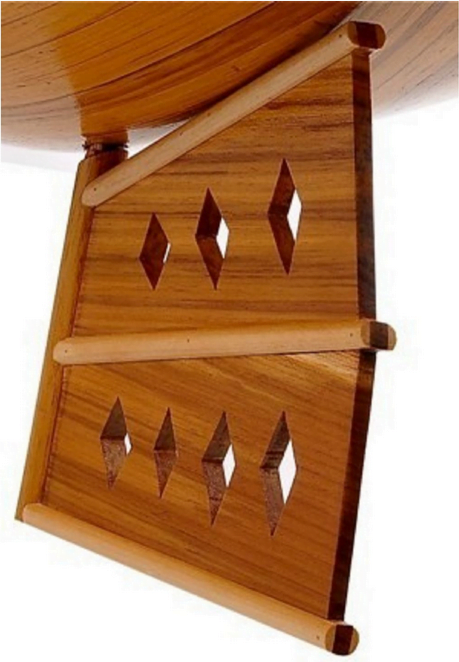
    My question involves “fenestrated rudders”, a Chinese invention that
    involved cutting diamond-shaped holes in the rudders of ancient Chinese
    sailing ships (known as Junks). According to several articles (on the
    internet, ha ha), it reduces the amount of effort required to steer the
    ship at higher speeds with “no loss of function”. All I can find is
    anecdotal evidence and I’d like to know if these claims hold water or if
    they’re just steering us in the wrong direction.

    First off:

    image

    Now, I’m no expert on ships or sailing, but let’s talk rudders. Ships use rudders for steering. The rudder is completely submerged and turning it deflects water and creates a side force that helps steer a boat. In essence, it’s an underwater wing that generates lift in the side-to-side direction. Modern rudders even have the same shape as airfoils. That’s clearly not the case with the rudders of Chinese junks, but flat plates are a lot easier to make.

    There’s another key feature of the junk’s rudder, and that’s the way it’s mounted. The junk’s rudder attaches to the ship such that it rotates about its leading edge. This makes it an unbalanced rudder. More modern rudders are typically mounted so that they rotate around an axis that’s partway back on the rudder. This is called a balanced rudder; I’ve illustrated both below.

    image

    The advantage of the balanced rudder is that it’s easier to turn. You can see this for yourself without adding water into the equation. Imagine holding a big rectangular sheet. If you hold it by one edge and try to rotate it, you can do it, but it’s kind of difficult. If you instead hold it about a third of the way across, you’ll find rotating it easier. Once you have a fluid moving past, it will only magnify how hard it is to turn the rudder.

    So the Chinese junks had rudders that were harder to handle (by later ship-building standards) to begin with. By putting holes in the rudder, they equalized the pressure on either face of the rudder. That does make it easier to steer, since the helmsman is no longer fighting pressure differences across the rudder, but it would also reduce steering efficiency. It’s likely, however, given the slow speed of the junks, large rudder area, and their low hydrodynamic efficiency to begin with, that any drop in efficiency was negligible compared to the reduction in force necessary to steer.

    Since modern designs rely on foil shapes to generate pressure differences (and therefore side force) across the rudder, adding holes to them would be a bad idea. But back in the Song dynasty, the fenestrated rudder was major advance in nautical engineering!

    (Image credits: Chinese junk ship model – Premier Ship Models; Joffrey applauding – HBO; Rudder diagram – N. Sharp)

  • Featured Video Play Icon

    Reader Question: Blood Jets

    Reader  shoebill-san asks:

    are blood jets realistic? when someone gets shot in the movies?

    This one’s a bit tough to boil down to a yes or a no, honestly. While piercing an artery can cause jetting (more on that below), movies tend to exaggerate the effect. And even among Hollywood movies, there’s a broad variation in how wounds are represented. I’m pretty sure no one thinks that blood actually behaves like it does in Monty Python or a Tarantino film!

    That said, depending on the wound, there can be a jetting effect thanks to the pulsing of our hearts. Scientists have even worked to numerically simulate human blood flow after a wound. I’ve included a video example above. Be warned – some viewers may find it gross. That said, there’s nothing all that graphic on display.

    As you can see, wounds to arteries have an apparent jetting motion thanks to our pulses. Bleeding from veins tends to look more uniform because the pressure pulse caused by each heartbeat has been smoothed out by the viscous effects of all the blood vessels in between. (Video credit: K. Chong et al.)

  • Reader Question: Splashes

    Reader Question: Splashes

    Reader effjoebiden asks:

    So is the crown splash the curving wave of water on either side of the tire, the spikes of water in the middle behind the tire, or both? And is the Worthington jet also the same phenomenon that can happen with a massive meteorite impact?

    Here the term “crown splash” refers to the curving sheets of water spreading on either side of the tire. Those liquid sheets (or lamella) break down at the edges into spikes and droplets just like the ones seen when a drop falls into a pool, which is the traditional source of the term “crown splash” because it resembles a crown.

    And, yes, enormous meteor impacts can create Worthington jets (that column of fluid that pops up after a droplet impacts)! This is why some craters have peaks in the middle. There are actually some surprising similarities between meteor impacts and fluid dynamics.

    (Image credits: S. Reckinger et al., original post)

  • Reader Question: Shower Curtains

    Reader Question: Shower Curtains

    Reader thansy asks:

    Why do the bottoms of shower curtains drift in toward the water coming from the shower head?

    We all know that moment. You’re minding your own business, scrubbing away, and all of a sudden, the shower curtain billows up and grabs you. Scientists have debated the cause of this behavior for years. Some argued that the curtain billowed due to hot air rising from the shower. Others claimed the fast-moving spray caused lift that pulled the curtain up. But fifteen years ago, one scientist tackled the problem computationally. He performed a numerical simulation of a shower head spraying into a bath and found that this spray of droplets creates a weak horizontal vortex in the shower.

    This shower vortex has a low-pressure core at the middle, which is thought to provide the suction that causes the shower curtain to billow. The scientist, David Schmidt, was awarded the 2001 Ig Nobel Prize for his work. (Image credits: N. Paix, D. Schmidt; research credit: D. Schmidt)

  • Reader Question: The Flash

    Reader pavlovs-dogs asks:

    About your running on water post, the show didn’t necessarily get it wrong when they said 1050kmph. You did not take into account that he was carrying another person. Adding another 60 kg or so. I can’t do the math right now, but I think that would come out fairly close to what they had

    I’ve got a handy calculator right here and it says that even with an extra 60 kg of passenger, Flash doesn’t even have to break 180 kph. When you actually listen to their technobabble it’s pretty clear that they’re just making numbers up. Cisco claims that, given Barry’s weight, he’d need to produce 450 pounds of force per step to stay on top of the water – that only makes sense if Barry weighed 450 pounds!

    I think what they wanted was motivation for Barry to have to run faster, preferably at a speed that seems believable for outrunning the blast wave after his passenger detonates.

  • Reader Question: Turbidity Current

    Reader Question: Turbidity Current

    Reader lizardking90 asks:

    Would a turbidity current from a large submerged earthquake or a avalanche be dangerous to be caught in: diving or in a submarine?

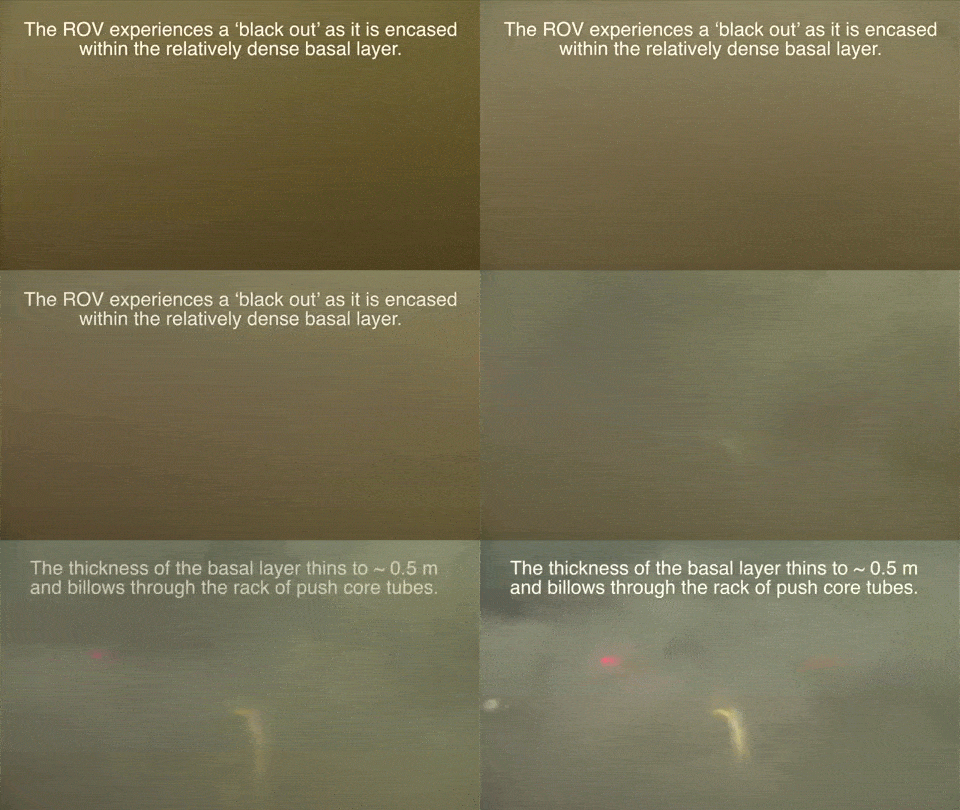
    As with an avalanche, how dangerous it is to get caught in a turbidity current depends on the conditions. Turbidity currents can be survivable–here’s some scuba divers in one and above is a clip from a remotely operated vehicle that got caught in one and lived to tell the tale–but they can also be quite destructive. In particular, they are hard on undersea infrastructure. They’ve been known to snap submarine telecommunications cables, sometimes in multiple locations during a single event, causing millions of dollars worth of damage. In short, if there were a large earthquake that triggered a turbidity current, chances are it would be bad news to get caught up in that flow. (Image credit: E. Sumner and C. Paull, source; via Deep Sea News)

  • Reader Question: Lift

    Reader Question: Lift

    everyonelikespotatissallad asks:

    so, how is lift actually generated? i’ve been going through Anderson’s Introduction to Flight (6th Ed.) and while it offers the derivation of various equations very thoroughly, it barely touches on why lift is generated, or how camber contributes to the increase of C(L)

    This is a really good question to ask. There are a lot of different explanations for lift out there (and some of the common ones are incorrect). The main thing to know is that a difference in pressure across the wing–low pressure over the top and higher pressure below–creates the net upward force we call lift. It’s when you ask why there’s a pressure difference across the wing that explanations tend to start diverging. To be clear, aerodynamicists don’t disagree about what produces lift – we just tend to argue about which physical explanation (as opposed to just doing the math) makes the most sense. So here are a couple of options:

    Newton’s 3rd Law

    Newton’s third law states that for every action there is an equal and opposite reaction. If you look at flow over an airfoil, air approaching the airfoil is angled upward, and the air leaving the aifoil is angled downward. In order to change the direction of the air’s flow, the airfoil must have exerted a downward force on the air. By Newton’s third law, this means the air also exerted an upward force–lift–on the airfoil.

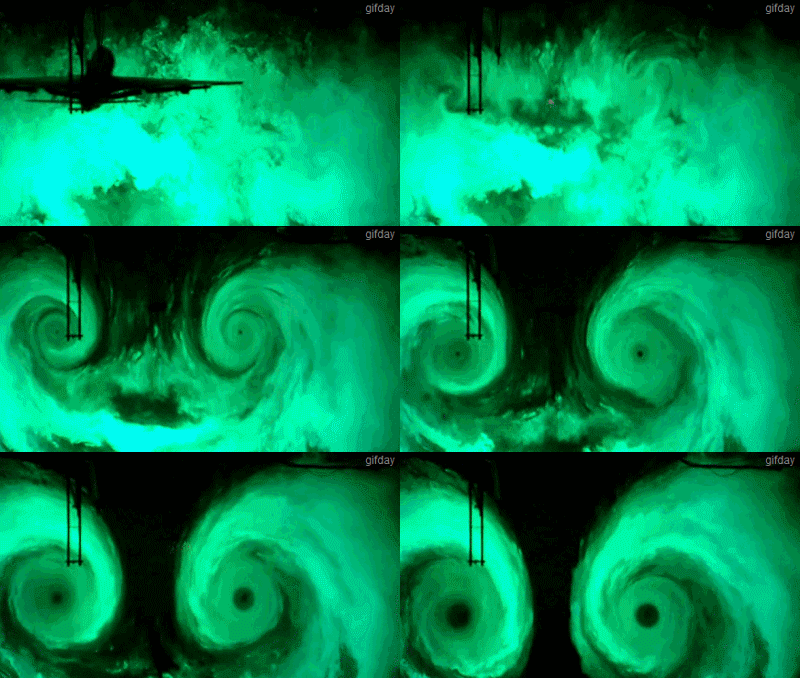
    The downward force a wing exerts on the air becomes especially obvious when you actually watch the air after a plane passes:

    Circulation

    This one can be harder to understand. Circulation is a quantity related to vorticity, and it has to do with how the direction of velocity changes around a closed curve. Circulation creates lift (which I discuss in some more detail here.) How does an airfoil create circulation, though? When an airfoil starts at rest, there is no vorticity and no circulation. As you see in the video above, as soon as the airfoil moves, it generates a starting vortex. In order for the total circulation to remain zero, this means that the airfoil must carry with it a second, oppositely rotating vortex. For an airfoil moving right to left, that carried vortex will spin clockwise, imparting a larger velocity to air flowing over the top of the wing and slowing down the air that moves under the wing. From Bernoulli’s principle, we know that faster moving air has a lower pressure, so this explains why the air pressure is lower over the top of the wing.

    Asymmetric Flow and Bernoulli’s Principle

    There are two basic types of airfoils – symmetric ones (like the one in the first picture above) and asymmetric, or cambered, airfoils (like the one in the image immediately above this). Symmetric airfoils only generate lift when at an angle of attack. Otherwise, the flow around them is symmetric and there’s no pressure difference and no lift. Cambered airfoils, by virtue of their asymmetry, can generate lift at zero angle of attack. Their variations in curvature cause air flowing around them to experience different forces, which in turn causes differing pressures along the top and the bottom of the airfoil surface. A fluid particle that travels over the upper surface encounters a large radius of curvature, which strongly accelerates the fluid and creates fast, low-pressure flow. Air moving across the bottom surface experiences a lesser curvature, does not accelerate as much, and, therefore, remains slower and at a higher pressure compared to the upper surface.

    (Image credit: M. Belisle/Wikimedia; National Geographic/BBC2; O. Cleynen/Wikimedia; video credit: J. Capecelatro et al.)

  • Reader Question: When Mercury Meets Lava

    Reader Question: When Mercury Meets Lava

    Reader lucondri asks:

    What happens when mercury touches lava?

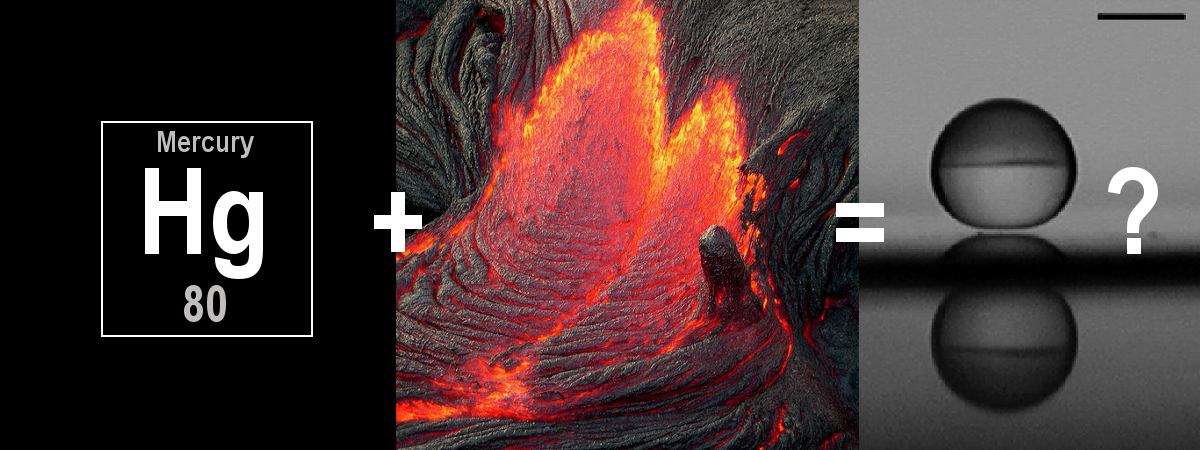
    That’s an interesting thought experiment, but hopefully no one tries it any time soon given mercury’s toxicity. So, what might happen? Mercury has a boiling point just under 630 Kelvin, and, although the temperature of molten lava varies, it’s between 970 and 1470 Kelvin when it first erupts. So mercury would definitely vaporize (i.e. boil) on contact with lava. (Again, this is very bad for anyone nearby.) If you’re curious what boiling liquid mercury looks like, wonder no further.

    Molten lava is much, much hotter than the boiling point of mercury, though, so there’s a possibility that the mercury won’t boil away instantly. This is because of the Leidenfrost effect, where a thin layer of vapor forms between a liquid and an extremely hot surface. The vapor has such low friction that the liquid can essentially skate across a surface, and it doesn’t boil away instantly because the vapor insulates it from the extreme heat. After some digging, I found a paper that placed the Leidenfrost temperature of mercury between about 850 and 950 Kelvin, meaning that fresh lava is probably hot enough to generate mercury Leidenfrost drops.

    So pouring a lot of mercury on lava will probably result in some boiling, but there’s also a good chance that it will form a bunch of skittering mercury droplets that will stick around awhile before they evaporate into toxic mercury gas. That said, it’s a lot easier and safer to watch awesome Leidenfrost drop videos with other liquids. (Collage credit: N.Sharp; images sources: Z. T. Jackson, and A.Biance)

  • Reader Question: Rippling Runoff

    Reader Question: Rippling Runoff

    Reader junolivi asks:

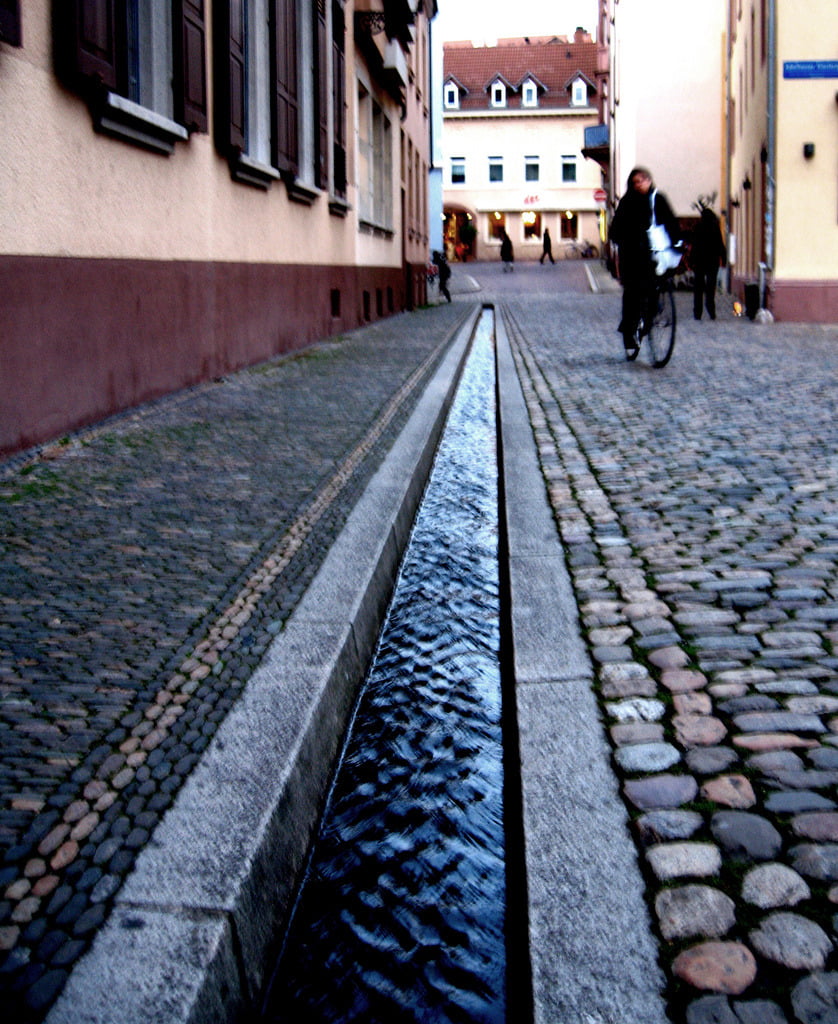
    When shallow water (like runoff from melting snow) flows across pavement, it creates small repeated wave-like ripples. What creates that texture and why isn’t it just a steady flow?

    This is a great question that’s probably crossed the mind of anyone who’s seen water running down the gutter of a street after a storm. The short answer is that this gravity-driven flow is becoming unstable.

    Fluid dynamicists often like to characterize flows into two main types: laminar and turbulent. Most flows in nature are turbulent, like the wild swirls you see behind cars driving in the rain. But there are laminar flows in nature as well. Often flows that begin as laminar will become turbulent. This happens because those laminar flows are unstable to disturbances.

    The classic example of stability is a ball on a hill. If the ball is at the top of the hill and you disturb it, it will roll down the hill because its original position was unstable. If, on the other hand, the ball is in a depression, then you can prod the ball and it will eventually settle back down into its original place because that position was stable. Another way of looking at it is that, in the unstable case, the disturbance–how far the ball is from its original position–grows uncontrollably. In the stable case, on the other hand, the disturbance can be initially large but eventually decays away to nothing.

    There are many ways to disturb a laminar flow–surface roughness, vibrations, curvature, noise, etc., etc. These disturbances enter the flow and they can either grow (and become unstable) or decay (because the flow is stable to the disturbance). Just as one can look at the stability of a pendulum, one can mathematically examine the stability of a fluid flow. When one does this for water flowing down an incline, one finds that the flow is quite unstable, even in the ideal case of a pure, inviscid fluid flowing down a smooth wall.

    The reason that one sees distinctive waves with a particular wavelength (assuming that they aren’t caused by local obstructions) is directly related to this idea of instability. Essentially, the waves are the disturbance, having grown large enough to see. One could imagine that any wavelength disturbance is possible in a flow, but mathematically, what one finds, is that different wavelengths have different growth rates associated with them. The wavelength we observe is the most unstable wavelength in the flow. This is the wavelength that grows so much quicker than the others that it just overwhelms them and trips the flow to turbulence. This is very common. For example, you can see distinctive waves showing up before the flow goes turbulent in both this mixing layer simulation and this boundary layer flow.

    (Image credits: anataman, mo_cosmo; also special thanks to Garth G. who originally asked a similar question via email)

  • Reader Question: Submarines

    Reader Question: Submarines

    Reader elimik asks:

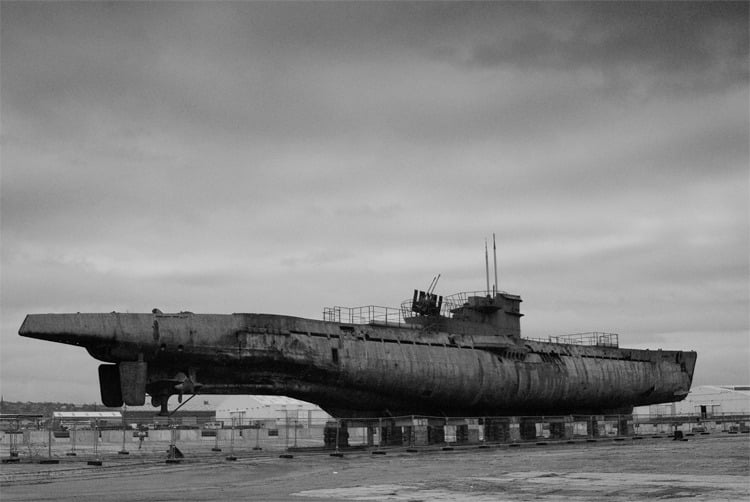
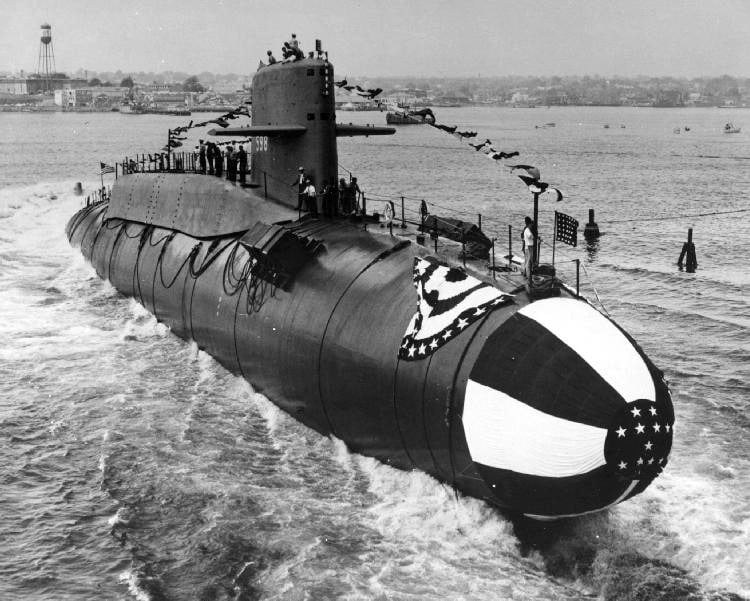
    Why do modern submarines have round bows instead of pointy ones, like the early WWII ones?

    Interestingly, there are more factors that affect this design choice than I originally thought! Perhaps the biggest factor, though, is propulsion. Although early submarines ran through several forms of propulsion from human power to steam, by World War II many subs were driven by diesel-power on the surface and relied on battery power when submerged. Power limitations meant that submarines of that era did most of their travel while at the surface, not underwater. As a result, the ships had better control and decreased drag with a pointed bow similar to that of a surface ship. It wasn’t until the advent of the nuclear-powered submarine that it became practical for submarines to spend most of their time submerged. Once fully-underwater travel was feasible (and, indeed, preferable), many subs transitioned to a blunter, rounded bow that’s more hydrodynamic underwater–and simultaneously more problematic control-wise when moving on the surface.

    Another factor separating WW-era submarines and modern subs is the depth to which they submerge. The deeper a submarine dives, the greater the pressure it must withstand. Rounded or cylindrical shapes make much better pressure vessels because they distribute pressure evenly around a surface. Historically, many subs have balanced control and hydrodynamics against pressure requirements by having two hulls, an outer one for cutting through surface waters and an inner cylindrical one that bears the brunt of the hydrostatic pressure. As we developed stronger materials, though, submarines have achieved greater depths. The German Type VII submarine, the most common U-boat of WWII, had a test depth of 230 m, whereas today’s Los-Angeles-class U.S. submarine can operate at 290 m. (Each 10 meters of depth adds about one atmosphere’s worth of pressure.) The combination of nuclear power for subsurface propulsion and stronger materials that allow deeper dives enables many modern submarines to have a single hull–the rounded hydrodynamic and pressure-resistant bow we commonly see.  (Image credits: U534 by P. Adams and USS George Washington by U.S. Navy)