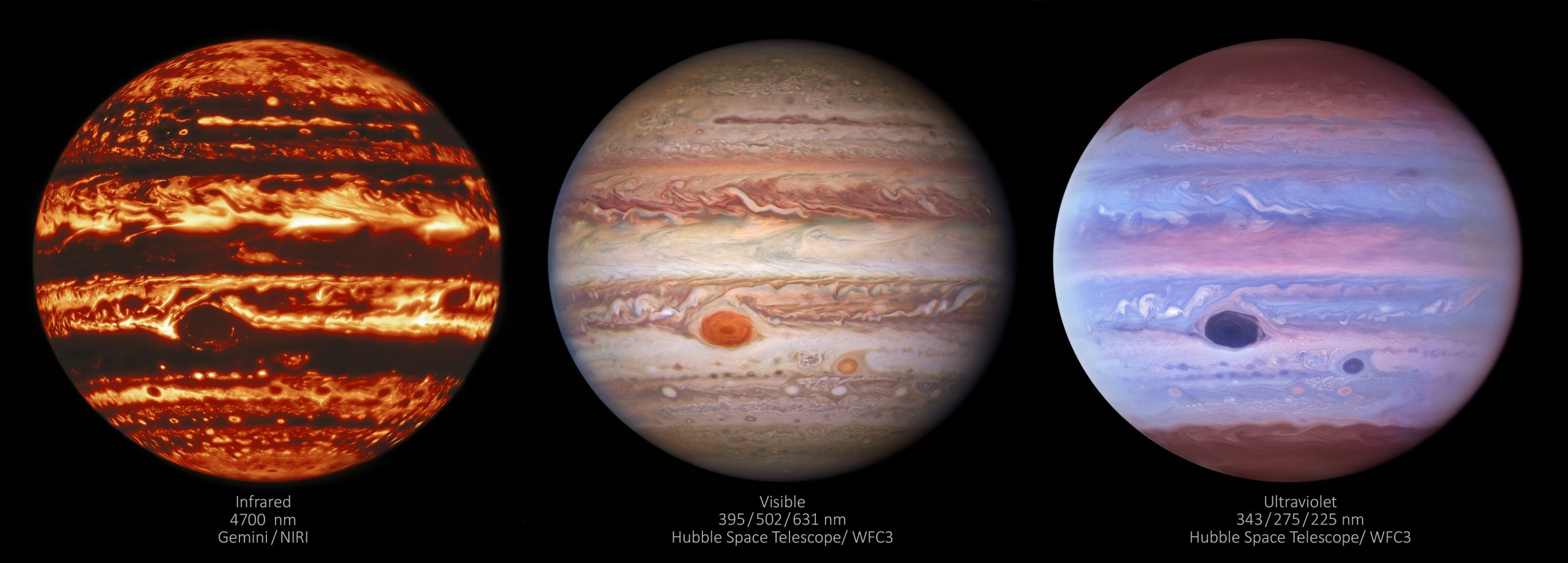
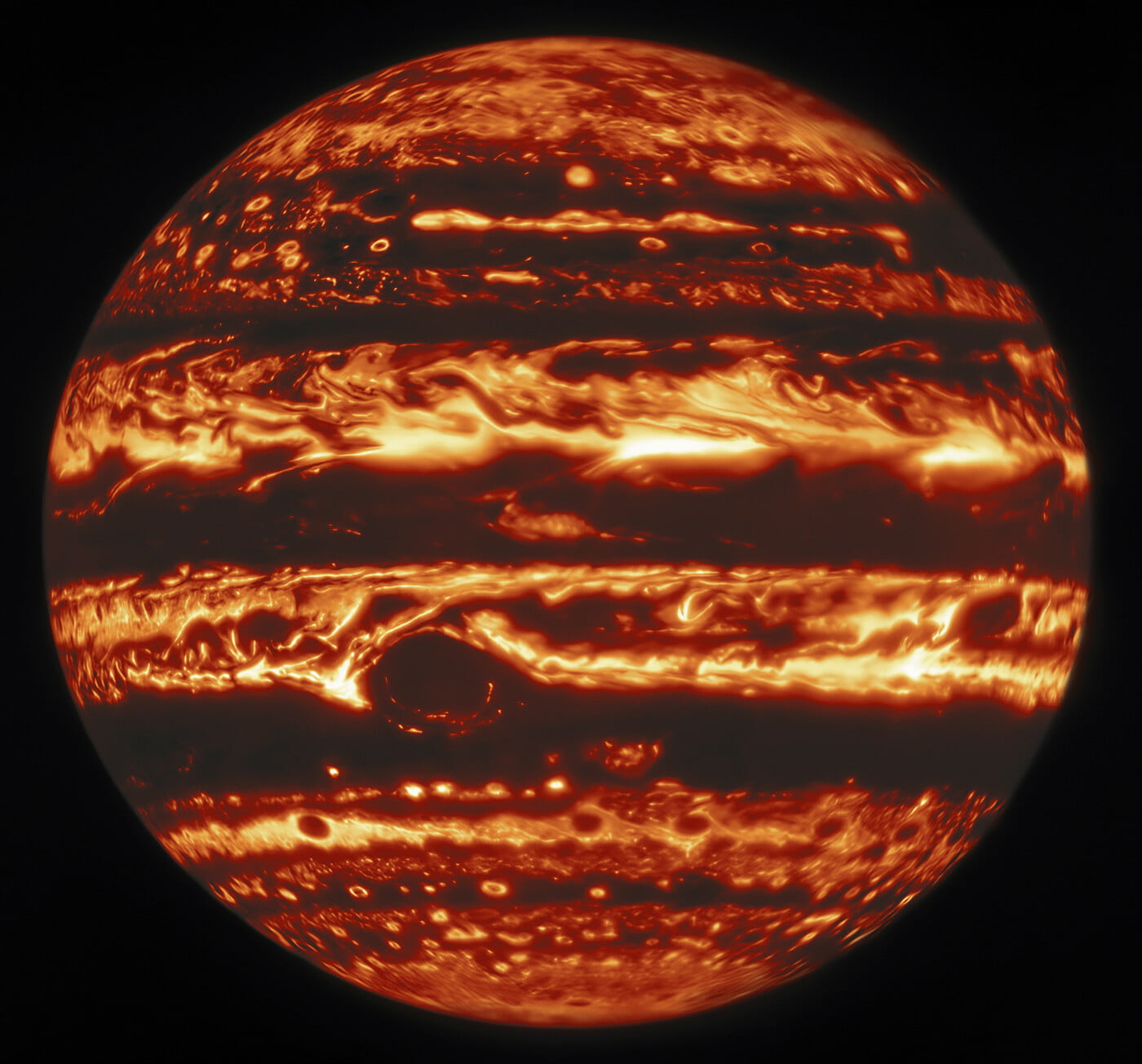
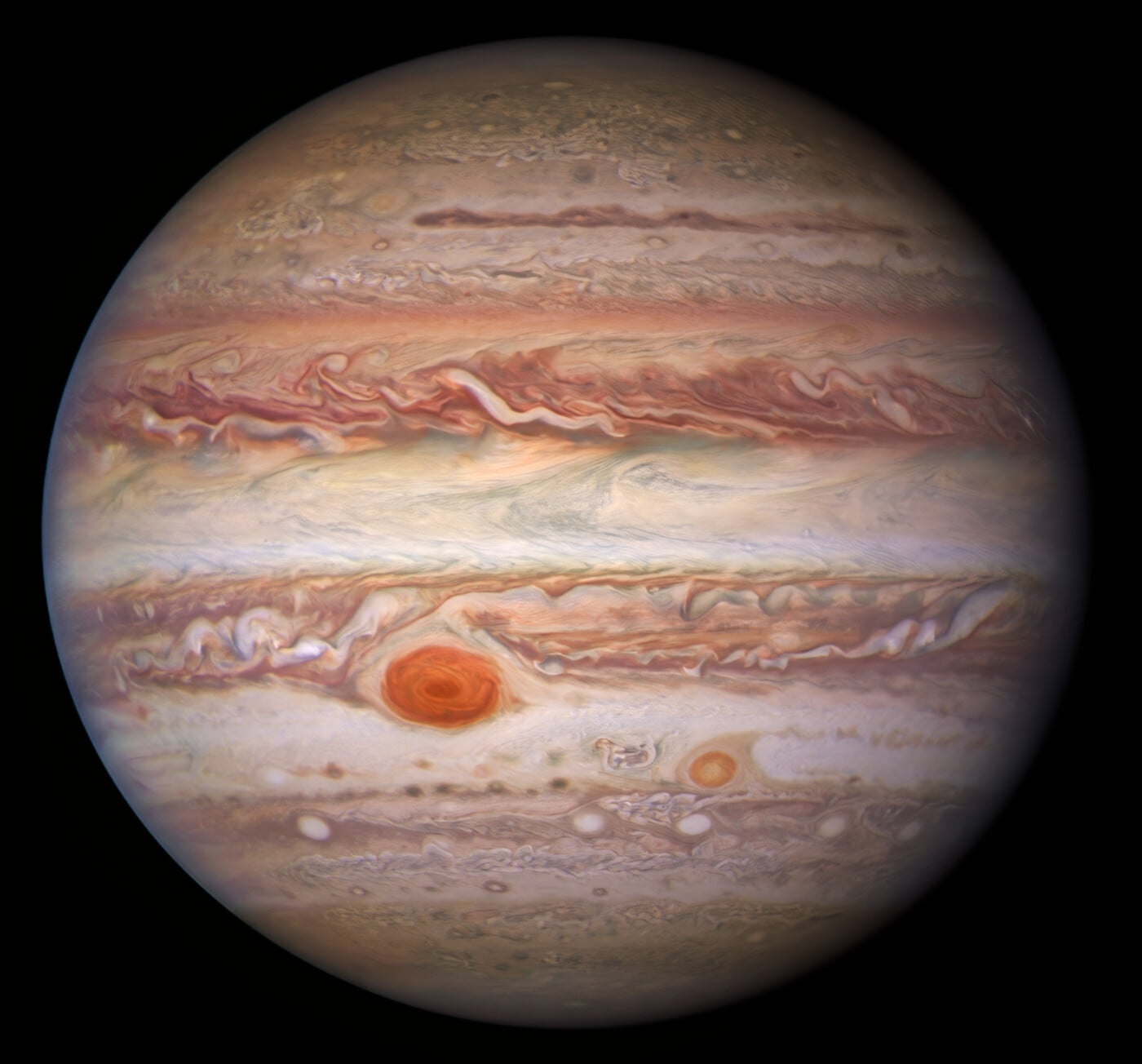
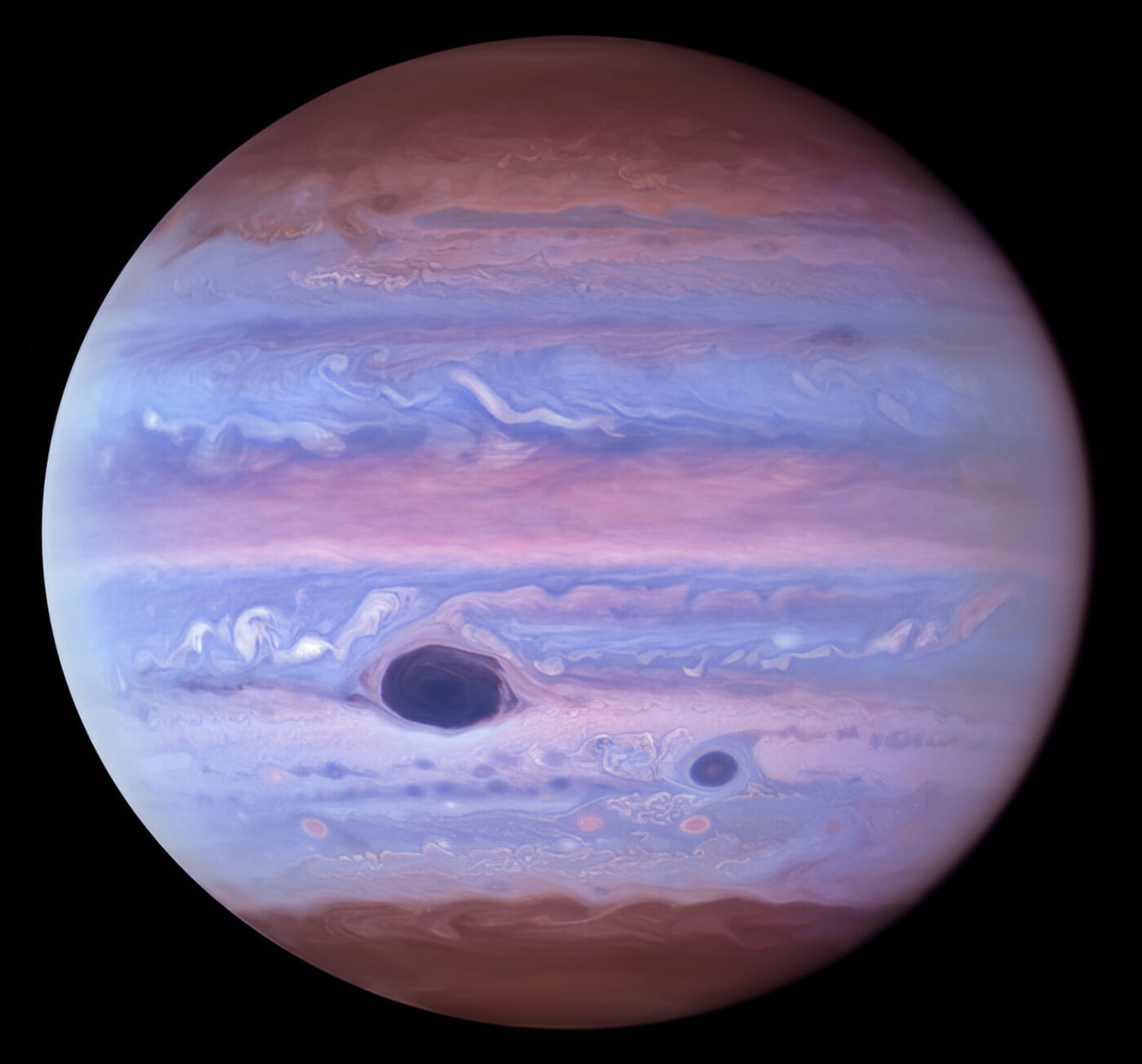
Sometimes the key to unraveling a mystery is to observe the phenomenon in different ways. That’s why researchers are increasingly taking advantage of multiple instruments simultaneously observing targets like Jupiter. Here we see the gas giant in three different types of light: infrared, visible, and ultraviolet. Infrared bands reveal the hot and cold regions of Jupiter’s clouds, allowing scientists to identify convective areas. Ultraviolet observations can reveal high-energy processes, like Jupiter’s auroras. And the colors revealed in visible light can give hints about chemical make-up in different regions. But to get a fuller picture, scientists compare all three modes — along with radio signal data from Juno — to understand topics like the planet’s lightning-filled storms. (Image credits: International Gemini Observatory/NOIRLab/NSF/AURA/NASA/ESA, M.H. Wong and I. de Pater (UC Berkeley) et al.; via Gizmodo)
One of the most important and underappreciated pieces of urban infrastructure is the sewage system. We rely on them to make our waste vanish, as if by magic. In reality, these systems are carefully engineered and built to be largely self-cleaning and future-proof. Gravity is the primary driver of the system, and engineers design the slope of sewage lines so that flow inside the pipes is fast enough to keep solid waste suspended. There are, of course, plenty of challenges involved; check out the full video for an overview. (Image and video credit: Practical Engineering)
Between November 2019 and March 2020 Betelgeuse, the red supergiant star in the constellation Orion’s left shoulder, experienced what’s being called the Great Dimming. Usually, the star is one of the ten brightest stars in the sky, often visible even in the suburban sprawl. But as of February 2020, it had dimmed by a factor of 2.5.
Observers speculated all sorts of causes, including the idea that this was a precursor to a supernova explosion. Instead, it’s a relatively normal occurrence for a star like Betelgeuse. The image above is from a numerical simulation of the star, and it shows approximately what it would look like to the human eye over a 7.5 year time span. As you can see, its brightness varies noticeably, and its surface seems almost to boil. This has to do with convection in the star. Compared to a star like our sun, Betelgeuse has fewer — and much larger — convection cells.
With a little more time and data, astronomers pinned down the exact source of Betelgeuse’s flickering during the Great Dimming. The year before the star belched an enormous bubble of gas into space. Then, when part of the star cooled in the aftermath, that gas condensed and formed a dust cloud which partially obscured the star. You can see an artist’s conception of the situation in the video below. (Image and research credit: B. Freytag; research credit: M. Montargès et al.; video credit: ESO/L. Calçada)
Mars is quite dusty. It periodically gets swallowed by planet-spanning dust storms, but it’s also home to regular dust devils whose size can put Earth’s to shame. Exactly how so much dust gets picked up by Mars’ incredibly thin atmosphere — only 1% of Earth’s — is still something of a mystery. So scientists were excited after the Ingenuity helicopter’s fourth flight, where cameras on the Perseverance rover caught a billowing dust cloud following Ingenuity as it flew. Knowing how the helicopter flies, they may be able to unravel just how its wake picks up and carries dust. Since Ingenuity’s only purpose was to demonstrate flight on another planet, this would be a big scientific bonus for an already successful mission! (Image credit: NASA/JPL-Caltech/ASU/MSSS/SSI; via Nature; submitted by Kam-Yung Soh and jpshoer)
For a long time, people thought baseball aerodynamics were simply a competition between gravity and the Magnus effect caused when a ball is spinning. But the seams of a baseball are so prominent that they, too, have a role to play. Here’s a baseline image of flow around a non-spinning baseball:
An non-spinning baseball with a straight, unaltered wake.
As in our previous post on golf, the colors indicate the direction of vorticity but don’t matter much to us here. What’s important is that the wake behind the ball is straight, indicating that there is no additional force beyond gravity and drag acting on the ball. Contrast this to the spinning baseball below:
Flow around a baseball spinning clockwise.
This ball is spinning in a clockwise motion, which causes flow to separate from the ball earlier on the advancing (bottom) side and later on the retreating (top) side. As a result, the wake is tilted downward. This indicates an upward force on the ball, caused by the Magnus effect.
But what if the seams fall in a place where they affect the flow? Here’s another baseball that’s not spinning:
Flow around a non-spinning baseball with a seam-shifted wake caused by early separation on the top surface of the baseball.
Notice that seam sitting just past the widest point on the top of the baseball. Flow around that wide point (called the shoulder) is very sensitive to disturbances essentially because the boundary layer is just barely hanging on to the ball. The blue arrow marks where the boundary layer separates from the ball on the top, which takes place earlier than the flow separation on the bottom, marked by the red arrow. As a result, the wake of the ball is tilted upward, indicating a downward force on the ball. The researchers who first proved this effect call it a seam-shifted wake, and it turns out to be a very common effect in baseball. They’ve got a great blog dedicated to baseball aerodynamics where you can learn tons more if you’re interested. (Image credit: top – Pixabay, others – B. Smith; research credit: B. Smith; see also Baseball Aerodynamics)
Today wraps up our Olympic coverage, but if you missed our earlier posts, you can find them all here.
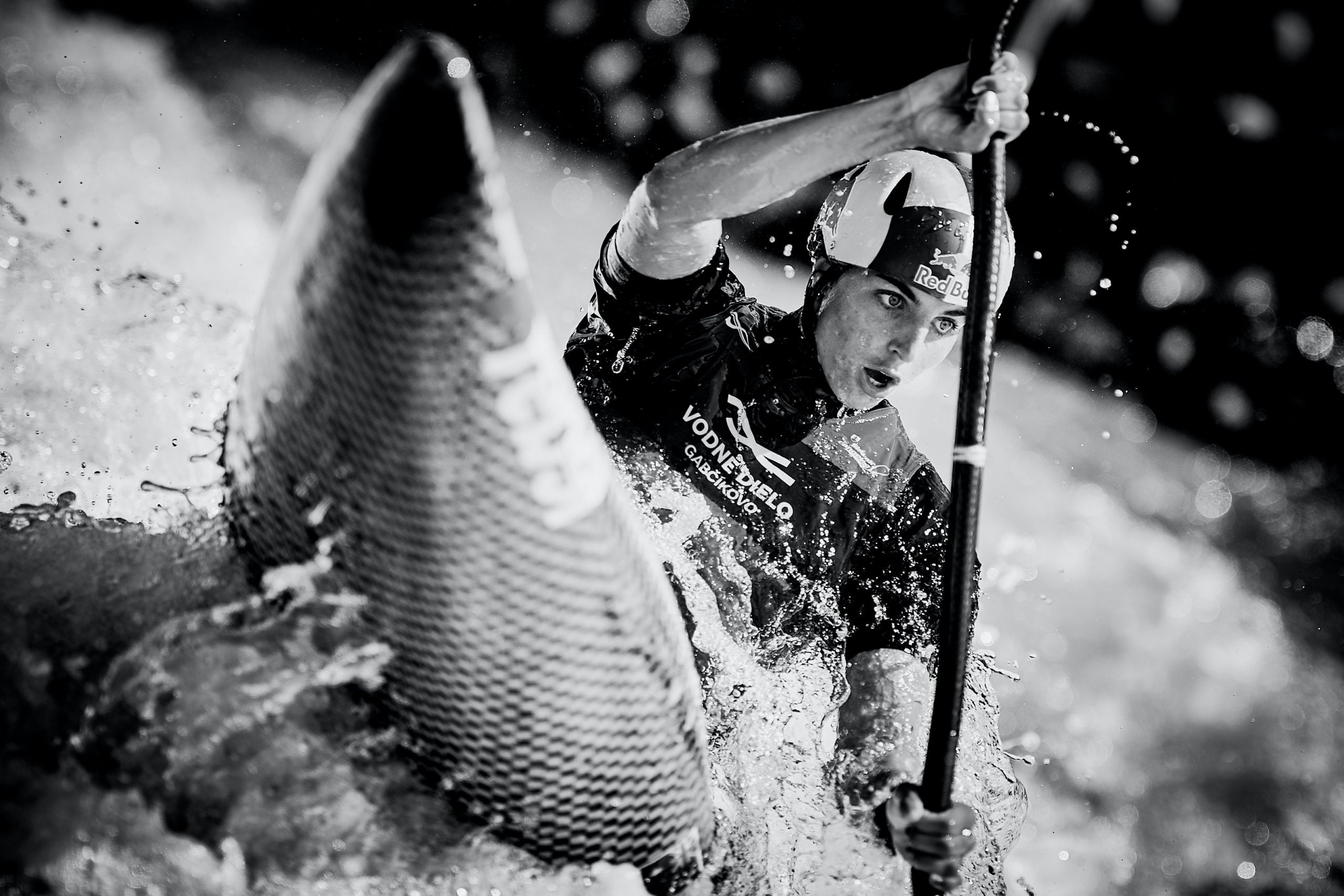
The Kasai Canoe Slalom Course is Japan’s first man-made whitewater venue. To test the design and its multiple configurations, engineers at CTU in Prague built this large-scale hydraulic model. Check out the video below to see it under construction and in action.
The course is adaptable so that it can be used for high-level competitions like the Olympics, then reconfigured for recreational use. You can even see what it’s like to run part of the course in a multi-person raft, thanks to a miniature, GoPro-equipped boat! (Image credit: top – M. Trizuliak, others – CTU Prague; video credit: CTU Prague)
It’s a bit mindboggling, but by exploiting physics and geometry, a sailboat can reach speeds faster than the wind propelling it. Steve Mould demonstrates how in this video using some cool tabletop set-ups. Like a wing, a sail generates force by changing the direction of the incoming air. But the optimal speed for a sail is the one where the the flow doesn’t get deflected from its initial path at all (middle). If the sail were moving slower than this, the air would get pushed aside, creating a force that accelerates the boat. If the sail were moving faster, the air’s deflection would generate low pressure that would slow the boat down. Given this ideal match, it’s straightforward to show that, with the right sail angle, a boat can cover more distance than the air pushing it does in the same amount of time (right). Part of the mark of a great sailor is knowing how to manipulate this relationship to maximize your boat’s speed! (Image and video credit: S. Mould)
Surfing is making its Olympic debut this year with a shortboard competition held at Shidashita Beach, with the event’s timing determined by weather and wave quality. The fluid dynamics involved in surfing could easily fill their own series of posts, so we’ll just scratch the surface here. Check out the video embedded below for a nice overview.
We sometimes think of waves as enormous walls of water moving on the ocean, but the truth is that individual water particles move very little when a wave passes. Instead waves are a method of transferring energy through the water, and surfers harness this energy while negotiating a delicate balance of forces between gravity, buoyancy, and hydrodynamics.
So how do surfers catch a wave? After all, anyone who’s been to the beach or in a wave pool knows that waves can easily pass without carrying you along with them. To ride a wave, surfers orient themselves in the direction the wave is traveling, then they paddle to bring their velocity close that of the incoming wave. Their surfboard helps by providing a large surface for the water to push, accelerating the surfer as the wave approaches. The longer and larger a surfboard is, the less speed the surfer themself has to provide. This is one reason it’s easier to catch a wave on a longboard than on a shortboard. But shortboards — like those used by competitors in the Tokyo Olympics — are far more maneuverable, allowing surfers more freedom in the moves they choose to make as they ride. (Image credit: B. Selway; video credit: TED-Ed; see also M. Grissom and Science Connected)
Recent controversies over swimsuit technologies haven’t damped the creativity of Speedo’s marketing staff. They recently unveiled Fastskin 4.0, a futuristic concept designed for the swimmers of 2040*. They’ve envisioned a custom-made, biodegradable, self-powered swimsuit that looks like a superhero’s costume. Some of the technologies strike me as extremely pie-in-the-sky, but a few of them have at least some basis in reality. Of particular interest to us, of course, are the Dynamic Flow Zones and the Shark Skin Boosters, two features intended to minimize drag and boost speed.
The Dynamic Flow Zones seem to be part of a built-in exoskeleton around the swimmer’s midriff, and they are apparently inspired by the underbelly of whales. At least one study shows that similar ridges on whale sharks help reduce flow separation on their bodies, but — given the vastly different swim styles of a human and a whale shark — it’s unclear to me that these structures would help a human swimmer. It also seems as though their helpfulness would be strongly dependent on what stroke the swimmer was using.
As for the Shark Skin Boosters, a shark’s skin does, in fact, helps its speed and agility. Individual denticles on the shark can (passively) bristle when flow near the skin tries to reverse direction. The adaptation helps them shut down flow separation before it happens, thereby maintaining flow control and low drag. Additionally, studies of 3D-printed shark skin have shown that the right texture can provide a speed boost. It would take some work to figure out just the right texture to adapt the shark’s ability to a human swimmer, but this is one feature of Fastskin 4.0 that isn’t just science fiction. (Image and video credit: Speedo; via Gizmodo)
*To be 100% clear, this product does not exist and likely never will.
Join us all this week for more Olympic-themed fluid dynamics!
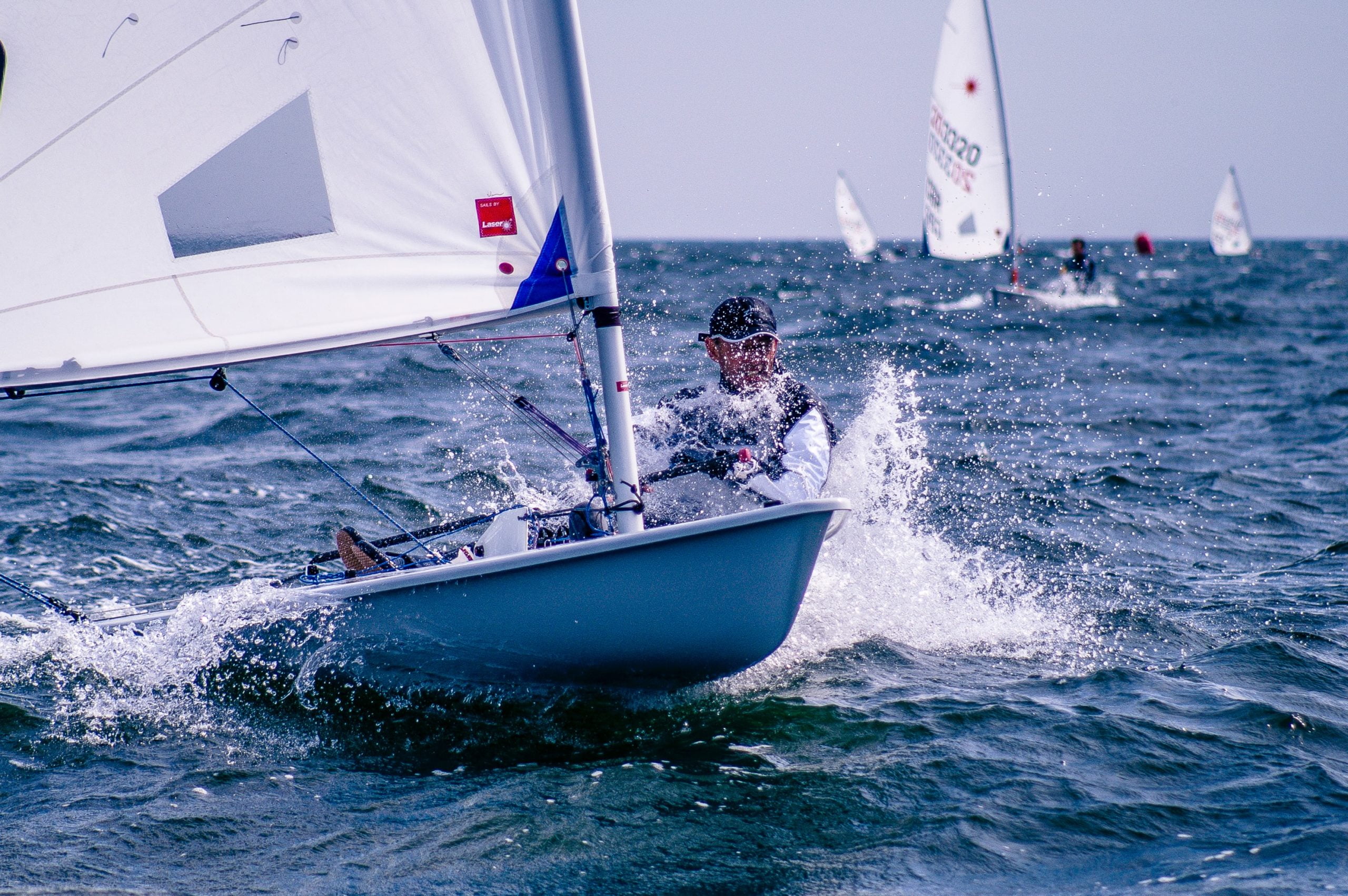
At first glance, sailboats don’t look much like an airplane, but physics-wise, they’re closely related. Both the sail and hull of a sailboat act like wings turned on their side. Just as with airplane wings, the driving force for a sail comes from a difference in pressure across the two sides of the sail. The same effects applied to the hull and its keel (the wing-like extension that sits below the hull) provide the force that keeps a sailboat from slipping sideways as it cuts a path through wind and water.
Like airplane wings, sailboats also generate tip vortices: one from the top of the sail, the other from the bottom of the keel. Those vortices are typically invisible, but in foggy weather, like in the photo below, you can see the tracks they leave behind. (Image credits: top – Ludomił; bottom – D. Forster; research credit: B. Anderson; submitted by Lluís J.)
Follow along all this week and next as we celebrate the Olympics with sports-themed fluid dynamics.







![The swimsuit's arms, legs, and (possibly?) shoulders feature a "shark skin texture [that] maximizes propulsion".](https://fyfluiddynamics.com/wp-content/uploads/2021/06/fastskin40C.png "The swimsuit's arms, legs, and (possibly?) shoulders feature a \"shark skin texture [that] maximizes propulsion\".")


![The swimsuit's arms, legs, and (possibly?) shoulders feature a "shark skin texture [that] maximizes propulsion".](http://fyfluiddynamics.com/wp-content/uploads/2021/06/fastskin40C.png)