Category: Phenomena

  • Featured Video Play Icon

    The Mobile Mud Spring of Niland, CA

    What’s part geyser, part mud pot, and all creeping, unstoppable natural disaster? The Niland Geyser, known as the world’s only moving mud spring. Dianna explores this geological mystery in the video above. Although the mud spring has been known for years, it was only in 2016 that it started moving toward railroad tracks and a state highway. So far engineering efforts to stop it have failed, so engineers are instead working to mitigate its effects on infrastructure.

    That’s a tall order when dealing with a pit of unknown depth that’s constantly bubbling with deadly carbon dioxide. The spring managed to move past a 75-foot-deep wall and, on another occasion, sent heavy drilling mud flying skyward from its built-up pressure. Check out the full video to learn more. (Image and video credit: Physics Girl)

  • The Intermittent Spring of Afton, WY

    The Intermittent Spring of Afton, WY

    Yellowstone may get top billing, but Wyoming is home to more fluid dynamical wonders, like the world’s largest rhythmic spring. Located a little outside Afton, WY, Intermittent Spring — as the name indicates — runs for roughly 15 minutes, stops for the same length, then starts up again. The leading theory for this periodic flow depends on the siphon effect. Essentially, water runs continuously into a cavern underground, but to get to the surface, it must traverse a narrow tube with a high point that lies above the spring’s eventual exit. When the water level reaches that high point, it creates a siphon, sucking water out of the cavern and making the spring flow. But eventually the water level drops to the point where air rushes in, breaking off the flow until the water level recovers. That’s consistent with the spring’s behavior; it only runs in this intermittent fashion from late summer to fall, when groundwater levels are lower. (Image credit: Wikimedia Commons; video credit: University of Wyoming Extension; submitted by Kam-Yung Soh)

  • Featured Video Play Icon

    Where Does Stormwater Go?

    Stormwater management is one of the biggest municipal challenges towns and cities face. Urban surfaces are largely impermeable, preventing rainwater from soaking into the ground. Instead roads, ditches, and channels collect water and, typically, divert it as quickly as possible into natural waterways.

    In contrast, wild landscapes tend to slow water run-off, filtering it into the water table, soaking it up with vegetation, and distributing it across a larger area. Recently, cities have started using low-impact development strategies, like rooftop gardens and rainwater collection, to mimic natural landscapes in urban ones. (Image and video credit: Practical Engineering)

  • Featured Video Play Icon

    Reintroducing Beavers

    Beavers are impressive ecological engineers and a keystone species for wetland environments. But in the UK, it’s been nearly 400 years since beavers were regularly found in the wild. In the meantime, Victorian engineering sensibilities drastically altered the landscape to quickly drain rainwater from upstream locations, which unfortunately increases flooding dangers downstream.

    But all of that is changing with the reintroduction of wild beavers in a Cornwall experiment. Within their 5 acres, the beavers are transforming the landscape by deepening ponds and slowing water drainage. Their dams create ideal habitat spaces not only for the beavers but for many other species of mammals, birds, and insects. Check out the full interview to learn more and see this previous post for a similar effort in the Western U.S. (Video and image credit: BBC Earth)

  • Featured Video Play Icon

    Building a Water-Based Computer

    Having previously tackled the “greedy” self-starting siphon, Steve Mould set out to build a water-based computer capable of adding simple numbers. To do this, he had to build logic gates capable of distinguishing concepts like AND and exclusive OR (XOR); the self-starting siphon was critical for this, diverting water down one output or another depending on the TRUE or FALSE result. With a series of water logic gates, he built a simple computer capable of adding numbers in binary. Check out the video to see it all in action! (Video and image credit: S. Mould)

  • Eye of the Stellar Storm

    Eye of the Stellar Storm

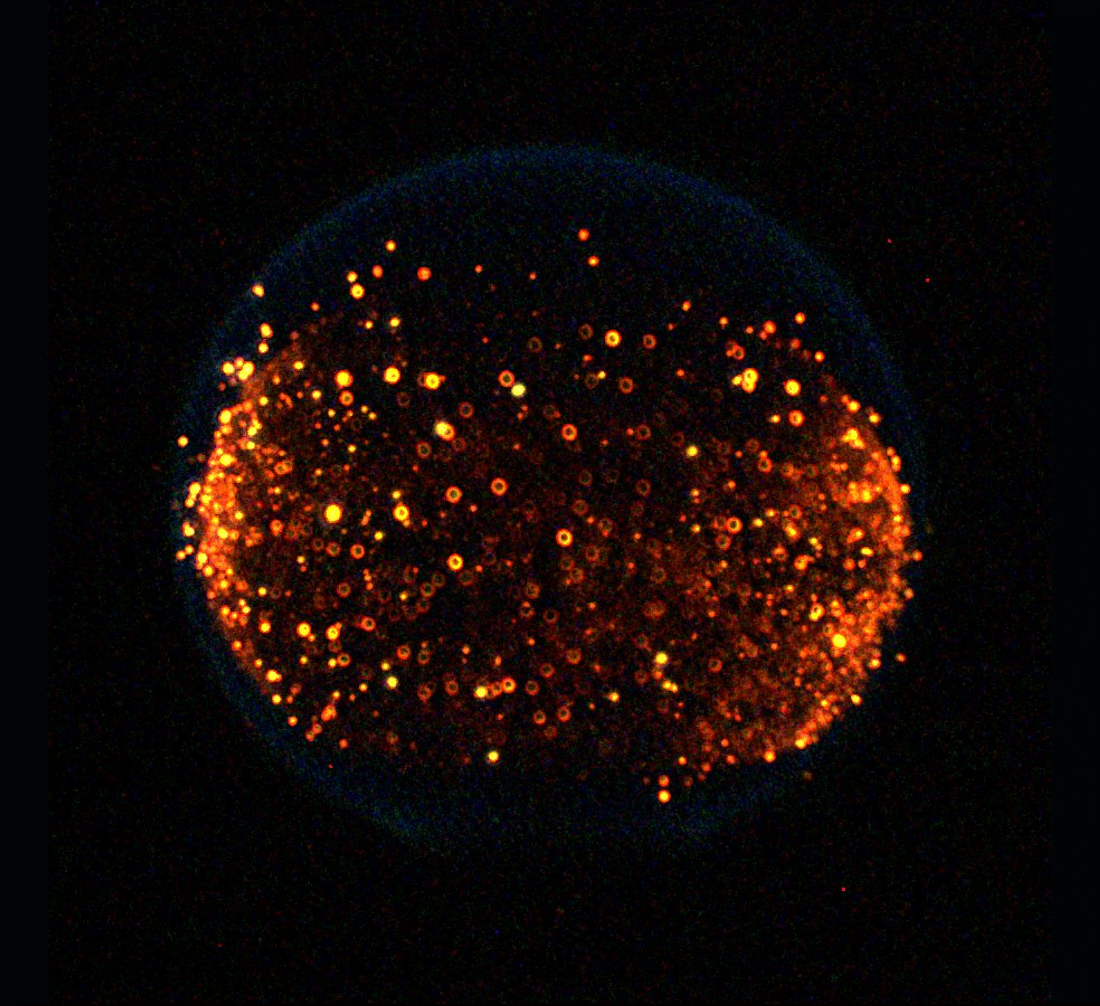
    AG Carinae is a bright, unstable luminous blue variable star. This rare type of star lives fast and dies young (by stellar standards) over only a few million years. During that time, it will occasionally blow off its outer layers in a violent eruption as a result of the ongoing tug of war between its radiation pressure and gravity. That’s the source for the nebula we see surrounding the star in this image. The red areas of the image are a mixture of hydrogen and nitrogen gas; the blue clumps are cooler pockets of dust shaped by the hotter, faster-moving stellar wind. Zoom in on the image and you can see amazing structural detail in the nebula, evidence of turbulence on a scale of light-years. (Image credit: NASA/ESA/STScI; via Gizmodo)

  • Bubbles Rising

    Bubbles Rising

    Here we see high-speed video of air bubbles rising through sesame oil. The flow rate of air is just right for one bubble to catch up to and merge with the previous bubble. As it the trailing bubble pinches off from the valve, it shoots a small jet through itself and into the prior bubble. For information on how to recreate this and related experiments, check out this article. (Image credit: C. Kalelkar and S. Paul, source; see also C. Kalelkar)

  • Featured Video Play Icon

    Breaking Ocean Currents

    Our global ocean currents move enough water to dwarf the flow of all Earth’s rivers. This worldwide circulation is driven largely by density and the movements of cold, salty water versus warmer, fresher water. The pump behind this action lies in the North Atlantic, where cold, salty water sinks down in the Atlantic Meridional Overturning Circulation, or AMOC. Among other things, AMOC is responsible for Western Europe’s relatively mild climate compared to similarly northern lands.

    Unfortunately, as our world warms, AMOC gets weaker. That means less cold water sinking in the North Atlantic and a smaller driving force behind global oceanic circulation. There is even a small but real chance that global warming breaks our ocean current system entirely and drastically changes climates around the world in ways that cannot be easily fixed. Watch the full video to learn more. (Video and image credit: It’s Okay To Be Smart)
  • Snail Locomotion

    Snail Locomotion

    Snails and other gastropods move using their single muscular foot and a viscoelastic fluid they secrete. Muscular waves in the foot run from tail to head and are transmitted to the ground through the thin, sticky mucus layer without the snail ever fully detaching from the surface. The characteristics of this mucus layer are critical to the snail’s locomotion. As a movement cycle begins, the mucus behaves like an elastic solid. As the muscular wave approaches, it shears the fluid, increasing its stress and ultimately reaching the yield point, where the gel begins to flow. Once the wave passes, the mucus quickly transitions back to its elastic solid behavior. The net result of each cycle is an asymmetric force that propels the snail forward while keeping it adhered to whatever surface it’s crawling on.

    Many animals rely on similarly complex fluids to move, attack prey, defend against predators, or enable their reproduction. Check out this review article for more examples. (Image credit: A. Perry; see also P. Rühs et al.; submitted by Pascal B.)

  • Featured Video Play Icon

    Inside the Blockage of the Suez Canal

    In March 2021, the world watched as the Ever Given container ship got stuck in the Suez Canal, disrupting global shipping for more than a week. In this Practical Engineering video, Grady delves into some of the phenomena that may have played a role in the incident of the ship that launched a thousand memes.

    Heavy container ships displace a lot of water, and in a narrow, shallow canal, there isn’t much space left for that water to go. To squeeze by, the water must speed up, which (per Bernoulli’s law) creates a pressure drop and suction force on the ship. For a ship too close to a canal bank, that suction will pull the ship further to the side, increasing its chances of lodging in the bank. (Video and image credit: Practical Engineering)